
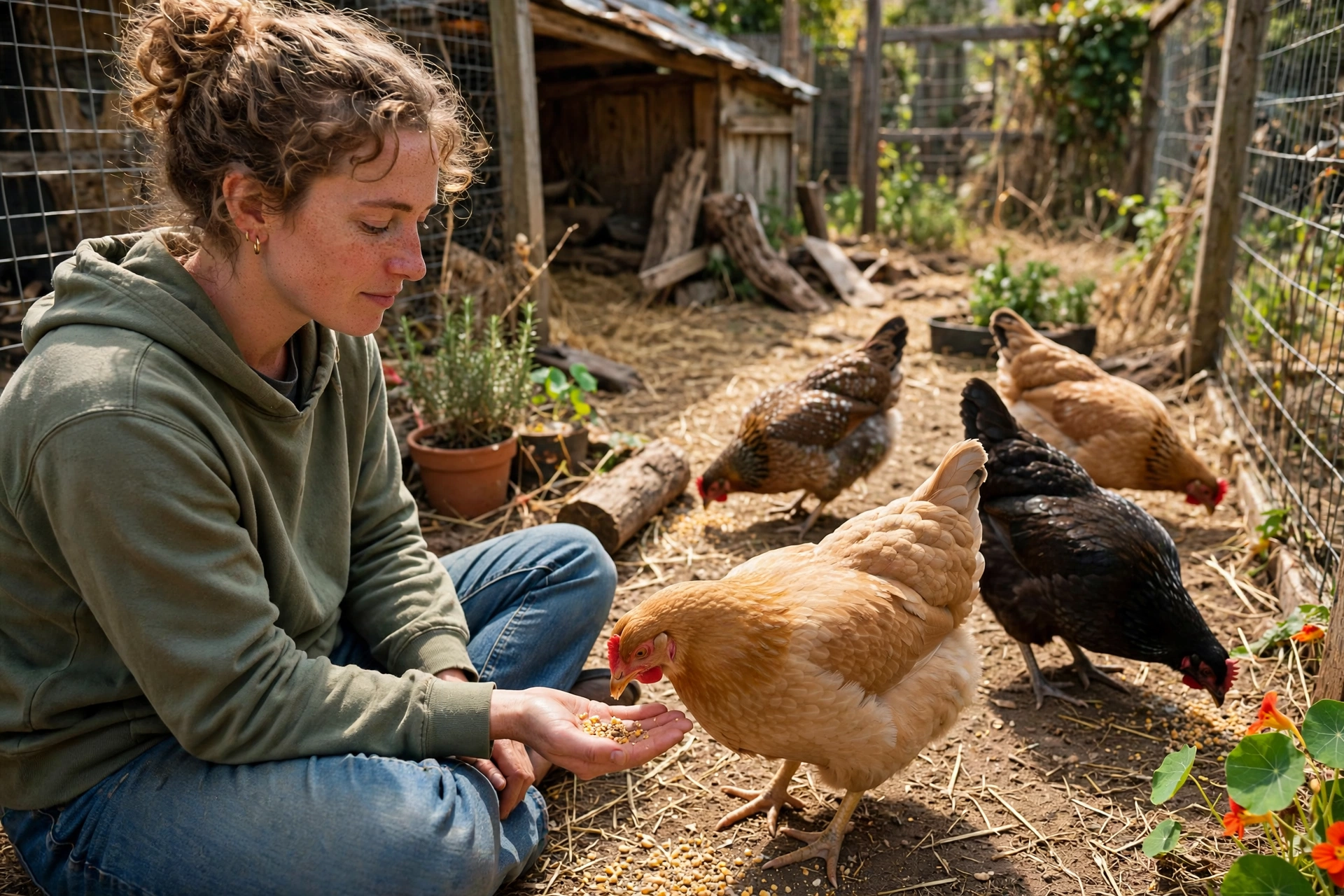
How do you tame a chicken? You do it slowly, on the chicken’s terms, and you start with trust, not touch. A tame hen is not a trick or a talent. She is a bird that has learned, day by day, that you are safe, that your hands bring food, and that being picked up does not hurt. This guide walks you through the trust ladder step by step, from sitting quietly near the flock to holding a hen calmly for a health check, and it covers chicks, adult hens, roosters and children too.
The short version is simple. Spend a little time with your flock every day, always at their level, always with a treat in your hand, and never chase a bird that walks away. Most hens start eating from your hand within a week or two, and most will accept being picked up within a few weeks after that, though shy birds and older hens take longer. The method below works for any breed, and it works best on the friendly breeds in our guide to the friendliest chicken breeds, because a calm breed gives you a head start.
Table of Contents
- 1 The Short Answer. Trust Comes Before Touch
- 2 How Long Does It Take to Tame a Chicken
- 3 The Trust Ladder in Five Steps
- 4 Hand Feeding. The Fastest Way to Win a Hen Over
- 5 How to Pick Up a Chicken Safely
- 6 How to Hold a Chicken Without Scaring It
- 7 Taming Chicks vs Taming Adult Hens
- 8 Can You Tame a Rooster
- 9 Taming Chickens With Children
- 10 Signs Your Chicken Trusts You
- 11 FAQs
Quick Facts
At a Glance Taming a chicken means building trust first, then touch. Sit quietly near the flock, hand feed treats, offer lap time, and only then pick a hen up, always with both hands supporting her body.
Holding Safely Pick a hen up from the side, low and slow, with one hand under her breast and the other supporting her legs and feet. Keep her wings tucked against her body, hold her close to yours, and never grab her legs, wings or tail.
Good to Know Most hens start eating from your hand within a week or two, and most accept being picked up within a few weeks after that, though shy birds and older hens take longer. Never chase a bird that walks away, and stop and try again another day if she panics.
The Short Answer. Trust Comes Before Touch
Can chickens be tamed? Yes, and most pet hens can be tamed a long way, to the point where they come when called, eat from your hand and settle on your lap. Chickens are not like dogs, they will not follow you because you asked them to, but they are quick learners when food and safety are involved, and they remember people. Our guide to whether chickens recognize their owners explains that hens can tell one person from another and remember who treats them well, which is exactly the memory taming builds on. How to make chickens friendly comes down to the same idea in every case. Be predictable, be low, be quiet, and be the person who brings the good food. A hen that is chased, grabbed from above or cornered learns the opposite lesson just as fast, so the first rule of taming is to move at her speed. If she walks away, let her go. She will come back sooner for a keeper who never forced her than for one who did.
How Long Does It Take to Tame a Chicken
How long does it take to tame a chicken? For a young hen from a friendly breed, expect the first signs of trust within a few days, hand feeding within a week or two, and calm holding within a few weeks. For an older hen, a shy breed or a bird that was rarely handled, plan on several weeks to a couple of months, and be glad of small steps along the way. The single biggest factor is time spent, not talent. Ten to fifteen minutes a day, at the same time of day and in the same spot, beats one long weekend session, because a chicken trusts a routine. The second biggest factor is the bird herself. A Buff Orpington or a Silkie will usually warm up faster than a flighty Leghorn, and a chick handled from its first weeks will tame far faster than an adult hen that has never been touched. Do not compare your flock with someone else’s. A hen that eats from your hand after ten days is tamed, even if she will not sit on your lap yet, and a hen that lets you pick her up without a flap is tamed, even if she never becomes a lap chicken. Progress counts, and pushing for more before she is ready is how trust gets broken.
The Trust Ladder in Five Steps
Taming chickens for beginners works best as a ladder, one step at a time, moving up only when the step below is solid. Rushing a step is the most common mistake, and the fix is always the same, go back one step and stay there until the bird is relaxed again.
Step 1. Just be there. Sit quietly in or beside the run for ten to fifteen minutes a day, at the bird’s level, on the ground or on a low stool. Read, talk softly or just watch. Do not reach for them, do not follow them, and do not stare them down. You are teaching them that your presence means nothing bad happens, and that lesson has to come first.
Step 2. Scatter treats near you. Once the hens carry on with their normal scratching and dust bathing while you sit there, scatter a few treats a short distance from you, then closer over the next days. Mealworms, cracked corn and peas all work well, and our mealworm guide sets out how many to offer and from what age. The goal is for the hens to link you with food arriving, not with a hand reaching out.
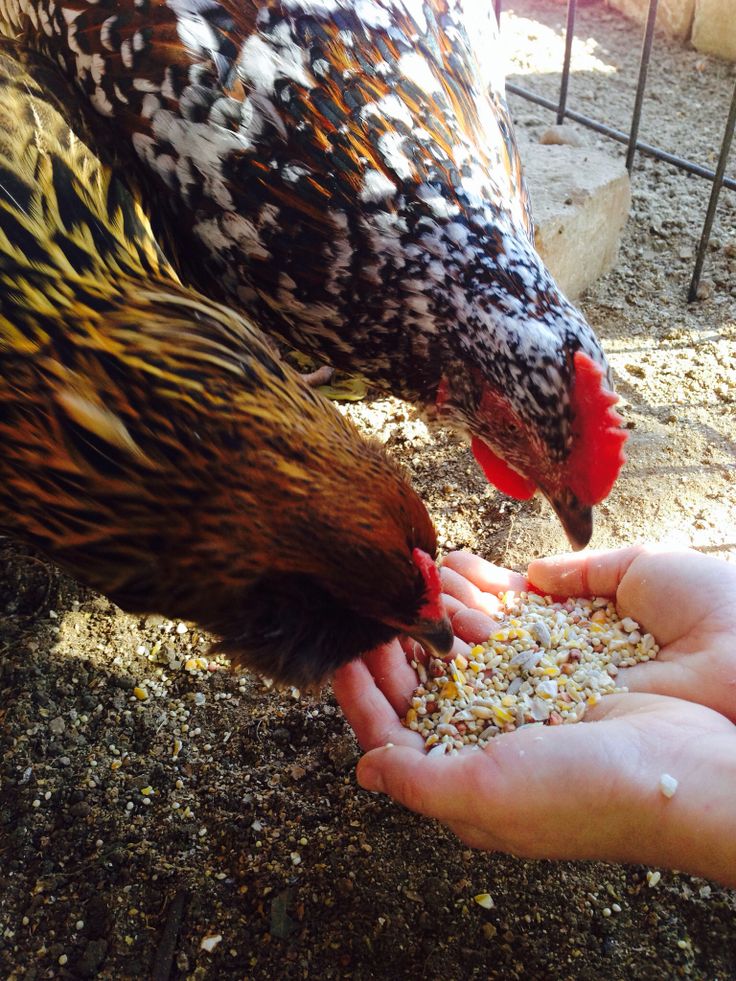
Step 3. Hand feed. Hold a few treats in your open palm, low and still, and let the boldest hen come to you. The first peck at your hand can startle a new keeper, but it does not hurt, it is just a hen testing whether the food is real. Stay still, stay quiet, and let her take her time. Once one hen eats from your hand, the rest usually follow within days, because chickens copy each other.
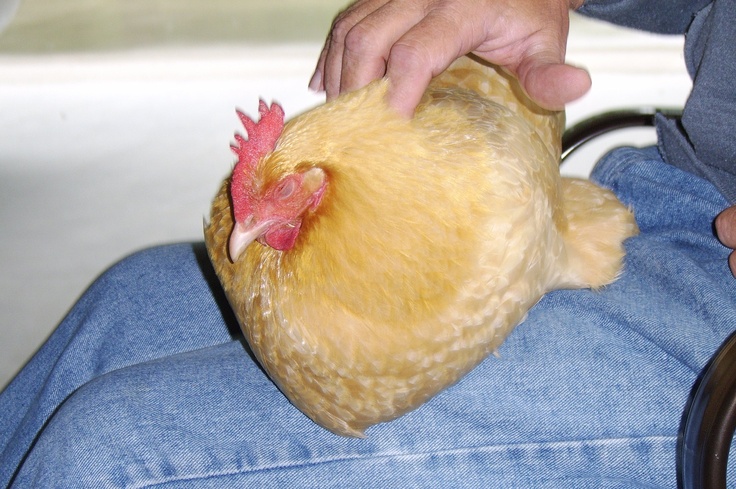
Step 4. Lap time. Sit with your legs stretched out or crossed and scatter a few treats on your lap. A hen that climbs up for the food is choosing to be close to you, and that choice matters more than any hold you could force. Let her stand, eat and leave when she wants. Stroke her back very gently with one finger only if she stays relaxed, and stop at the first sign of tension.
Step 5. Pick her up. Only now, when she eats from your hand and climbs onto your lap without worry, should you try lifting her, using the safe hold in the next sections. Keep the first holds short, a few seconds, then set her down gently and offer a treat. Short and calm beats long and wriggly every time.
Hand Feeding. The Fastest Way to Win a Hen Over
Hand feeding is the fastest way to win a hen over, because it turns your hand from a grabbing thing into a food thing. The rules are simple. Offer the same small treat every time, so the hens learn the routine. Keep your hand low, flat and still, never reaching toward the bird. Let the bird come to you, and never close your fingers around her head or neck while she eats. Mealworms are the classic taming treat, because hens love them and a few go a long way, and our mealworm guide covers dried and live mealworms, the right amount and the right age to start. Peas, sweetcorn, chopped grapes and small pieces of watermelon work too, and the treat should always be a small extra on top of their normal layer feed, never a replacement for it. If a hen is too nervous to eat from your hand, scatter the treats near your feet instead and try the hand again in a few days. Nervous hens often start by eating from the ground beside you, then from your shoe, then from your hand, and each of those is real progress. One warning. Do not hand feed through the wire of the run. A hen that has to push her head through wire to reach food learns to peck at fingers through wire, and that is a habit you do not want with children around.
How to Pick Up a Chicken Safely
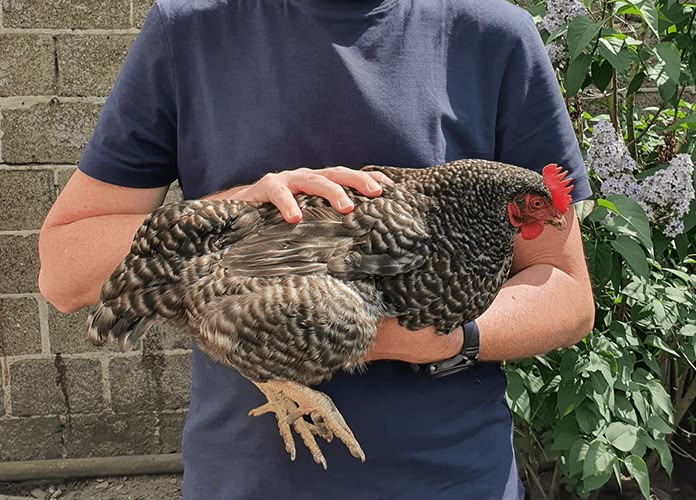
How to pick up a chicken without stressing it comes down to three things, low, slow and from the side. Never swoop down on a hen from above, because a shape dropping from the sky is exactly what a hawk looks like to her, and she will panic before your hands get near. Instead, crouch or sit beside her, talk quietly, and slide one hand under her breast from the side while your other hand rests lightly over her back to keep her wings folded. Lift in one smooth motion and bring her straight against your body, so she feels supported and not dangling. How to hold a chicken safely starts before you lift, with the wings. A hen’s wings must stay tucked against her body while you hold her, because a flapping wing in your grip can strain a joint and scratch you, and a hen that feels her wings are trapped will fight harder. If she flaps, do not squeeze tighter. Hold her firmly but gently against your body, wait for her to settle, and if she does not settle within a few seconds, set her down calmly and try again another day. Never pick a hen up by her legs, her wings or her tail, and never carry her upside down. Those holds hurt, they frighten her, and they teach her that your hands are dangerous, which undoes weeks of trust in seconds. The evening is the easiest time for a first pickup. Hens are calmer as dusk approaches, and a hen that is already settling toward the roost is far easier to lift gently than one in the middle of a busy afternoon scratch.
How to Hold a Chicken Without Scaring It
Once she is up, how to hold a chicken is mostly about support and stillness. Cradle her against your body like a rugby ball, with one hand under her breast and the other hand supporting her legs and feet, and keep her wings folded against her sides. Hold her close enough that she feels your warmth and your heartbeat, but never squeeze her, because a chicken’s chest needs room to breathe and a tight grip can injure her. Keep your movements slow and your voice low. If you need to walk with her, walk slowly and keep her tucked in, and if you need to check her over, do it while she is settled in this hold, lifting a wing gently or parting the feathers at the vent, then letting everything go back into place. Holding a hen calmly is also what makes health checks possible. A tame hen lets you look at her feet for bumblefoot, check under her wings and around her vent for mites, and feel her weight, and those checks are the reason a pet keeper wants a tame bird in the first place. If she starts to struggle, do not fight her. Lower her gently to the ground, let her walk away, and offer a treat once she has settled. A hold that ends calmly, even a short one, teaches her that being picked up is safe, and the next hold will be easier. A hold that ends in a flap and a chase teaches her the opposite, so ending early is always the right call.
Taming Chicks vs Taming Adult Hens
Taming baby chicks is the easiest version of this job, because chicks that are handled gently every day from their first week grow up expecting hands to be safe. Hold a chick for a few minutes at a time, a few times a day, always with both hands cupped around it, always low over a soft surface in case it wriggles free, and always with clean hands. Talk to the chicks while you handle them, offer tiny treats from your palm once they are old enough, and let them fall asleep in your hands if they choose to. Chicks that are handled this way usually grow into hens that walk up to you, which is why breeders who sell pet chicks handle them daily. Taming an adult hen takes longer, but it works the same way. An adult that was never handled has to unlearn caution first, so expect weeks rather than days, and celebrate the small steps, eating near you, then from your hand, then standing on your lap. The one case that needs extra patience is a hen that has been chased or grabbed before. She has a reason to be wary, and the only fix is a long run of calm, predictable, treat filled visits with no grabbing at all, until she decides for herself that you are safe. Age matters less than history, and a calm older hen that was handled as a chick will usually tame again quickly after a break, while a young hen that was never touched may take just as long as an old one.
Can You Tame a Rooster
Can you tame a rooster? Up to a point, yes, and the same trust ladder applies, quiet visits, hand feeding and no chasing. A rooster that eats from your hand and tolerates being near you is a tamed rooster in the practical sense, and that is a useful thing to have, because it makes feeding, health checks and moving him around the run much easier. But a rooster is not a hen, and the limits matter. Never try to cuddle a rooster the way you would a hen, and never pick up a rooster that is showing you challenge behaviour, standing tall, hackles raised, staring, or dancing sideways at you. That is a bird telling you he sees you as a rival, and grabbing him then will make the next challenge worse, not better. If a rooster turns aggressive, do not run, do not kick, and do not try to dominate him by force. Walk calmly, carry a stick or a broom to keep distance between you, and talk to experienced keepers about whether that bird fits a family flock. Children should never try to tame a rooster on their own, and a rooster that has attacked a child should be rehomed to a flock without small children. A gentle rooster is a pleasure to keep, and many keepers have one, but the honest line is that a rooster’s trust is narrower than a hen’s, and respecting that line keeps everyone safe.
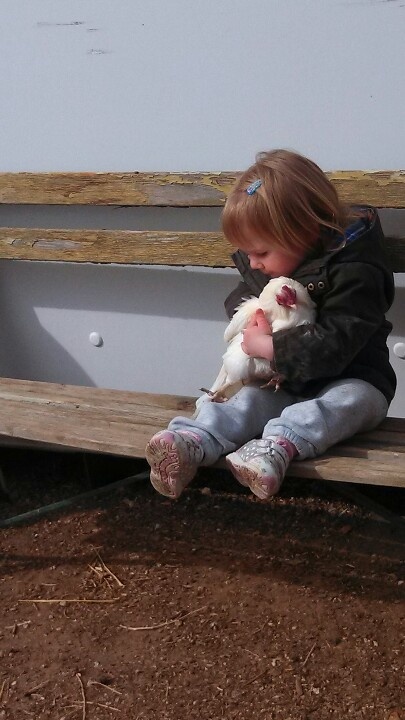
Taming Chickens With Children
Taming chickens with children works well when the adult sets the pace. Teach a child to sit on the ground, stay still and quiet, and let the hens come to them, exactly as the trust ladder teaches an adult. A child who chases a hen, even lovingly, teaches that hen to run from small people, so the first lesson is always that we sit and wait. Give the child a small cup of treats to scatter, then to offer from a flat open hand, and praise the hens as much as the child when a bird comes close. When it is time to hold a hen, the adult lifts the bird and settles it in the child’s lap, with the adult’s hands staying close by, and the child strokes the back gently with one finger. A hen should never be handed to a child to carry around, because a dropped hen is a hurt hen and a frightened hen, and a child who is scratched by a flapping wing may be scared of the flock for a long time after. Keep the sessions short, ten minutes is plenty, and end while everyone is still happy. The reward for doing it right is real. Children who tame a hen learn patience, gentleness and responsibility from a living animal, and a hen that trusts a child will follow them around the garden, sit on their lap and fall asleep there, which is the kind of memory that makes a lifelong chicken keeper. Our guide to whether chickens show affection describes the lap sitting, following and soft trilling that a tame hen offers the people she trusts, and children usually notice those signs before adults do.
Signs Your Chicken Trusts You
How do you know the taming is working? The signs are plain, and they arrive in order. First, the hen stops running when you enter the run and carries on scratching instead. Then she comes toward you when she sees you, instead of waiting for you to come to her. Then she eats from your hand, and then she pecks gently at your shoes, your clothes or your fingers, not to hurt you but to ask whether you have food. Later signs are the ones that make all the patience worth it. She squats when you reach toward her, she lets you stroke her back, she settles on your lap and closes her eyes, and she makes the soft trilling sound that keepers call purring. A hen that falls asleep on your lap trusts you completely, and a hen that follows you around the garden has decided you are part of her flock. Those are the same signs our guide to whether chickens show affection lists for a bonded hen, and they are the reward for weeks of quiet, patient work. If you see the opposite signs, flapping, squawking, running to the far end of the run, panting or freezing in place, the bird is telling you she is scared, and the right answer is to step back, give her space and go back a step on the ladder. Trust is never won by arguing with a frightened hen. It is won by proving, one quiet visit at a time, that you are safe.
FAQs
How to tame a chicken that is scared of people?
Go back to the start of the ladder. Sit quietly in the run every day without reaching for her, scatter treats near you, and let her decide when to come closer. A scared hen tames on her own timetable, and chasing or cornering her only adds to the fear. Most scared hens start eating near you within a couple of weeks of calm daily visits.
How long does it take to tame a chicken?
Most hens from friendly breeds start eating from your hand within a week or two, and most accept being picked up within a few weeks after that. Older hens, shy breeds and birds that were rarely handled can take several weeks to a couple of months. Ten to fifteen minutes a day at the same time beats one long session.
How do you hold a chicken safely?
Lift her from the side, low and slow, with one hand under her breast and the other supporting her legs and feet. Keep her wings tucked against her body, hold her close to yours, and never pick her up by her legs, wings or tail, and never carry her upside down.
Can you tame an adult chicken?
Yes. Adult hens tame the same way chicks do, with quiet visits, hand feeding and patience, it just takes longer. An adult that was handled as a chick usually tames again quickly, while a hen that was never touched may take several weeks. The method is the same at any age.
Can you tame a rooster?
Up to a point. A rooster can learn to eat from your hand and tolerate being near you, but he should never be cuddled like a hen, and never picked up while he is showing challenge behaviour. Children should never try to tame a rooster on their own, and an aggressive rooster needs experienced handling or rehoming.
Taming a chicken is not a trick you learn in an afternoon. It is a small daily habit, sitting quietly, offering food from a still hand, and letting the bird choose to trust you. Do it that way and you get a hen that comes when called, eats from your hand and settles on your lap, and a flock that is easy to handle when it matters, for health checks, for moving house or for a vet visit. Start today, with ten quiet minutes and a pocketful of mealworms. For choosing the calmest birds to start with, see our guide to the friendliest chicken breeds, and for what trust looks like once it is built, see our guide to whether chickens recognize their owners.
Once your hen is happy to be held, the next job is keeping her fed through the cold months. What to Feed Chickens in Winter and What to Stop Giving Them sets out the winter base, the extra feed and the treats to swap out.
Keep Reading
- Friendliest Chicken Breeds That Make Great Pets
- Do Chickens Recognize Their Owners
- Do Chickens Show Affection

Nusrat
Author, TheChickenPet.com