
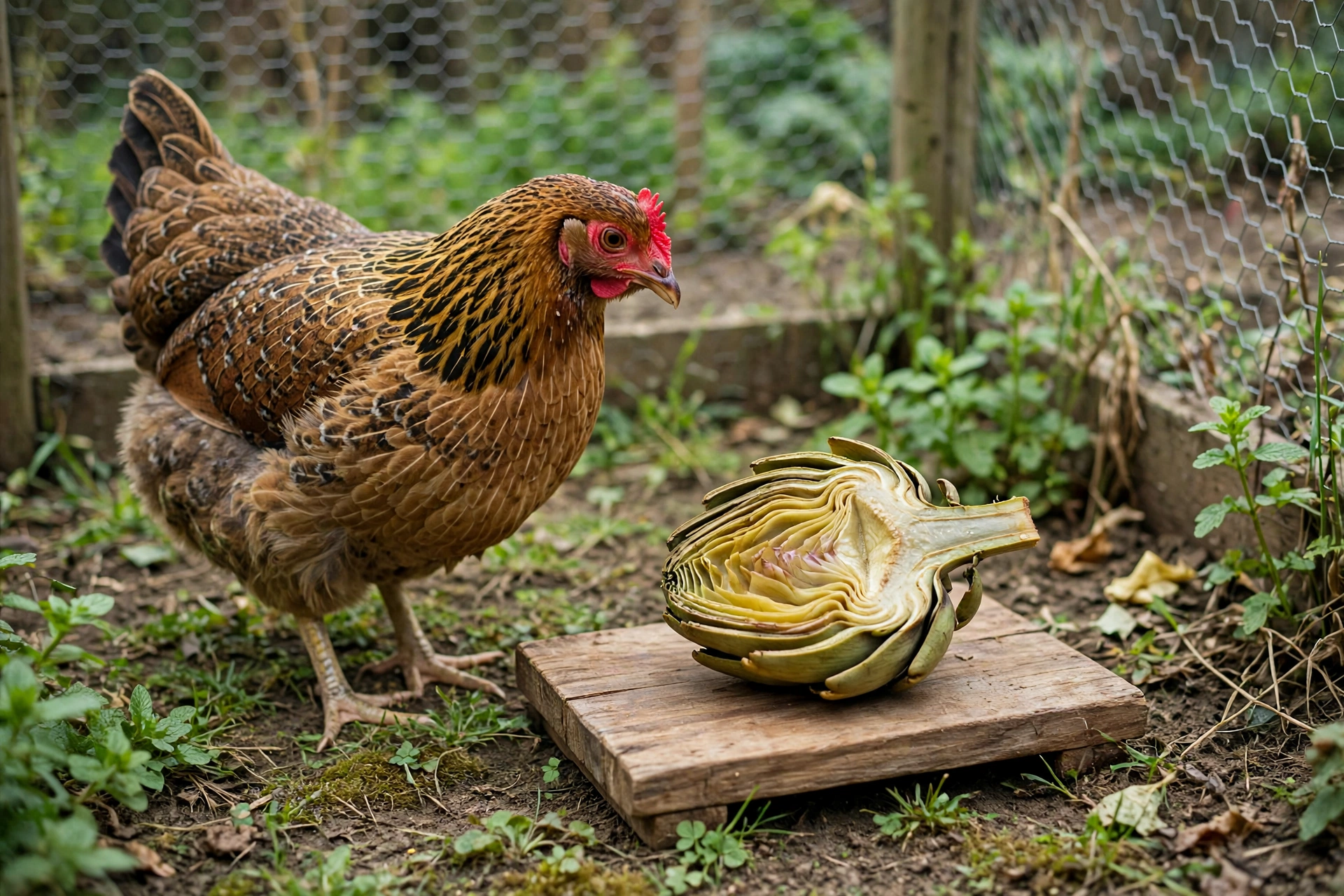
Yes, chickens can eat artichokes, and the answer comes with one clear condition. The hearts and the leaves are safe once they are cooked plain, and the fuzzy choke in the middle must always be removed first. An artichoke is a treat, not a staple food, so it belongs in the small treat portion of the diet and never replaces the balanced layer feed your hens need every day. If you serve it the plain way, with no salt, no butter and no dip, it is a safe and interesting snack that most hens enjoy pecking at. If you serve it the way people usually eat it, dipped in butter or garlic sauce, it is not suitable, and the seasoning is the problem, not the artichoke itself.
Artichokes look tricky because they are built like a puzzle, with tough outer leaves, a tender heart and a spiky choke hiding in the center. That is why this guide goes part by part, so you know exactly what to offer, what to cut away and how to cook it. The site food checker lists artichoke as Safe with the note “Cooked hearts and leaves”, and this article follows that verdict exactly. Jerusalem artichoke is a different plant with its own entry, and it gets its own short section near the end so the two are never mixed up.
Table of Contents
- Are Artichokes Safe for Chickens
- Which Parts of an Artichoke Chickens Can Eat
- The Choke and the Parts to Skip
- How to Cook and Serve Artichokes to Chickens
- Can Chickens Eat Artichoke Leaves
- Can Baby Chicks Eat Artichokes
- Jerusalem Artichokes Are a Different Plant
- What to Do If Your Chickens Eat Raw Artichoke
- Frequently Asked Questions
Quick Facts
Artichokes are safe for chickens when the hearts and leaves are cooked plain and the choke is removed.
Serve only a few bites per bird, once or twice a week at most, as a treat beside their normal feed.
Cook by steaming or boiling in plain water with no salt, no butter and no dip, then cool and chop before serving.
Raw leaves are tough and hard to peck, so cook them until tender and chop them small.
The choke, the fuzzy center of the artichoke, is never fed to chickens.
Jerusalem artichoke is a different plant, and its tubers must be chopped or cooked before serving.
Are Artichokes Safe for Chickens
Yes, artichokes are safe for chickens when they are served the right way. The site food checker lists artichoke as Safe with the note “Cooked hearts and leaves”, and that short note holds the whole rule. Cooked hearts and cooked leaves are fine, the choke is not, and raw leaves are too tough to be worth serving. There is no poison or toxin hiding in a globe artichoke, which is why it sits in the safe foods group rather than the caution group, but safe still means a small treat and not a daily food.
An artichoke is mostly water and fiber, with small amounts of vitamins and minerals, and it brings very little energy compared with the grain based feed that laying hens need. That is the honest limit on it. A food can be perfectly safe and still be a poor choice in large amounts, because every bite of treat pushes a little balanced feed out of the day. Hens that fill up on treats lay less well over time, and their eggshells can suffer too, so the treat portion should stay small. The feeding pillar guide at What Can Chickens Eat sets the same treat limit for every food in this series, and artichoke is no exception to it.
The other honest limit is the cooking. People eat artichokes with melted butter, garlic mayonnaise, lemon aioli and salty dips, and none of that belongs in a chicken run. Salt is hard on a small bird, butter is pure fat with no benefit, and garlic sauce adds a concentrated flavour that chickens do not need. The artichoke itself is safe, and the way it is usually served is what makes it unsuitable, so keep the two ideas separate when you decide what to offer. Plain steamed hearts on a plate are a treat, while the same hearts dragged through dip are not.
There is also a fair question about whether artichokes are worth the effort at all. They take a while to cook, they give you very little edible flesh for their size, and a bag of leafy greens is cheaper and easier. That is a fair point, and the answer depends on what you already have. If you grew artichokes and have spare heads, or if you have leftover plain cooked artichoke from your own meal, it is a good use of them. If you are buying food specially for your hens, there are simpler treats to choose. Either way, the safety answer stays the same, and it stays yes for the cooked hearts and leaves.
One more thing worth saying plainly is that artichoke is not a medicine. You may read that it helps the liver or cleans the blood, and those claims come from herbal traditions about people, not from trials on backyard hens. Do not feed artichoke to treat a sick bird, and do not expect it to fix laying problems or parasites. It is a safe snack, nothing more, and a hen that looks ill needs proper care and, when in doubt, a vet.
Which Parts of an Artichoke Chickens Can Eat
A globe artichoke has four parts that matter to a chicken keeper, and three of them are usable once they are cooked. The heart is the best part, the leaves are good once they are soft, the stem is usable when it is cooked and chopped, and the choke is the one part that must always be thrown away. Knowing the parts before you start cooking makes the whole job easy, because you can prepare the artichoke for your hens while you prepare your own portion.
The heart is the thick, pale base that sits under the leaves, and it is the most tender part of the plant. Once the choke is scraped away, the heart is soft, mild and easy to chop into small pieces. Hens take to it quickly, and it is the part worth offering first if your flock has never tried artichoke before. A single heart, chopped small, is enough for a few hens to share, and there is no need to offer more than that in one serving.
The leaves are the part most people throw away, but cooked leaves are fine for chickens too. Each leaf has a fleshy base that softens when it is steamed or boiled, and that is the part the hens peck at. The outer leaves are thicker and tougher than the inner ones, so they need a longer cook and a good chop before serving. The thin, papery tips of the leaves carry almost no flesh and are best left out, since they are mostly fiber that hens will ignore. Chop the cooked leaves into short pieces so no hen has to wrestle with a long, stringy leaf.
The stem is the part many people cut off and forget, yet it is edible once it is cooked. It is firm and slightly woody when raw, so peel away the tough outer skin, then steam or boil it until it is tender and chop it into small rounds or dice. It behaves much like other stalky vegetables your hens already know, and the same plain cooking rule applies. Our guide to celery covers another stalky vegetable with the same idea, cook it plain, chop it small, and serve it as a treat.
What holds all three usable parts together is the cooking. Raw artichoke is dense and fibrous, and a hen’s beak is not built to tear through it the way a knife is. Cooking softens the fiber, makes the pieces easy to swallow, and lets the hens actually get something from the food instead of just pushing it around the run. If a part is still tough after cooking, cook it a little longer or chop it smaller, and never serve a piece that a hen has to struggle with.

The Choke and the Parts to Skip
The choke is the one part of an artichoke that chickens must never eat. It is the fuzzy, thistle like center that sits on top of the heart, under the inner leaves, and it is made of fine, hair like fibers that are inedible for people and for hens alike. It can irritate the throat and the crop, and its fibers can tangle into a mass that is hard to pass, so it has no place in a chicken treat. When you prepare an artichoke, cut the head in half, scoop the choke out with a spoon, and throw it in the compost or the bin before anything goes to the run.
Removing the choke is simple once you have done it once. Steam or boil the artichoke first, then let it cool enough to handle, pull the inner leaves away, and you will see the pale, fuzzy patch sitting on the heart. Scrape it out cleanly with a spoon until only the smooth heart is left, and check the edges, because stray fibers can cling to the rim. If you are in doubt about whether you got it all, scrape once more. A few extra seconds here are worth it, and the heart underneath is the reward.
Beyond the choke, the skip list is short and it is mostly about seasoning and condition. Skip any artichoke leaves that were cooked in salted water, because the salt soaks into the leaves and there is no way to rinse it out. Skip artichoke that was served with dip, butter, garlic sauce or any seasoning, because the coating is the problem even when the artichoke underneath is fine. Skip mouldy or spoiled artichoke, and skip any piece that smells off or has gone slimy in the fridge, since spoiled food is never a treat. And skip raw artichoke hearts that are still hard and woody, not because they are toxic but because they are a choking and crop risk that cooking removes entirely.
There is one more thing to skip, and it is the idea of feeding artichoke every day. Even the safe parts are treats, and treats belong in the small part of the diet. A hen that eats artichoke daily is a hen that is eating less of the feed that carries her calcium, protein and energy, and that trade shows up in the nest box sooner or later. Once or twice a week is plenty, and a break between servings is a good thing.
How to Cook and Serve Artichokes to Chickens
Cooking artichokes for chickens is the same as cooking them for people, minus everything people add at the table. Start with a fresh, firm head that feels heavy for its size and has tight leaves with no dark spots or mould. Rinse it under running water, trim the stem to about an inch, and snip the sharp tips off the outer leaves if you like, though your hens will not mind the tips once the leaves are cooked and chopped.
Steam or boil the artichoke in plain water with nothing added. No salt in the water, no lemon in the pot for the hens portion, and no oil. Steaming takes around 30 to 40 minutes for a medium head, and boiling is a little faster, and the artichoke is ready when an outer leaf pulls away easily and the base feels tender when you press it with a knife. Let it cool completely before it goes anywhere near the run, because a hot artichoke can burn a hen’s mouth and crop, and hens will not wait for it to cool on their own.
Once it is cool, cut the head in half and scoop out the choke, as described above, until only the clean heart is left. Then chop the heart into small pieces, about the size of a pea or a little bigger, and chop the cooked leaves into short strips. Scatter the pieces on the ground or in a shallow dish rather than piling them in one heap, so every hen gets a share and the bolder birds do not take it all. A few bites per bird is the right amount, and a single medium artichoke is enough for a small flock of four to six hens.
How often you serve it matters as much as how much. Once or twice a week is a good rhythm, and it keeps artichoke in the treat category where it belongs. If you have a glut of artichokes from the garden, you can freeze the cooked hearts and leaves in small portions and thaw one portion at a time, which spreads the treat out instead of feeding a large amount on one day. Do not serve artichoke two days in a row, and do not let it become a regular part of the daily feed.
This plain cooking rule is the same rule that runs through the whole feeding series. Our guide to pasta makes the same point for another plain kitchen scrap, which is that plain cooked food is a treat and seasoned food is not. If you would not serve it to your hens without the sauce, do not serve it with the sauce either. The artichoke does not need help to be interesting to a hen, and the plain version is the safe version.
A practical tip for the first serving is to offer a small amount and watch. Most hens will peck at the chopped heart straight away, and a few may be cautious with the leaves until they see the others eating. That is normal, and there is no need to push it. If your flock ignores the leaves entirely, offer only the heart next time, and use the leaves in your compost instead. Treats should be enjoyed, and a food your hens do not want is not worth forcing.
Can Chickens Eat Artichoke Leaves
Yes, chickens can eat artichoke leaves, and the answer depends on how the leaves are prepared. Cooked leaves are safe, while raw leaves are so tough that they are barely food at all. The fleshy base of each leaf softens when it is steamed or boiled, and that is the part hens can manage. The thin tips carry almost nothing and are best left out, and the outer leaves need a longer cook than the inner ones because they are thicker.
The reason raw leaves are a poor choice is their texture. A raw artichoke leaf is fibrous, springy and hard to tear, and a hen that pulls at one can end up with a long, stringy piece that is difficult to swallow. Long strings are a crop risk, since they can tangle and sit in the crop instead of passing through, and a crop that stays full and doughy is a problem that needs attention. Cooking solves this completely, because heat breaks the fiber down and lets you chop the leaves into short, soft pieces that pass easily.
To prepare the leaves, cook the whole head first, then pull the leaves away once it has cooled. Press the fleshy base of each leaf between your fingers, and you will feel how soft it has become. Chop the leaves into pieces no longer than an inch, and mix the pieces in with the chopped heart so the hens find them while they are pecking. The inner leaves are the most tender and the best ones to offer, while the outermost leaves are the toughest and can go to the compost if they are still stiff after cooking.
Leaves fit the same pattern as other leafy green treats your hens already know. Our guide to cabbage covers another leafy green that is served in the same way, cooked or raw when it is tender, chopped small, and given as a treat rather than a meal. Artichoke leaves are simply the tougher cousin in that family, which is why they need the cooking step that cabbage does not.
One caution about leaves is worth repeating, and it is about salted cooking water. Leaves soak up the water they are cooked in, so leaves boiled in salted water carry that salt into the run, and you cannot rinse it out afterwards. Always cook the hens portion in plain water, even if you salt the pot for your own meal. If you are cooking one artichoke for the family and the hens, cook it plain and let people add their own salt and dip at the table.

Can Baby Chicks Eat Artichokes
Baby chicks should not eat artichokes until they are older, and even then only in a very gentle form. Chicks in their first few weeks need chick starter feed and nothing else, because that feed is made to give them exactly the protein and energy they need to grow, and their tiny crops and guts are not ready for fibrous vegetables. Treats of any kind are best held back until chicks are at least a month old, and artichoke, being tougher than most treats, is a good one to hold back a little longer.
From about four to six weeks old, a chick that is eating well and has grit available can try a very small amount of artichoke heart, cooked until it is soft and chopped into tiny pieces. The heart is the right part to start with, because it is the softest and the easiest to swallow, and the leaves should wait until the chicks are older still. Offer only a pinch per chick, and watch that every chick can reach the food and that no chick is struggling to swallow. If a chick coughs or shakes its head at a piece, take the pieces away and try again in another week or two.
Grit matters here more than it does for soft treats, because even cooked artichoke has fiber that needs grinding in the gizzard. Chicks that live on starter feed alone do not need grit, but the moment you start offering anything other than starter, grit must be available in a small dish beside the feed. Without it, fibrous food can sit undigested in the crop, and that is a problem you can avoid with a dish of chick grit that costs almost nothing.
The simplest and safest choice is to wait. Artichoke is not a food chicks need, and there is no benefit to rushing it. A chick that meets artichoke for the first time at eight weeks old, with a grown crop and good grit habits, will enjoy it far more than a chick that is given a tough piece too early. Starter feed first, then soft treats, and artichoke near the end of that list is the order that keeps chicks safe.
Jerusalem Artichokes Are a Different Plant
Jerusalem artichoke is not the same food as globe artichoke, and the two should never be mixed up. Globe artichoke is the thistle head this article is about, with its leaves, heart and choke. Jerusalem artichoke is a knobbly underground tuber from a sunflower relative, and it looks more like a small, lumpy potato than like any part of a globe artichoke. The name is shared, and almost nothing else is, so a recipe or a garden label that just says artichoke is worth a second look.
The good news is that Jerusalem artichoke is safe too. The site food checker lists it as a separate entry, Safe, with the note “Chop or cook the tubers”, and that is the whole rule for it. Scrub the tubers clean, chop them into small pieces or cook them until soft, and serve them plain as a small treat. Raw tubers are firm and starchy, so chopping them small is important, and cooking makes them softer and easier for hens to manage. There is no choke to remove, because a tuber has no choke at all.
Jerusalem artichokes are rich in a starchy fiber called inulin, which is why people sometimes find them hard to digest, and the same caution applies in a small way to hens. A few small pieces are fine, and a large amount can give a hen loose droppings, so keep the serving small and do not offer them every day. If you grow them, you will know how freely they spread, and a small handful of tubers now and then is a good way to use the surplus.
Cardoon deserves one line here too, since it is a close relative of the globe artichoke with the same thistle look. The checker lists cardoon as Safe with the note “Cooked stalks, like artichoke”, so the rule is the same, cook the stalks plain, chop them small, and serve them as a treat. If you grow cardoon and globe artichokes in the same bed, treat them the same way and you will not go wrong.

What to Do If Your Chickens Eat Raw Artichoke
If your hens get into a raw artichoke, do not panic, because a raw artichoke is not poisonous. The risk is not toxicity, it is texture, and the thing to watch is whether the pieces are passing through normally. A hen that tears off a small piece of raw leaf and swallows it will usually be fine, while a hen that gulps a long, stringy piece or a hard chunk of raw heart is the one to keep an eye on.
First, take the rest of the raw artichoke away so no hen eats more of it. Then offer fresh water and make sure grit is available, since water and grit are what help the crop and gizzard deal with fibrous food. Watch the hens for the next few hours, and look for the normal signs of a bird that is well, which are pecking, drinking, scratching and passing normal droppings. A hen that is eating and drinking normally after a raw leaf is a hen that is fine.
The sign that needs attention is a crop that stays full and doughy long after the bird has stopped eating, especially if the hen is standing hunched, shaking her head, or refusing food and water. A crop problem can follow any long, fibrous food, not just artichoke, and it needs to be caught early. If the crop is still full the next morning before the hen has eaten, or if the bird looks distressed, keep her somewhere quiet with water only and call a vet who knows poultry. Do not try to massage a badly blocked crop hard, and do not offer more food until the crop has emptied.
The best protection is the simple one, which is to keep raw artichokes out of reach and to serve this food cooked and chopped only. Hens are curious and will peck at anything new in the garden, so if you grow artichokes, fence the plants off or pick the heads before the hens can reach them. A cooked treat that you control is safe, and a raw plant the hens help themselves to is a risk you can avoid.
Frequently Asked Questions
Are artichokes safe for chickens?
Yes, artichokes are safe for chickens when the hearts and leaves are cooked plain and the choke is removed. The site food checker lists artichoke as Safe with the note “Cooked hearts and leaves”. Serve them as a small treat once or twice a week, with no salt, no butter and no dip.
Can chickens eat artichoke leaves?
Yes, chickens can eat artichoke leaves once they are cooked until tender and chopped into short pieces. Raw leaves are too tough and stringy to be worth serving, and they can be a crop risk. Cook the leaves in plain water with no salt, and skip the thin papery tips.
Can chickens eat artichoke hearts?
Yes, the heart is the best part of the artichoke for chickens. Remove the fuzzy choke from the top of the heart, cook the heart until it is soft, let it cool, and chop it into small pieces. A single chopped heart is enough for a few hens to share.
Can chickens eat Jerusalem artichokes?
Yes, Jerusalem artichokes are safe, but they are a different plant from globe artichokes. They are tubers, not thistle heads, and the checker lists them separately as Safe with the note “Chop or cook the tubers”. Serve small plain pieces as a treat, and do not confuse the two plants.
Can chickens eat raw artichokes?
Raw artichokes are not poisonous, but they are not a good idea. The leaves are tough and stringy and the heart is hard, so they are difficult to swallow and can sit in the crop. Cook artichokes plain until tender, remove the choke, chop them small, and let them cool before serving.
How much artichoke can chickens eat?
A few bites per bird, once or twice a week at most, is the right amount. A single medium artichoke is enough for a small flock of four to six hens. Treats should stay a small part of the diet, and layer feed should always come first.

Nusrat
Author, TheChickenPet.com
Bread is another plain kitchen treat that follows the same plain rule, so see our guide to bread for how much to serve and which breads to avoid.