
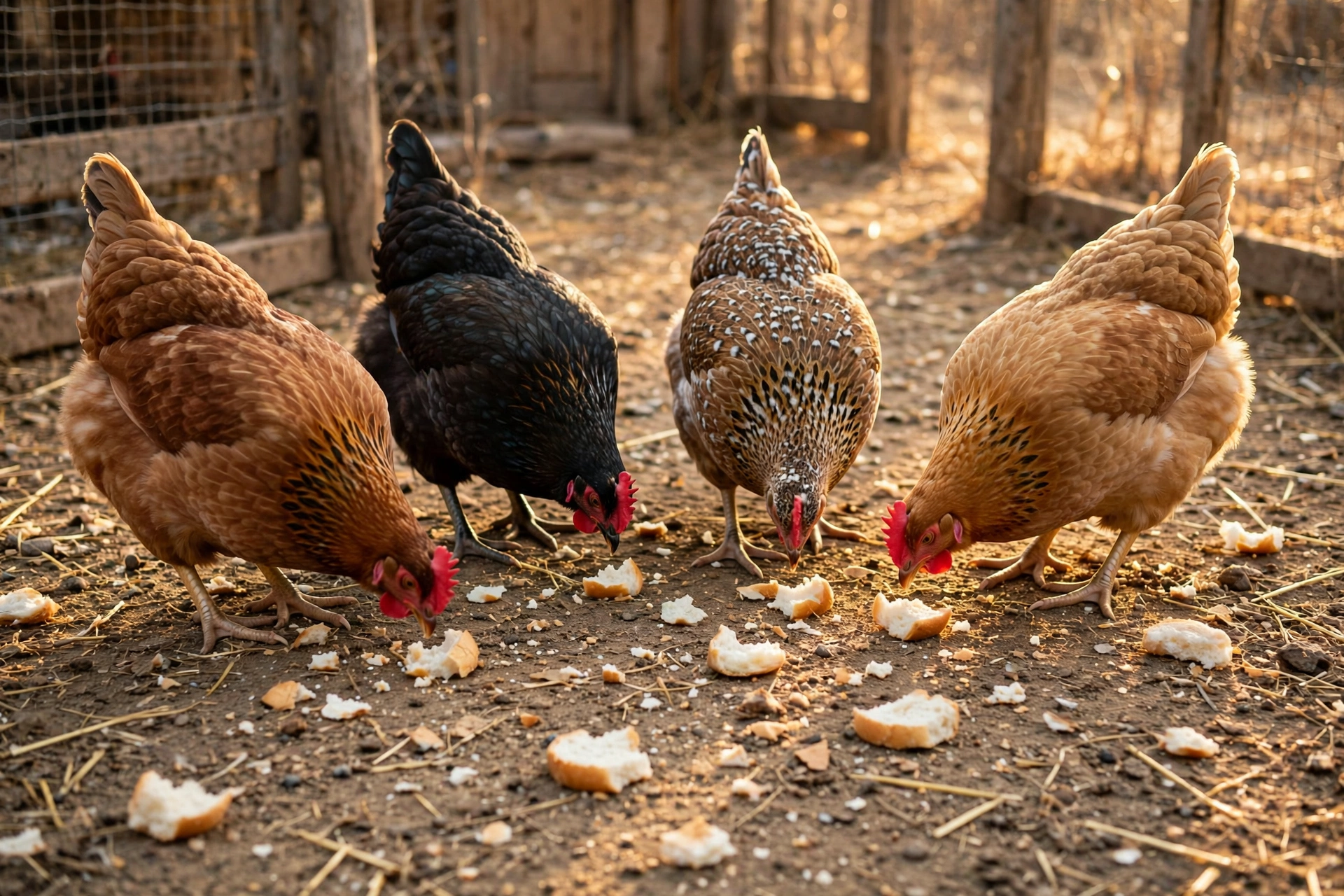
Yes, chickens can eat bread, but only in small amounts and only as an occasional treat. Plain bread is safe for a healthy hen, yet it is almost empty of the protein, calcium and vitamins a laying hen needs, so it should never replace proper feed. Our own food checker gives bread a Caution verdict, treat only, low nutrition, fills them up, and that sums up the whole story in one line. A few small torn pieces once a week will do no harm, while a daily slice slowly pushes real feed out of the diet and leaves the hen fuller on less nutrition. This guide covers which breads are safe, how much to serve, the mouldy bread rule, and the breads that should never reach the run.
Table of Contents
What Kind of Bread Can Chickens Eat
How Much Bread Can Chickens Eat
How to Serve Bread to Chickens
Bread Compared With Other Carb Treats
Verdict: Caution, treat only, low nutrition, fills them up
Serving: A few small torn pieces per hen, shared from one slice between four or five hens
How often: Once a week at most, never every day
Best form: Plain bread, torn small, soaked in plain water if stale or dry
Never feed: Mouldy bread, garlic bread, onion bread, raw dough, or bread with chocolate or raisins
Is Bread Safe for Chickens
Yes, bread is safe for chickens when it is plain and served in small amounts. There is nothing poisonous in a plain slice of white or whole wheat bread, and hens will eat it with enthusiasm, which is why so many keepers reach for it. The problem with bread is not that it harms a hen, it is that it gives her almost nothing she needs. A hen that fills up on bread eats less of her layer feed, and layer feed is where her protein, calcium and vitamins come from. That is why the honest answer to the question is bread safe for chickens has two parts. It is safe, and it is also a poor food, so it belongs in the treat bowl and not in the feeder.
The usual treat rule still applies here, and it is the rule that keeps bread harmless. Treats of every kind should stay under 10 percent of what a hen eats in a day, and bread should stay well under that limit because it is one of the least nutritious treats you can offer. A laying hen needs about 16 percent protein in her diet and a steady supply of calcium for strong shells. Plain white bread has roughly 8 to 9 percent protein and almost no calcium at all, so every mouthful of bread is a mouthful that is not layer feed. One small serving a week changes nothing. A slice every morning changes the maths of her whole diet, and over a few weeks that shows up as fewer eggs, thinner shells and hens that put on weight without laying any better.

What Kind of Bread Can Chickens Eat
Plain bread is the only kind that belongs in the run, and within that rule there are still better and worse choices. White bread is fine in small pieces, and it is the bread most keepers have in the kitchen, but it is also the least nutritious of the common breads, because it is made from refined flour with most of the fibre and minerals milled away. Whole wheat and wholemeal bread are a small step up, because they carry a little more fibre and a few more minerals, yet they are still a treat and still follow the same once a week rule. The difference between white and whole wheat bread matters far less than the amount you serve, so use whichever plain loaf you have and keep the portion small.
Sourdough is safe for chickens when it is plain and served in small pieces. The tang in sourdough comes from fermentation, and a little of it in a torn piece of bread is no problem for a hen. Avoid heavily salted artisan loaves and any sourdough that has garlic, olives or seeds baked through a sugary glaze, and treat plain sourdough exactly like any other bread, a few small pieces, once a week at most. Bread crusts are fine too, as long as they are torn small. Hard crusts can be tough for a hen to swallow, so soak them in plain water for a few minutes before you scatter them, and never offer a whole dry crust that a hen has to wrestle with.
Bread crumbs are fine in the same way, as long as they are plain. A small pinch of plain crumbs scattered in the run is a harmless treat, but seasoned crumbs, the kind made for coating fried food, should stay in the kitchen, because they carry salt and flavourings a hen does not need. Toast is simply toasted bread, and our food checker gives it the same Caution verdict, just toasted bread, treat only, low nutrition. Serve plain toast in small pieces with nothing on it, no butter, no jam and no honey. Pita bread follows the same rule, and the checker gives it a Caution verdict too, treat only, small torn pieces. Plain wraps and flatbreads are no different, so tear them small and keep them plain.
How Much Bread Can Chickens Eat
A few small torn pieces per hen is the right amount, and once a week is the right frequency. In practice that means one slice of bread, torn into small pieces and shared between four or five hens, is plenty for the whole flock. A small flock of three hens needs even less, about half a slice between them. There is no exact gram amount that fits every flock, because hens differ in size and appetite, but the picture to hold in your head is a scattering of pieces that is gone in a minute or two, not a pile that sits in the run while the hens pick at it all afternoon.
The reason the amount matters so much is the crop. A hen stores food in her crop before it moves on to be digested, and dry bread swells as it soaks up moisture inside the crop. A small amount swells a little and passes on without trouble, while a large amount of dry bread can sit in the crop as a dense, doughy mass. A hen with an overfull crop goes off her feed and stands puffed up and quiet, and in the worst case the crop stops emptying at all. That condition, an impacted crop, is painful and sometimes needs a vet to put right, and it is almost always the result of too much dry bread at once, which is why small pieces and small amounts are the whole safety rule here.
Frequency matters just as much as amount. Bread once a week is a treat, while bread every day is a habit, and a daily habit is where the nutrition cost appears. A hen that eats bread every morning eats less layer feed every morning, and over a month that adds up to a real shortfall in protein and calcium. The eggs get smaller, the shells get thinner, and the laying slows down. None of that is permanent, because cutting bread back to once a week will put things right, but it is much easier to keep bread rare from the start.
Stale bread is fine for chickens as long as it is not mouldy, and it is actually one of the best uses for a loaf that has gone dry. Soak stale pieces in plain water for a few minutes until they soften, then scatter them small. The water does two useful things at once, it softens the bread so it is easier to swallow, and it stops the bread swelling so much inside the crop. Never soak bread in milk, because hens do not digest milk well, and never soak it in anything sweetened or flavoured. Plain water is the only liquid bread needs.

How to Serve Bread to Chickens
How you serve bread matters as much as how much you serve, and the method is simple. Tear the bread into pieces no bigger than your thumbnail, and scatter them across the run so the hens have to scratch and peck for them. Scattering has two benefits, it stops the boldest hen from eating the whole serving while the shy ones watch, and it turns a treat into a little bit of natural foraging, which is good for the flock. Never put out a whole slice or a whole loaf, because hens will tear at it themselves and swallow pieces that are too big, and the biggest pieces are the ones most likely to sit heavily in the crop.
Serve bread after the hens have eaten their proper feed, not instead of it. Mid morning or midday is a good time, because the hens have already filled up on layer feed and the bread is a small extra on top of a full crop, not the first thing they eat on an empty stomach. A hen that eats bread first thing in the morning fills her crop with starch before she has touched her feed, and she may then eat less feed for the rest of the day. The same rule applies to every treat, and it is worth repeating here because bread is the treat most likely to be handed out first thing, straight from the kitchen table.
Remove any uneaten bread before it turns. Wet bread left in the run goes sour quickly, especially in warm weather, and sour bread attracts flies and can upset a hen’s stomach. Dry bread left out draws rats and mice at night, so pick up what the hens leave behind. If you soaked the bread, serve only what the hens will finish in a few minutes, and tip the rest away.

Can Chickens Eat Moldy Bread
No, chickens must never eat mouldy bread, and this rule has no exceptions. Mould on bread is not just a green spot on the surface. The mould you can see is only the fruit of the fungus, while its invisible threads run deep through the loaf, far beyond the spot you can see. Cutting off the mouldy corner and feeding the rest of the slice does not make the bread safe, because the threads and the toxins they produce are already spread through the whole slice. If a loaf has any mould on it at all, the whole loaf is out, and it goes in the bin or in a compost heap the hens cannot reach.
The danger in mouldy bread is a group of toxins called mycotoxins, and they are the reason the rule is absolute. Mycotoxins survive toasting, freezing and cooking, so there is no kitchen trick that makes mouldy bread safe again. Toasting a mouldy slice only makes the mould harder to see, and the toxins stay exactly where they were. A hen that eats mouldy bread may go off her feed, lay fewer eggs, or show no sign at all, while the toxins slowly harm her liver over time. If you think a hen has eaten mouldy bread, take the rest away at once, watch her closely, and call a vet if she goes off her feed, looks lethargic or stops laying.
The practical side of this rule is simple. Check every slice before it goes to the run, and look at both sides in good light. A loaf that has been open for a few days in a warm kitchen can grow mould on the last slices while the first slices look fine, so check the slice you are actually serving. Store bread in a cool dry place, and when in doubt, throw it out. A slice of bread costs almost nothing, and a hen costs far more. Never put mouldy bread in the compost heap inside the run either, because the hens will scratch through it and eat it anyway.
Breads to Avoid
Garlic bread is out, and so is onion bread. Garlic in bread is not the same as the tiny amounts of fresh garlic some keepers offer as a rare treat, because garlic bread carries garlic, butter and salt together, and the butter and salt alone are reason enough to keep it away from the run. Onion bread is worse, because onion in any form is a problem for chickens, and a loaf baked with onion through it cannot be made safe by picking the pieces out. If a loaf has garlic or onion in it, it stays in the kitchen.
Sweet breads and buns are out too. Cinnamon rolls, doughnuts, sweet buns, fruit loaves and any bread with chocolate chips or raisins in it should never reach the hens. The sugar is the first problem, because hens do not need it, and raisins and chocolate are the second problem, because neither belongs in a hen’s diet at all. A plain bread roll is a treat, while a sweet bun is a treat wrapped in sugar, and the flock gains nothing from it.
Buttered bread, jam covered bread and bread with any spread on it should stay in the kitchen as well. Butter is salty and fatty, jam is sugar, and honey is sugar too, so a slice with a spread on it is no longer plain bread. If you want to give the hens a piece of the loaf you are eating, tear off a plain piece from the end before you butter it, and give them that. The same goes for sandwiches. A sandwich is bread plus a filling, and the filling is almost always the problem, so do not feed leftover sandwiches to the flock.
French toast is a borderline case, and the checker gives it a Caution verdict, egg dipped fried bread, plain tiny pieces only, no syrup or powdered sugar. A tiny piece of plain french toast is harmless, but it is fried, so it carries fat, and it is rarely worth the trouble. A grilled cheese sandwich is in the same place, and the checker gives it a Caution verdict too, melted cheese on buttered bread, salty and fatty, small amounts only. Plain bread would have been the better choice in both cases.
Raw dough is the one bread related food that is genuinely dangerous. Never feed raw bread dough to chickens. Dough rises in the warmth of the crop, and the yeast in it keeps producing gas and alcohol as it ferments. A hen that eats raw dough can suffer a swollen crop and alcohol poisoning, and that can be fatal. If dough falls on the floor while you are baking, pick it up before the hens get to it, and never put dough scraps in the treat bowl.
Can Baby Chicks Eat Bread
Baby chicks should not eat bread. Chicks under eight weeks old live on starter feed, and starter feed is carefully balanced to give them the protein and energy they need to grow fast. A chick’s crop is tiny, and a piece of bread fills it with starch that pushes out the starter feed the chick actually needs. Growth in the first eight weeks sets the shape of the whole bird, so a chick that eats treats instead of starter feed grows more slowly and can end up weaker than her flock mates. There is no benefit to giving a chick bread, and there is a real cost, so keep bread away from the brooder entirely.
Once the chicks pass eight weeks and move onto grower feed, a tiny piece of bread as a rare treat is harmless, but keep the piece very small and the frequency very low. A chick of eight weeks is still growing, and she still needs her proper feed first. Tear the bread into pieces smaller than a pea, offer only a few, and watch that every chick gets a share rather than one bold chick eating it all. If you are unsure whether a chick is old enough, wait. There is no harm in waiting, and there is no hurry to introduce a treat that gives the chick nothing she needs.
Bread Compared With Other Carb Treats
Bread is not the only plain carb treat a keeper can offer, and it is honestly the weakest of the group. Plain cooked pasta is the better carb scrap, and our guide to pasta covers it in full. Cooked pasta is plain, holds its shape, and is fun for hens to peck at, and it follows the same plain rule as bread, no sauce, no salt and no butter. Pasta is still a treat, and it still follows the once a week rule, but it is a more interesting treat than bread, and it does not swell in the crop the way dry bread can.
Plain cooked rice is the next comparison, and our guide to rice covers it in full. Cooked rice is a similar treat to bread, plain, filling and low in nutrition, and it follows the same small amounts rule. Rice has one advantage over bread, because cooked rice is already soft and full of water, so it does not swell in the crop the way dry bread does. A spoonful of plain cooked rice scattered in the run is a safer carb treat than a slice of dry bread, though it is still a treat and not a food.
Cooked oatmeal is the best of the carb treats, and our guide to oatmeal covers it in full. Oatmeal has more fibre than bread, it suits cold mornings, and hens love it warm in winter. It still follows the treat rule, because it is still a carb, but it gives the flock a little more than bread does for the same effort. If you have to choose one carb treat for the flock, oatmeal is the better choice, and bread is the one to keep rarest.
The plain carb rule ties all four together, and it is the rule that keeps every carb treat safe. Plain means no sauce, no salt, no butter and no seasoning, and small means a few pieces per hen, once a week at most. Bread, pasta, rice and oatmeal all follow it, and the only difference between them is how much nutrition each one carries. Bread carries the least, which is why it should be the rarest of the four. For the full picture of what a hen can eat, see our pillar guide what can chickens eat, which puts every treat in its place beside the proper feed a hen actually needs.

Why Bread Is a Poor Food for Chickens
Bread is a poor food for chickens because it is almost entirely refined starch. A slice of white bread gives a hen energy and very little else. It has roughly 8 to 9 percent protein, while layer feed has about 16 percent, and it has almost no calcium, while layer feed is made with calcium added for strong shells. It has few vitamins, little fibre and no meaningful minerals, so a hen that eats bread is eating calories without the building blocks those calories are supposed to carry, and that is why bread is safe and worthless in the same breath.
Whole wheat bread is only a little better. It keeps more of the fibre and a few more minerals from the grain, but it is still a starch first and a food second. The gap between bread and layer feed is so wide that no choice of loaf closes it, and that is the point keepers should remember. Bread is not a substitute for feed, it is not a supplement, and it is not a health food. It is a snack, and snacks are judged by how much harm they do, not by how much good they do. Bread does little harm in small amounts, and that is the best that can be said for it.
The cost of too much bread shows up slowly, and that is what makes it easy to miss. A hen that eats bread every day eats less layer feed every day, and the shortfall in protein and calcium builds up over weeks. The first sign is usually fewer eggs, and the second is thinner shells, while the hens may also put on weight, because bread is energy dense. None of this is permanent, because cutting bread back to once a week will put things right within a few weeks, but it is much easier to keep bread rare from the start.
None of this means bread is a bad treat. A few small pieces once a week is a pleasure for the flock and a pleasure for the keeper, and there is nothing wrong with enjoying that. The honest summary is the one our food checker gives, treat only, low nutrition, fills them up. Keep bread in that place, a rare small treat, and it will never cause a problem.
Frequently Asked Questions
Is bread safe for chickens?
Yes, plain bread is safe for chickens in small amounts. Our food checker gives bread a Caution verdict, treat only, low nutrition, fills them up. A few small torn pieces once a week will do no harm, but bread should never replace proper layer feed, because it has almost no protein, calcium or vitamins.
Can chickens eat white bread?
Yes, chickens can eat white bread in small pieces. White bread is the least nutritious of the common breads, because it is made from refined flour, so keep the portion small and the frequency to once a week at most. Whole wheat bread is a small step up, because it carries a little more fibre, but it follows the same rule.
Can chickens eat moldy bread?
No, chickens must never eat mouldy bread. The mould you can see is only part of the fungus, and its invisible threads run through the whole loaf. The toxins mould produces, called mycotoxins, survive toasting, freezing and cooking, so there is no kitchen trick that makes mouldy bread safe. If a loaf has any mould on it, throw the whole loaf away.
Can baby chicks eat bread?
No, baby chicks under eight weeks old should not eat bread. Their starter feed is carefully balanced for fast growth, and a chick’s crop is tiny, so bread fills it with starch and pushes out the feed the chick needs. After eight weeks, a tiny piece of soft bread as a rare treat is harmless, but keep it very small and very rare.
Can chickens eat bread every day?
No, chickens should not eat bread every day. Bread should be a treat once a week at most, and treats of every kind should stay under 10 percent of what a hen eats in a day. Daily bread crowds out layer feed, and over a few weeks that shows up as fewer eggs, thinner shells and hens putting on weight.
Can chickens eat bread crusts?
Yes, chickens can eat bread crusts as long as they are torn small. Hard crusts can be tough to swallow, so soak them in plain water for a few minutes before you scatter them. Never offer a whole dry crust, and never offer a crust with butter, jam or any spread on it.

Nusrat
Author, TheChickenPet.com
Garlic is another kitchen food that needs the same care. Our guide to whether chickens can eat garlic explains how little is safe and which garlic foods to skip.