
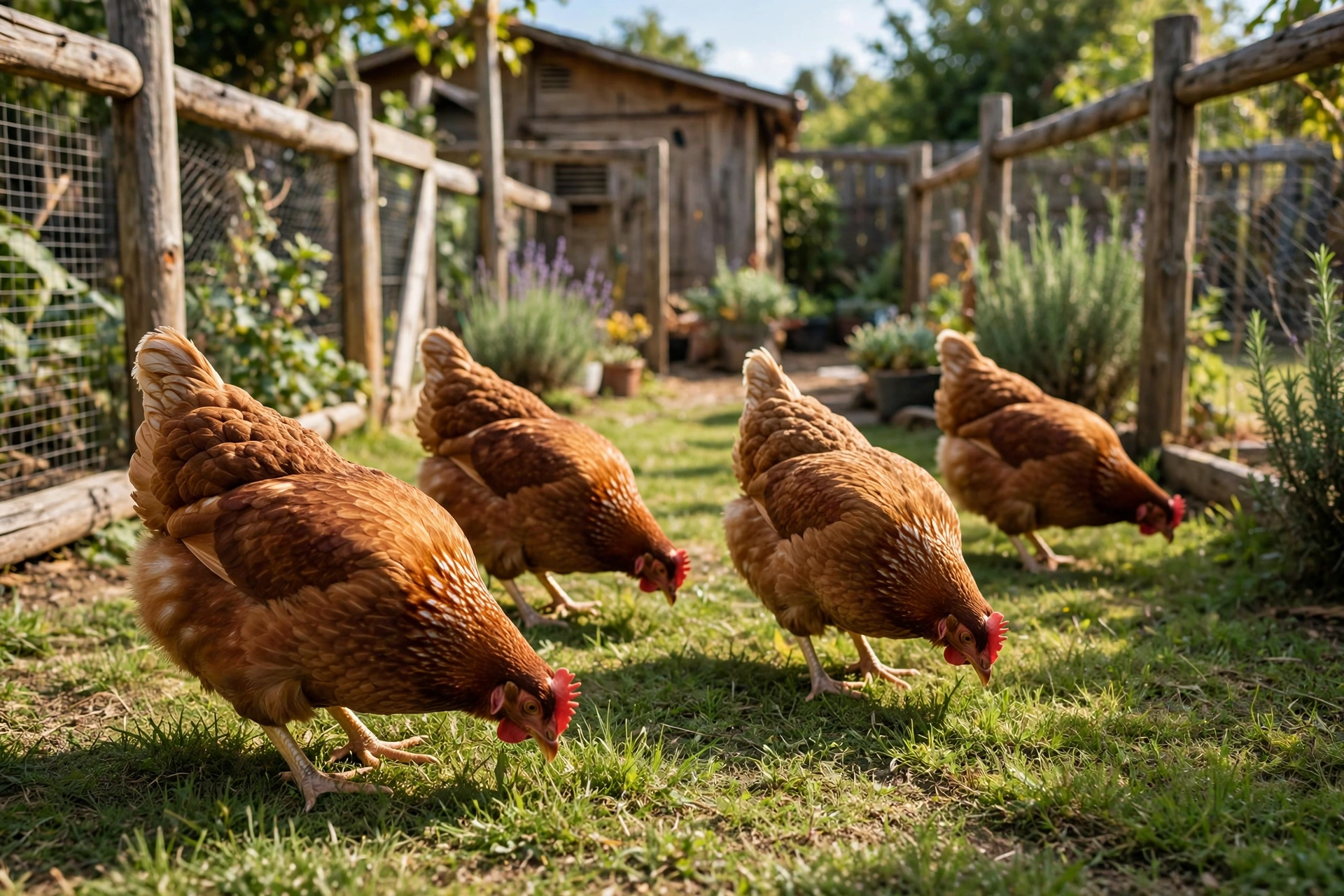
Let a flock out onto a lawn and the first thing most hens do is put their heads down and graze. Chickens eat grass, and they will happily graze all day if you let them. It is one of the most natural sights in backyard chicken keeping, a hen moving slowly across the grass, tearing off tender tips and pecking at the tiny insects at the base of the stems.
Short fresh grass is good for them. It gives vitamins and xanthophylls, the pigments that deepen yolk colour, and it keeps a flock busy and active through the day. But grass has its limits, and it has one real danger too. Chickens cannot fully digest grass cellulose, so grass is a supplement to a proper diet, never a complete diet on its own, and long dry strands can tangle in the crop and cause an impacted crop.
This guide covers how chickens graze, why short grass helps, when grass turns dangerous, how to feed lawn clippings safely, what chicks can have, and which plants to keep out of the forage, so you can let your flock graze with confidence.

Table of Contents
- Do Chickens Eat Grass
- Why Grass Is Good for Chickens
- Can Chickens Live on Grass Alone
- Is Long Grass Dangerous for Chickens
- Can Chickens Eat Lawn Clippings
- How to Feed Grass Clippings Safely
- Can Baby Chicks Eat Grass
- Can Chickens Eat Grass Seeds
- Keeping the Pasture at the Right Length
- Toxic Plants to Watch for in Forage
- Frequently Asked Questions
Quick Facts
At a Glance Chickens graze naturally and will eat grass all day if they can. Short fresh grass gives vitamins and xanthophylls that deepen yolk colour.
The One Danger Long dry strands can tangle into a hairball in the crop and cause impacted crop. Keep pasture at 2 to 4 inches and never give long stringy grass.
Good to Know Lawn clippings must be short, fresh and untreated, never mower-mouldy piles and never from a treated lawn. Grass is a supplement, never a complete diet, and a flock on grass alone will lose weight and stop laying.
Do Chickens Eat Grass
Do chickens eat grass. Yes, and grazing is one of the first things a hen does when she gets onto fresh ground. Chickens graze naturally, and a flock with access to a run will spend much of the day with their heads down, moving slowly and pecking as they go. Grass is not a treat you have to introduce. It is food they find for themselves the moment they can reach it.
They eat it in a particular way. A hen tears off the tender tips of the grass blades and pecks at the base of the stems, where tiny insects hide. She does not gulp down mouthfuls of long grass the way a grazing animal does. She takes small bites, picks the softest growth first, and moves on to the next patch when the best bits are gone. That is why a flock can graze the same lawn day after day and still find something worth eating.
They are choosy about it too. Young tender growth goes first, and old tough stems are left standing. A hen will walk past dry, stemmy grass to reach a patch of soft new growth, and she will spend longer on a lawn that is kept short than on one that has gone tall and coarse. If your hens seem to ignore the grass in their run, the chances are it is too long, too dry or too tough for their liking, not that they do not eat grass at all.
Grass also comes with company. The base of the stems and the soil beneath hold tiny insects, and hens snap those up as they graze. The insects are a bonus, not the point, but they are part of why a hen loves to graze. She is hunting and eating at the same time, and that keeps her busy in a way a feeder never will.
Why Grass Is Good for Chickens
Short fresh grass gives a flock things their feed does not. It gives vitamins, and it gives xanthophylls, the natural pigments that deepen yolk colour. Hens that graze on fresh green grass often lay eggs with richer, deeper orange yolks, and that colour comes straight from the grass they ate.
It also gives fibre and variety. A hen that only ever eats from a feeder misses the range of textures and tastes that grazing gives her, and a flock that can graze is a flock that stays occupied. Grazing is exercise and entertainment in one, and a busy hen is a calmer hen. Hens that spend the day foraging are less likely to pick at each other out of boredom.
Fresh grass is better than dry grass for all of this. Tender young growth is soft, easy to tear and full of the good things a hen gets from grazing. Old dry grass is tough, hard to digest and much less appealing, and hens will often leave it alone. The best grass for your flock is the grass you would want to walk on barefoot, short, green and soft underfoot.
None of this makes grass a food in its own right. It is a supplement, a useful extra on top of a balanced diet. Think of it the way you would think of salad with a meal. It adds vitamins and variety, it keeps the eater busy and healthy, and it is never the whole meal.
Can Chickens Live on Grass Alone
Can chickens live on grass alone. No, and this is the point that matters most in this guide. Chickens cannot fully digest grass cellulose, which is the tough fibre that makes up most of a grass blade. A hen can tear off the tips and get the vitamins and pigments from them, but she cannot break down the bulk of the grass the way a grazing animal can.
That means grass fills the crop without giving the hen enough of what she needs. A flock kept on grass alone, with no proper feed, will lose weight and stop laying. The hens may look busy and content, grazing all day, and still slowly grow thin, because the food they are eating cannot keep them going. A hen that has stopped laying and is losing weight despite eating all day is a hen that needs real feed, not more grass.
Grass is a supplement, never a complete diet. Your flock still needs its normal balanced feed every day, with protein and calcium for eggs and growth, and fresh water at all times. Let them graze as much as they like on top of that, and the grass does them good. Take the feed away and leave only the grass, and the flock will fade.
The same is true of any single green food. No one plant can feed a chicken on its own. Grass earns its place as part of a varied diet, alongside proper feed and the other things a hen forages, and that is where it should stay.
Is Long Grass Dangerous for Chickens
Is long grass dangerous for chickens. Yes, and it is the one real danger in this whole guide. Long dry strands can tangle into a hairball in the crop and cause impacted crop. The strands knot together instead of passing through, the crop blocks up, and the hen is in trouble. It is the same reason you should never give a hen long stringy grass of any kind.
The rule is simple. Keep pasture at 2 to 4 inches. At that length the grass is tender, easy to tear and easy to pass through, and a hen can graze all day on it without any risk. Once grass grows tall and dry, the stems turn tough and stringy, and that is when the trouble starts. A lawn that has gone to seed and dried out in the sun is not a safe place to graze.
If your pasture has grown tall, mow it before you let the hens in, or fence off the tall patch until it is cut. It takes one mowing to turn a risky run into a safe one, and it is worth doing before the flock goes out rather than after a bird has eaten the wrong thing. Short grass is safe grass, and that is the whole of the rule.
If you are worried about a hen that has eaten long grass, our guide on sour crop in chickens and how to tell it from an impacted crop explains what an impacted crop is and what to look for. The best cure is prevention, and prevention is a mower and a short lawn.

Can Chickens Eat Lawn Clippings
Can chickens eat lawn clippings. Yes, as long as they are the right kind of clippings. The site’s food checker has an entry for grass clippings, and it rates them Safe, with this note. “Short, fresh, untreated clippings only, never long strands or mower-mouldy piles”.
Read that note carefully, because it holds the whole answer. Short means the clippings came from grass that was cut while it was still short, not from a lawn that had grown tall and gone stringy. Fresh means the clippings were offered the same day they were cut, while they were still green and clean. Untreated means the lawn has had no weed killer, fertiliser spray or other chemical on it.
Long clippings are the same danger as long grass. If you have let the lawn grow tall and then mowed it, the clippings will be long and stringy, and they carry the same crop risk as grazing on tall grass. Those clippings belong on the compost heap, not in front of the hens. Only short clippings are safe to offer.
There is no checker entry for grazing grass itself, only for clippings, so the verdict above is about clippings and nothing else. Grazing on short pasture follows the same common sense, short and fresh and untreated, and the rest of this guide follows that rule through.
How to Feed Grass Clippings Safely
Scatter clippings thinly, never dump them in a pile. A thin scattering lets every hen pick at the fresh green bits, and nothing sits long enough to go off. A big heap is the opposite. Clippings left in a pile heat up fast, turn slimy and go mouldy, and mower-mouldy piles are never safe to feed. If the clippings have sat in a heap, even for a day, throw them on the compost and cut fresh ones.
Only ever offer clippings cut the same day. Fresh clippings are green, clean and sweet smelling. Clippings from yesterday are already on their way to going off, and clippings from a damp heap are worse. The rule is simple. If you would not want it in your own salad bowl, do not give it to the hens.
Never offer clippings from a treated lawn. Weed killer, fertiliser spray and other lawn chemicals stay on the grass long after they are sprayed, and they have no place in a chicken’s diet. Keep hens off a sprayed lawn for at least 30 days after treatment, and do not feed them clippings from it in that time either. If you are not sure whether a lawn has been treated, do not use its clippings at all.
A small handful per hen, scattered on clean dry ground, is plenty. Clippings are a treat and a supplement, not a meal, and the hens still need their normal feed. Offer them in the morning so the hens have the whole day to pick through them, and clear away anything left uneaten by the evening.
Can Baby Chicks Eat Grass
Can baby chicks eat grass. Yes, chicks can have finely chopped grass from a young age. The key word is finely chopped. A chick is small, and a long strand of grass is a big problem for a small bird, so the grass must be cut into tiny pieces before it is offered.
Introduce it gradually. Start with a tiny pinch of finely chopped grass, mixed in where the chicks can find it, and let them get used to it over a few days. Build the amount up slowly, and keep it as a small extra alongside their normal feed, never as a replacement for it. Chicks grow fast, and they need their proper feed far more than they need grass.
The same rules apply to chicks as to adults. Short, fresh and untreated, and never long or stringy. Grass from a treated lawn is no good for chicks either, and clippings that have sat in a pile are no good for them. If the grass is safe for the hens, chopped fine and offered in small amounts, it is safe for the chicks too.
Watch the chicks as they try it. Most will peck at it straight away, and a few will ignore it for a day or two before they join in. That is normal. There is no rush, and a chick that is eating its normal feed well has everything it needs while it learns to graze.

Can Chickens Eat Grass Seeds
Can chickens eat grass seeds. Yes, grass seeds are fine for chickens. A hen that grazes on a lawn that has gone to seed will peck at the seed heads and eat the seeds along with the grass, and that is a natural part of foraging. Seeds are food a chicken is built to eat, and she will pick them out happily.
Seed heads are one of the reasons hens love a slightly longer patch of grass, as long as it is not too long or dry. The seeds give energy, and the hen gets them by doing what she loves, scratching and pecking through the grass. It is foraging at its simplest.
There is nothing special to prepare. You do not need to collect seeds or scatter them yourself, though a handful of seed heads tossed into the run will keep a flock busy for a while. Just make sure the seeds come from untreated grass, the same as the clippings and the grazing. Seeds from a sprayed lawn carry the same risk as the grass they grew on.
Grass seeds are a small part of the diet, not a main food, and that is fine. They are a bonus that comes with grazing, and a flock that can forage for seeds, insects and tender tips is a flock that is eating the way chickens were made to eat.
Keeping the Pasture at the Right Length
Keeping the pasture at the right length is the single most useful job in this guide, and it is an easy one. Keep it at 2 to 4 inches, and most of the risks in this guide disappear on their own. Short grass is tender, safe and full of the good things hens get from grazing, and it stays that way as long as you mow it regularly.
Mow little and often rather than letting the grass grow tall and cutting it back hard. A regular mow keeps the growth soft and young, and it gives you short clippings you can safely offer the hens too. A lawn that is mowed every week or so in the growing season stays in the safe range without much thought.
If you can, rest patches of ground in turn. Let the hens graze one patch while another recovers, then swap them over. Rested ground grows back soft and green, and the hens get fresh growth to graze each time they move. If you only have one run, a regular mow does the same job, and the hens will still have plenty to graze.
A good run is more than grass. A dry dust bath gives hens a place to clean their feathers and keep mites down, and our guide on how to make a dust bath for chickens shows how to set one up in a corner of the run. Short grass, fresh water, a dust bath and a dry shelter are the makings of a run your hens will love, and for a wider look at keeping the flock healthy, the Chicken Care and Health pillar is a good place to start.
Toxic Plants to Watch for in Forage
Grass itself is safe, but not everything that grows mixed in with grass is. Watch for toxic plants in the forage, and the three to know by name are nightshade, foxglove and azaleas. All three are poisonous to chickens, and none of them belongs in a run or a pasture where hens graze.
Nightshade grows as a weed in damp corners and along fences, with dark berries that catch a hen’s eye. Foxglove is a tall garden flower with bell shaped blooms, and it is poisonous through and through. Azaleas are garden shrubs, and their leaves and flowers are poisonous too. If any of these grows where your hens range, pull it out and keep it out.
Walk the run and the pasture now and then and look at what is growing there. You do not need to know the name of every weed, but you should know the plants in the places your hens graze, and anything you cannot identify is worth keeping the hens away from until you know what it is. A quick look once a month is enough to catch most problems before the hens do.
If a plant you do not recognise has appeared in the run, fence it off or pull it out rather than leaving the hens to decide for themselves. Hens are choosy, and they will usually leave bitter or strange tasting plants alone, but usually is not always, and a plant that is pulled out cannot be eaten by mistake.

Frequently Asked Questions
Do chickens eat grass?
Yes. Chickens graze naturally and will eat grass all day if they can. They tear off the tender tips and peck at the tiny insects at the base of the stems, and they prefer young soft growth to old tough stems.
Can chickens eat lawn clippings?
Yes, as long as the clippings are short, fresh and untreated. Never offer long stringy clippings or clippings that have sat in a heap and gone mouldy, and never offer clippings from a treated lawn.
Can chickens live on grass alone?
No. Chickens cannot fully digest grass cellulose, so grass is a supplement, never a complete diet. A flock on grass alone will lose weight and stop laying. Hens still need their normal balanced feed and fresh water every day.
Is long grass dangerous for chickens?
Yes. Long dry strands can tangle into a hairball in the crop and cause impacted crop. Keep pasture at 2 to 4 inches and never give long stringy grass.
Can baby chicks eat grass?
Yes. Chicks can have finely chopped grass from a young age, introduced gradually in small amounts alongside their normal feed. The grass must be chopped fine, short, fresh and untreated.
Keep Reading
Chicken Care and Health and the pillar guide for keeping your flock healthy.
How to Make a Dust Bath for Chickens and the other half of a happy run.
Sour Crop in Chickens and How to Tell It from an Impacted Crop and what to do when a crop goes wrong.

Nusrat
Author, TheChickenPet.com