
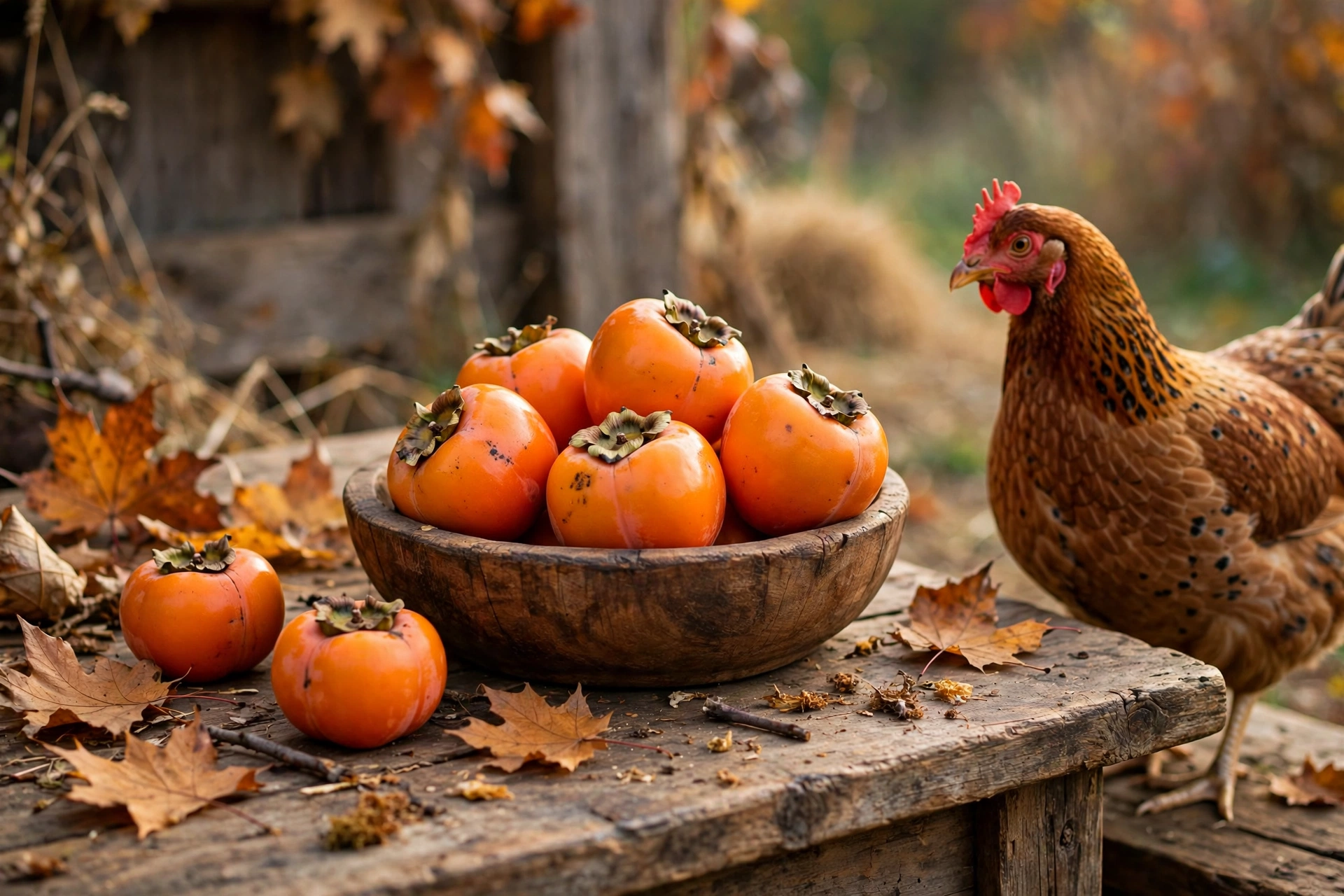
Persimmons arrive in autumn, just as the garden is slowing down and the hens are looking for something new to peck at. The fruit is bright orange, soft and honey sweet when it is ripe, and it looks like exactly the kind of treat a chicken would love. It is, but only when it is fully ripe. An unripe persimmon is a very different thing, and feeding one to your flock is a mistake you only need to make once to understand why.
The short answer is yes, chickens can eat persimmon, as long as it is fully ripe. A ripe persimmon is a safe sweet treat, rich in vitamin A, vitamin C and manganese, and most hens will eat it happily. An unripe persimmon is very astringent, and that astringency comes from tannins that can upset a chicken’s digestion and block nutrient absorption. So the whole question comes down to ripeness, and learning to tell a ripe persimmon from an unripe one is the most important part of this guide.
This guide covers the ripeness test, the two types of persimmon you will meet in the shops, what to do about seeds and skin, how much to give, and when to skip persimmon altogether. It also answers the questions keepers ask most, including whether chickens can eat fuyu and hachiya persimmons and whether the seeds are safe.

Table of Contents
- Are Persimmons Safe for Chickens
- What Makes an Unripe Persimmon Unsafe
- How to Tell if a Persimmon Is Ripe
- Fuyu and Hachiya, the Two Types
- How to Feed Persimmon to Chickens
- Can Chickens Eat Persimmon Seeds
- Can Chickens Eat the Skin
- How Much Persimmon Can Chickens Eat
- When Not to Feed Persimmon
- Dried Persimmons
- Why Chickens Love Persimmon
- Frequently Asked Questions
Quick Facts
At a Glance A fully ripe persimmon is a safe treat for chickens. An unripe one is not, because it is very astringent.
The Ripeness Test A ripe persimmon feels soft, like a water balloon. If it puckers your own tongue, it is not ready.
Good to Know Persimmons are rich in vitamin A, vitamin C and manganese, but high in sugar, so they are a rare treat once or twice a week, never a staple.
Are Persimmons Safe for Chickens
Yes, persimmons are safe for chickens, but only when the fruit is fully ripe. The food checker lists persimmon as Safe, with the note “Only fully ripe, unripe is very astringent”. That one line is the whole rule. A ripe persimmon is soft, sweet and easy for a hen to eat, and it brings vitamin A, vitamin C and manganese with it. An unripe persimmon is hard, bitter and puckering, and it has no place in the run.
The difference between ripe and unripe is not a small one. A persimmon that is almost ripe can still be unpleasantly astringent, and a hen that pecks at one will usually drop it and walk away. That is the bird telling you the fruit was not ready. Trust her, and take the rest of the fruit away rather than leaving it in the run for her to come back to.
If you are new to persimmons, the safest way to start is to taste a piece yourself first. If it is sweet and soft, your hens can have some. If it makes your mouth pucker, it is not ready, and no chicken should eat it yet. This simple check is the one that matters most, and it is covered in detail in the ripeness section below.
What Makes an Unripe Persimmon Unsafe
An unripe persimmon is full of tannins, and tannins are what make your mouth feel dry and puckered when you bite into one. Those same tannins are the problem for chickens. In a hen, tannins can cause digestive upset, and they can block nutrient absorption, which means the bird gets less good from the food she eats. A small peck at an unripe persimmon is unlikely to cause lasting harm, because most hens will stop eating it at once, but it is still an unpleasant experience for the bird, and there is no reason to risk it.
Tannins fade as the fruit ripens. That is why a persimmon that was inedible last week can be soft and sweet this week. The fruit is not changing its nature, it is simply finishing the job of ripening, and the tannins are breaking down as it does. This is also why patience is the best tool you have with persimmons. If the fruit is not ready, leave it on the counter for a few more days and try again.
The same warning applies to windfall fruit. A persimmon that has fallen from the tree is not automatically ripe. Check it with your hands and your own tongue before you offer it to the flock. A fallen fruit that is still firm and astringent belongs in the compost, not in the run.
How to Tell if a Persimmon Is Ripe
The ripeness test for a persimmon is mostly about touch. A ripe persimmon feels soft, like a water balloon, and it gives gently when you press it with your thumb. An unripe persimmon feels firm and hard, almost like an apple, and it will not give at all. If the fruit still feels firm, it is not ready, no matter how orange it looks. Colour alone will not tell you, because many persimmons turn a deep orange well before they are soft enough to eat.
The second part of the test is taste. Take a small piece and taste it yourself. If it is sweet and soft, it is ready for the hens. If it puckers your own tongue and leaves your mouth feeling dry, it is not ready, and you should wait a few more days. This is the most reliable test there is, because your own tongue will feel the astringency long before your eyes can see it.
A third sign is the skin. A ripe persimmon often has skin that looks slightly wrinkled or translucent, and the fruit may feel heavy for its size. These are useful hints, but touch and taste are the real tests. When in doubt, wait another day. A persimmon that is a day past perfect is still a fine treat, while a persimmon that is a day too early is not.
Fuyu and Hachiya, the Two Types
There are two types of persimmon you are most likely to meet, and knowing which one you have makes the ripeness test much easier. Fuyu persimmons are non astringent, which means they are far less risky. They are squat and round, a little like a tomato, and they can be eaten while still firm, though they are sweetest when they are soft. If you are buying persimmons for the first time, Fuyu is the safer and simpler choice, because even a slightly underripe Fuyu is unlikely to be very astringent.
Hachiya persimmons are astringent, and they must be fully soft before feeding. They are taller and more pointed, shaped a little like an acorn, and they are the ones that give persimmons their tricky reputation. A Hachiya that is still firm is intensely astringent, and it should never be offered to chickens. Wait until it feels soft like a water balloon, and taste it yourself first. When a Hachiya is properly ripe, it is very sweet and almost jelly like inside, and hens love it.
If you do not know which type you have, treat it as a Hachiya. Wait until it is fully soft and taste it before you offer any to the flock. That way you are safe either way, and you will never feed an astringent fruit by mistake.

How to Feed Persimmon to Chickens
Feeding persimmon to chickens is simple once the fruit is ripe. Cut the persimmon into pieces that are easy for a hen to peck at, and remove the seeds and the tough woody calyx at the top first. The calyx is the leafy cap where the fruit joined the stem, and it is too tough for a hen to eat comfortably. Take it off and throw it away. Then cut the soft flesh into chunks and scatter them on clean ground or in a dish in the run.
You can also halve a soft ripe persimmon and set the halves cut side up for the hens to peck at. This works well with Hachiya persimmons, which are so soft when ripe that the hens can scoop the flesh out easily. Whichever way you serve it, give the fruit in the morning or early afternoon, when the hens are active and foraging, so they eat it while it is fresh and you can see how they take to it.
Do not leave uneaten persimmon sitting in the run overnight. Soft fruit spoils quickly, especially in warm weather, and it will attract flies and wasps. If the hens have not finished it by evening, clear it away. Fresh fruit is a treat, and a treat should be fresh.
For more ideas on what fits into a healthy feeding routine, our feeding pillar covers the foods chickens can eat every day and the ones that should stay as occasional treats.
Can Chickens Eat Persimmon Seeds
No, persimmon seeds should be removed before you feed the fruit to your chickens. Persimmons sometimes contain a few hard brown seeds inside the flesh, and they are not something a hen needs to eat. The seeds are hard and woody, and they add nothing to the treat. Cut the fruit open, pick the seeds out, and throw them away before you offer the flesh to the flock.
Seeds are easy to miss in a very soft Hachiya, because the flesh is so soft that the seeds can hide inside it. Take a moment to check each piece as you cut it. A quick look and a feel with your fingers is enough. If you find a seed, remove it and carry on. It only takes a few seconds, and it keeps the treat safe and simple.
The same habit is worth building with other fruits too. Many fruits carry seeds or pits that are better removed before feeding, and checking the fruit as you prepare it is a small step that keeps your hens safe. If you want another soft sweet fruit to compare, our guide on figs covers a fruit that hens enjoy in much the same way.
Can Chickens Eat the Skin
Yes, the skin of a ripe persimmon is fine for chickens, and it is nutritious. You do not need to peel the fruit. The skin is thin and soft on a ripe persimmon, and hens will eat it along with the flesh without any trouble. It carries some of the same goodness as the flesh, and peeling would only take that away.
The one exception is a persimmon that is not quite ripe, because the skin of an unripe fruit carries the same astringency as the flesh. But if the fruit is not ripe, it should not be fed at all, skin or no skin. So the rule stays simple. If the persimmon is fully ripe, the whole fruit is fine apart from the seeds and the calyx. If it is not ripe, wait.
Wash the fruit before you feed it, as you would for yourself. A quick rinse removes dust and any spray residue from the skin, and it takes only a moment. Then cut it up and offer it to the flock.

How Much Persimmon Can Chickens Eat
Persimmon is high in sugar, so it is a rare treat, not a staple. A good rule is to offer it once or twice a week, in small amounts, as part of the treat portion of the diet. A few chunks per hen is plenty. The hens will enjoy it, and their main feed will still do the real work of keeping them healthy and laying.
The reason for the limit is the sugar. Sweet fruit is a fine treat in small amounts, but too much sweet food can unbalance a hen’s diet and lead to weight gain and fewer eggs. Treats of all kinds should stay a small part of what a hen eats in a day, and persimmon is no different. If you have a lot of ripe persimmons at once, share them out over several days rather than giving the whole lot in one go.
Watch how your flock reacts the first time you offer persimmon. Most hens will eat it eagerly, but a few may be cautious with a new food, and that is normal. Let them come to it in their own time. If a hen ignores it, take it away and try again another day. There is no need to push a treat on a bird that does not want it.
When Not to Feed Persimmon
There are a few times when persimmon should stay off the menu. The first is when the fruit is not fully ripe, which is the main rule of this guide. The second is with young birds. Do not feed persimmon to chicks under 8 weeks old. Young chicks need their starter feed and nothing else, because their digestion is still developing and they need every bit of nutrition their feed gives them. Sweet fruit has no place in a chick’s diet.
The third is when a hen is already unwell. If a bird has digestive trouble, a vet visit is the right step, not a new treat. A hen with an upset stomach does not need sweet fruit, and it will not help her recover. Keep her on her normal feed and fresh water, and get advice if she does not improve.
Finally, do not feed persimmon that has gone off. Soft fruit turns quickly, and a persimmon that smells sour or has mould on it belongs in the compost. Hens should only ever get fresh, clean food, and a spoiled persimmon is not fresh food.
Dried Persimmons
Dried persimmons can be given to chickens, but only if they are unsweetened and have no added sulfites. Many dried persimmons sold in shops have added sugar or sulfites to keep them looking bright and to make them last longer, and those are not suitable for hens. Read the packet before you buy. If the ingredients list is just persimmon, it is fine. If it lists sugar, sulfur dioxide or sulfites, leave it on the shelf.
Dried persimmon is much sweeter and denser than fresh, because the water has been taken out and the sugar is concentrated. That means an even smaller portion is enough. A few small pieces per hen, once in a while, is plenty. Cut the dried fruit into small pieces so the hens can peck at it easily, and do not offer it often. Fresh ripe persimmon is the better treat, and dried persimmon is only an occasional change.
If you dry your own persimmons at home, with no added sugar and no sulfites, you know exactly what is in them, and they are a good way to use up a glut of ripe fruit in autumn. Store them in a dry airtight container, and offer them sparingly through the winter.

Why Chickens Love Persimmon
Chickens love persimmon for the same reasons people do. It is sweet, soft and easy to eat, and it arrives in autumn when the garden is giving less. A ripe persimmon is one of the softest fruits you can offer a hen, and even older hens with worn beaks can manage it easily. It is also a bright orange treat in a season that is turning brown and grey, and hens are drawn to bright colours in their food.
Persimmon also fits well into the autumn feeding routine. It is a seasonal fruit, which means it is at its best for a short window each year, and that makes it feel like a special treat rather than an everyday food. Offering it once or twice a week while it is in season is a nice way to mark the season for your flock, and it gives the hens something new to look forward to.
If your hens enjoy persimmon, they will probably enjoy other sweet autumn fruits too. Our guide on apples covers another fall fruit that fits the same treat routine, and our guide on mango covers a sweet fruit that hens love in the same way, even though it is not an autumn fruit.
Frequently Asked Questions
Can chickens eat persimmons?
Yes, chickens can eat persimmons, as long as the fruit is fully ripe. A ripe persimmon is a safe sweet treat, rich in vitamin A, vitamin C and manganese. An unripe persimmon is very astringent and should not be fed, because the tannins in it can cause digestive upset and block nutrient absorption. Always check ripeness with touch and taste before you offer persimmon to your flock.
Are persimmons safe for chickens?
Yes, persimmons are safe for chickens when they are fully ripe. The food checker lists persimmon as Safe, with the note “Only fully ripe, unripe is very astringent”. That is the rule to remember. Ripe fruit is safe, unripe fruit is not, and the ripeness test is simple. A ripe persimmon feels soft like a water balloon, and if it puckers your own tongue it is not ready.
Can chickens eat persimmon seeds?
No, persimmon seeds should be removed before feeding. The seeds are hard and woody and add nothing to the treat. Cut the fruit open, pick out any seeds, and remove the tough woody calyx at the top as well. The soft flesh and the skin of a ripe persimmon are fine to feed, but the seeds should always come out first.
Can chickens eat fuyu persimmon?
Yes, chickens can eat fuyu persimmon, and Fuyu is the safer of the two types. Fuyu persimmons are non astringent, which means they are far less risky, and they can be eaten while still fairly firm, though they are sweetest when soft. If you are buying persimmons for the first time, Fuyu is the simpler choice, but the fruit should still be ripe before you feed it to your hens.
Can chickens eat hachiya persimmon?
Yes, chickens can eat hachiya persimmon, but only when it is fully soft. Hachiya persimmons are astringent, and a firm Hachiya is intensely astringent and must never be fed to chickens. Wait until it feels soft like a water balloon, taste it yourself first, and only offer it to the flock when it is sweet and jelly like inside. A properly ripe Hachiya is very sweet, and hens love it.
Keep Reading
What Can Chickens Eat and the full feeding pillar for safe foods and treats.
Can Chickens Eat Mango and another sweet fruit your hens will love.
Can Chickens Eat Apples and another fall fruit for the treat bowl.

Nusrat
Author, TheChickenPet.com