
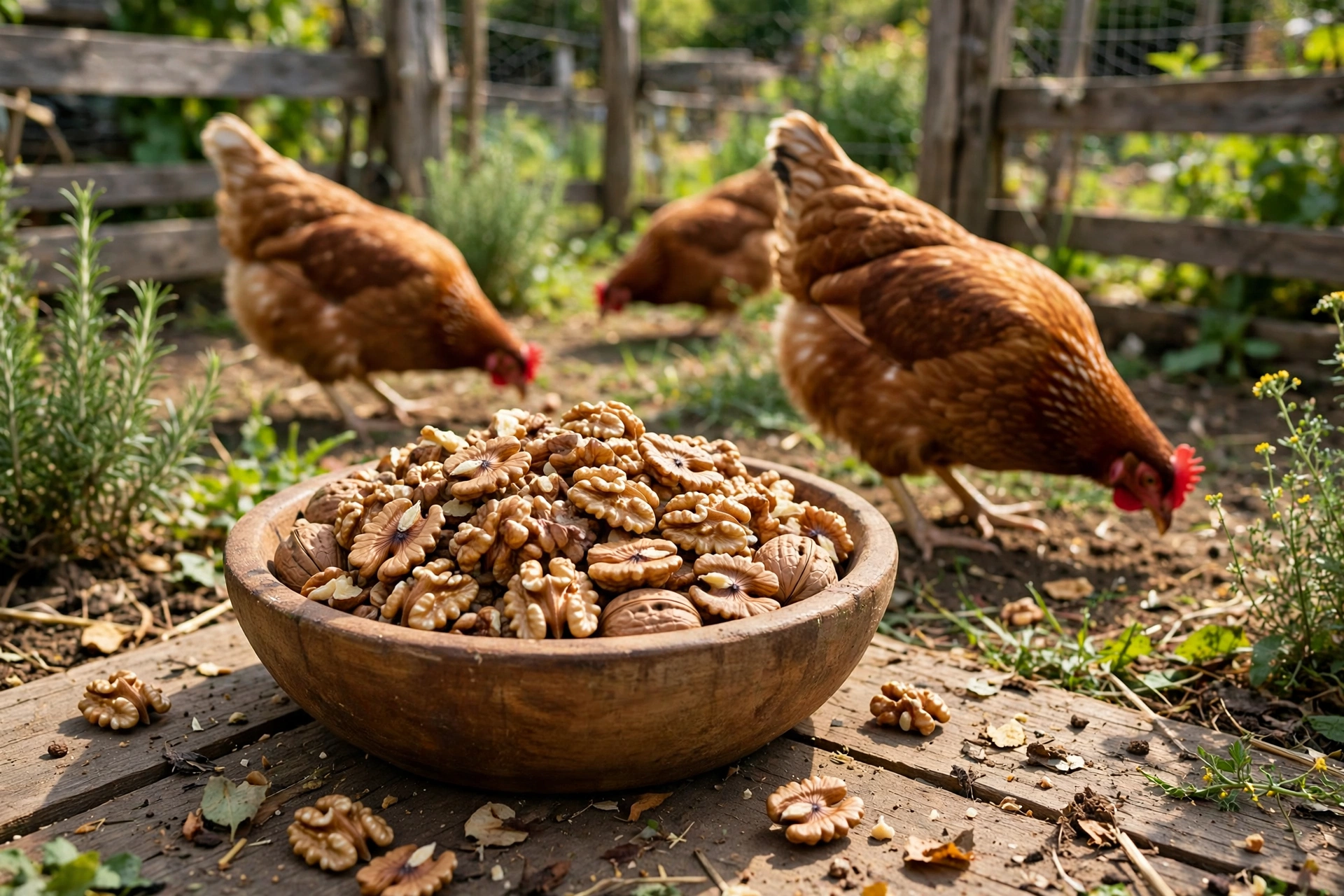
Walnuts are one of those foods that look like a perfect chicken treat at first glance. They are natural, they are full of protein and healthy fats, and most hens will run across the run for a piece of walnut kernel. A keeper who has a bag of walnuts left over from baking, or a walnut tree dropping nuts in the garden, will naturally wonder whether the flock can share them.
The short answer is yes, chickens can eat walnuts, but only in small amounts and only when the nuts are plain, fresh and shelled. Walnuts are a rich treat, not a feed, and the way you serve them matters as much as the nut itself. A few chopped pieces of fresh walnut kernel make a fine occasional treat for healthy adult hens. A whole walnut in its shell, a salty handful from a snack packet, or a mouldy nut from the bottom of the bag are all things your chickens should never get.
This guide covers walnuts for chickens in full. You will learn whether walnuts are safe for chickens, what nutrition they offer, how to serve raw walnuts, how much to give, why salted walnuts are never safe, why walnut shells must stay out of the feeder, and whether baby chicks can eat walnuts at all.

Table of Contents
- Are Walnuts Safe for Chickens
- What Nutrition Do Walnuts Offer Chickens
- Can Chickens Eat Raw Walnuts
- How to Serve Walnuts to Chickens
- How Much Walnut Can Chickens Eat
- Can Chickens Eat Salted Walnuts
- Can Chickens Eat Walnut Shells
- Can Baby Chicks Eat Walnuts
- Walnuts to Avoid and Signs of Trouble
- Frequently Asked Questions
Quick Facts
At a Glance Walnuts are a caution food for chickens. Shelled pieces are a safe treat in small amounts, but the high fat content means they must never become a regular part of the diet.
How to Serve Offer plain, fresh, unsalted walnut kernels only, shelled and chopped or crushed into small pieces. Never serve whole nuts in the shell, and never serve salted, flavoured, candied or mouldy walnuts.
How Much A few small pieces per bird, once a week at most, is plenty. Treats of every kind together should stay under 10 percent of what a hen eats in a day, and walnuts should be only a small share of that.
Are Walnuts Safe for Chickens
Are walnuts safe for chickens. Yes, walnuts are safe for chickens when they are fresh, plain, shelled and served in small amounts. The kernel of an ordinary English walnut is not toxic to chickens, and a few pieces make a protein rich treat that most hens enjoy. The food checker on this site lists walnuts as Caution, with the note shelled pieces, fatty treat, and that verdict sums the whole story up well. The nut itself is fine, but the fat is the reason for care.
Walnuts are one of the fattiest foods a keeper can offer a flock. Roughly two thirds of a walnut kernel is fat by weight, which makes walnuts far more energy dense than fruit, vegetables or leafy greens. A small piece of walnut carries a lot of calories, and a hen that eats too many will put on weight quickly. Overweight hens lay fewer eggs, struggle in hot weather, and are more likely to suffer reproductive problems such as egg binding and internal laying. That is why walnuts belong in the occasional treat group, alongside other rich foods, and never in the daily feed.
The safety of walnuts also depends on which walnut you are offering. Ordinary English walnuts from the supermarket are the safe kind, as long as they are fresh and plain. Black walnuts are a different matter. The husks, leaves and stems of the black walnut tree contain juglone, a natural compound that is irritating and potentially harmful to small animals, and black walnut husks carry far more of it than English walnut husks. A shelled black walnut kernel is not the same as a green husk, but the safest choice for a backyard keeper is to stick to plain English walnuts and to keep any walnuts still in their green husks well away from the flock.
Freshness matters just as much as the type. Walnuts go stale and mouldy faster than many keepers expect, especially when they are stored in a warm or damp place. Mouldy walnuts can carry aflatoxins, which are toxic substances made by certain moulds, and aflatoxins can badly harm chickens, even in small amounts. A walnut that smells musty, looks dark or discoloured, or feels damp should go in the bin, not in the feeder. If you would not eat the nut yourself, do not give it to your hens.
Our feeding pillar on what can chickens eat puts walnuts in their proper place, as one small part of a much wider list of safe and unsafe foods, and it is worth reading before you add any new treat to the flock’s diet. A balanced layer feed should always be the main food, with treats kept to a small share of the day.
What Nutrition Do Walnuts Offer Chickens
Walnuts offer chickens a useful mix of nutrients, and the mix is the reason they make a good occasional treat rather than a daily food. The kernel is rich in plant based protein, which supports feather growth, muscle maintenance and egg production. It also contains healthy fats, including polyunsaturated fats, which give the birds energy and help them stay warm in cold weather. A hen that is moulting or growing new feathers after a hard laying spell can benefit from a little extra protein and fat, and a few pieces of walnut can help supply it.
Walnuts also carry several minerals that matter to chickens. They contain phosphorus, magnesium, copper and manganese, along with vitamin E and some B vitamins. These nutrients support bone strength, shell quality and general health, though no single food can supply everything a hen needs. A hen gets her full nutrition from a complete layer feed, and walnuts simply add a little extra on top of that.
The fat in walnuts is the part that needs respect. Fat is useful in small amounts, because it carries energy and helps the body absorb some vitamins, but too much fat is one of the fastest ways to make a hen overweight. A fat hen eats less of her proper feed, because the rich treat fills her up, and that means she gets less protein and calcium overall, even while she takes in more calories. Over weeks and months, that pattern leads to weight gain, fatty liver and fewer eggs. That is why the serving size for walnuts is so small, and why they should never be given every day.
Compared with other protein rich treats, walnuts sit in the middle of the pack. Black soldier fly larvae are richer in protein and calcium, while chickpeas offer protein with far less fat, as long as they are cooked first. Walnuts are best as a high value weekly treat, not as an everyday protein source.
Can Chickens Eat Raw Walnuts
Can chickens eat raw walnuts. Yes, chickens can eat raw walnuts, and raw is the best way to serve them. A fresh raw walnut kernel, shelled and chopped into small pieces, is perfectly safe for a healthy adult hen. There is no need to cook walnuts before feeding them, and cooking adds nothing that the birds need.
Raw walnuts do need to be fresh, though, and that is the part some keepers miss. A raw walnut that has been sitting open in a warm kitchen for months may look fine but taste stale, and a raw walnut that has picked up damp may already carry mould that you cannot see. Always check each nut before you offer it. Crack it open, look at the kernel, and smell it. A good walnut kernel is pale, firm and clean smelling. A bad one is dark, shrivelled, damp or musty, and it should be thrown away at once.
Lightly dry roasting walnuts is also fine, as long as the nuts are plain and unsalted. Roasting at a gentle heat for a few minutes can make the kernels slightly easier to break up and can help kill surface mould, but it is not necessary, and it does not make the nuts safer if they were already mouldy inside. Roasting never rescues a bad nut. If a walnut was mouldy before it went in the oven, it is still mouldy after, and it still belongs in the bin.
One thing to avoid is any walnut that has been roasted in oil or coated in anything. Oil roasted walnuts carry extra fat that the birds do not need, and coated walnuts usually carry salt, sugar or flavourings that are not safe for chickens. The rule is simple, and it applies to every nut you offer. Plain is safe, and anything added to the nut is a reason to leave it out.
Raw walnuts straight from a garden tree need the same care as shop bought ones. Remove the green husk completely, crack the shell, check the kernel, and only then offer the pieces to the birds. Never let hens peck at fallen walnuts still in their husks, because the green husk is the part that carries the most juglone.
How to Serve Walnuts to Chickens
How you serve walnuts matters more than most keepers expect, because chickens have no teeth and cannot bite through a hard shell. A whole walnut in its shell is too hard for a hen to crack, and most birds will simply ignore it or peck at it without getting anywhere. A bird that does manage to swallow a piece of shell risks crop impaction, which is a blockage in the crop that can turn serious fast. So always shell the walnuts yourself before they reach the flock.
The best way to serve walnuts is in four simple steps. First, crack the walnuts with a nutcracker or a heavy mallet and remove the shells completely. Second, check every kernel for mould, dark spots or a musty smell, and throw away anything that looks or smells wrong. Third, chop or crush the kernels into small pieces, about the size of a pea or smaller, so several birds can share them and no bird has to swallow a large chunk. Fourth, scatter the pieces across the run rather than piling them in one place, so every bird gets a few pieces and the boldest hen does not eat the whole lot.
A rolling pin or a meat mallet works well for crushing walnuts, and a few pieces in a small bag can be crushed quickly with the flat of a knife. You do not need to grind the nuts into powder. Small chunks are the right size, because they are easy to peck up and easy for the gizzard to handle. Very fine crumbs are fine too, but they can blow away in the wind, so chunks are usually the better choice outdoors.
Mixing walnuts with other foods is a good way to make a small amount go further. A few chopped walnut pieces scattered over a handful of scratch grains turn a rich treat into a foraging game that keeps the flock busy, and scattering the mix encourages natural scratching behaviour.

How Much Walnut Can Chickens Eat
Walnuts should be a small treat, and the amount is deliberately tiny. A good rule is one or two walnut kernels per bird, chopped up and shared out, no more than once a week. For a small flock of four hens, that means about half a handful of chopped walnut pieces in total, scattered across the run so every bird gets a fair share. For a larger flock, scale the amount up by the number of birds, but keep the per bird share the same.
Treats of every kind together should stay under 10 percent of what a hen eats in a day, and walnuts should be only a small share of that 10 percent. That is because walnuts are far richer than most treats. A piece of lettuce, a few berries or a slice of cucumber can be given more freely, because they are mostly water and fibre. Walnuts are the opposite, dense in fat and calories, so a little goes a long way. If you have already given the flock a rich treat this week, such as sunflower seeds or mealworms, skip the walnuts until next week rather than piling rich food on rich food.
The risk of overfeeding walnuts builds slowly, so it is easy to miss. A hen that gets a handful of walnuts every day will not look sick the next morning. She will simply eat a little less of her layer feed, put on a little weight, and lay a few fewer eggs over the coming weeks. By the time a keeper notices that she is waddling instead of walking, or that her eggs have become thin shelled, the pattern has been going on for a while. That is why a strict once a week limit works better than a vague promise to keep it occasional.
Young pullets that are still growing need even less, and baby chicks should not have walnuts at all, which the section on chicks below covers in detail. Older hens that are already carrying extra weight should get walnuts rarely, if at all, until they are back to a healthy weight. A keeper can check a hen’s weight by picking her up and feeling her breastbone through the feathers. You should be able to feel the bone under a thin layer of muscle. If you cannot feel it at all, the bird is too fat, and rich treats should stop until she trims down.
Can Chickens Eat Salted Walnuts
Can chickens eat salted walnuts. No, chickens must never eat salted walnuts. Salt is dangerous for chickens in amounts that would seem small to a person, and salted walnuts carry far more salt than a hen can handle. A chicken’s body is not built to process salt the way a human body is, and too much salt can cause kidney damage, excessive thirst, diarrhoea and, in serious cases, salt poisoning. The checker lists salted mixed nuts as Unsafe with the note that the salt level is dangerous, and the same warning applies to salted walnuts on their own.
Salted walnuts usually come from a snack packet, and those packets often carry more than salt. Honey roasted walnuts are coated in sugar and honey, candied walnuts are coated in sugar, chocolate covered walnuts carry chocolate and sugar, and spiced walnuts carry seasonings such as onion powder, garlic powder or chilli, which are not safe for chickens either. None of these belong in the run, even in small amounts. The only walnuts that are safe for chickens are plain walnuts with nothing added.
Read the packet before you share anything with the flock. If the ingredients list mentions salt, sugar, honey, chocolate, flavourings or oil, put the packet back in the cupboard and offer the hens something plain instead.
If a hen does eat a salted walnut by accident, do not panic, but do act. Give the flock fresh clean water at once, and watch the birds for signs of trouble, such as drinking far more water than usual, loose droppings or lethargy. A single salted nut is unlikely to poison a healthy adult hen, but a handful of them can, so remove the rest and keep an eye on the flock for a day. If a bird looks seriously unwell, contact a vet rather than waiting to see if it passes.
Can Chickens Eat Walnut Shells
Can chickens eat walnut shells. No, chickens should not eat walnut shells. Walnut shells are hard, woody and indigestible, and they offer the birds nothing at all. A hen’s gizzard is strong, and it can grind up grain and small seeds with the help of grit, but it is not built to break down a piece of hard walnut shell. A swallowed piece of shell can sit in the crop or the gizzard, cause irritation, and in the worst case cause a blockage that stops food passing through.
Most hens will leave walnut shells alone if they are given a choice, because shells are hard, tasteless and difficult to pick up. The risk comes when shells are mixed in with the kernels, or when whole walnuts are thrown into the run and the birds peck at them out of curiosity. A hen that is hungry, or a hen that is competing with flock mates for food, may swallow a piece of shell that she would normally leave behind. That is why the keeper should always remove every trace of shell before the walnuts reach the birds.
When you crack walnuts for the flock, take a moment to check the chopped pieces for shell fragments. The thin brown skin on the kernel itself is fine, and the birds can eat it without any trouble. The hard outer shell is the part to remove, along with any sharp woody fragments that have broken off during cracking. A quick look through the chopped pieces before scattering them takes only a few seconds, and it removes the main risk entirely.
Walnut shells do have uses in the garden, just not as chicken food. Crushed walnut shells can be composted, though they break down slowly, and they can be used as a mulch or a path covering in parts of the garden where the hens do not forage. Just keep the shell pile away from the run, so the birds cannot get at it, and never use walnut shells as bedding in the coop.
Black walnut shells deserve an extra warning. The shells of black walnuts, along with the green husks, carry high levels of juglone, and juglone is toxic to many plants and irritating to animals. Never let hens peck at black walnut shells or husks, and never use black walnut shells as mulch or bedding anywhere the flock forages. English walnut shells are safer in the garden, but they still belong outside the run, not in it.

Can Baby Chicks Eat Walnuts
Can baby chicks eat walnuts. No, baby chicks should not eat walnuts. A chick’s digestive system is still developing, and walnuts are far too rich, too hard and too fatty for a young bird. Chicks need a complete starter feed that gives them the exact balance of protein, vitamins and minerals they need to grow, and anything that fills them up without supplying that balance works against them.
The practical risks for chicks are real. A chick’s crop and gizzard are small, and a piece of walnut that an adult hen would handle easily can block a chick’s crop or cause choking. The high fat content can upset a chick’s stomach and cause loose droppings, which is a serious problem in a young bird that can dehydrate quickly. A chick that fills up on walnuts will also eat less starter feed, and that means slower growth and weaker bones at the age when growth matters most.
Wait until the birds are at least 8 weeks old before offering any walnuts at all, and even then start with a tiny amount. At 8 weeks, a young bird can handle a few very finely chopped pieces, scattered so the birds have to scratch for them, and only once in a while. Before that age, stick to starter feed, clean water and chick grit, and leave the rich treats for the adults.
Young pullets between 8 and 18 weeks can have a little more, but they still need less than a laying hen. A few small pieces once every week or two is plenty, and the pieces should be chopped finer than the pieces you give to adult birds. Their main job is growing, not eating treats, and a pullet that grows steadily on a balanced grower feed will become a better layer than one filled up on rich snacks.
If you keep chicks and adults together, scatter walnut pieces where only the adults forage and keep the chick area separate during treat time, so the chicks cannot steal rich treats meant for the adults.
Walnuts to Avoid and Signs of Trouble
Not every walnut is safe, even when it is plain and shelled, and a keeper should know the warning signs before offering any nuts to the flock. The first thing to avoid is any walnut that is mouldy, damp, dark or musty smelling. Mouldy walnuts can carry aflatoxins, and aflatoxins are among the most dangerous substances a chicken can eat. A hen that eats mouldy nuts may go off her feed, become lethargic, lay fewer eggs, or show pale combs and wattles. In serious cases, aflatoxin poisoning can damage the liver and can kill a bird, so any nut that looks or smells wrong should be thrown away without a second thought.
The second thing to avoid is walnuts that are old and rancid. Walnuts are high in oil, and that oil goes rancid when nuts are stored for too long or kept in a warm place. Rancid walnuts smell sharp and unpleasant, and they taste bitter. They are not as dangerous as mouldy nuts, but they can still upset a hen’s stomach and cause loose droppings. Store walnuts in a cool dry place, in a sealed container, and use them within a few months of opening the packet. A bag of walnuts that has been open in the kitchen since last winter is not a treat for the flock, it is compost.
The third thing to avoid is walnuts of unknown origin. Walnuts from a sprayed orchard can carry pesticide residue, and nuts kept with mothballs or other pest treatments should never be fed to chickens at all. When in doubt, buy walnuts meant for human food from a shop you trust.
Watch the flock after any new treat, including walnuts. Healthy hens will be active, bright eyed and eating normally within an hour. A hen that is fluffed up, sitting alone or off her feed may have eaten something that disagreed with her. In most cases the trouble passes within a day, but a bird that stays unwell for more than a day, or shows a swollen crop or laboured breathing, needs a vet.
Keep a simple rule for every treat, not just walnuts. If you would not eat it yourself, do not feed it to your hens. The Chicken Care and Health pillar explains the signs that mean a hen needs help, and it is worth reading before a problem appears.

Frequently Asked Questions
Are walnuts safe for chickens?
Yes, walnuts are safe for chickens in small amounts, as long as they are fresh, plain, shelled and unsalted. The food checker lists walnuts as Caution, with the note shelled pieces, fatty treat. That means the kernel itself is safe, but the high fat content calls for small servings, about one or two kernels per bird, no more than once a week.
Can chickens eat raw walnuts?
Yes, chickens can eat raw walnuts, and raw is the best way to serve them. Shell the nuts, check each kernel for mould or a musty smell, and chop the kernels into small pieces before scattering them in the run. There is no need to cook walnuts, and lightly dry roasting plain kernels is also fine. Never serve walnuts that are roasted in oil, salted, sugared or coated in anything.
Can chickens eat salted walnuts?
No, chickens must never eat salted walnuts. Salt is dangerous for chickens, and salted walnuts carry far more salt than a hen can handle safely. The checker lists salted mixed nuts as Unsafe, because the salt level is dangerous. Honey roasted, candied, chocolate covered and spiced walnuts are also unsafe, because they carry sugar, chocolate or seasonings that chickens should not eat.
Can chickens eat walnut shells?
No, chickens should not eat walnut shells. The shells are hard, woody and indigestible, and a swallowed piece can irritate the crop or cause a blockage. Always shell walnuts yourself, check the chopped pieces for shell fragments, and compost the shells well away from the run. The thin brown skin on the kernel is fine for the birds to eat.
Can baby chicks eat walnuts?
No, baby chicks should not eat walnuts. Their digestive systems are still developing, and walnuts are too rich, too hard and too fatty for a young bird. Wait until the birds are at least 8 weeks old, then offer only a few very finely chopped pieces, once in a while. Until then, chicks should eat starter feed, with clean water and chick grit.
Can chickens eat black walnuts?
Black walnuts need more care than ordinary English walnuts. The husks, leaves and stems of the black walnut tree contain juglone, a natural compound that is irritating and potentially harmful, and black walnut husks carry far more of it than English walnut husks. The safest choice is to stick to plain English walnuts and keep black walnut husks and shells away from the flock.
How often can chickens eat walnuts?
Once a week at most is the right frequency for walnuts. One or two chopped kernels per bird, scattered in the run, is a good serving. Treats of every kind together should stay under 10 percent of what a hen eats in a day, and walnuts should be only a small share of that. If the flock has already had another rich treat this week, skip the walnuts until next week.
What should I do if my chickens eat mouldy walnuts?
Remove any remaining nuts at once and give the flock fresh clean water. Watch the birds closely for a day, and look for signs such as going off feed, lethargy, loose droppings or pale combs and wattles. A single small piece of mouldy nut may cause only a brief upset, but a bird that stays unwell for more than a day, or shows a swollen crop or laboured breathing, needs a vet. Mouldy walnuts can carry aflatoxins, which are toxic to chickens.
Keep Reading
What Can Chickens Eat and the full guide to safe and toxic foods for your flock.
Can Chickens Eat Black Soldier Fly Larvae and another protein rich treat your hens will love.
Can Chickens Eat Chickpeas and a lower fat protein treat, cooked only.

Nusrat
Author, TheChickenPet.com