
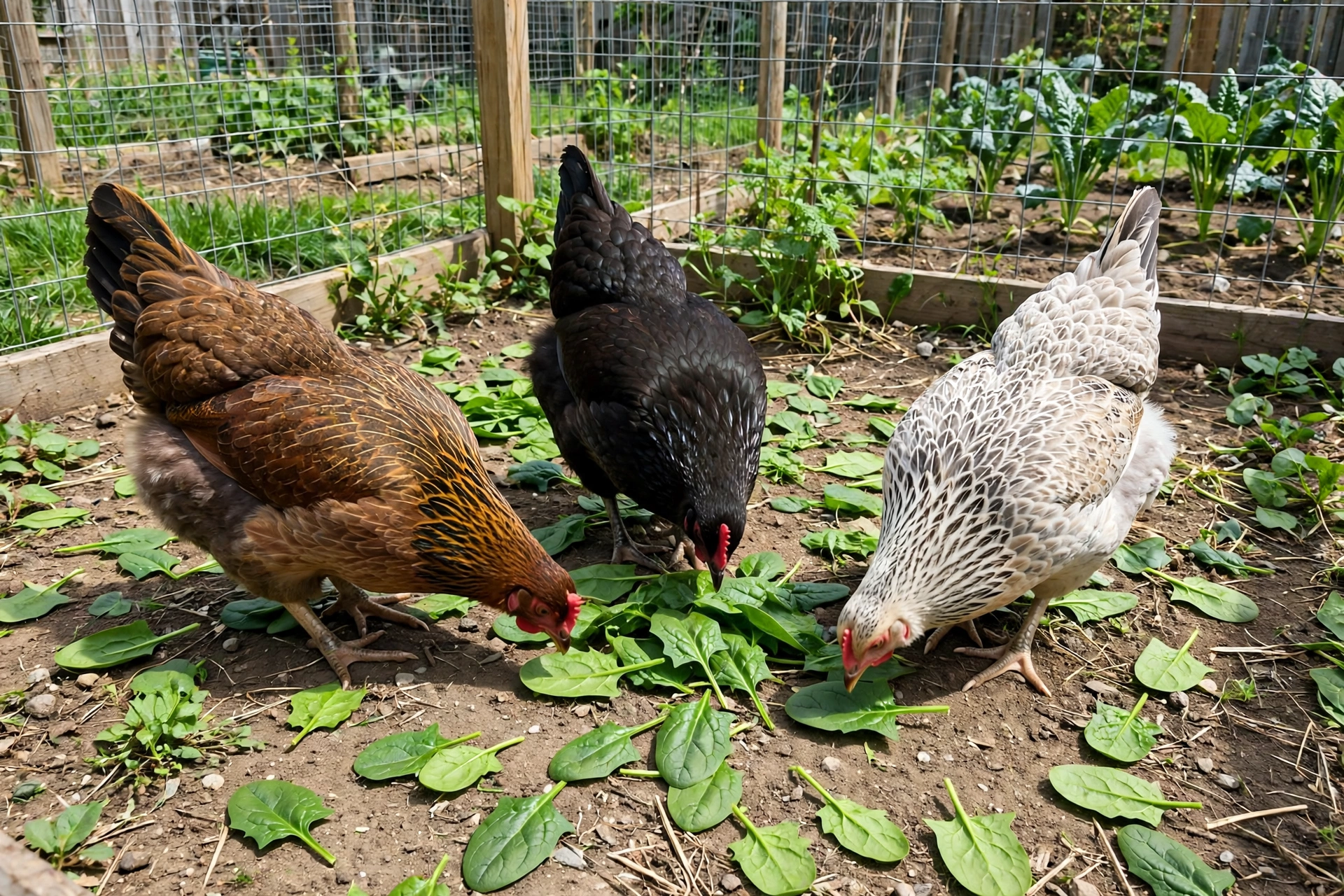
Yes, chickens can eat spinach, but only in small amounts and only now and then. Spinach is a Caution food on the site checker, not a free daily green. It is packed with vitamins and minerals, and hens usually love it, yet its oxalic acid binds calcium, so a laying hen that eats too much of it can end up short of the calcium she needs for strong shells. The safe way to feed it is simple, a small handful chopped, once or twice a week at most, as one green among many. This guide explains why the limit exists, how much to serve, whether raw or cooked is better, how spinach compares with kale, and what to do for baby chicks.
Table of Contents
Quick Facts
Spinach is a Caution food, high in oxalic acid, small amounts only. Serve a small handful chopped, once or twice a week at most. Raw is fine and cooked plain is fine too. Kale is the better daily green because its calcium is actually absorbed. Wait until chicks are at least 4 weeks old and offer only a few tiny pieces. Never serve spinach with salt, butter, dressing or dip.
Is spinach safe for chickens
Spinach is safe for chickens in small amounts, and the checker verdict says exactly that, Caution, high in oxalic acid, small amounts only. It is not toxic, it is not on the unsafe list, and a hen that steals a few leaves from the garden bed will be fine. The caution is about quantity and frequency, not about a poison hiding in the leaf. Spinach brings real nutrition to the flock, vitamin A for eyesight and healthy skin, vitamin K for blood clotting, folate for cell growth, and magnesium and iron in useful amounts. Hens usually take to it fast, and a scatter of chopped leaves gives them something green to peck at on a day when the run is bare.
The reason spinach stays a caution food is the oxalic acid, which is covered in detail below. For a keeper, the practical rule is easy to remember. Spinach is a treat green, not a staple green. It sits in the same group as other foods that are fine in small doses and unhelpful in large ones. A laying hen eats about 120 grams of feed a day, and treats of every kind together should stay under a tenth of that. A small handful of spinach once or twice a week fits inside that budget without crowding out the layer feed that carries the calcium and protein she actually needs. If spinach becomes a daily bucketful, the oxalate load starts to matter, and that is when shells get thin and the feed balance slips.
It is worth saying plainly that spinach will not make up for a poor diet, and it will not fix a calcium problem on its own. Some keepers reach for dark leafy greens when they see a thin shell, thinking the minerals in the leaf will help, but spinach is the wrong green for that job, because much of its calcium is locked up by its own oxalic acid. That is why the guide that covers what chickens can eat as a whole puts spinach in the caution group, and why kale, which you can read about in our guide to kale, is the green to reach for every day. Spinach still earns its place in the rotation, it is cheap, hens enjoy it, and in a small serving it adds variety and vitamins, it simply needs a limit.

Why oxalic acid is the problem
Oxalic acid is a natural compound found in many leafy greens, and spinach is one of the richest sources of it. On its own it is not a poison. The trouble starts in the gut, where oxalic acid binds with calcium to form calcium oxalate, a compound the hen cannot absorb. The calcium in the spinach itself, and some of the calcium from the rest of the meal, passes out in the droppings instead of reaching the bloodstream. For a hen that is not laying, that is a small loss and barely matters. For a laying hen, calcium is the single most demanding nutrient in her day, because every eggshell is almost pure calcium carbonate, and she must find roughly 4 grams of it daily. A food that ties up calcium works directly against that need.
This does not mean a few leaves will harm a hen. The oxalate in one small serving is a small amount, and a healthy hen on a good layer feed has calcium to spare for that day. The problem builds only with large or daily servings, where the oxalate load is repeated meal after meal. Over weeks of heavy spinach feeding, shells can get thinner and more fragile, and the hen may draw more calcium from her own bones to make up the shortfall. That is a slow effect, not a sudden one, which is why it is easy to miss, and why the checker verdict is a caution rather than a ban. Small amounts are fine, daily armfuls are not.
Spinach is not the only green with this trait. Beet leaves carry a good deal of oxalic acid too, and our guide to beets covers the same limit for the tops of the plant. Rhubarb leaves are a different story altogether, they are unsafe and should never be fed, so do not lump spinach in with them. Spinach sits in the middle, nutritious and safe in a small serving, unhelpful in a large one. The same logic applies to the iron in spinach. Spinach is often praised as an iron rich food, but its oxalate also limits how much of that iron a hen absorbs, so do not count spinach as an iron supplement. Its real value is as a vitamin rich green treat in a varied diet, nothing more and nothing less.
One more point matters for keepers who grow their own food. Oxalic acid levels vary a little with the variety and the season, and older, tougher leaves tend to carry more of it than young tender ones. That is another reason to pick young leaves for the flock and to keep the serving small. It is also a reason not to worry about precision, no keeper needs to weigh oxalate, the handful rule below is enough. If you feed spinach once or twice a week in a small serving, the oxalate stays a footnote in the diet, not a problem.
How much spinach and how often
The serving answer is a small handful chopped, once or twice a week at most. A small handful means a loose handful for every four or five hens, roughly a cup of chopped leaves for a small flock, not a bucket and not a carrier bag full. Chop the leaves so the pieces are easy to peck and swallow, scatter them in the run or in a shallow dish, and let the hens finish them in a few minutes. If leaves are still lying around at the end of the day, you served too much, pick them up so they do not wilt and rot in the run.
Frequency matters as much as amount. Once or twice a week keeps spinach as a rotating treat, and it leaves room in the week for other greens that do the daily work better. A good rotation is kale most days, lettuce as a light extra, and spinach as the once a week change of pace. Our guide to lettuce explains why lettuce is safe but low in nutrition, so it is a fun treat rather than a staple, and spinach fits the same pattern, only with a firmer limit because of the oxalate. Variety is the point, and a flock that gets a different green every day or two eats a wider range of nutrients than a flock that gets the same leaf every morning.
Watch the flock for the signs that the serving is too big. Droppings that stay loose for a day after a spinach feed, or shells that turn thin and rough when spinach has been served several days running, are both signs to cut back to once a week or to skip it for a fortnight. These signs are not proof of spinach alone, thin shells have many causes, and a hen that is moulting or coming back into lay will lay odd eggs for a while, but if the timing lines up with heavy spinach feeding, the feed is the first thing to check. The layer feed is the foundation of the diet, and every treat, spinach included, should stay under a tenth of what the hens eat in a day. If the treat budget is already full of kitchen scraps and scratch grain, skip the spinach that day and save it for a day when the hens have eaten mostly feed.

Raw spinach or cooked spinach
Raw spinach is the usual way to feed it, and it is the simplest. Wash the leaves well to remove soil and any spray residue, chop them roughly, and scatter them for the hens. Raw leaves keep all their vitamin C and their fresh texture, and hens enjoy tearing at them. The only care needed is the chopping, because whole wet leaves can mat together into a slippery clump that smaller hens struggle to pull apart. A quick rough chop solves that, and it also makes the serving size easier to judge.
Cooked spinach is fine too, as long as it is cooked plain. Steamed or blanched leaves with no salt, no butter, no oil and no seasoning are perfectly good for hens. Cooking has one small advantage, blanching lowers the soluble oxalate a little, so a cooked serving carries a slightly smaller oxalate load than the same weight raw. It also has one small drawback, some vitamin C is lost in the cooking water, so the leaves are a little less nutritious. Neither difference is large enough to matter, and the choice comes down to what you have on hand. If you have raw leaves, feed them raw. If you have leftover plain steamed spinach from the kitchen, let it cool and offer that.
Frozen spinach is fine in the same way, as long as it is plain. Thaw it, squeeze out the extra water, and offer a small amount. What does not work is spinach that has been dressed or seasoned. Creamed spinach, spinach dip, spinach cooked in salted water with butter, and salad leaves coated in dressing are all out, and the details are in the section on spinach to skip below. The rule is plain leaves, raw or plain cooked, and nothing else added. If you would not eat it plain yourself without reaching for the salt, it is not the right form for the hens either.
Spinach or kale, which green is better
Kale is the better daily green, and it is not close. The checker lists kale as Safe with the note to chop or hang whole leaves, and our guide to kale explains why it earns that verdict. Kale is rich in calcium and, unlike spinach, its calcium is actually absorbed, because kale is low in oxalic acid. A hen that eats kale gets the calcium from the leaf as well as the vitamins. Kale is also tougher and slower to eat, so a hung bunch keeps hens busy for a while, which is useful on a wet day when the run is muddy and there is little else to peck at.
Spinach still has a place, just not the daily one. It is softer, hens eat it faster, and it brings vitamin A and folate in good amounts. Think of it as the change of pace green, the one that keeps the weekly rotation interesting, while kale does the steady work. The table below sums up the three leafy greens most keepers reach for, so the choice is easy at a glance.
| Green | Checker verdict | How often |
|---|---|---|
| Kale | Safe, chop or hang whole leaves | Daily green, the best of the three |
| Spinach | Caution, high in oxalic acid, small amounts only | Once or twice a week at most |
| Lettuce | Safe, any leafy type, low nutrition but loved | Often, as a light treat, not a staple |
A keeper who only grows one green should grow kale. A keeper who grows both has the best of it, kale for the daily calcium and spinach for the weekly variety. The same thinking applies to beet leaves, which are also high in oxalate and belong in the once in a while group, as our guide to beets explains. The pattern is consistent across the leafy greens, and once you know it, the whole feeding list gets easier to read. Low oxalate greens can be daily, high oxalate greens are weekly treats, and that single rule covers most of the decisions a keeper has to make.
Can baby chicks eat spinach
Baby chicks can eat spinach, but only in tiny amounts and only once they are old enough to handle greens. Wait until chicks are at least 4 weeks old, and only offer spinach once they are eating their starter feed well and have access to chick grit. Before that age, the starter feed is the whole diet, and it is carefully balanced for fast growth, so treats of any kind only dilute it. A chick that fills up on leaves instead of starter feed grows more slowly, and that is a real cost in the first weeks of life.
When the time comes, the serving is much smaller than for adult hens, a few tiny pieces of finely chopped leaf for the whole brooder, once a week at most. Chop the spinach very fine, because chicks peck at small pieces and can struggle with long wet leaves, and scatter the pieces on a clean surface so they can find them without scratching through bedding. Make sure chick grit is available in a separate small dish, because chicks need grit to grind any food that is not starter crumb, and greens count. If the chicks ignore the spinach, take it away and try again in a week or two, there is no hurry, and spinach is never essential for chicks.
The same caution about oxalate applies even more to chicks, because their bodies are small and their bones are growing fast. Calcium matters enormously in the first weeks, and a food that ties up calcium is the last thing a growing chick needs in quantity. That is why the handful rule for adults becomes a pinch rule for chicks, and why kale is the better first green when the time comes for treats. A few shreds of kale or a dandelion leaf are a kinder introduction than spinach, and spinach can join the rotation later, once the chicks are older and eating a wider diet. If in doubt, skip the spinach for the chicks and save it for the laying hens, who can handle it in their weekly serving.
Spinach to skip
Most spinach is fine, but a few forms should never reach the flock. Creamed spinach is out, because it is full of butter, cream and salt, and none of those belong in a hen’s diet. Spinach dip is out for the same reason, and it often contains garlic and onion in amounts that are unhelpful too. Spinach cooked in salted water with butter is out, and so is any spinach that has been dressed with oil, vinegar or salad dressing. The salt is the main problem, hens need very little of it and too much strains their kidneys, while the fat adds calories with no nutrition. If the spinach came from a dish you seasoned for the table, it stays at the table.
Mouldy or slimy leaves are out as well. Spinach wilts fast in the fridge, and a bag that has gone slimy is a bag that has started to grow mould. Mouldy food can carry toxins that survive cooking, so it goes in the compost, not in the run. The same goes for leaves picked from a bed that was recently sprayed, unless the spray is one you know is safe and the waiting time has passed. Wash everything, and when in doubt, throw it out.
A short note on names will save confusion. Malabar spinach and water spinach are different plants from common garden spinach, and the checker lists them as Safe in their own entries, but they are not the same food as the spinach in this article, so do not take their verdict as a verdict on common spinach. Tree spinach and longevity spinach are also different plants, and the checker lists them as Caution with little data behind them, so treat them with the same small amounts rule and do not assume they behave like common spinach. This article covers common garden spinach only, the leaf you buy in a bag or grow in a bed, and its verdict is Caution, high in oxalic acid, small amounts only.
How to serve spinach
Serving spinach well takes about two minutes. Pick young tender leaves, or buy a fresh bag, and check that the leaves are green and firm, not slimy or yellow. Wash them well under running water to remove soil, then shake off the extra water. Chop the leaves roughly, not finely, for adult hens, a rough chop is enough, and scatter the pieces in the run or in a shallow dish where all the hens can reach them. Watch for a minute, the boldest hens will come first and the shy ones will follow once they see the others eating.

Remove anything the hens have not eaten by the end of the day. Wet leaves left overnight go slimy fast, and they attract flies and slugs, so a quick tidy up keeps the run clean. If you want to make spinach a regular part of the week, growing your own is the easiest way to do it. Spinach grows fast in cool weather, it suits a small bed or a large pot, and a few plants give a steady supply of young leaves. Cut the outer leaves and let the plant keep growing, and you will have a handful a week for the flock through the cool months. In hot weather spinach bolts and turns bitter, so that is the season to lean on kale instead, which handles heat better.

Mix spinach with other treats rather than serving it on its own every time. A scatter of chopped spinach with a few mealworms or some scratch grain gives the hens a reason to scratch and search, and it spreads the treat out so no single hen eats the whole serving. The goal is a small green treat inside a varied week, not a spinach meal, and the hens will be healthier and happier for it.
Frequently asked questions
Is spinach safe for chickens?
Yes, in small amounts. Spinach is a Caution food, high in oxalic acid, small amounts only. A small handful chopped, once or twice a week, is safe for laying hens. Daily or large servings are not a good idea, because the oxalic acid binds calcium and can lead to thin shells over time.
Can chickens eat raw spinach?
Yes. Raw spinach is the usual way to feed it. Wash the leaves well, chop them roughly so they do not mat into a clump, and scatter them in the run. Raw leaves keep all their vitamin C and their fresh texture, and hens enjoy tearing at them.
Can chickens eat cooked spinach?
Yes, as long as it is cooked plain. Steamed or blanched leaves with no salt, no butter, no oil and no seasoning are fine. Blanching lowers the soluble oxalate a little, which is a small bonus, though some vitamin C is lost. Never serve creamed spinach, spinach dip, or spinach cooked with salt and butter.
Can baby chicks eat spinach?
Yes, but only in tiny amounts and only from about 4 weeks old. Offer a few tiny pieces of finely chopped leaf once a week at most, and only once the chicks are eating their starter feed well and have access to chick grit. Before 4 weeks, starter feed is the whole diet.
Is spinach better than kale for chickens?
No, kale is the better daily green. Kale is Safe on the checker, and its calcium is actually absorbed because kale is low in oxalic acid. Spinach is still worth feeding once or twice a week for variety and vitamins, but kale should do the daily work. Lettuce is safe too, but it is low in nutrition, so it is a light treat rather than a staple.
How often can chickens eat spinach?
Once or twice a week at most, a small handful chopped for every four or five hens. That keeps the oxalate load small and leaves room in the week for kale and other greens. If shells turn thin or droppings stay loose after spinach feeds, cut back to once a week or skip it for a fortnight.

Nusrat
Author, TheChickenPet.com
Keep Reading
For the daily green that does the heavy work, read our guide to kale. For a lighter leafy treat, see our guide to lettuce. And for the other high oxalate green, read our guide to beets.