
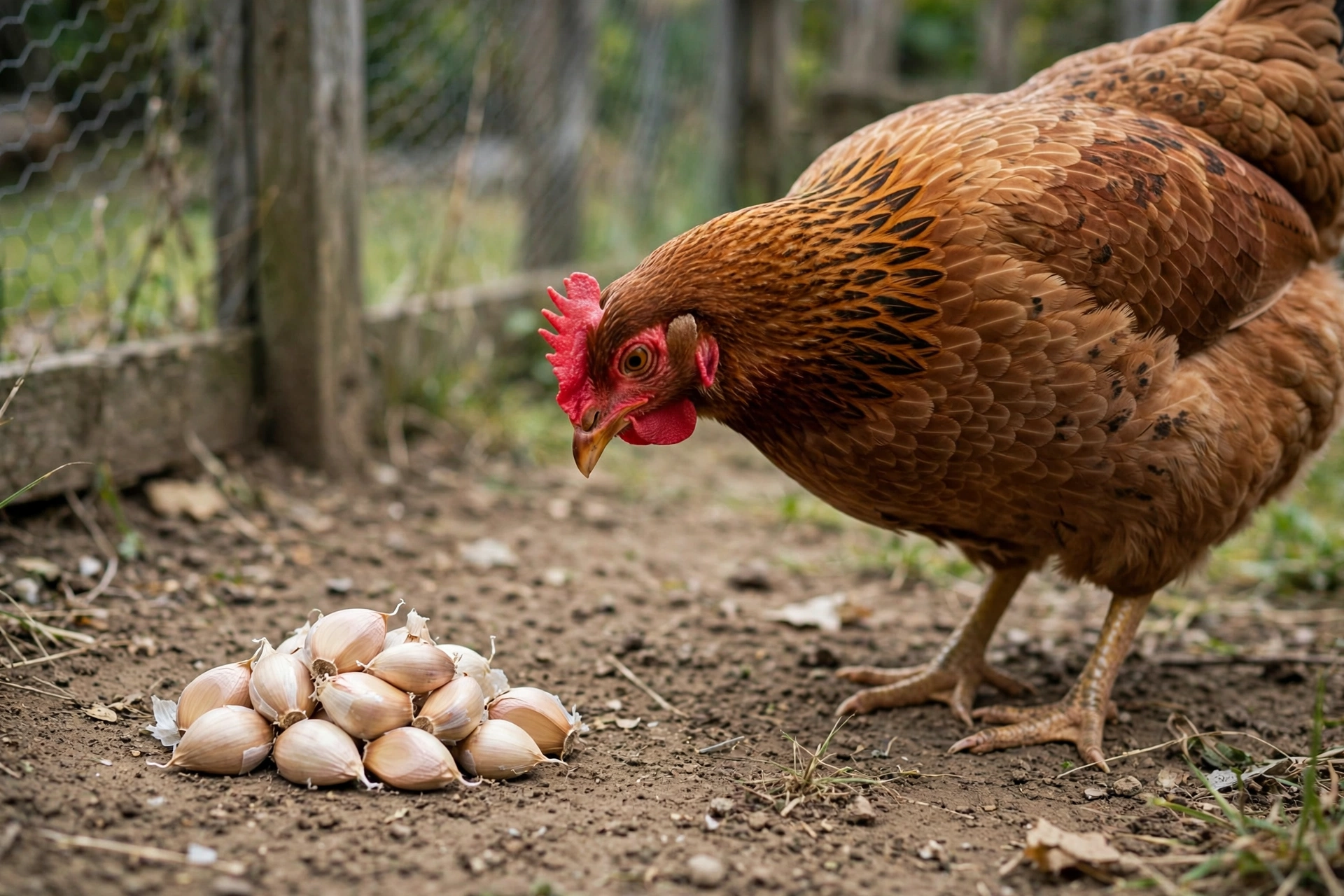
Can chickens eat garlic? Yes, in tiny amounts only. Garlic is a Caution food on our checker, not a free treat and not a medicine. A little grated garlic mixed into feed once in a while is fine for most adult hens, but a whole clove per bird, garlic every day, or garlic used as a cure for worms or illness is too much. The honest answer is that garlic is optional. Your flock does not need it, and skipping it costs them nothing. If you do feed it, keep the amount small, keep it plain, and keep it rare.
Our food checker lists garlic as Caution with the note “Tiny amounts only, large doses harm blood cells”. That is the whole story in one line. Garlic belongs to the allium family with onions, and the same compounds that give it its strong smell can damage red blood cells when a bird eats a lot of it. A tiny amount is far below that level, which is why the verdict is Caution and not Unsafe. The line between the two is the amount, so this article is mostly about how little “tiny” really means.
Table of Contents
What the Feeding Trials Actually Show
Garlic Is Not an Antibiotic or a Respiratory Cure
How to Feed Garlic in Tiny Amounts
Raw Garlic, Garlic Powder and Garlic Water
Quick Facts
Verdict: Caution, tiny amounts only, never as medicine
Serving: One small clove, finely grated, mixed through the feed of a small flock, once or twice a week at most
Garlic powder: Caution too, tiny pinches only, because it is concentrated
Chicks: Skip garlic for chicks under 8 weeks old
Never feed: Garlic salt, seasoned garlic, garlic bread, or garlic as a treatment for worms or illness
Watch for: Garlic flavoured eggs, which mean you are feeding too much
The Short Answer
Yes, chickens can eat garlic in tiny amounts. Our checker rates it Caution, which means it is allowed as an occasional extra and not as a regular food. One small clove, finely grated and mixed through the feed of a whole small flock, once or twice a week at most, is the kind of amount this article means by tiny. A clove per bird, a spoonful of powder, or garlic every day is not tiny, and that is where the problems start.
Garlic is not something your hens need. A good complete feed already gives them everything they need, and garlic adds nothing they are missing. If you never feed garlic, your flock loses nothing at all. That matters because much of the advice about garlic online treats it as a must have health food, and it is not. It is a kitchen extra that is safe in a small amount and pointless in a large one, so the safest way to think of it is as a rare treat you can take or leave.
The rest of this article covers the three questions keepers actually ask. How much is safe, what garlic does not do, and which forms of garlic to keep out of the coop. If you only remember one thing, remember the checker line. Tiny amounts only, because large doses harm blood cells.
Is Garlic Safe for Chickens
Is garlic safe for chickens? In a tiny amount, yes. In a large amount, no. The answer depends entirely on the dose, and that is why garlic sits in the Caution group rather than the Safe group. Safe foods can be fed freely as treats. Caution foods need a limit, and garlic needs a strict one.
Garlic contains sulphur compounds called thiosulphates, the same family of compounds found in onions. In small amounts a chicken’s body handles them without trouble. In large amounts those compounds damage red blood cells, which carry oxygen around the body. A bird that has eaten far too much garlic can become weak, pale in the comb, and short of breath, because its blood is carrying less oxygen than it should. This is not a rare allergy or a freak reaction. It is the known effect of alliums in large doses, and it is the reason the checker note warns about blood cells.
The good news is that the harmful dose is far above a tiny taste. A single small clove shared across a flock is nowhere near it. The risk comes from keepers who read that garlic is healthy and then feed it generously, every day, or in concentrated forms like powder and oil. Powder is the easiest way to overshoot, because a pinch of powder holds far more garlic than a pinch of fresh clove, and the checker rates garlic powder separately for exactly that reason.
So the safety rule is simple. Fresh garlic, plain, in a tiny amount, rarely, is safe. Large amounts, daily feeding, concentrated forms, or garlic used as a treatment are not. If you are ever unsure whether the amount in front of you is tiny enough, it is probably too much, and the right move is to feed less or skip it that week.
Our guide to what chickens can eat puts garlic in context with the rest of the treat list, and it is worth a read before you add any new food. Treats of every kind should stay a small part of the diet, and garlic is one of the treats where the small part needs to be genuinely small.

What the Feeding Trials Actually Show
A lot of garlic claims come from feeding trials, so it is worth saying plainly what those trials did and did not prove. The trials that studied garlic in poultry mixed measured amounts of garlic powder into complete feed and fed it to birds for several weeks. They were looking at growth, feed use, and egg laying in farm flocks, not at backyard hens eating kitchen scraps.
Those trials do not give you a number of cloves per hen per day. They used garlic powder weighed into tonnes of feed, under farm conditions, and the results do not translate into a teaspoon dose for a backyard flock. Any article that tells you an exact clove count per bird is guessing, because no trial measured that. What the trials do support is a cautious middle ground. Small measured amounts of garlic powder in feed did not harm the birds in those studies, while the chemistry of alliums says large amounts do harm blood cells. That is consistent with the checker verdict, tiny amounts only, and it is the limit this article works from.
Two other things the trials do not prove are worth naming, because they are the source of most garlic myths. First, the trials were not testing garlic as a medicine, so they say nothing about curing worms, infections, or breathing problems. Second, the birds in the trials ate garlic as part of a complete balanced feed, not instead of it. Garlic never replaced good feed, and it should never replace good feed in your coop either.
The practical takeaway is modest. If you feed garlic, treat it as a tiny flavour extra in an otherwise complete diet, not as a health programme. A small grated clove mixed through feed once or twice a week at most is in line with what the evidence supports. Anything more is moving beyond the evidence and toward the dose where blood cell damage becomes a real risk.
Garlic Is Not a Dewormer
Is garlic a natural dewormer for chickens? No. This is the most repeated garlic claim in backyard keeping, and it is not true. Garlic does not kill worms, does not clear a worm burden, and does not stop hens picking worms up from the ground. A flock with worms needs a real wormer, and garlic will only delay that treatment while the worms keep doing damage.
The claim probably survives because garlic smells strong and tastes strong, so it feels like it ought to drive parasites away. Feeling strong is not the same as working, and no good evidence shows garlic removing worms from chickens. The feeding trials that studied garlic were not worming trials, and the keepers who swear by it are usually describing flocks that had no serious worm problem to begin with.
That matters because worms are common and they are not harmless. A heavy worm burden leaves hens thin, pale, and laying badly, and young birds suffer worst. If you suspect worms, look at the droppings, check the birds, and use a proper wormer made for poultry, following its instructions and its egg withdrawal period. Our guide to chicken mites covers the other parasite problem keepers often confuse with worms, and it explains how to spot and treat external parasites properly instead of hoping a kitchen ingredient will do the job.
Garlic can sit beside proper parasite care as a tiny occasional extra, but it can never replace it. If anyone tells you garlic alone keeps a flock worm free, they are selling a story, not a treatment.
Garlic Is Not an Antibiotic or a Respiratory Cure
Garlic is also claimed as a natural antibiotic and as a cure for coughs, sneezes, and rattly breathing. It is none of those things. Garlic does not kill the bacteria that cause sick chickens, and it does not clear a respiratory infection. A hen that is sneezing, wheezing, or sitting puffed up with her eyes closed is sick, and she needs warmth, clean air, and proper care, not garlic in her water.
The confusion comes from laboratory studies where garlic extracts killed bacteria in a dish. A dish is not a chicken. The amount of garlic needed to reach that effect inside a bird would be far above a safe dose, and it would harm blood cells long before it helped an infection. That is the same dose problem that runs through this whole article, and it is why “natural antibiotic” is a dangerous label. It invites keepers to feed more and more garlic to a sick bird, which is the worst time to risk blood cell damage.
If a hen shows breathing trouble, separate her from the flock, keep her warm and dry, make sure her water is fresh, and watch whether she improves. If she does not improve quickly, or if more birds start showing signs, speak to a vet who sees poultry. Garlic water will not fix a respiratory disease, and waiting while you try it can turn a treatable problem into a flock wide one.
Garlic has a place as a tiny food extra. It has no place as medicine, and keeping those two roles apart is the most useful thing this article can tell you.
How to Feed Garlic in Tiny Amounts
If you decide to feed garlic, the method matters as much as the amount. The safest way is to take one small clove, peel it, grate it finely, and mix it through the feed of your whole small flock. Mixing it through feed spreads it out so no single hen gets a whole clove, and grating it means it blends in instead of sitting as a tempting lump. Once or twice a week at most is plenty. There is no benefit in feeding it daily.
Do not hand a hen a whole clove. Do not drop cloves into the run for the birds to fight over. One bold hen can easily eat several cloves that way, and that is exactly how a tiny amount becomes a large one. The same goes for scattering garlic across the ground. The confident birds get most of it and the shy ones get none, which defeats the purpose and creates the risk at the same time.
Fresh garlic is the only form this article recommends, and only in the small amount described above. If you are cooking with garlic for your own meals, a little of the plain grated clove can go to the hens, but keep their share small. Do not save them the garlic from a big family meal, because the amount will be far too much for a small flock.
The herb rule from our herbs guide applies here too. Fresh kitchen herbs and spices in small amounts are one thing, and concentrated forms like oils and extracts are another. Never use garlic oil, garlic extract, or any concentrated garlic product for your hens. Those are far stronger than fresh garlic, and the line between a tiny amount and a harmful one is much harder to judge with them. Fresh and plain is the rule, and if you cannot keep it fresh and plain, skip it.

Raw Garlic, Garlic Powder and Garlic Water
Can chickens eat raw garlic? Yes, raw is the form this article means when it says garlic. A small amount of raw garlic, peeled and finely grated, is the safest way to feed it, because you can see exactly how much you are giving. Cooked garlic is also fine in the same tiny amount, since cooking softens the flavour but does not remove the compounds that matter. The form matters less than the amount, and raw or cooked, the amount stays tiny.
Can chickens eat garlic powder? Yes, but with more care than fresh garlic, because powder is concentrated. Our checker lists garlic powder as a separate Caution entry, “Tiny pinches only, concentrated allium”. A pinch of powder holds the garlic of several cloves, so it is very easy to overshoot. If you use powder, use a tiny pinch mixed well through feed, and do it rarely. Never use a spoonful, and never sprinkle it where one hen can eat most of it. Fresh garlic is easier to judge and easier to share fairly across a flock, so it is the better choice for most keepers.
Garlic water is a habit many keepers have, and it needs the same honest treatment. A single crushed clove steeped in a drinker of water is a very weak dose, and it is unlikely to harm a healthy flock if the water is changed daily. But it is also unlikely to do anything useful, and it is not a treatment for anything. If you offer garlic water, keep it very weak, make it fresh every day, and always keep plain fresh water available beside it. Never put garlic in the only water source for a sick bird, and never use garlic water as a reason to delay proper care. A hen that needs help needs help, not flavoured water.
Whichever form you choose, the rule does not change. Tiny, plain, rare, and never as medicine.

Garlic Salt, Seasoned Garlic and Garlic Bread
Some forms of garlic should never reach your hens. Garlic salt is the first. It is mostly salt, and salt is a real risk for chickens in even small amounts. A bird that eats garlic salt gets a large salt dose along with the garlic, and that combination is far worse than plain garlic on its own. Keep garlic salt, onion salt, and all seasoned salts out of the coop entirely.
Seasoned garlic is out for the same reason. Garlic butter, garlic mayonnaise, garlic dips, and garlic sauces are all high in salt and fat, and they are made for human taste, not for hens. The garlic in them is the least of the problem. The salt and fat are the reason to skip them, and a hen that fills up on dip has no room left for the feed she actually needs.
Garlic bread is a double problem. It combines the low nutrition of bread with the salt and fat of garlic butter, and it is exactly the kind of food that feels like a treat but gives a hen nothing useful. Bread on its own is already a treat only food, and garlic bread adds salt and fat to it. If you have leftover garlic bread, it belongs in your bin, not in the run.
The same thinking applies to shop bought foods that contain garlic. Hummus is a good example. Our checker lists hummus as Caution because it contains garlic and lemon, and our chickpeas guide explains the hummus trap in full. A tiny taste of plain hummus is not a disaster, but it is not a good treat either, and it is no way to feed garlic. Keep garlic plain, keep it fresh, and keep seasoned and salted forms away from the flock.
Garlic and Laying Hens
Garlic and laying hens deserve their own section, because the effect on eggs is real and it is the clearest sign you are feeding too much. Laying hens fed too much garlic lay garlic flavoured eggs. The flavour passes into the egg, and the eggs taste of garlic when you cook them. If your eggs start tasting of garlic, the amount you are feeding is too high, and you should stop feeding garlic until the flavour clears, then feed far less or not at all.
This is not a health emergency on its own, but it is a useful warning. Eggs pick up strong flavours from the diet, and garlic is one of the strongest. A tiny amount once in a while will not flavour the eggs. A regular or generous amount will, and that tells you the dose has crept above tiny without you noticing. Treat garlic flavoured eggs as a signal to cut back, not as a curiosity to ignore.
There is no good reason to feed garlic to laying hens in the first place. It does not make hens lay more eggs, it does not make the shells stronger, and it does not improve the yolks. The calcium and protein in a good layer feed do that work, and garlic adds nothing to it. If you keep hens for eggs, the simplest choice is to skip garlic most of the time, and if you do feed it, keep it to the tiny rare amount described in this article so the eggs stay clean tasting.

Can Baby Chicks Eat Garlic
Can baby chicks eat garlic? Not when they are very young. Skip garlic entirely for chicks under 8 weeks old. Young chicks have small bodies, growing blood, and a diet that should be nothing but proper chick starter feed. They have no room for extras, and no tolerance for the compounds that make garlic a Caution food for adults.
After 8 weeks, a tiny amount is acceptable in the same way it is for adults, grated finely and mixed through feed so no chick gets a whole piece. Keep it even rarer for young birds than for adults, and watch them after the first time. If the chicks ignore it, leave it there. There is no need to push a food they do not need, and a chick that fills up on garlic is a chick that is not eating starter feed.
The general chick treat rule applies here too. Treats should wait until chicks are a few weeks old, and they should stay a small part of the diet. Garlic is one of the treats where the small part needs to be genuinely small, and for chicks under 8 weeks the right amount is none at all.
Signs You Have Fed Too Much
Most keepers will never see a garlic problem, because a tiny amount is safe. But it helps to know the signs, so you can act fast if a mistake happens. The signs of too much garlic are weakness, a pale comb and wattles, and laboured breathing. These all point to the same cause, red blood cells damaged by too much allium, carrying less oxygen than the bird needs. A hen that has eaten far too much garlic may also go off her feed, sit quietly apart from the flock, and lay fewer eggs, or stop laying for a while.
If you think a bird has eaten too much garlic, remove all garlic at once, including garlic water, and give the flock plain fresh water and their normal feed. Do not offer any more treats until the birds are back to normal. Most birds recover once the garlic is gone, as long as the amount was not huge and the exposure was short. If a bird is very weak, struggling to breathe, or not improving within a day, speak to a vet who sees poultry and tell them what the bird ate.
The best fix is prevention, and it is easy. Keep garlic in a sealed container away from the run, so a knocked over jar cannot become a feast. Never leave a bag of cloves where hens can reach it, and never assume a bird will stop eating something just because it is strong tasting. Hens are curious and greedy in equal measure, and a pile of garlic cloves on the ground is an accident waiting to happen.
FAQs
Is garlic safe for chickens?
Yes, in tiny amounts. Our checker rates garlic as Caution, “Tiny amounts only, large doses harm blood cells”. One small clove, finely grated and shared across a small flock once or twice a week at most, is safe for most adult hens. Large amounts, daily feeding, and concentrated forms are not safe, because the thiosulphate compounds in garlic damage red blood cells in large doses.
Can chickens eat garlic powder?
Yes, but with more care than fresh garlic. Garlic powder is a separate Caution entry on our checker, “Tiny pinches only, concentrated allium”. A pinch of powder holds far more garlic than a pinch of fresh clove, so it is easy to feed too much. Use a tiny pinch mixed well through feed, rarely, and never a spoonful. Fresh garlic is easier to judge, so it is the better choice for most keepers.
Can chickens eat raw garlic?
Yes, raw garlic is the form this article recommends. Peel one small clove, grate it finely, and mix it through the feed of the whole flock so no single hen gets a whole clove. Cooked garlic is also fine in the same tiny amount. The form matters less than the amount, and raw or cooked, the amount stays tiny.
Is garlic a natural dewormer for chickens?
No. Garlic does not kill worms, does not clear a worm burden, and does not stop hens picking worms up from the ground. A flock with worms needs a proper poultry wormer, used as directed, including any egg withdrawal period. Garlic can sit beside proper parasite care as a tiny occasional extra, but it can never replace it. Our mites guide explains how to handle the external parasites that garlic is also wrongly claimed to fix.
Can baby chicks eat garlic?
Not under 8 weeks old. Young chicks should eat nothing but proper chick starter feed, and they have no tolerance for the compounds that make garlic a Caution food. After 8 weeks a tiny amount, grated finely and mixed through feed, is acceptable, kept rarer than for adults.
Why do my eggs taste of garlic?
Because you are feeding too much garlic. Laying hens fed too much garlic lay garlic flavoured eggs, and the flavour is a clear sign the dose has crept above tiny. Stop feeding garlic until the flavour clears, then feed far less or not at all. A tiny amount once in a while will not flavour the eggs.

Nusrat
Author, TheChickenPet.com