
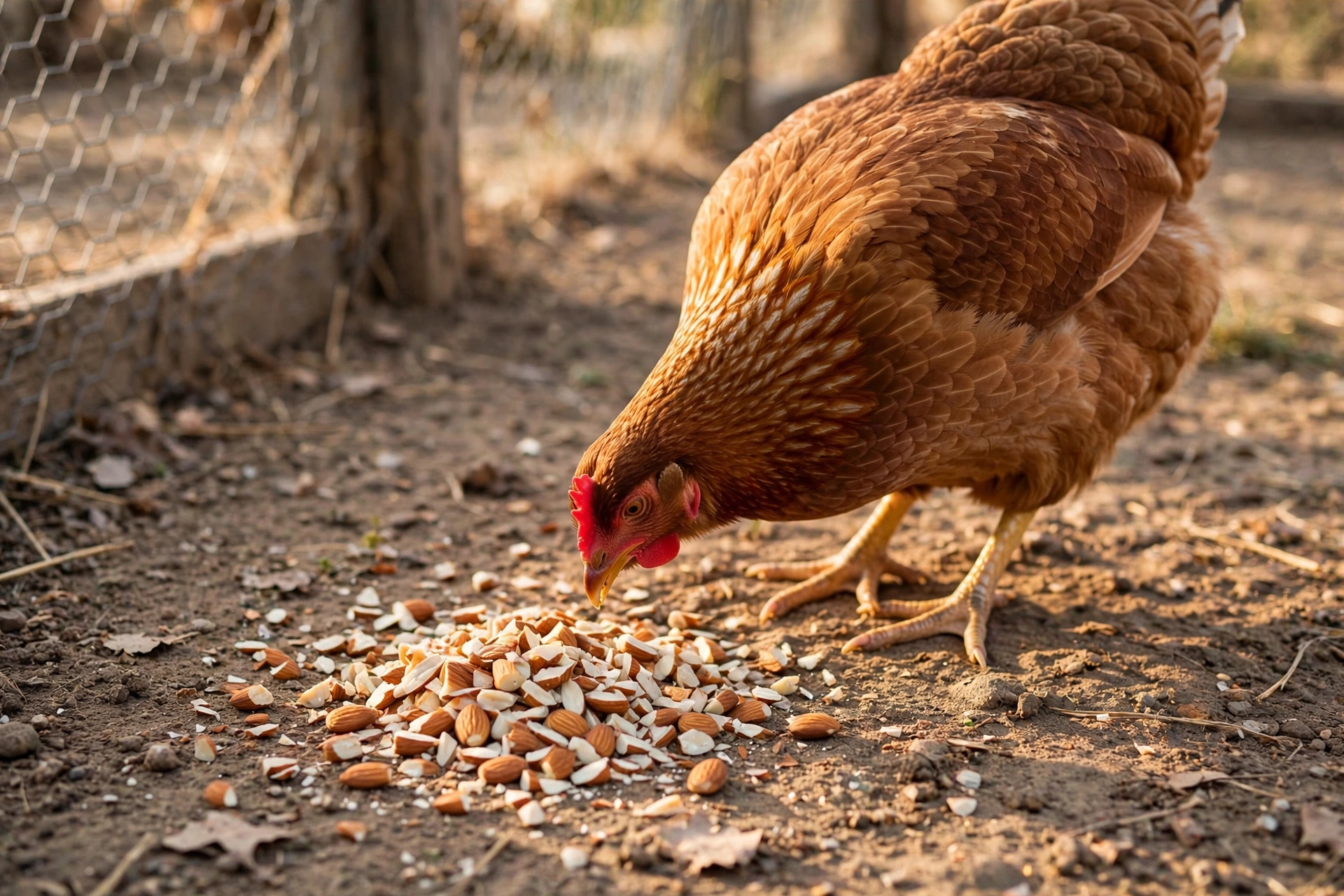
Almonds look like a perfect chicken treat at first glance. They are crunchy, rich in healthy fats and protein, and most hens will rush across the run for a small handful. A few chopped pieces can add welcome variety to a flock that already eats a balanced layer feed, fresh greens and the odd kitchen scrap. They also give your birds something interesting to peck at, which matters for chickens that spend long hours in the same run.
The short answer is that chickens can eat almonds, but only in the right form and only in small amounts. Plain raw sweet almonds, chopped into small pieces and served unsalted, are a fatty treat rather than a daily food. Whole almonds can be a choking risk, salted or seasoned almonds can harm your birds, and bitter almonds are dangerous and must never be fed to chickens. The difference between a safe treat and a risky one comes down to the kind of almond, the way you prepare it and how often you offer it.
This guide walks through the whole picture in plain terms. You will learn why the checker lists almonds as Caution, how to chop and serve them safely, how many pieces each bird should get, which kinds to avoid completely, when chicks can try them and what to do with almond butter and other almond foods. By the end you will know exactly when a few almond pieces are a nice extra and when it is better to skip them and reach for a safer treat instead.

Table of Contents
Quick Facts
At a Glance
Almonds are a rich fatty treat for chickens when they are plain, raw, unsalted and chopped into small pieces. They are not a daily food and they never replace a balanced layer feed.
The Verdict
Almonds are Caution. Chopped pieces, fatty treat. Offer only a few chopped pieces per bird a couple of times a week at most, and skip them on days when your flock already has another rich treat.
Good to Know
Whole almonds can choke a chicken, salted and seasoned almonds are never safe, and bitter almonds are dangerous because they carry far more cyanide than sweet almonds. Chicks need finely crushed pieces only, and only from about four weeks of age.
Can Chickens Eat Almonds
Yes, chickens can eat almonds when the almonds are the right kind and they are prepared the right way. Plain raw sweet almonds are the only kind to offer, and they must be chopped into small pieces before they reach your birds. A few pieces scattered on the ground or mixed into a small treat bowl will be pecked up happily by most hens, and the rich flavour makes them a useful high value treat for training or for tempting a shy bird out of the coop.
Almonds are not a food that chickens need. A good layer feed already gives your flock the protein, calcium and vitamins it needs for strong eggshells and steady laying. Treats like almonds sit on top of that balanced diet, so they should stay a small extra rather than a regular part of the daily feed. Think of them the way you would think of any rich nut treat, welcome in small amounts and unhelpful in large ones.
If you want a broader view of what belongs in the treat bowl, the feeding pillar at https://thechickenpet.com/what-can-chickens-eat/ brings the safe foods together in one place. Almonds fit into that wider picture as one option among many, and they work best when they are rotated with lighter treats such as leafy greens, cooked grains and soft fruit. A flock that gets a little variety stays interested in its food without filling up on fat before it has eaten enough of its proper feed.
The key point to carry through this whole guide is preparation. Chickens do not chew, they peck and swallow, and their crop and gizzard do the rest of the work. A whole almond is hard, smooth and just the wrong size for easy swallowing, so chopping is not a nice extra, it is the step that makes almonds safe to offer at all. Chop them small, keep the portion tiny, and serve them plain, and almonds can be a perfectly fine occasional treat for a healthy adult flock.
Are Almonds Safe for Chickens
Are almonds safe for chickens in general, and what does the checker verdict mean in practice. The food checker lists almonds as Caution, with the note Chopped pieces, fatty treat. That verdict sits between the clear safe foods and the foods to avoid, and it tells you that almonds are fine in the right form and amount but risky if you get the form or the amount wrong. It is not a ban, and it is not a free pass to feed handfuls every day.
The main reason for caution is fat. Almonds are very energy dense, with a lot of fat packed into a small nut. A chicken that fills up on fatty treats eats less of its layer feed, and over time that can lead to weight gain, fatty liver problems and fewer eggs. Fatty treats also crowd out the calcium and protein that laying hens need most. A few pieces a couple of times a week will not cause that problem, but a daily handful can quietly push the diet in the wrong direction.
The second reason is the physical form of the nut. A whole almond is hard and slippery, and it can lodge in the throat or sit awkwardly in the crop. Chopping solves most of that risk, and it also slows the birds down a little so no single hen can gulp down a large pile in seconds. Smaller pieces are easier to swallow, easier to digest and easier to share fairly around the flock, which matters when you have a bold hen that likes to guard the treat bowl.
The third reason is the kind of almond. Sweet almonds, the kind sold for everyday eating, are the only ones to consider, and even those must be plain and unsalted. Salted, smoked, honey roasted, flavoured or chocolate coated almonds bring salt, sugar, spices or coatings that chickens do not need and cannot handle well. Bitter almonds are a separate danger altogether, and they are covered in their own section below because they must never be fed to chickens under any circumstances.
For a healthy adult flock, plain chopped sweet almonds in tiny portions are safe. For a flock with overweight birds, a bird recovering from illness, or a bird that already gets a lot of rich treats, it is better to skip almonds for now and choose a lighter option. The safety of almonds depends on the bird in front of you as much as on the nut itself, so watch your flock, keep portions small and let the balanced feed do the heavy lifting.

How to Feed Almonds to Chickens
Feeding almonds well takes only a few minutes, and the steps are simple once you know them. Start with plain raw sweet almonds from a packet that lists only almonds as the ingredient. Check the label before you buy, because many snack packs hide salt, oil, sugar or flavourings in the small print. If the packet mentions salt, seasoning, roasting in oil or a coating of any kind, put it back and choose a plain pack instead.
Chop the almonds into small pieces before you offer them. A kitchen knife on a chopping board works well, or you can put a small amount in a sturdy bag and crush it gently with a rolling pin. Aim for pieces no bigger than a pea, and smaller is better for bantams or younger birds. Avoid turning them into a fine powder, because a little texture helps the birds peck and enjoy them, but make sure no large half almond or whole almond slips through. If you are in doubt, chop them a little finer rather than a little coarser.
Scatter the chopped pieces on clean bare earth, on a flat tray or in a shallow dish, rather than tossing them into deep litter where they can pick up dirt and droppings. Scattering also stops one bold hen from claiming the whole pile, because the pieces spread out and every bird gets a fair chance. Offer the almonds in the morning or early afternoon, so the birds have time to eat their proper feed afterwards and the treat does not replace the last feed of the day.
Always offer fresh water alongside any treat, and almonds are no exception. A full drinker helps the crop move food along and keeps digestion comfortable. Do not soak almonds for hours, do not serve them stale or mouldy, and do not leave uneaten pieces out overnight where they can attract rats or go damp. If any pieces are left after a short while, pick them up and throw them away. Fresh, plain and chopped is the whole method, and it does not need to be more complicated than that.
Can chickens eat raw almonds is a question many keepers ask, and the answer is yes when the almonds are raw sweet almonds and they are chopped. Raw is the simplest and safest form, because roasting often adds oil or salt and can change the texture. You do not need to cook almonds for chickens, and you should not add anything to them. Plain raw pieces, served in a tiny portion, are exactly what the checker verdict describes.
How Many Almonds Can Chickens Eat
How often can chickens eat almonds, and how many pieces should each bird get, are the two questions that matter most once you know the almonds themselves are safe. The answer to both is small and infrequent. A good rule is a few small chopped pieces per bird, a couple of times a week at most, and less than that if your flock already gets other rich treats in the same week.
Treats as a whole should stay under about ten percent of what a chicken eats in a day, and almonds are rich enough that they should take up only a small part of that treat allowance. In practical terms, that means two or three small chopped pieces per hen is plenty for one serving, and one small almond chopped between two or three birds is often enough. It will look like a very small amount in your hand, and that is the point. Chickens are small animals, and a portion that looks tiny to us is a real treat to them.
Space almond days apart rather than offering them on back to back days. If you gave almonds on Monday, choose leafy greens or a soft fruit on Tuesday and save the next almond serving for later in the week. That spacing keeps the fat load low and keeps the birds interested, because a treat that appears every day soon becomes ordinary. It also leaves room in the diet for the layer feed that carries the calcium and protein your hens need for eggshells.
Watch your flock after you introduce almonds, just as you would with any new food. Healthy signs are normal droppings, normal energy and a normal appetite for feed afterwards. If a bird goes off its feed, has loose droppings or seems uncomfortable after eating almonds, stop offering them and go back to plain feed and water. Most flocks will show no problem at all with a tiny chopped portion, but every flock is different and the birds themselves will tell you if the amount was too much.
If you are looking for another rich treat to rotate with almonds, walnuts are a useful comparison, and the guide at https://thechickenpet.com/can-chickens-eat-walnuts/ covers them in the same careful way. Both nuts are fatty treats, both need chopping and small portions, and both work best when they take turns rather than appearing together. Rotating treats keeps the diet varied without doubling the fat in any single week.
Salted and Seasoned Almonds
Can chickens eat salted almonds is a question with a clear answer, and the answer is no. Salted almonds must never be fed to chickens. Chickens are very sensitive to salt, and even a small amount of extra salt can cause thirst, loose droppings and, in larger amounts, salt poisoning. A salted almond carries far more salt in one small nut than a chicken should ever eat in a treat, and a handful of salted almonds could make a bird seriously ill.
Seasoned almonds are just as unsuitable, even when they do not taste very salty to us. Smoked almonds, barbecue almonds, chilli almonds, honey roasted almonds and almonds coated in sugar, yoghurt or chocolate all bring ingredients that chickens cannot handle. Spices can irritate the crop and gut, sugar adds empty calories, and chocolate is toxic to chickens. The flavourings are made for human taste buds, not for a small bird with a delicate digestive system, and there is no safe amount of a seasoned almond to offer.
This rule applies even if you rinse salted almonds or pick the coating off. Rinsing does not remove all the salt that has soaked into the nut, and a coating that looks removed can still leave sugar, oil or spice behind. If the only almonds in your cupboard are salted or seasoned, the safe choice is to keep them for yourself and buy a plain unsalted pack for the flock. The same applies to mixed nuts sold as a snack, because those mixes usually contain salt, oil and sometimes other nuts or dried fruit that are not safe for chickens.
When you shop for almonds for your birds, read the ingredient list and look for a single word, almonds. If the list is longer than that, do not use the pack for the flock. Plain raw sweet almonds, chopped small and served in a tiny portion, are the only version that fits the checker verdict, and everything else in the snack aisle should stay out of the run.
Bitter Almonds Are Dangerous
Bitter almonds chickens should never meet, because bitter almonds are dangerous in a way that sweet almonds are not. Bitter almonds carry far more cyanide than sweet almonds, and a few can kill a chicken. This is not a matter of portion size or preparation, and chopping or soaking does not make bitter almonds safe. If you have bitter almonds in your home, keep them well away from your flock and never offer them as a treat.
The danger comes from compounds in the bitter almond that release cyanide when the nut is chewed and digested. Sweet almonds contain only tiny traces of those compounds, which is why a few chopped sweet almonds are a safe treat. Bitter almonds contain far higher levels, and the difference is large enough that even a small number can be lethal to a small bird. A chicken weighs only a few pounds, so a dose that might make a person ill can kill a hen outright.
Most keepers will never buy bitter almonds on purpose, because they are not sold as an everyday snack. They are used in small amounts in some baking and in traditional recipes, and they can sometimes turn up in a garden if a bitter almond tree is growing nearby. If you are not sure whether the almonds you have are sweet or bitter, do not guess and do not feed them. Taste is not a safe test for a chicken keeper to rely on, and the only safe approach is to feed almonds only when you are certain they are plain sweet almonds from a labelled food packet.
If a chicken ever eats a bitter almond by accident, watch the bird closely and contact a vet straight away, especially if the bird seems wobbly, weak, gasping or unusually quiet. Do not wait to see if it gets better on its own, because cyanide poisoning moves fast. The best protection is prevention, so store bitter almonds out of reach, clear up any fallen nuts under a bitter almond tree before the flock can reach them, and tell anyone who feeds your birds that bitter almonds are never allowed.
Can Baby Chicks Eat Almonds
Can baby chicks eat almonds is a common question for keepers raising a new batch, and the answer needs more care than it does for adult hens. Chicks should not eat almonds in their first few weeks of life. Their digestive systems are still developing, they need the balanced nutrition in chick starter feed, and hard nut pieces are too much for a tiny crop and gizzard to handle. For the first month, chick starter, fresh water and a little chick grit are all a chick needs.
From about four weeks of age, a chick can try a very small amount of finely crushed almond, and only if the chick is healthy, active and already eating starter feed well. Crush the almond much finer than you would for an adult hen, until the pieces are like coarse crumbs rather than small chunks. Offer only a crumb or two per chick, and only once in a while, never as a daily food. Make sure the chicks have access to chick grit, because grit helps the gizzard grind hard foods like nut pieces.
Watch the chicks closely after their first taste. They should stay bright, keep eating their starter feed and produce normal droppings. If a chick seems quiet, stops eating or has loose droppings, stop offering almonds and give the chick time to settle back onto starter feed alone. Chicks grow fast, and their nutritional needs change quickly, so a treat that is harmless for an adult hen can still be too rich or too hard for a young bird.
For most keepers, the simplest choice is to wait until the chicks are well grown before offering almonds at all. There is no rush, and the birds will not miss out by waiting a few extra weeks. When they are older, stronger and eating a grower feed, you can introduce the same small chopped pieces you would offer an adult hen, and you can build up to the normal adult portion slowly. Patience in the first month pays off in healthy birds later.

Almond Butter and Other Almond Foods
Can chickens eat almond butter is another question that comes up often, and the answer is yes in very small amounts, with strict conditions. Almond butter must be plain and unsalted, with no added sugar, salt, oil or flavourings. The ingredient list should read like plain almonds and nothing else. Offer it only as a thin smear, never as a thick spoonful, because almond butter is sticky, very rich and easy for a chicken to eat too much of in one go.
A thin smear on a small piece of plain cooked pumpkin, a slice of cucumber or a flat stone gives the birds something to peck at without letting any one bird gulp down a large amount. Do not put a dollop of almond butter in a bowl, because a hen can scoop up a beakful in seconds and the sticky paste can be hard to swallow. Do not mix almond butter into the main feed, because that turns a treat into a regular part of the diet and pushes the fat content up for the whole flock. Keep it as an occasional extra, in a thin layer, and only for healthy adult birds.
Almond milk is a different matter, and it is not a useful food for chickens. Most almond milk sold in shops contains added sugar, salt, flavourings or thickeners, and it offers almost no nutrition that a chicken needs. Chickens also do not need milk of any kind, and their bodies are not made to digest it well. Fresh clean water is the drink your flock needs, and almond milk should stay out of the run. If you have plain unsweetened almond milk at home, there is still no reason to offer it, because water does the job better.
Almond flour and ground almonds follow the same rule as chopped almonds, only in a finer form. A tiny sprinkle of plain ground almond mixed into a small treat portion is fine for an adult hen, but a large amount is still a fatty food and should be kept small. Almond extract, almond essence and almond flavouring must never be fed to chickens, because they are concentrated, often contain alcohol or bitter almond compounds, and they bring no nutrition at all. Keep those bottles in the kitchen cupboard and well away from the flock.
If you want a protein rich treat that is easier to serve than almond butter, black soldier fly larvae are a good option, and the guide at https://thechickenpet.com/can-chickens-eat-black-soldier-fly-larvae/ explains how to offer them. Chickpeas are another protein rich choice, and the guide at https://thechickenpet.com/can-chickens-eat-chickpeas/ covers them, with the important detail that chickpeas must be cooked first. Rotating between a nut treat, an insect treat and a cooked legume keeps treat time interesting without relying on any single rich food too often.
For general care questions that sit alongside feeding, the care pillar at https://thechickenpet.com/chicken-care-and-health/ brings health, housing and daily care together. Almonds are only one small part of keeping chickens well, and a flock that has clean water, a balanced feed, a dry coop and room to forage will always do better than a flock that gets rich treats but misses the basics.

Frequently Asked Questions
Can chickens eat raw almonds?
Yes, chickens can eat raw almonds when the almonds are plain sweet almonds and they are chopped into small pieces. Raw is the simplest form to offer, because it has no added oil or salt. Serve only a few chopped pieces per bird a couple of times a week at most, and always with fresh water nearby.
Can chickens eat salted almonds?
No, chickens must never eat salted almonds. Salted almonds carry far more salt than a chicken can handle, and even a small amount can cause thirst, loose droppings and illness. Seasoned, smoked, honey roasted and chocolate coated almonds are also unsafe. Only plain unsalted sweet almonds are suitable, and only in chopped pieces.
Can chickens eat almond butter?
Yes, chickens can eat almond butter in very small amounts when it is plain and unsalted, with no added sugar, salt or flavourings. Offer it only as a thin smear on a plain food or a flat surface, never as a thick spoonful or in a bowl. Keep it as an occasional treat for healthy adult birds, and skip it for chicks.
Can baby chicks eat almonds?
Baby chicks should not eat almonds in their first few weeks of life. From about four weeks of age, a healthy chick can try a very small amount of finely crushed almond, only once in a while and only with chick grit available. Most keepers find it simpler to wait until the chicks are well grown before offering almonds at all.
How often can chickens eat almonds?
Chickens can eat almonds a couple of times a week at most, and only a few small chopped pieces per bird each time. Space almond days apart, and skip them in weeks when the flock already has another rich treat. Treats should stay a small part of the daily diet, with balanced layer feed doing the main work.
Can chickens eat whole almonds?
No, chickens should not eat whole almonds. Whole almonds are hard and slippery, and they can choke a chicken or sit awkwardly in the crop. Always chop almonds into small pieces before offering them, and chop them finer for bantams and younger birds. If a whole almond slips through while you are chopping, take it out before you serve the rest.

Nusrat
Author, TheChickenPet.com