
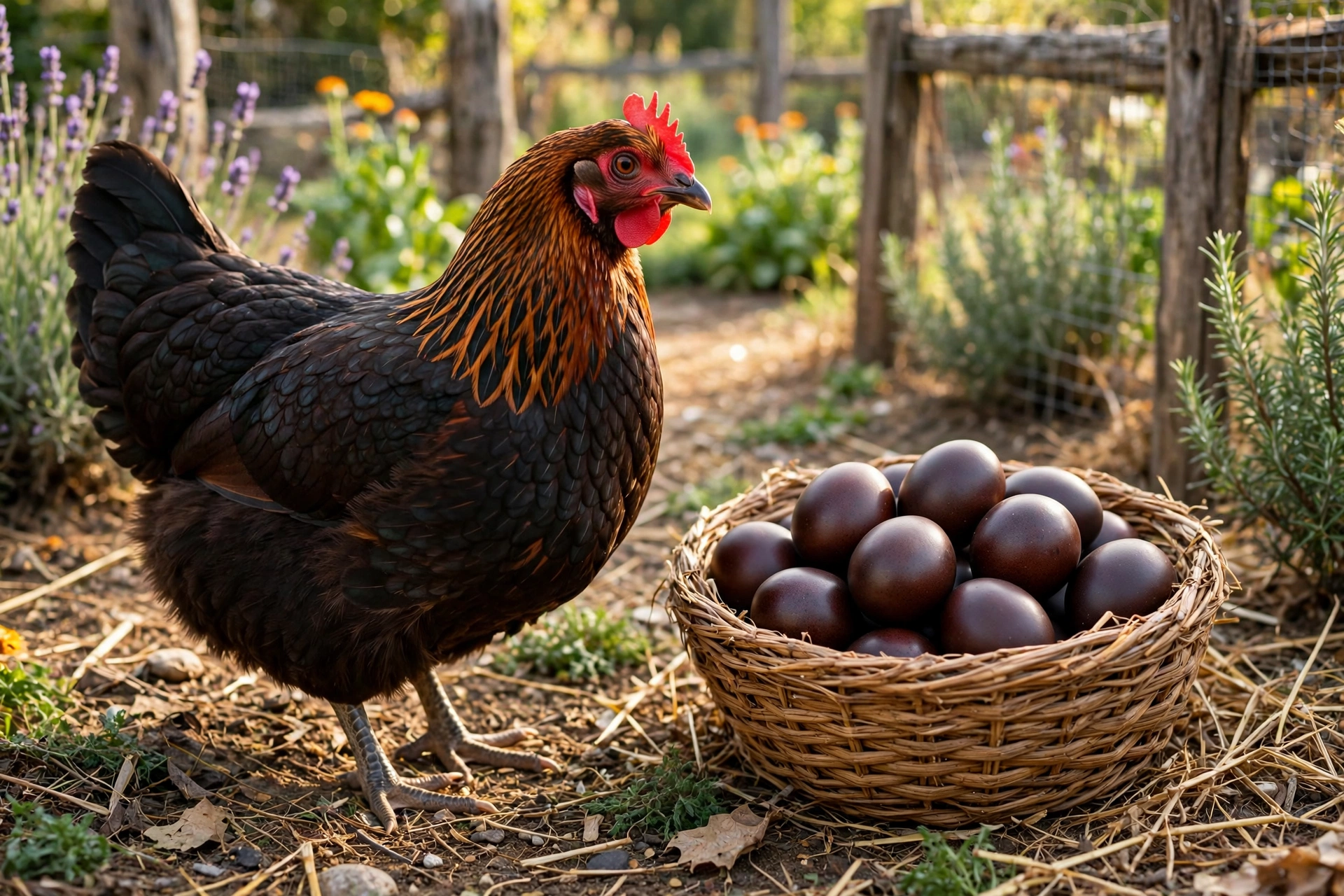
Marans are the chickens behind some of the darkest brown eggs you will ever see in a backyard flock. A Black Copper Marans hen lays eggs that look almost chocolate coloured, and that single trait has made the breed a favourite with keepers who love a colourful egg basket. But before you bring home chicks or hatching eggs, it is fair to ask how long the birds themselves will be with you.
Most Marans live 5 to 8 years. That is the honest middle of the range, and it fits what keepers report for healthy birds in a well run backyard flock. Some birds live shorter lives because of illness, predators or poor care, while well kept birds can reach 10 years, and a few go beyond that. The number on its own does not tell the whole story, because how long a Marans lives depends on where she came from, how she is fed, how safe her coop is, and how much attention she gets as she ages.
This guide looks at the Marans lifespan in full. You will find how long hens and roosters usually live, how heritage birds compare with hatchery birds, how many years of laying you can expect, why the famous dark eggs get lighter over time, and what you can do to help your birds live longer.

Table of Contents
Quick Facts
At a Glance
Most Marans live 5 to 8 years. Well kept birds can reach 10 years. Black Copper Marans is the best known variety and is famous for very dark chocolate brown eggs.
Laying Life
Expect around 150 to 200 dark brown eggs a year in the first years. Laying starts at about 5 to 6 months of age, is strongest in the first two to three years, and then slows down. Egg colour also fades as the hen ages and through the laying season.
Good to Know
Marans are active, hardy and good foragers. They are calm but not usually lap chickens. French type birds have feathered legs and need dry ground. Hens go broody only occasionally.
How Long Do Marans Chickens Live
A Marans hen usually lives 5 to 8 years in a backyard flock. That range covers most healthy birds that are fed well, housed in a dry and predator proof coop, and checked regularly for signs of illness. Birds at the lower end of the range often face a single serious problem, such as a predator attack, a laying problem or an illness that is caught too late. Birds at the upper end tend to come from good breeding stock and live in a calm flock with a careful keeper.
A lifespan of 10 years is possible for a Marans, and keepers do report birds reaching that age. It is not something you should count on for every bird, and it is not the average. Think of 10 years as a good result for a well kept bird, not as the number every Marans will reach. The same is true of other popular breeds, and the comparison helps put the Marans in context. If you would like to see how another well loved breed compares, read our guide on how long Silkie chickens live.
The Marans lifespan is similar to that of many other dual purpose and laying breeds. What makes the Marans stand out is not an unusually long life, but the way the breed combines a reasonable lifespan with beautiful dark eggs, a hardy nature and a calm temperament.
Age affects a Marans in the same gradual way it affects other chickens. A young hen is busy, bright eyed and quick to forage. A middle aged hen still lays well but may take longer breaks in winter and during moult. An older hen lays less, moves more slowly and spends more time resting, yet she can still be a valued member of the flock for years after her best laying days are behind her. Planning for that full life, and not only for the laying years, is part of keeping Marans well.
Heritage or Hatchery Birds
Where your Marans came from matters, and it can change both lifespan and egg colour. Heritage Marans come from breeders who select birds to the breed standard, including the dark egg colour that made the breed famous. Hatchery Marans come from large hatcheries that breed for volume and for birds that are easy to produce in large numbers. Both types can make good backyard chickens, but they are not quite the same bird.
Heritage birds, especially Black Copper Marans from a breeder who selects for egg colour, tend to lay the darkest eggs. Their egg colour is often richer and holds up better through the season, though it still fades with time. They also tend to match the breed standard more closely in size, feathering and temperament. Because a good breeder selects for health as well as looks, heritage birds often have a steadier constitution, and that can support a longer life.
Hatchery Marans are usually cheaper and easier to find, and they often start laying a little earlier and lay a little more often. The trade off is that their eggs are often lighter brown, sometimes much lighter than the famous chocolate colour. Their feathering and size can also vary more from bird to bird. That does not make them poor chickens, and many keepers are very happy with hatchery Marans, but if dark eggs are the main reason you want the breed, a heritage breeder is the safer choice.
The Black Copper Marans lifespan follows the same general range as the rest of the breed, about 5 to 8 years, with well kept birds reaching 10. The variety does not live much longer or shorter than other Marans varieties, such as Cuckoo Marans or Wheaten Marans. What differs between varieties is mostly feather colour and pattern, not lifespan. So when you read that the black copper Marans lifespan is 5 to 8 years, you can take that as the figure for the breed as a whole.
When you buy Marans, ask the breeder or hatchery about the parent birds and the egg colour of the breeding hens. A breeder who can show you dark eggs from their own hens and who keeps older birds in good condition is a good sign.
Lifespan or Laying Life
A Marans will live longer than she lays, and it helps to know the difference between the two. The laying life is the number of years a hen lays a useful number of eggs. The lifespan is the number of years she lives in total. A hen can live several years after she stops laying, and she still needs the same care, food, shelter and company in those later years.
Most Marans hens lay around 150 to 200 dark brown eggs a year in the first years. That is a good rate for a heritage style breed, though it is lower than the rate of a high output layer such as a commercial hybrid. Laying is strongest in the first two to three years. After that, the number of eggs falls a little each year, and the hen takes longer breaks in winter and during moult. By the age of four or five, many Marans hens lay far fewer eggs than they did at two, and some stop almost entirely by six or seven, even though they may live on for several more years.
The question of how long Marans lay eggs has no single exact answer, because it varies with breeding, feeding, daylight and health. A useful guide is that you can expect good laying for about three years, fair laying for another year or two, and then a slow taper. If you keep chickens mainly for eggs, that taper matters when you plan your flock. If you keep them as pets as well as layers, it matters less, because an older hen still has plenty to offer as a forager and a companion.
When do Marans start laying eggs. Most pullets start at about 5 to 6 months of age, though some take a little longer, especially if they mature in autumn when the days are getting shorter. The first eggs are often smaller and lighter in colour than the eggs the same hen will lay a few weeks later. That is normal, and the colour usually deepens as she settles into laying. If you want more detail on laying ages in general, our guide on when chickens start laying eggs covers the signs to watch for.
Egg colour is a special part of the Marans story, and it deserves its own note here. The dark brown colour comes from a pigment that the hen adds to the shell near the end of egg formation. She has only a limited amount of pigment to give, so the colour is darkest at the start of a laying cycle, after a break such as moult, and in the first years of laying. As the laying season goes on, the pigment is used up a little more each day, and the eggs get lighter. As the hen ages, the same thing happens over a longer period, and her eggs become lighter year by year. This is why keepers ask why Marans eggs get lighter, and the answer is usually this natural fading, not a health problem.
You can also read more about the full laying life of hens in our guide on how long hens lay eggs for, which covers how laying changes with age across breeds.
What Affects Their Lifespan
Several things shape how long a Marans lives, and most of them are within your control as a keeper. Genetics comes first. Birds from healthy parent stock with no history of serious laying problems tend to live longer. Birds from lines bred only for egg numbers, or from inbred stock, tend to have more health trouble. That is why the breeder you choose matters so much, and why it pays to buy from someone who keeps their birds well.
Feeding is the next big factor. Marans do best on a good quality layer feed once they start laying, with clean water always available and grit to help them digest their food. Treats should stay a small part of the diet, and kitchen scraps should be safe and fresh. Too many treats can lead to overweight birds, and overweight hens are more likely to have laying problems. Too little protein, or a diet low in calcium, can lead to thin shells and egg problems. A steady, balanced diet supports a longer life far better than a rich diet with gaps in it.
Housing matters just as much. Marans are hardy birds, and they cope well with cold weather, but they still need a dry, draught free coop with good ventilation and enough space. Damp bedding is a real risk, especially for French type Marans with feathered legs. Feathered legs pick up mud and stay wet, and wet feathered feet can lead to scaly leg mite and foot problems. Dry ground in the run, a covered area in wet weather, and clean dry bedding in the coop all help feathered leg birds stay healthy for longer. You can find more on day to day care in our chicken care and health guide.
Predators cut many backyard chicken lives short, and Marans are no exception. They are active foragers and they like to roam, which is a joy to watch, but it also puts them at risk if the run is not secure. A sturdy coop, a covered run or supervised free ranging, and a latch that a raccoon cannot open are worth the effort. One predator attack can end the life of a bird that would otherwise have lived for years.
Disease and parasites also shorten lives when they are missed. Worms, mites and lice weaken birds over time, and respiratory illness can take hold quickly in a damp or crowded coop. Regular checks, a clean coop, and quick action when a bird looks off colour all help. So does keeping new birds apart from the flock for a few weeks before mixing them in, so that any illness they carry does not spread to your older birds.
Stress plays a quieter role. A flock with too many birds in too little space, a bully that is never dealt with, or constant disturbance from dogs or loud noise will wear birds down. Marans are calm birds, and they do best in a settled flock with enough space, enough feeders and drinkers, and a safe place to rest. A calm flock is a longer lived flock.
Broodiness and Laying
Do Marans go broody a lot. The short answer is no, not a lot. Marans hens go broody only occasionally, and many hens never go broody at all. When a Marans hen does go broody, she is usually a steady and careful mother, and she will sit well and look after her chicks. But broodiness is not a strong trait in the breed, so you should not buy Marans if your main plan is to have hens that hatch their own chicks every year.
Broodiness still matters for lifespan and laying, because a broody hen stops laying while she sits, and she eats and drinks less during that time. A short broody spell of a few weeks is normal and does no harm. A hen that stays broody for a long time can lose weight and condition, and that can affect her health. If you do not want chicks, it is kinder to break the broodiness gently, by moving her to a wire bottomed cage with food and water for a few days, or by lifting her off the nest several times a day until the urge passes.
The laying pattern of a Marans is steady rather than frantic. She lays well in spring and summer, slows in autumn as the days shorten, and often stops or lays very little in the depths of winter. A moult in autumn also pauses laying while she grows new feathers. These breaks are normal and healthy, and they give the hen time to rest and rebuild her body.
Signs of an Ageing Marans
Ageing in a Marans is gradual, and the signs build up slowly over months and years. The first sign most keepers notice is laying. An older hen lays fewer eggs, takes longer breaks, and may lay eggs with thinner shells or odd shapes. Her eggs also get lighter in colour, as the pigment fades with age. None of this means she is ill. It is the normal pattern of an ageing layer.
Her comb and wattles may look paler and a little smaller than they did in her prime, especially outside the laying season. Her feathers may lose some of their shine, and the copper hackle feathers of a Black Copper Marans may look duller than they did at two years old. She may moult more slowly and take longer to grow her new feathers back. These changes are normal, and they are not a reason to worry on their own.
Movement changes too. An older Marans may walk more slowly, jump less readily onto a high perch, and spend more time resting in a sunny spot. She may be slower to come for treats, and she may let younger hens push past her at the feeder. That is why it helps to give older birds a lower perch, a ramp into the coop, and a feeder and drinker they can reach without a climb or a fight.
There are signs that mean more than normal ageing, and you should watch for them. A hen that stops eating, sits hunched and fluffed up, has a swollen belly, or has trouble passing an egg needs help quickly. The same is true of a hen that is suddenly lame, has a pale comb that does not recover, or loses weight fast. Normal ageing is slow. A sudden change is a warning, and it deserves a closer look the same day.

How to Help Yours Live Longer
You cannot change the genetics of the birds you already have, but you can change almost everything else, and those changes add up. The single most useful thing you can do is to keep the basics steady every day. Fresh water, good feed, a clean dry coop and a safe run are not exciting, but they are what keep chickens alive for years.
Start with feed. Give laying hens a proper layer feed with enough calcium, and offer oyster shell on the side so each hen can take what she needs. Keep treats to a small share of the diet, and choose healthy treats such as greens, mealworms and a little fruit. Avoid salty food, mouldy food and too much bread or scratch. A hen that stays at a healthy weight is less likely to have laying trouble, and laying trouble is one of the main risks for an older hen.
Keep the coop dry and clean. Clear out damp bedding, keep the water outside the sleeping area if you can, and give the birds good ventilation without a cold draught blowing straight across the perches. In wet weather, give feathered leg Marans a dry area to stand on, and check their feet and legs regularly for mud balls, mites or sores. A quick weekly check of legs, feet, vent and eyes will catch most problems while they are still small.
Give them space to forage. Marans are good foragers, and they are at their happiest when they can scratch, peck and explore. Foraging keeps them active, keeps their weight in check, and gives them greens and insects that add variety to their diet. If you cannot free range them, a large run with deep litter, logs to climb on and greens to peck at will still keep them busy. An active bird is a healthier bird.
Protect them from predators. Check the coop and run for gaps, weak wire and loose latches, and lock the birds in at dusk every night. If you free range, try to be around while they are out, and give them bushes or a covered area to run to if a hawk passes over. A safe flock lives longer, and a single night with a coop door left open can undo years of good care.
Watch the flock every day. The best keepers know each bird, and they notice when one is a little quieter, a little slower, or off her food. A bird that is caught early, kept warm, given water and food close by, and seen by a vet if needed has a far better chance than a bird that is found only when she is already very ill. Keep a simple note of each bird, her age and any treatment she has had, so you can spot patterns over time.
Let older hens retire with dignity. When a Marans stops laying, she still needs food, shelter, water and company. Do not push her to lay with extra light, and do not move her to a new flock where she will be at the bottom of the pecking order. A lower perch, a ramp, a quiet corner and a little extra care will keep her comfortable for years. Many keepers find that their oldest hens become the calm heart of the flock.

Marans Rooster Lifespan
Marans rooster lifespan is much the same as the lifespan of the hens, about 5 to 8 years, with well kept birds reaching 10. Roosters do not face the strain of laying eggs, so they avoid the egg binding and laying problems that affect hens. That can work in their favour. On the other hand, roosters face their own risks, and those risks can shorten their lives if they are not managed.
A rooster that lives with too many other roosters will fight, and fighting causes injuries, stress and sometimes serious wounds. A single rooster with a suitable number of hens, usually about 8 to 10 hens per rooster, is a calmer and safer arrangement. If you keep more than one rooster, give them plenty of space and watch how they get on, especially in spring when hormones run high.
Roosters also need protection from predators, and they are often the bird that stands its ground while the hens run for cover. That bravery is part of what makes a good rooster, but it also puts him at risk. A secure run and a coop that locks well at night protect the rooster just as much as they protect the hens.
As a rooster ages, he becomes calmer and less quick to challenge other birds or people. His crow may become less frequent, his spurs grow longer and may need trimming, and he may spend more time watching over the flock than chasing hens. An older rooster can still be a good flock guardian, and many keepers keep a steady older rooster for years because he keeps the flock calm.
Feeding a rooster is simple. He does not need the high calcium level of layer feed, but in a mixed flock he will eat the same feed as the hens, and that is usually fine. Fresh water, space and a safe coop matter for him just as much as they do for the hens.
Are Marans good for beginners. Yes, Marans are a good choice for a beginner, and their lifespan is part of the reason. They are hardy, calm and good foragers, and they do not need special care beyond the basics. They are not usually lap chickens, so a beginner who wants a bird that loves to be held may prefer a Silkie or an Orpington. But a beginner who wants dark eggs, a steady temperament and a bird that copes well with a normal backyard setup will be happy with Marans. The comparison with a gentle and long lived layer is useful here, and our guide on how long Buff Orpington chickens live shows how another beginner friendly breed compares. You may also want to compare them with a hardy red layer in our guide on how long Rhode Island Red chickens live.

Frequently Asked Questions
How long do Marans chickens live?
Most Marans live 5 to 8 years. Well kept birds can reach 10 years. The exact age varies with breeding, feeding, housing and care, and a bird that is protected from predators and checked regularly has the best chance of a long life.
What is the Marans lifespan for a Black Copper Marans?
The black copper Marans lifespan is the same as the breed average, about 5 to 8 years, with well kept birds reaching 10. The variety is best known for its very dark chocolate brown eggs and its copper coloured neck feathers, not for a different lifespan.
How long do Marans lay eggs?
Expect good laying for about three years, with around 150 to 200 dark brown eggs a year in the first years. Laying then slows each year, and many hens lay very few eggs by the age of five or six, even though they may live for several more years.
When do Marans start laying eggs?
Most Marans pullets start laying at about 5 to 6 months of age. Some take a little longer, especially if they mature in autumn when daylight is falling. The first eggs are often smaller and lighter, and the colour usually deepens as the hen settles into laying.
How long do Marans roosters live?
Marans roosters usually live 5 to 8 years, the same as the hens, with well kept birds reaching 10. They avoid laying problems, but they face risks from fighting with other roosters and from predators, so space and a secure coop matter for them too.
Do Marans go broody a lot?
No, Marans do not go broody a lot. They go broody only occasionally, and many hens never go broody at all. When they do sit, they are usually steady mothers, but broodiness is not a strong trait in the breed.
Why do Marans eggs get lighter?
Marans eggs get lighter because the hen adds a limited amount of dark pigment to each shell, and that pigment is used up a little more as the laying season goes on. The same fading happens as the hen ages. It is normal, and it does not mean the hen is ill or that the eggs are less good to eat.
Are Marans good for beginners?
Yes, Marans are good for beginners. They are hardy, calm, active and good foragers, and they cope well with a normal backyard setup. They are not usually lap chickens, so keepers who want a very cuddly bird may prefer another breed, but for dark eggs and a steady temperament, Marans are a sound first choice.

Nusrat
Author, TheChickenPet.com