

You have a rooster in the flock, or you are thinking of getting one, and now you want to know whether the eggs are fertilized, without cracking every egg you collect and wasting the lot. There are two real ways to tell, and both are simple. Crack one sample egg and look for the bullseye on the yolk, or candle the eggs after about 7 days of incubation and look for spider veins and a dark growing area. That is the whole answer in one sentence, and the rest of this guide explains both methods step by step, plus the myths that waste good eggs, the blood spot myth, the float test myth, and the idea that you need a rooster at all.
Table of Contents
- The Short Answer. Two Ways, and One Myth to Kill First
- The Bullseye. Cracking One Egg to Check the Flock
- Candling on Day 7. Spider Veins and a Dark Spot
- What a Fertilized Egg Looks Like, Day by Day
- Blood Spots Are Not Fertility
- The Float Test Says Nothing About Fertility
- No Rooster, No Fertilisation
- Can You Eat Fertilized Eggs
- A Fertilized Egg Only Develops If It Is Incubated
- FAQs
A fertilized egg shows a bullseye on the yolk when cracked, or spider veins when candled on day 7. A blood spot is not fertility, and the float test says nothing about it.
Crack one sample egg and look for the bullseye blastoderm, a white ring with a clear centre. Or candle after about 7 days of incubation and look for spider veins and a dark growing area.
A blood spot is not fertility. The float test measures age, not fertility. Without a rooster there is no fertilisation at all.
The Short Answer. Two Ways, and One Myth to Kill First
There are two real ways to tell if a chicken egg is fertilized, and one myth to kill first.
The first way is the bullseye. Crack one sample egg into a bowl and look at the yolk. A fertilized egg has a small white bullseye on the yolk, a white ring with a clear centre, called the blastoderm. An unfertilized egg has only a small solid white dot, called the blastodisc. The bullseye means the egg was fertilized. The solid dot means it was not.
The second way is candling. Put the eggs in an incubator or under a broody hen, wait about 7 days, then hold each egg up to a bright light in a dark room. A fertilized egg shows spider veins spreading from a dark spot, the growing embryo. An unfertilized egg stays clear, with no veins and no dark spot.
The myth to kill first is the blood spot. A blood spot on the yolk is a tiny broken blood vessel, not a sign of fertilisation, and it appears in fertilized and unfertilized eggs alike. Our guide to blood spots in chicken eggs explains it in full, and the short answer is that a blood spot tells you nothing about fertility.
The Bullseye. Cracking One Egg to Check the Flock
The bullseye method is the fastest way to check whether your rooster is doing his job, and it costs you one egg. Crack a fresh egg into a bowl, gently, so the yolk stays whole. Look at the top of the yolk, where you will see a small white spot. If the spot is a ring with a clear centre, like a tiny bullseye or a donut, the egg is fertilized. If the spot is a small solid white dot with no ring, the egg is unfertilized.
The bullseye is the blastoderm, the cluster of cells that would become a chick if the egg were incubated. The solid dot is the blastodisc, the same cluster of cells before fertilisation, and it stays small and solid because no rooster was involved.

You do not need to crack every egg. One sample egg tells you about the whole flock, because if the rooster is mating with the hens, most of the eggs will be fertilized, and if he is not, most will not be. Crack one egg a week to check, and you will know whether the rooster is fertile without wasting the lot.
The bullseye is easiest to see on a fresh egg, in good light, with the yolk still firm. An older egg has a flatter yolk and the spot is harder to see, so use a fresh egg, collected that day if you can.
Candling on Day 7. Spider Veins and a Dark Spot
Candling is the second way to tell, and it is the way to use when you have already set eggs for hatching and want to know which ones are developing. Put the eggs in an incubator or under a broody hen, and wait about 7 days. Then, in a dark room, hold each egg up to a bright light, a torch works well, and look through the shell. A fertilized egg shows a network of fine red veins spreading out from a dark spot in the middle, like a spider’s web, and the dark spot is the growing embryo. An unfertilized egg stays clear, with no veins and no dark spot, and you can see straight through it.
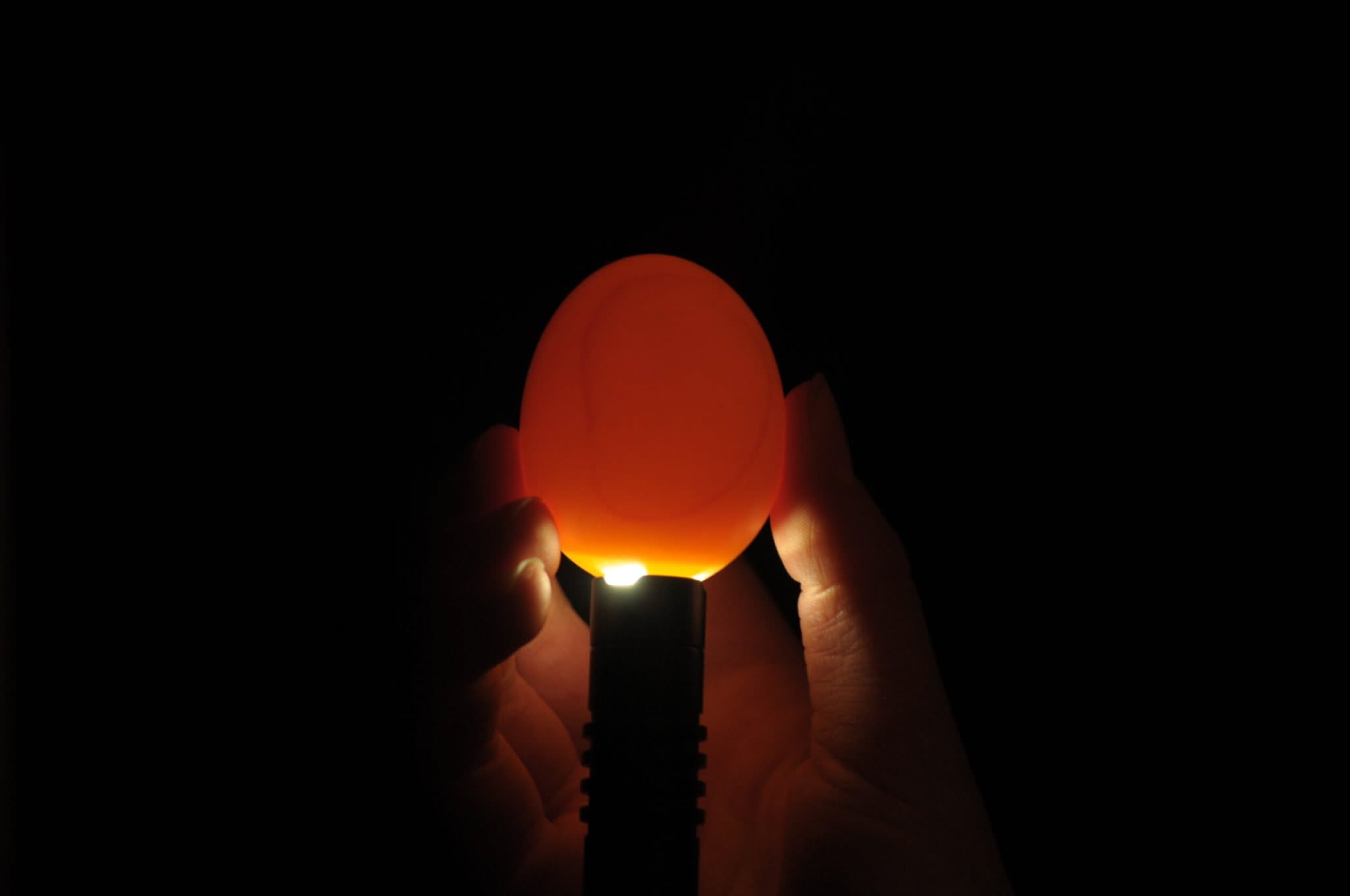
Day 7 is the right time because the veins are clear by then, but the embryo is still small enough to see. Candle too early, on day 3 or 4, and the veins may not be visible yet. Candle too late, on day 14 or later, and the egg will be mostly dark, because the chick has grown to fill the shell, and you will not be able to see the veins clearly.
Remove the clear eggs after day 7, because they will never develop, and leaving them in the incubator wastes space and risks them going bad. Keep the veined eggs, and candle again on day 14 to check they are still growing.
Our guide to hatching chicken eggs at home in an incubator covers the full incubation process, including when to candle and what to do with clear eggs.
What a Fertilized Egg Looks Like, Day by Day
A fertilized egg changes as it develops, and knowing what to expect on each day helps you read the candle correctly. On day 1, the egg looks the same as an unfertilized egg. The bullseye is there on the yolk, but you cannot see it through the shell, and candling shows nothing yet.
On day 3 to 4, the first veins start to appear, faint and hard to see, spreading from a small dark spot. If you candle on day 4 and see nothing, wait until day 7 before you decide the egg is clear.
On day 7, the veins are clear and the dark spot is obvious. This is the day to make the call, keep the veined eggs and remove the clear ones.
On day 10 to 14, the egg gets darker as the chick grows, and the air cell at the blunt end gets bigger. The veins are harder to see now, because the chick fills more of the shell, but the egg should still show movement if you watch it closely in the light.
On day 18 to 21, the egg is almost completely dark, and the chick is ready to hatch. Do not candle after day 18, because the chick needs stillness and humidity to hatch, and handling the egg now can harm it.
If an egg stays clear on day 7 and day 10, it is unfertilized, or the embryo died very early, and it will never hatch. Remove it, and do not leave it in the incubator, because a rotten egg can burst and spoil the whole batch.
Blood Spots Are Not Fertility
A blood spot is the most common reason keepers think an egg is fertilized, and it is completely wrong. A blood spot is a tiny blood vessel in the hen that broke while the yolk was being released, and a drop of blood landed on the yolk or the white. It is a normal accident of egg making, not a sign of fertilisation, and not a sign of disease. It appears in fertilized and unfertilized eggs alike, and it tells you nothing about whether a rooster was involved.
The confusion is easy to understand, because a blood spot is red and noticeable, and a fertilized egg is supposed to be different from an unfertilized one, so people connect the two. But the bullseye is white, not red, and it is a ring, not a spot, and it sits on the yolk in a specific place. A blood spot is red, and it can be anywhere on the yolk or in the white, and it has no ring.
If you crack an egg and see a blood spot, the egg is still safe to eat when properly cooked, and the spot can be scooped out with a spoon if it bothers you. The blood spot is not fertility, and it is not a baby chick, and it is not a reason to throw the egg away.
The Float Test Says Nothing About Fertility
The float test is a useful check for egg freshness, but it says nothing at all about fertility, and it is the second myth that wastes good eggs. The float test works like this. Put the egg in a bowl of water. A fresh egg sinks and lies flat on the bottom. An older egg stands on its end, and a bad egg floats. The test measures the size of the air cell inside the egg, which grows as the egg ages, so it tells you how old the egg is, not whether it is fertilized. A fertilized egg and an unfertilized egg float exactly the same way, because fertilisation does not change the air cell, and it does not change the weight or the density of the egg. The float test cannot tell them apart, and it was never meant to.
Our guide to the float test explains it in full, and it is the check to use when you are unsure about an egg’s age, not its fertility.
If you want to know whether an egg is fertilized, use the bullseye or the candle, not the float test. The float test will only tell you the egg is fresh, which is useful, but it is a different question.
No Rooster, No Fertilisation
Without a rooster, there is no fertilisation at all, and every egg your hens lay is unfertilized. A hen lays eggs on her own schedule, whether or not a rooster is in the flock, and the eggs are unfertilized unless a rooster has mated with her. An unfertilized egg is a normal egg, it tastes the same, it looks the same, and it is the egg most people eat. A rooster is needed only if you want fertile eggs for hatching.
Our guide to whether chickens need a rooster to lay eggs answers this in full, and the short answer is no, they do not need a rooster to lay, and a rooster is needed only for fertile eggs.
If you have a rooster, most of the eggs will be fertilized, as long as he is healthy and mating with the hens. A young rooster may take a few weeks to become fertile, and an old rooster may become less fertile, so the bullseye check is useful to confirm he is doing his job.

If you do not have a rooster, you do not need to worry about fertilisation at all. Every egg is unfertilized, and none of them will ever develop into a chick, no matter how long you leave them in the nest or in the incubator.
Can You Eat Fertilized Eggs
Yes. Fertilized eggs are safe to eat, and they taste the same as unfertilized eggs, as long as they are collected daily and stored properly. A fertilized egg only starts to develop into a chick if it is incubated, either by a broody hen or in an incubator, at the right temperature for the right time. An egg that is collected daily and kept in the fridge, or on the counter for a short time, does not develop at all, because it is too cold for the embryo to grow. The bullseye stays a bullseye, and the egg stays an egg.
The only time a fertilized egg is not good to eat is when it has been left under a broody hen or in a warm place for days, and the embryo has started to develop. That egg will have veins and a dark spot, and it is no longer a fresh egg. Collect your eggs daily, and this will never happen.
There is no health difference between a fertilized egg and an unfertilized egg. Both have the same nutrition, the same taste, and the same safety, as long as they are fresh and properly cooked. The idea that fertilized eggs are somehow different, or that they contain a baby chick, is a myth, and it is the same myth that makes people throw away good eggs with blood spots.
A Fertilized Egg Only Develops If It Is Incubated
A fertilized egg is not a chick, and it will never become one unless it is incubated. Incubation means keeping the egg at the right temperature, about 99.5F, with the right humidity, and turning it regularly, for 21 days. A broody hen does this naturally, sitting on the eggs and turning them with her beak, and an incubator does it with a heater and a fan. Without that steady warmth, the embryo does not grow, and the egg stays an egg.

This is why a fertilized egg from the nest is safe to eat. It has been fertilized, but it has not been incubated, so nothing has started to grow. The bullseye is there, but it is just a cluster of cells, and it will stay that way until the egg is warmed up for days.
If you want to hatch chicks, you need a broody hen or an incubator, and you need to set the eggs within a few days of laying, because fertility drops as the egg ages. Our hatching guide covers the full process, from setting the eggs to the first chick breaking out of the shell. If you do not want to hatch chicks, collect the eggs daily, keep them cool, and eat them as normal. The rooster’s presence does not change what is on your plate, only what could happen if you chose to incubate.
FAQs
How can you tell if a chicken egg is fertilized.
Crack one sample egg and look for the bullseye on the yolk, a white ring with a clear centre, which means fertilized, or a small solid white dot, which means unfertilized. Or candle the eggs after about 7 days of incubation and look for spider veins and a dark growing area.
What does a fertilized egg look like when cracked.
It has a small white bullseye on the yolk, a ring with a clear centre, called the blastoderm. An unfertilized egg has only a small solid white dot, called the blastodisc. A blood spot is not fertility, it is a broken blood vessel and appears in both kinds of egg.
Can you eat fertilized eggs.
Yes, fertilized eggs are safe to eat and taste the same as unfertilized eggs, as long as they are collected daily and stored properly. A fertilized egg only develops into a chick if it is incubated at the right temperature for 21 days.
Does a blood spot mean an egg is fertilized.
No. A blood spot is a tiny broken blood vessel from egg formation, and it appears in fertilized and unfertilized eggs alike. It tells you nothing about fertility, and the egg is safe to eat when properly cooked.
How long after mating are eggs fertilized.
A hen’s eggs are usually fertilized within a day or two of mating, and she can keep laying fertilized eggs for up to two or three weeks after the rooster is removed, because she stores sperm. Crack one sample egg a week to check whether the rooster is still fertile.
For a leafy green treat your hens will love, see our guide Can Chickens Eat Lettuce and Which Kind Is Worth Giving Them.
Keep Reading

Nusrat
Author, TheChickenPet.com