
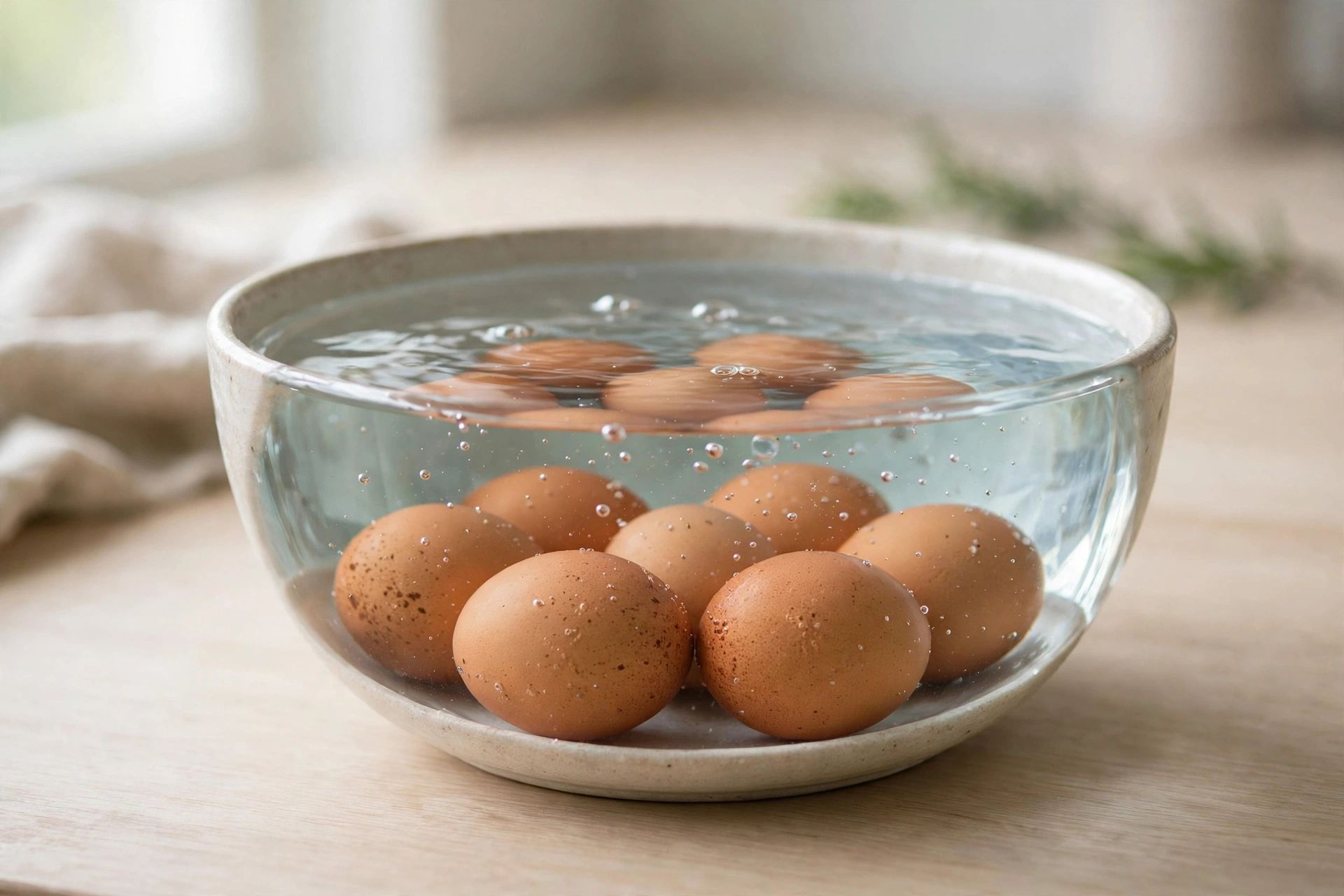
Do bad eggs float or sink? The honest answer is that the float test shows how old an egg is, not whether it is safe to eat. An egg floats when the air cell inside it has grown large, and the air cell grows as the egg ages and loses moisture through the shell. A floating egg is an older egg, and an older egg is not automatically a bad egg. A sinking egg is not automatically a safe egg either.
This guide runs the egg float test step by step, explains what each result really means, covers the egg sinks but stands up middle result that most guides skip, and gives the crack, look and smell checks that actually decide safety. If you keep backyard hens, you will also learn why writing the collection date on the egg beats any test at all.
Table of Contents
- 1 The Short Answer. The Test Shows Age, Not Safety
- 2 How to Do the Egg Float Test
- 3 Egg Sinks and Lies Flat
- 4 Egg Sinks but Stands Up
- 5 Egg Floats
- 6 Why a Bad Egg Can Still Sink
- 7 The Crack, Look and Smell Checks That Decide Safety
- 8 Backyard Eggs and Shop Eggs
- 9 How to Store Eggs So You Rarely Need the Test
- 10 FAQs
Quick Facts
At a Glance
- The float test shows egg age, not safety.
- The air cell grows as the egg ages and loses moisture through the shell.
- A floating egg is older, not automatically bad, and a sinking egg is not automatically safe.
The Test Results
- Sinks flat means fresh with a small air cell.
- Sinks but stands up means older, usually still fine if it passes the crack checks.
- Floats means oldest, treat with suspicion and check by cracking.
Good to Know
- Always crack into a separate bowl, never straight into the pan.
- If in doubt, throw it out.
- Do not wash backyard eggs and then store them, because washing removes the natural bloom that protects the shell.
The Short Answer. The Test Shows Age, Not Safety
Should eggs float or sink? Fresh eggs sink, older eggs float, and the test only measures the air cell inside the shell. As an egg ages it loses moisture through the shell and the air cell at the wide end grows, so the egg becomes more buoyant. That is all the test tells you. It cannot tell you whether bacteria got inside, whether the egg was stored warm, or whether the shell was cracked, and those are the things that actually make an egg unsafe. Keep that distinction in mind through the whole guide, because every section below returns to it.
How to Do the Egg Float Test
Fill a bowl or jug with cool water deep enough to cover the egg, and lower the egg in gently. Do not drop the egg, and do not use hot water, because a cracked shell lets bacteria in and hot water can start to cook the white. Test one egg at a time so you know which result belongs to which egg. Do not return a tested egg to the fridge or the egg box for later use, because a wet shell is easier for bacteria to cross, so only test eggs you will cook straight away. Dry your hands and the bowl between eggs only if the eggs will be cooked straight away, and read the result as soon as the egg settles.

Egg Sinks and Lies Flat
An egg that sinks and lies flat on the bottom is fresh, with a small air cell. Use it as normal, for frying, poaching or baking, and it will hold a thick white and a tall yolk when cracked. This is the result every keeper hopes for, and with backyard eggs collected daily it is the result you will see most often. A fresh sinking egg still deserves the crack check below if the shell is cracked or dirty, because freshness alone does not make a damaged egg safe.
Egg Sinks but Stands Up
An egg that sinks but stands up, or tilts on one end, is the middle result, and it confuses keepers more than any other. It means the air cell has grown, so the egg is older, and it is usually still fine for cooking if it passes the crack checks below. The white will be thinner and the yolk flatter than a fresh egg, so it is better for baking, scrambling or hard boiling than for poaching, where a neat shape matters. Do not throw it out on the float test alone. Crack it into a separate bowl, look, smell, and decide from there.
Egg Floats
An egg that floats is the oldest of the three results, with the largest air cell, and it should be treated with suspicion. Floating alone does not prove it is rotten, and a sound older egg kept cool can float and still be safe to cook thoroughly, though its texture will be poor for poaching or frying. Treat a floating egg as a warning, not a verdict. Crack it into a separate bowl, look at the white and yolk, and smell it. If it smells off, looks pink, green or iridescent, or has a cracked or slimy shell, discard it, whatever the float test said. If eggs float in water are they bad is the question most searchers ask, and the honest answer is that floating means old, and old means check carefully, not eat blindly.
Why a Bad Egg Can Still Sink
A bad egg can still sink, and this is the part of the float test that catches people out. A recently laid egg that was stored warm, cracked or contaminated can be unsafe while still sinking, because the air cell has not had time to grow. Age and safety are two different things, and the float test only measures one of them. A sinking egg with a cracked shell, a slimy shell, or a bad smell when cracked is a bad egg, no matter how firmly it sat on the bottom of the bowl. Do not present any single test as a safety guarantee, and never eat an egg that fails the crack checks just because it sank.

The Crack, Look and Smell Checks That Decide Safety
How to tell if an egg is bad comes down to three checks, and they decide safety where the float test cannot. First, crack the egg into a separate bowl, never straight into the pan or the mixing bowl, so one bad egg cannot spoil a whole dish. Second, look at the white and yolk. A fresh egg holds a thick white and a tall yolk, an older egg spreads thin, and a bad egg may look pink, green or iridescent, or have a cloudy or watery white. Third, smell it. A bad egg smells bad at once, sulphurous and unmistakable, even before cooking. Discard any egg that smells off, looks pink, green or iridescent, or has a cracked or slimy shell, whatever the float test said. If in doubt, throw it out, and say so plainly, because an egg costs far less than a day of food poisoning.
| Result | What it means | What to do |
|---|---|---|
| Sinks and lies flat | Fresh, small air cell | Use as normal, still crack into a separate bowl if the shell is damaged. |
| Sinks but stands up | Older, larger air cell | Usually fine, cook thoroughly, check by cracking, better for baking than poaching. |
| Floats | Oldest, largest air cell | Treat with suspicion, check by cracking, discard if it smells off or looks wrong. |
Backyard Eggs and Shop Eggs
Backyard eggs often carry a laying date the keeper knows, which beats any test. Write the collection date on the egg or the box, and use the oldest eggs first, so you rarely need the float test at all. Shop eggs carry a best before date, and the float test is at best a rough freshness guide for those too, because a shop egg has already spent days in transport and on a shelf before you buy it. The test is most useful for the odd egg you find at the back of the fridge with no date on it, and for the eggs your hens lay while you are away. And if one of those backyard eggs is a tiny yolkless oddity, the fairy egg explainer covers when it is harmless and when a pattern matters. For the wider picture of why hens stop laying in the first place, see the not laying guide, and for what a normal laying rhythm looks like, see how often hens lay.

How to Store Eggs So You Rarely Need the Test
Keep eggs cool, pointy end down where possible, in a clean dry box, and use older eggs first. Pointy end down keeps the yolk centred and the air cell where it belongs, and a steady cool temperature slows the moisture loss that grows the air cell. Do not wash backyard eggs and then store them, because washing removes the natural bloom that protects the shell, and a washed egg spoils faster than an unwashed one. If an egg is dirty, wipe it dry or wash it only just before cooking. The free starter checklist includes an egg tracker that makes dating and rotating eggs a habit rather than a chore.

FAQs
FAQ 1. Do bad eggs float or sink?
Both, and that is why the test cannot decide safety. Old eggs float because the air cell has grown, but a recently laid egg that was stored warm or cracked can be bad while still sinking. Use the crack, look and smell checks to decide.
FAQ 2. Do good eggs float or sink?
Fresh good eggs sink and lie flat. An older good egg can float and still be safe to cook thoroughly, though its texture will be poorer for poaching or frying. Floating means old, not automatically bad.
FAQ 3. If eggs float in water are they bad?
Not necessarily. Floating means the egg is old, with a large air cell. Treat it with suspicion, crack it into a separate bowl, and discard it if it smells off or looks pink, green or iridescent.
FAQ 4. What does it mean if an egg sinks but stands up?
It is older than a flat lying egg, with a larger air cell, and is usually still fine for cooking if it passes the crack checks. It is better for baking or scrambling than for poaching.
FAQ 5. How long do eggs last?
A cool stored backyard egg stays good for several weeks, and a written collection date beats any test for knowing its age. Shop eggs should be used by their best before date, and any egg that smells off when cracked should be thrown out, whatever its date.
The float test is a useful freshness guide and a poor safety test, and knowing which one it is keeps you from throwing out good eggs and from eating bad ones. Date your eggs, store them cool and pointy end down, and let the crack, look and smell checks have the last word.

WRITTEN BY
Nusrat
Author, TheChickenPet.com