
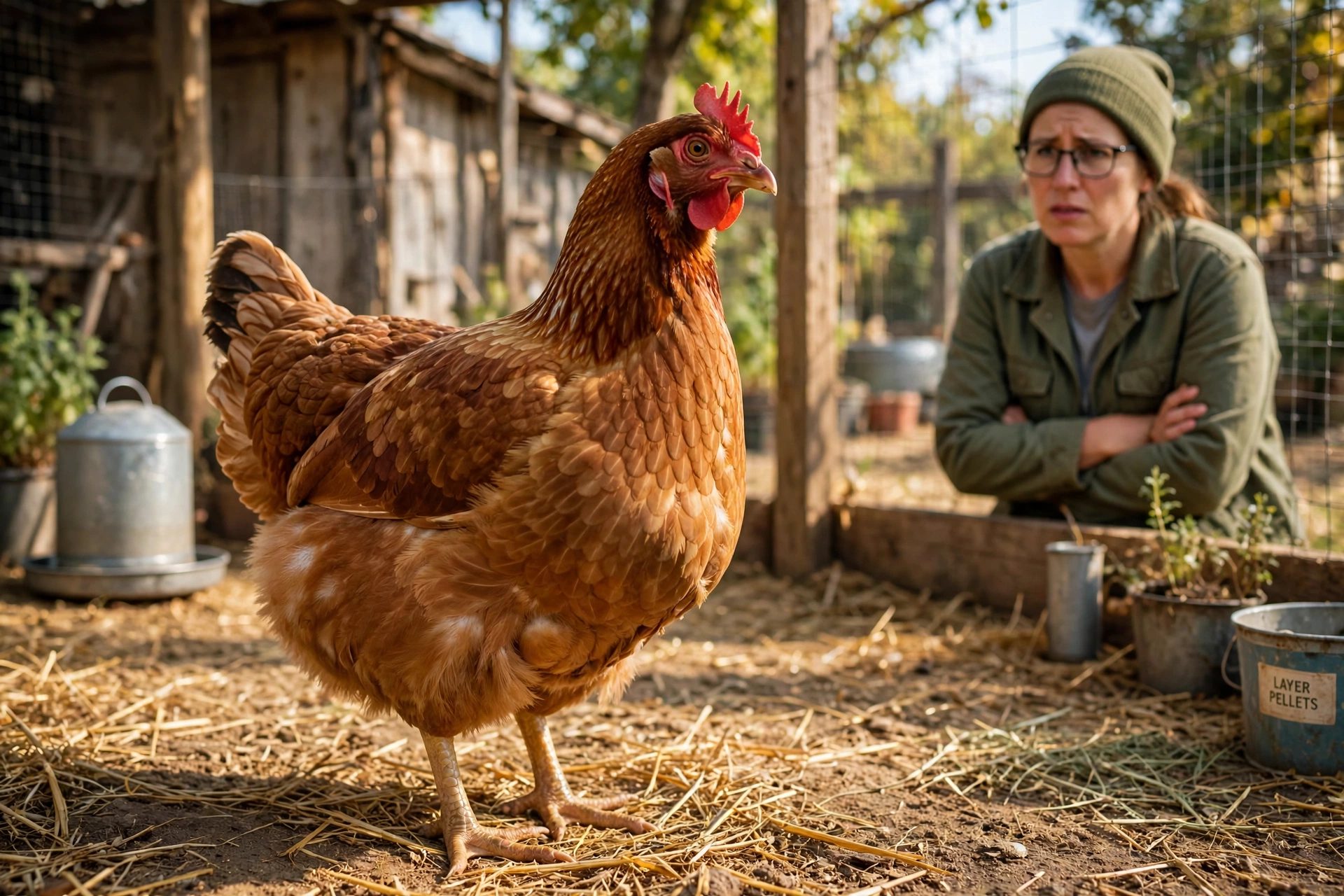
A keeper usually notices something wrong on an ordinary morning check, when a hen that was bright and busy yesterday is now sitting quietly in a corner with her belly looking full and round. She may stand upright like a penguin, she may have stopped laying, and she may not want her usual food.
The problem behind those signs is often egg yolk peritonitis, a serious reproductive problem in laying hens. It happens when yolk misses the oviduct and drops into the body cavity instead. Yolk does not belong there, so the body reacts with inflammation and infection, and fluid builds up inside the belly. There is no home cure, so a hen with these signs needs a vet the same day.

Table of Contents
Quick Facts
At a Glance Egg yolk peritonitis is a serious reproductive problem in laying hens. Yolk misses the oviduct and drops into the body cavity, where it causes internal infection and fluid build-up.
Watch Out A swollen belly, a penguin-like stance, stopped laying, lethargy and laboured breathing are the signs to act on. There is no home cure, so a hen with these signs needs a vet the same day.
Prevention Good layer feed with calcium, sensible light management, avoiding overfeeding and not pushing young pullets to lay early all lower the risk.
The Short Answer
Egg yolk peritonitis is a serious internal infection in a laying hen, caused by yolk that misses the oviduct and drops into the body cavity. The yolk does not belong there, so the body responds with inflammation, infection sets in, and fluid gathers inside the belly. The hen becomes ill, her belly swells, she stops laying, and she often stands upright like a penguin because the fluid and the swelling make it hard for her to stand normally.
There is no home cure for this condition. Warm baths, oils, massage and herbal remedies cannot remove yolk and infected fluid from inside the body cavity, and they cannot undo the infection. A vet may drain fluid from the belly and give antibiotics, and some hens do recover, but the outlook is often poor and many hens do not recover even with treatment. If you see a laying hen with a swollen belly, a penguin-like stance and no eggs for several days, treat it as urgent and call a vet the same day. Our guide on why are my chickens not laying eggs covers the other reasons laying can stop. While you wait, keep her warm, quiet and comfortable, with fresh water close by, and handle her as little as possible.
What Is Egg Yolk Peritonitis
Each yolk is normally released from the ovary into the funnel at the top of the oviduct, the long tube where the egg white, the membranes and the shell are added as the yolk travels down. When everything works as it should, the yolk is caught by that funnel every time, and the finished egg is laid in the nest box.
Egg yolk peritonitis happens when that step goes wrong. The yolk is released from the ovary but misses the funnel, and instead of entering the oviduct, it drops into the body cavity. This is sometimes called internal laying, because the yolk ends up inside the body rather than inside an egg. A single missed yolk may cause only a small problem, but repeated misses let yolk and fluid build up inside the belly, and that is when a hen becomes seriously ill.
Yolk is rich food for bacteria, so once it is loose inside the body cavity, infection often follows. The lining of the body cavity becomes inflamed, which is what the word peritonitis means, and fluid gathers around the organs. The fluid presses on the lungs and the other organs, which is why a hen with this condition often breathes with effort and stands upright. Her belly grows rounder and feels full or tight when you lift her gently, and she may waddle when she walks.
Why It Happens
Age and heavy laying are the biggest risk factors. A hen that has laid for two or three seasons has put her oviduct through thousands of cycles, and the tissues can lose some of their strength and elasticity. The funnel that catches each yolk may not close around it as neatly as it once did, so a yolk can slip past and fall into the body cavity.
Infection of the reproductive tract is another common cause. Bacteria such as E. coli can infect the oviduct, and the inflammation that follows can damage the funnel and the lining of the tube. An infected oviduct may also produce sticky material that blocks the normal path of the yolk. Stress and sudden changes can trigger the problem too. A hen that is startled while a yolk is being released may have the yolk drop in the wrong place, because the oviduct contracts at the wrong moment. Moving house, a predator attack, a change of flock mates, a sudden change in feed, or very hot or very cold weather can all disrupt laying.
Nutrition and light also play a part. A hen that is overfed, especially on high energy feed with too many treats, can become overweight, and fat around the reproductive organs makes it harder for the oviduct to work properly. A lack of calcium can weaken the shell gland and the muscles of the oviduct. Hens that are pushed to lay early, before their bodies are fully grown, are more likely to develop reproductive problems later. A hen that has already had a reproductive problem, such as a soft shelled egg or a lash egg, is worth watching closely. Our guide on lash eggs in chickens covers another reproductive problem that can point to trouble in the same system.
Signs to Look For
The egg yolk peritonitis symptoms usually build up over days rather than appearing all at once. A hen may seem a little quieter than usual for a day or two, she may eat a little less, and she may spend more time sitting in the nest box or in a corner of the run. Her laying may become irregular first, with a soft shelled egg or a missed day, before it stops altogether. If you know your hens and their normal habits, these small changes are worth paying attention to.
A swollen belly in a laying hen is the sign most keepers notice first. The belly, the area between the legs and below the vent, becomes round and full, and it may feel tight or firm when you lift the hen gently. In some hens the swelling is soft and fluid filled, and it feels like a water balloon under the skin. The swelling grows slowly, and a hen that had a normal belly a week ago may have a clearly rounded one now.
The penguin-like stance is another classic sign. A hen with fluid in her belly stands more upright than normal, with her tail held low and her body tilted forward, because the weight of the fluid changes her balance. She may waddle when she walks, take short careful steps, and sit down often to rest. Stopped laying goes with the swelling, and a hen with egg yolk peritonitis usually stops laying altogether.
Lethargy grows as the infection builds. A hen with egg yolk peritonitis becomes quieter, moves less, sits more, and may lose interest in treats that she normally loves. She may hold her eyes half closed, fluff her feathers out, and sit apart from the rest of the flock. Laboured breathing is a sign that the problem has become serious. The fluid in the belly presses upwards on the lungs, so the hen has to work harder to breathe. She may breathe with her beak open, pant even when the weather is cool, and her tail may bob up and down with each breath. Her comb may become pale, and her droppings may become watery, with yellowish material that looks like yolk. A hen that shows several of these signs together should be seen by a vet the same day.
Egg Yolk Peritonitis Versus Egg Binding
Egg yolk peritonitis and egg binding are both reproductive emergencies, and they can look alike at first, but they are different problems and they need different responses. Egg binding means an egg is stuck inside the hen, usually in the lower part of the oviduct, and it cannot come out. The hen strains hard to lay, she may pump her tail up and down, she may walk with a waddle, and she may sit in the nest box for hours without producing an egg. A stuck egg can often be felt through the belly, just above the vent, as a hard round shape. Egg binding comes on quickly, often within a day, and it can kill a hen within 24 to 48 hours if the egg does not pass.
Egg yolk peritonitis is slower. The yolk is not stuck in the oviduct at all, it has missed the oviduct entirely and is loose inside the body cavity. The hen does not strain to lay in the same way, because there is no egg to push out. Her belly swells gradually over days, she stands like a penguin, she stops laying, and she becomes lethargic. There is no hard round egg to feel, because the problem is fluid and yolk spread through the belly, not a single stuck egg.
What you do is different too. For a bound hen, a warm bath and gentle care can sometimes help the egg pass, and a vet may need to remove the egg. For a hen with egg yolk peritonitis, a warm bath will not help, because there is no egg to pass and the problem is infection and fluid inside the body. Massaging her belly can do harm, because it can push infected fluid around and cause more pain. The safest course for either problem is to call a vet the same day. Read our guide on egg bound hen for the full picture of the stuck egg emergency. If you have a hen that is straining and you are not sure which problem she has, treat it as egg binding until the vet says otherwise, because a stuck egg kills faster.
Egg Yolk Peritonitis Versus Broodiness
Broodiness is the third problem that keepers sometimes confuse with egg yolk peritonitis, because a broody hen also stops laying, sits in the nest box for long periods, and may seem quieter than usual. The difference is that broodiness is normal behaviour, while egg yolk peritonitis is a disease, and a broody hen is healthy even though she is not laying.
A broody hen sits on the nest because her hormones are telling her to hatch eggs. She flattens herself over the nest, she puffs her feathers out, she growls or clucks in a low voice when you reach towards her, and she may peck at your hand if you try to lift her off. She leaves the nest once or twice a day to eat, drink and have a large dropping, and then she hurries back. Her belly is not swollen, her breathing is normal, and when you lift her off the nest she walks normally, even if she is grumpy about it.
A hen with egg yolk peritonitis sits because she feels ill, not because she wants to hatch eggs. She may sit in a corner of the run or in the nest box, but she does not flatten herself over eggs, she does not growl when you approach, and she does not hurry back to the nest after eating. Her belly is swollen and round, she stands like a penguin when she does stand, she breathes with effort, and she may not want food at all. Her comb may be pale, her eyes may be half closed, and she may be too weak to peck at your hand. If her belly is swollen, if she is breathing with her beak open, or if she has not eaten for a day, do not assume broodiness, and call a vet the same day.
What a Vet Does
A vet starts by examining the hen and working out whether the problem is egg yolk peritonitis or something else. The vet will feel the belly gently to check for fluid, listen to the breathing, look at the comb and the vent, and ask you how long the hen has been ill, when she last laid, and what her droppings have looked like. The vet may use an ultrasound or an X-ray to look inside the belly, because fluid and yolk show up differently from a stuck egg or a tumour.
The main egg yolk peritonitis treatment is to drain the fluid from the belly, a procedure that is sometimes called abdominocentesis. The vet uses a fine needle to draw fluid out through the belly wall, which takes pressure off the lungs and the organs and helps the hen breathe more easily. The fluid that is drawn out can also be tested to confirm the diagnosis and to find out which bacteria are involved, which helps the vet choose the right antibiotic. Antibiotics are usually given as well, because infection is almost always part of the problem. They cannot remove the yolk that is already in the body cavity, and they cannot undo the damage to the oviduct, but they can fight the infection and give the hen a chance to recover.
Supportive care is part of the treatment too. A vet may keep the hen in the clinic for a day or two, with warmth, fluids, and easy food, while the antibiotics start to work. It is important to be honest about the outlook. Some hens do recover, especially when the problem is caught early and the hen is still strong. But the outlook is often poor, and many hens do not recover even with the best care, because the yolk and the infected material are spread through the body cavity and the oviduct may already be badly damaged. The vet may talk about stopping laying altogether, through a hormone implant or, in some cases, surgery, because a hen that stops laying cannot develop the problem again. The vet may also raise the question of euthanasia if the hen is suffering and treatment is no longer helping, and that is a hard conversation, but it is kinder than letting a hen suffer with a belly full of infected fluid and laboured breathing.
What to Do at Home While You Wait for the Vet
While you wait for the vet, your job is to keep the hen comfortable, warm and calm, and to avoid doing anything that could make the problem worse. There is no home treatment that cures egg yolk peritonitis, so do not try to fix it yourself, and do not delay the vet visit to try a remedy you have read about online. The steps below are about comfort and safety, not about curing the disease.
Move the hen to a clean, quiet pen of her own, away from the rest of the flock. A sick hen needs rest, and she needs to be safe from pecking and from being pushed away from food and water. The pen should be warm, out of draughts, and easy for her to move around in, with soft bedding that she can sit on comfortably. Put her food and water close to where she rests, so she does not have to walk far to reach them. Offer fresh clean water at all times, and offer soft easy food. Soaked layer pellets, scrambled egg, plain yoghurt and soft greens are all good choices for a hen that may not feel like eating hard pellets. Do not force food or water into her beak, because a hen that is struggling to breathe can choke.
Keep her warm, but do not overheat her. A warm pen, a heat lamp at a safe distance, or a warm towel wrapped around a hot water bottle can help, and make sure she can move away from the heat if she gets too warm. Handle her as little as possible, and handle her gently when you must. Do not massage her belly, do not try to feel for an egg by pressing hard, and do not try to drain fluid yourself. Pressing on a swollen belly can cause pain, it can push infected fluid around, and it can make breathing harder. Do not give her medicines meant for people, and do not give her antibiotics left over from another bird or another animal.

Prevention
Prevention is the most useful part of this guide, because egg yolk peritonitis is much easier to prevent than it is to treat. Our pillar guide on chicken care and health covers flock health in full. Feed a good layer feed with calcium, and keep treats small. A hen in lay needs a balanced layer feed that provides the protein, the vitamins and the calcium her body needs to make eggs and to keep her oviduct healthy. Keep treats such as corn, kitchen scraps and mealworms to a small part of the diet, because too many high energy treats lead to overweight hens, and overweight hens are more likely to develop reproductive problems. Our guide on why is my chicken laying soft shell eggs covers calcium and shell quality in more detail, and soft shelled eggs are often an early warning that the diet or the calcium supply needs attention.
Manage light sensibly, and do not push young pullets to lay early. Pullets should be allowed to grow to full size before they start laying, and they should not be pushed with very long artificial light in their first season. A pullet that starts laying too young is more likely to develop reproductive problems later. Once hens are laying, give them a natural break in winter, or at least do not keep them under very long light all year without a rest. Avoid overfeeding, and keep hens at a healthy weight. A hen should feel firm but not fat, with a breast bone you can feel easily under a thin layer of muscle.
Reduce stress, and keep the flock calm. Keep the coop and the run safe from predators, avoid sudden changes in feed or flock mates, handle hens gently, and give them enough space, perches and nest boxes so that they do not have to fight for a place to lay. Keep the coop clean, with fresh bedding, clean feeders and clean waterers, because a clean coop reduces the bacteria that can infect the oviduct. Check your hens every day, and look for the early signs covered in this guide. Early action is the best chance a hen has, so do not wait for a swollen belly before you act.
When It Is an Emergency
Egg yolk peritonitis is always serious, but some signs mean the hen needs a vet the same day, without delay. A swollen belly with laboured breathing is an emergency. The fluid in the belly is pressing on the lungs, and the hen is struggling to get enough air. A hen that breathes with her beak open, pants even in cool weather, or has a tail that bobs with each breath is in trouble, and she may get worse quickly. Do not wait to see if she improves on her own, because she will not improve without treatment.
A hen that has stopped eating and drinking for more than a day is an emergency too. A hen that will not drink becomes dehydrated quickly, and dehydration makes the infection worse. Offer water in a shallow dish, and offer soft food, but if she takes nothing for a full day, she needs a vet the same day, even if her breathing seems normal. A hen that is too weak to stand, or that collapses when she tries to walk, is an emergency.
A hen with a swollen belly and yellowish fluid or yolk-like material around her vent is an emergency as well. That discharge can mean that infected material is leaking, and it can mean that the oviduct is badly damaged. Do not try to clean inside the vent, and do not try to pull anything out. A hen that is straining hard, with a hard round shape you can feel near her vent, may have a stuck egg as well as egg yolk peritonitis, and that is an emergency that can kill within a day. Treat a straining hen as egg bound until the vet says otherwise, and call the vet at once.

Frequently Asked Questions
What are the egg yolk peritonitis symptoms?
The egg yolk peritonitis symptoms are a swollen belly, a penguin-like stance, stopped laying, lethargy and laboured breathing. A hen may also have a pale comb, watery droppings, and yellowish material around the vent. The signs build up over days, and a swollen belly in a laying hen, especially when it goes with stopped laying and laboured breathing, should always be treated as urgent.
Is egg yolk peritonitis contagious?
Egg yolk peritonitis itself is not contagious in the way that a cold or a virus is contagious, because it is not passed from hen to hen through the air or through contact. One hen cannot catch it from another hen simply by living in the same coop. The bacteria that infect the yolk inside the body, such as E. coli, are common in the environment, and several hens can develop the problem at the same time if they share the same risk factors, such as poor diet, stress, or a dirty coop.
What is the egg yolk peritonitis treatment?
The egg yolk peritonitis treatment a vet gives is usually a mix of draining fluid from the belly, antibiotics to fight the infection, anti-inflammatory medicine to reduce swelling and pain, and supportive care such as warmth and fluids. Draining the fluid takes pressure off the lungs and helps the hen breathe more easily, and it can be repeated if the fluid builds up again. There is no home cure, and no cream, oil, bath or herbal remedy can remove yolk and infected fluid from inside the body cavity.
Can a chicken survive egg yolk peritonitis?
Can a chicken survive egg yolk peritonitis is a question every keeper asks, and the honest answer is that some hens do survive, but many do not. The outlook is often poor, and many hens do not recover even with a vet’s help, because the yolk and the infected material are spread through the body cavity and the oviduct may already be badly damaged. Hens that are caught early, that are still strong, and that are seen by a vet the same day have the best chance
What causes a swollen belly in a laying hen?
A swollen belly in a laying hen can have several causes, and egg yolk peritonitis is one of the most serious. Other causes include a stuck egg, a tumour of the reproductive tract, fluid from heart or liver disease, and simple overweight. A stuck egg usually comes on quickly, with hard straining and a hard round shape you can feel near the vent. Egg yolk peritonitis builds up slowly over days, with a soft or firm round belly, a penguin-like stance, stopped laying and lethargy.
Can a hen with egg yolk peritonitis lay eggs again?
A hen that recovers from egg yolk peritonitis may lay again, but many do not return to normal laying. The oviduct is often damaged by the infection and the inflammation, and it may not work as smoothly as it once did. Some hens lay soft shelled eggs or irregular eggs after recovery, and some stop laying altogether. A vet may suggest stopping laying on purpose, through a hormone implant, to prevent the problem coming back.
Should I separate a hen with egg yolk peritonitis from the flock?
Yes, separate her at once, and keep her in a clean, quiet pen of her own. Separation is not mainly about contagion, because the condition itself is not passed from hen to hen, but it is about rest and safety. A sick hen needs a warm, dry place where she can rest without being pecked or pushed away from food and water, and she needs her food and water close by. Separation also lets you watch her closely, and note whether she is eating and drinking.
Can you eat eggs from a hen with egg yolk peritonitis?
A hen with egg yolk peritonitis usually stops laying altogether, so there are often no eggs to eat. If she does lay an egg while she is ill, do not eat it, and do not sell it or give it away. The hen may be on antibiotics, and eggs laid during antibiotic treatment should not be eaten until the withdrawal period the vet gives has passed.

Keep Reading
Egg Bound Hen and the stuck egg emergency to tell it apart from egg yolk peritonitis.
Lash Eggs in Chickens and another reproductive problem in laying hens.
Chicken Care and Health and the pillar guide for keeping your flock healthy.

Nusrat
Author, TheChickenPet.com