
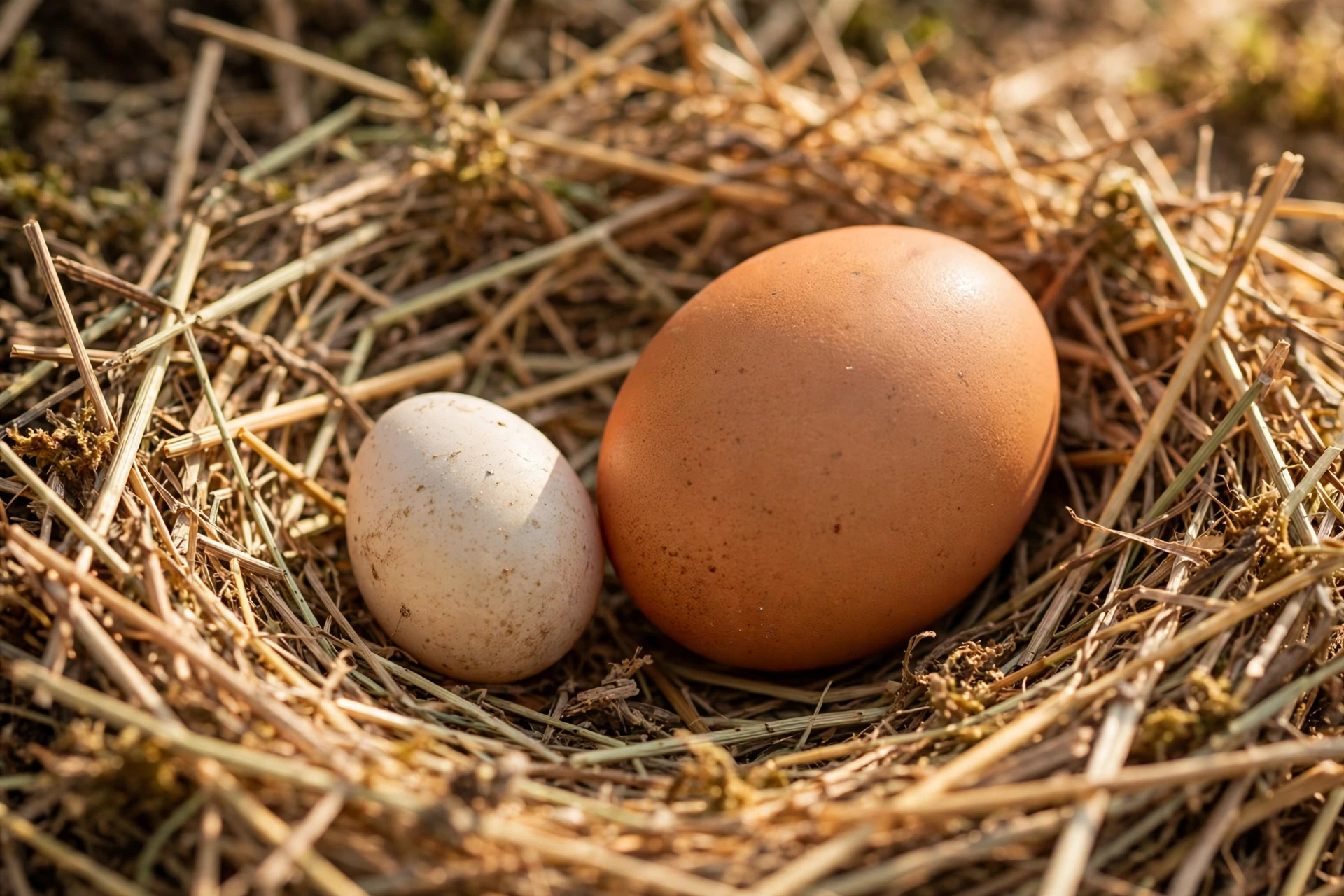
You open the nest box expecting the usual egg, and there it is, a small egg, half the size of the others, sitting in the straw like a joke. The first time it happens, most keepers worry. Is the hen ill, is something wrong with her feed, or is this the start of a bigger problem. Most of the time, the answer is far simpler than the worry.
Small eggs are common, and they usually have a simple cause. A young hen that has just started laying will lay small eggs, and they grow to full size over the coming weeks. A tiny yolkless egg, called a fairy egg, is a small glitch in the reproductive system and nothing to fear. Stress, heat, breed and age all play a part too, and only a few causes of small eggs are worth real worry.
This guide covers the common causes of small eggs, one by one, so you can work out which one fits your flock. It also covers what to do about each cause, and the warning signs that mean a hen needs a closer look or a vet.

Table of Contents
Quick Facts
At a Glance Small eggs are usually normal. The most common causes are a young hen that has just started laying, a fairy egg, stress, heat, or simply the breed of the hen.
Normal or Not A pullet egg grows to full size over a few weeks, and a fairy egg is a one off glitch. Small eggs from a mature hen that used to lay full size eggs deserve a closer look.
Watch Out Small eggs alongside a drop in laying, misshapen shells, or a hen that looks unwell can mean illness or a reproductive problem, and a hen that strains without laying needs a vet at once.
The Short Answer
Why are my chickens laying small eggs. The most common answer is that the hen is young and has just started laying. A pullet that has just come into lay produces small eggs at first, and they grow to full size over the first few weeks of laying. That is normal, and it needs no action at all.
The next most common answers are a fairy egg, a one off tiny egg with no yolk, and stress or heat, both of which can shrink eggs for a few days. Breed matters too, because some breeds simply lay smaller eggs than others. A Silkie will never lay an egg as big as a Rhode Island Red’s, and that is not a problem, it is just the breed.
The cause that needs attention is a change. A mature hen that has laid full size eggs for months and suddenly starts laying small ones is telling you something has changed, and the sections below help you work out what. The rest of this guide goes through each cause in turn, so you can match what you see in the nest box to what is happening with your birds.
Fairy Eggs
A fairy egg is a tiny egg, often about an inch long, with no yolk inside. It is sometimes called a fart egg, a wind egg or a rooster egg, though no rooster is involved. It happens when a small piece of tissue breaks loose inside the hen’s reproductive tract and the hen’s body treats it like a yolk, wrapping it in white and then a shell. The result is a perfect miniature egg with nothing inside it but white.
Fairy eggs are a glitch, not a disease. They show up most often in young hens that are just starting to lay, because the reproductive system is still settling into its rhythm, and in old hens whose system is winding down. They also appear after a fright or a disruption, when the laying cycle is knocked off track for a day. A single fairy egg is nothing to worry about, and most keepers who keep chickens for a few years will find one sooner or later.
Our article on the fairy egg covers these tiny eggs in full, including what they look like inside and when they appear. If you keep finding fairy eggs from the same hen, week after week, that is worth a closer look, because a hen that keeps producing them may have a problem in her reproductive tract. But one fairy egg, or one now and then, is normal.

New Layers and Pullet Eggs
A pullet that has just started laying will lay small eggs, and that is the most common cause of small eggs in a backyard flock. Her reproductive system is new, her body is still growing, and the eggs she produces at first are small because she is small and her system is still learning its rhythm. These first eggs are called pullet eggs, and they are a normal part of starting to lay.
Pullet eggs grow to full size over the first few weeks of laying. The first egg may be surprisingly small, the next ones a little bigger, and by the time the hen has been laying for a month or two, her eggs should be close to their full size. The shell may be a little rough or uneven at first too, and that also settles down as the system gets into its rhythm.
There is nothing to do about pullet eggs except wait. Do not change the feed, do not add supplements, and do not worry. Make sure the young hen is eating a proper layer feed with oyster shell on the side, and that she has clean water and a quiet nest box. The eggs will grow on their own, and the wait is usually only a few weeks.
One thing to watch is the size of the eggs compared with the hen. A very small pullet that starts laying very early can lay eggs that are too big for her body, and that can lead to problems. But small eggs from a young hen are the normal pattern, and they are a sign that her body is doing things in the right order, small first and bigger later.
Breed Makes a Difference
Breed is one of the simplest reasons for small eggs, and it is easy to overlook. Some breeds lay large eggs, and some lay small ones, and no amount of feeding will change that. A Rhode Island Red or a Plymouth Rock lays a large brown egg. A Leghorn lays a large white egg. A Silkie, a bantam or a Sebright lays a small egg, and that is simply what the breed does.
Egg size follows body size in a rough way. A large hen lays a large egg, and a small hen lays a small egg. Bantams are the clearest example, because a bantam hen is a miniature chicken and her eggs are miniature too, often about half the size of a standard egg. That is not a problem, and it is not a sign of poor health. It is the breed doing what the breed does.
If you keep several breeds together, compare like with like. A small egg from your Silkie is normal, and a small egg from your Rhode Island Red is not. The question is not whether the egg is small in absolute terms, but whether it is small for that hen. Keep a mental note of what each hen usually lays, and a change in one hen’s eggs will stand out far more clearly than a comparison between different breeds.
Stress and Disruption
Stress can shrink eggs, and it does so quickly. A hen that has been frightened by a predator, moved to a new coop, or had new birds added to the flock may lay smaller eggs for a few days, or stop laying altogether for a while. The stress hormones in her body interrupt the laying cycle, and the egg that was forming at the time comes out smaller than it should have been.
Common stress events include a dog running at the run, a fox visit at night, a loud storm, a change of coop, new flock members, and a change in the daily routine. Even a small change, such as a new feeder or a different person collecting the eggs, can unsettle a nervous hen. The effect usually lasts only a few days, and the eggs return to normal size once the hen settles.
If stress is the cause, the fix is to remove the stress and give the hen time. Keep the routine steady, keep the coop quiet and secure, and do not add new birds to the flock while a hen is already unsettled. A hen that feels safe will lay normally again, and a hen that keeps being frightened will keep laying small eggs. If a hen has stopped laying altogether, our guide on why are my chickens not laying eggs covers the wider problem.
Heat and Summer
Heat shrinks eggs in a simple way. A hen that is hot eats less, and a hen that eats less has less to put into her eggs. On a hot summer day, a hen spends her energy keeping cool, panting and holding her wings away from her body, and she eats far less feed than she would on a mild day. The eggs she lays during a heatwave are often smaller, and she may lay fewer of them too.
The fix is to keep the hens cool. Shade is the first thing, whether from a tree, a tarp or a solid roof over the run. Fresh cool water is the second, and on a hot day the water should be checked and refilled more often than usual. A shallow tray of water for the hens to stand in, a frozen bottle of water in the run, and a cool damp patch of ground to lie on all help. Good ventilation in the coop matters too, because a hot coop at night means a hen that never cools down properly.
Heat also affects the shell. A hen that is panting loses carbon dioxide, and that changes the chemistry of her shell gland, so eggs laid in hot weather may have thinner shells as well as smaller size. This is another reason to keep the flock cool, and our guide on why is my chicken laying soft shell eggs covers shell problems in detail.
Feed and Nutrition
Feed affects egg size, though less than most keepers expect. A hen that is short on protein will lay smaller eggs, because the egg white is mostly protein and a hen that does not eat enough of it cannot build a full size egg. A hen that is short on energy will lay fewer eggs, and the ones she does lay may be smaller. A balanced layer feed, with around 16 to 18 percent protein, gives a hen what she needs for full size eggs.
Calcium affects the shell more than the size. A hen that is short on calcium will lay eggs with thin or soft shells, but the eggs themselves will not necessarily be smaller. That is worth knowing, because adding more oyster shell will fix a shell problem but it will not fix a size problem. If the shells are fine and the eggs are small, calcium is not the issue.
Too many treats can shrink eggs too. A hen that fills up on scratch grain, kitchen scraps and corn will eat less of her layer feed, and her eggs will show it. Treats should stay under 10 percent of what a hen eats in a day, and the layer feed should always be the main food. A hen that eats her proper feed will lay the eggs her breed and age are capable of, and no supplement will push her past that.
Old Hens and Small Eggs
Old hens usually lay larger eggs, not smaller ones, so small eggs from an old hen deserve a closer look. A hen that has laid for years will lay fewer eggs as she ages, but the eggs she does lay tend to be bigger than the ones she laid in her first year. If an old hen starts laying small eggs, something has changed, and the cause is usually one of the problems in the next section.
An old hen’s reproductive system wears out over time. The tissues that form the egg become less efficient, and the hen may start laying eggs that are misshapen, rough shelled, or smaller than they used to be. That is a normal part of ageing, and it is not something a keeper can fix. An old hen that is still eating, drinking and moving well, and that lays a small egg now and then, is simply an old bird.
The line between normal ageing and a real problem is in the bird herself. An old hen that lays a small egg but looks bright and well is probably fine. An old hen that lays small eggs and also looks dull, loses weight, or has a swollen belly needs a vet, because those signs point to a reproductive problem rather than simple ageing.

Illness and Reproductive Problems
Illness can shrink eggs, and one disease in particular is known for it. Infectious bronchitis, a common respiratory disease of chickens, can cause small, misshapen and wrinkled eggs, and a sharp drop in laying. A flock that has had a respiratory illness and then starts laying small wrinkled eggs has very likely met infectious bronchitis. The eggs are still safe to eat, but the flock will need time to recover, and laying may never fully return to what it was.
Reproductive problems can also cause small eggs. A hen with a problem in her oviduct, the tube that forms the egg, may lay eggs that are small, misshapen or shell-less. Internal laying, where a yolk drops into the body cavity instead of into the oviduct, can cause a hen to lay small eggs and then stop laying altogether. A hen that strains, walks like a penguin, or has a swollen belly may be egg bound, and that is an emergency. Our guide on the egg bound hen covers that problem in full, and it should be read at once if a hen shows those signs.
Parasites can shrink eggs too, in a slower way. A heavy worm load drains a bird’s strength and takes the protein she needs for her eggs. A hen that is losing weight, has pale wattles, and lays small eggs may be carrying worms. A fecal test from a vet will confirm it, and treatment is straightforward.
What to Do Step by Step
Start by working out which hen is laying the small eggs. If you have several hens, watch the nest boxes, or separate the hens for a day to see who lays what. Knowing which hen is involved is the first step, because the cause is usually about one bird, not the whole flock.
Next, check the hen’s age and breed. A young pullet that has just started laying needs nothing but time. A bantam or a Silkie is laying the eggs her breed lays, and that is normal. A mature hen that used to lay full size eggs and has suddenly changed needs a closer look.
Then check for stress and heat. Has anything changed in the last few days. A predator visit, a move, new birds, a heatwave, a change of feed. If something has changed, give the hen a few quiet days and see if the eggs return to normal size. Check the feed too, and make sure the hen is eating a proper layer feed with oyster shell on the side, and that treats are under 10 percent of what she eats.
Finally, look at the hen herself. Is she eating and drinking normally, does she look bright, is her vent clean, does her belly feel normal. A hen that looks well and lays a small egg now and then is probably fine. A hen that looks unwell, has stopped eating, or shows any of the warning signs in the next section needs a vet.

When to Worry
Most small eggs are nothing to worry about, but a few signs mean a hen needs help. A hen that strains to lay, walks like a penguin, or has a swollen belly may be egg bound, and that is an emergency that needs a vet at once. A hen that has stopped eating or drinking, that sits hunched and fluffed up, or that cannot stand, needs help the same day.
Small eggs alongside a sharp drop in laying, wrinkled or misshapen shells, or a hen that looks dull and thin, point to illness or a reproductive problem, and a vet should see the bird. A hen that keeps laying fairy eggs week after week, or that lays small eggs for more than a few weeks without any clear cause, is also worth a vet visit, because a persistent change in egg size is a clue that something inside the bird has changed.
Do not wait if you are unsure. A vet can feel the hen’s belly, check for egg binding, run a fecal test for worms, and tell you whether the problem is simple or serious. A visit that turns out to be unnecessary costs little, and a visit that comes too late can cost a hen. For more on keeping the flock healthy, the Chicken Care and Health pillar is a good place to start.
Frequently Asked Questions
Why are my chickens laying small eggs?
The most common reason is that the hen is young and has just started laying. Pullet eggs start small and grow to full size over a few weeks. Other common causes are fairy eggs, stress, heat, and the breed of the hen. A mature hen that suddenly starts laying small eggs after laying full size eggs deserves a closer look.
Are small eggs safe to eat?
Yes, small eggs are safe to eat, and they taste the same as full size eggs. A pullet egg, a fairy egg and a small egg from a stressed hen are all fine to eat, as long as the shell is intact and the egg is fresh. Our guide on do bad eggs float or sink shows how to check whether an egg is fresh.
What is a fairy egg?
A fairy egg is a tiny egg, often about an inch long, with no yolk inside. It happens when a small piece of tissue breaks loose inside the hen and her body wraps it in white and shell, just as it would a yolk. Fairy eggs are most common in young hens that are just starting to lay and in old hens, and a single one is nothing to worry about.
How long do pullet eggs stay small?
Pullet eggs grow to full size over the first few weeks of laying. The first eggs may be surprisingly small, and by the time the hen has been laying for a month or two, her eggs should be close to their full size for her breed.
Can heat cause small eggs?
Yes, heat can cause small eggs. A hen that is hot eats less, and a hen that eats less has less to put into her eggs. Shade, fresh cool water and good ventilation in the coop help the flock keep laying normally through hot weather.
Do old hens lay small eggs?
Old hens usually lay larger eggs, not smaller ones, though they lay fewer of them. If an old hen starts laying small eggs, it can be a normal part of ageing, but it can also mean a reproductive problem, especially if she also looks dull, loses weight or has a swollen belly. A vet should see any old hen that changes suddenly.
Keep Reading
Why Are My Chickens Not Laying Eggs and the wider laying problem behind small eggs.
Fairy Egg and the tiny yolkless egg explained in full.
Why Is My Chicken Laying Soft Shell Eggs and the other egg quality problem to know.

Nusrat
Author, TheChickenPet.com