
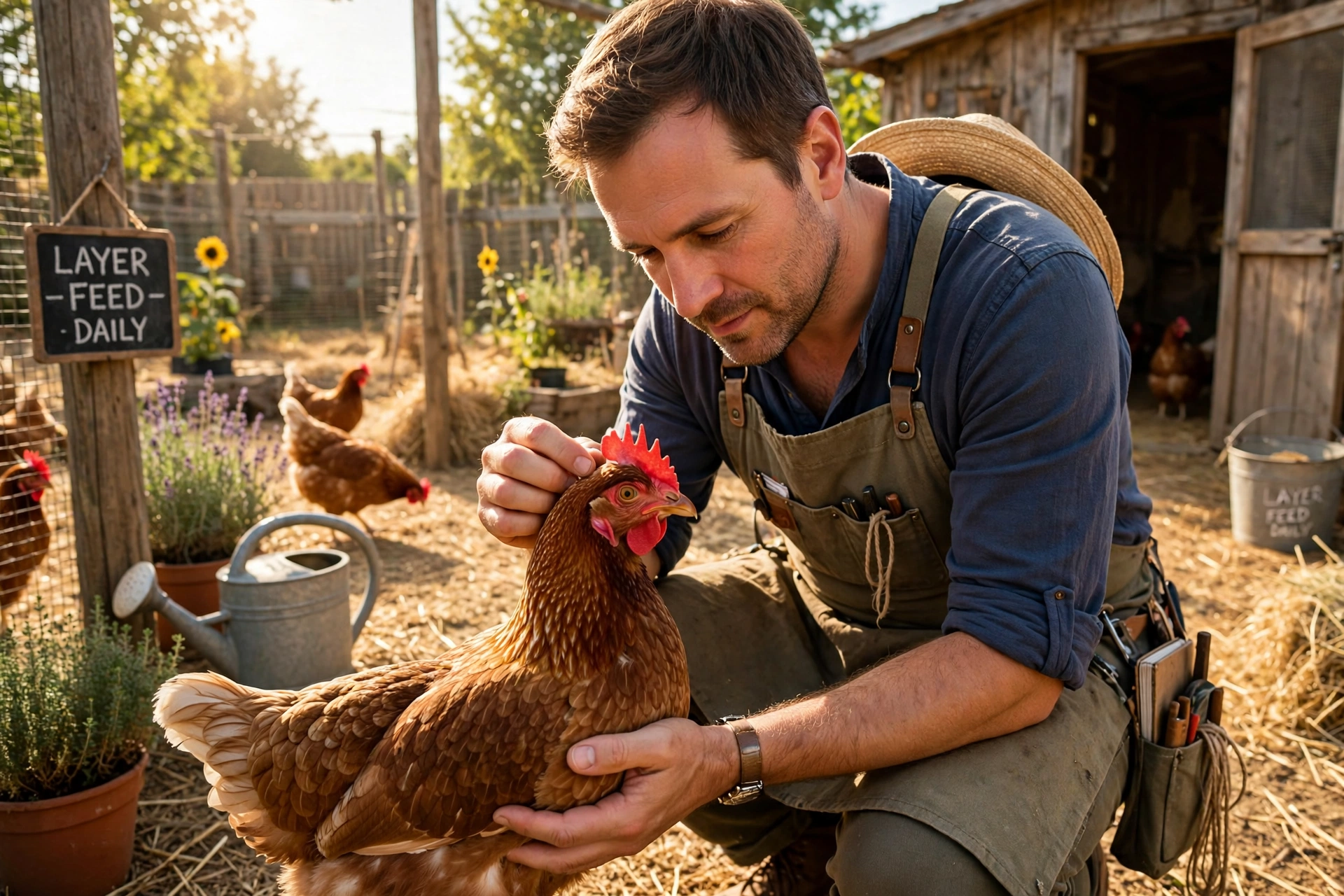
A keeper usually notices fowl pox on an ordinary morning check, when a hen’s comb shows a few raised bumps that were not there the day before. The bumps look like small warts, and over the next few days they darken into scabs. It is an alarming sight the first time you see it, and it is natural to worry about what it means for the bird and for the rest of the flock.
Fowl pox is a viral disease of chickens, and it is one of the more common diseases a backyard flock can meet. It comes in two forms. The dry form affects the skin and is usually mild, and most birds recover on their own. The wet form affects the mouth and throat, and it can be serious. There is no medicine that kills the virus, but there is a lot a keeper can do to help a sick bird through it, and there is a vaccine that prevents it.
This guide covers what fowl pox is, how to tell the two forms apart, how it spreads, what to look for, how to care for a hen that has it, and how to protect the rest of your flock. It also covers when a bird needs a vet at once, because with the wet form, waiting can cost a hen her life.

Table of Contents
- What Is Fowl Pox
- The Dry Form
- The Wet Form
- How Fowl Pox Spreads
- Signs to Look For
- Fowl Pox or Something Else
- Is There a Cure
- Caring for a Hen With Dry Pox
- When Wet Pox Turns Into an Emergency
- Protecting the Rest of the Flock
- Vaccination Against Fowl Pox
- Recovery and Immunity
- Can You Eat the Eggs
- Frequently Asked Questions
Quick Facts
At a Glance Fowl pox is a viral disease with two forms. The dry form causes warty scabs on the comb and wattles and usually clears up on its own. The wet form causes plaques in the mouth and throat and can block breathing.
How It Spreads Mosquitoes are the main carriers, and the virus also spreads by direct contact with scabs and through contaminated feeders, waterers and equipment.
Watch Out There is no medicine that kills the virus, so care is supportive. A bird that gasps, stretches her neck or stops eating needs a vet at once, because that can mean the wet form.
What Is Fowl Pox
Fowl pox is a viral disease caused by the Avipoxvirus, and it affects chickens, turkeys and many other birds. It is slow moving compared with some chicken diseases, and it usually shows up within one to two weeks after a bird is exposed. It does not spread from bird to bird through the air the way a cold does, and it needs either an insect bite or a break in the skin to get in.
The disease takes two forms, and a bird can have one form or both at the same time. The dry form, sometimes called cutaneous pox, affects the skin on the parts of the bird that have no feathers, mainly the comb, the wattles, the face and around the eyes. The wet form, sometimes called diphtheritic pox, affects the inside of the mouth, the throat and the windpipe. The dry form is the one most keepers see, and it is usually mild. The wet form is less common and much more dangerous.
Fowl pox is not a new disease, and it is found in backyard flocks all over the world. It is most common in warm weather and in places where mosquitoes are thick, because mosquitoes carry it from bird to bird. A flock that has never met the virus has no protection against it, which is why a first outbreak can affect many birds at once. Once a bird has had it and recovered, she is usually protected for life.
The Dry Form
The dry form is the milder and more common form of fowl pox. It starts as small raised bumps on the comb, the wattles, the face or the skin around the eyes. The bumps look like warts, and they grow slowly over several days. They then darken, dry out and turn into rough scabs. The scabs usually fall off on their own after two to four weeks, and the skin underneath heals.
Most birds with the dry form keep eating, drinking and moving around normally. They may look rough, and a hen with scabs over her eyes may have trouble seeing, but the disease itself rarely makes a bird seriously ill. Laying may drop for a while, and a bird with scabs near her eyes may be slower to find food and water, so a little extra help goes a long way. A few birds get scabs on their legs or around the vent too, though the comb and wattles are the usual places.
The scabs are the part of the disease that spreads it. A scab that falls off carries the virus, and it can stay infectious in the environment for a long time, especially in dry conditions. That is why the scabs should be left alone to fall off on their own, and why anything that touches them should be cleaned. Picking a scab off does not help the bird heal, and it spreads the virus to your hands, your clothes and the next bird you touch.
The Wet Form
The wet form is the dangerous form of fowl pox. Instead of scabs on the skin, it causes yellowish white plaques inside the mouth, on the tongue, in the throat and down the windpipe. These plaques grow and thicken, and they can narrow the airway until the bird struggles to breathe. A bird with the wet form may gasp, stretch her neck forward, open her beak wide and shake her head as if she is trying to clear something from her throat.
Eating and drinking become hard too. A plaque in the mouth or throat makes swallowing painful, so a bird may stop eating, lose weight quickly and become weak. The wet form can kill, and it kills more often in young birds, whose airways are smaller and who have less strength to fight with. A bird that has both forms at once is in the most danger, because she is dealing with skin sores and a blocked throat at the same time.
The wet form is less common than the dry form, and many keepers never see it. But it is the reason fowl pox must be taken seriously. A bird with scabs on her comb and no other signs is usually fine with simple care. A bird that gasps, stretches her neck or stops eating is a bird that needs a vet at once, because those are the signs that the disease has moved inside.
How Fowl Pox Spreads
Mosquitoes are the main carriers of fowl pox. A mosquito that bites an infected bird picks up the virus, and when it bites the next bird, it passes the virus on. This is why fowl pox is most common in warm, damp weather, when mosquitoes are thick, and why it often appears in late summer and autumn. A single mosquito can carry the virus for weeks, so one infected bird can lead to many more.
The virus also spreads by direct contact. A healthy bird that pecks at a scab, or that rubs against an infected bird, can pick the virus up through a small break in the skin. Pecking injuries, scratches from the run, and the small wounds birds give each other in the pecking order are all ways in. The virus enters through broken skin, not through healthy skin, which is why birds with injuries are more likely to catch it.
Contaminated equipment spreads it too. Feeders, waterers, perches and bedding that have touched scabs or infected droppings can carry the virus to the next bird. The virus survives well in dry scabs and in the environment, so a feeder that has not been cleaned can stay infectious for a long time. Wild birds can carry the virus as well, and a wild bird that visits the run can bring it in without ever showing signs.
Signs to Look For
The first sign of fowl pox is usually the bumps. Check the comb, the wattles and the face of each bird during your regular handling, and look for small raised nodules that were not there before. They start pale and firm, then grow, darken and turn into scabs. The scabs are rough and dark brown or black, and they sit on top of the skin like a wart.
Watch for changes in behaviour too. A bird with the dry form may eat a little less, lay fewer eggs, or sit more than usual, but she usually stays bright. A bird with the wet form shows clearer signs. She may gasp for air, stretch her neck forward, open her beak wide, shake her head, or make a rattling sound when she breathes. She may stop eating and drinking, and she may sit apart from the flock with her eyes half closed. If you see a bird breathing with her beak open, look inside her mouth with a torch. Yellowish white plaques on the tongue or in the throat point to the wet form, and that bird needs a vet.
Eyes are another place to check. Scabs can grow on the eyelids and close the eye, and a bird that cannot see well will have trouble finding food and water. A bird with one eye closed by scabs is not in danger from that alone, but she needs her food and water placed where she can find them, and she needs to be kept away from bullies in the flock while she recovers.
Fowl Pox or Something Else
Fowl pox is not the only thing that causes scabs and sores on a chicken, so it is worth knowing what else it can look like. Pecking injuries are the most common lookalike. A pecked comb bleeds and then scabs over, but the scab is flat and follows the shape of the wound, while a pox nodule is raised and wart-like and grows slowly over days. If several birds develop raised bumps at the same time, pox is more likely than pecking.
Scaly leg mites cause raised crusty scales, but they affect the legs and feet, not the comb and wattles. Favus, a fungal infection, causes white crusty patches on the comb, but the patches are flat and powdery rather than raised and wart-like. Marek’s disease can cause skin tumours, but those are usually found on feathered skin and come with other signs such as leg paralysis. Our guide on Marek’s disease in chickens covers that disease in full, and it is worth reading if a bird shows weakness or paralysis alongside skin problems.
Canker is the main lookalike for the wet form, because it also causes yellowish plaques in the mouth and throat. Canker is caused by a parasite rather than a virus, and it needs different treatment, so a bird with mouth plaques should be seen by a vet who can tell the two apart. Do not try to scrape plaques out of a bird’s mouth yourself. Scraping can cause bleeding, spread the infection, and make breathing worse.
Is There a Cure
There is no medicine that kills the fowl pox virus. Antibiotics do not work on viruses, and no drug can make the disease go away faster. A vet may still prescribe antibiotics if a secondary bacterial infection sets in around the scabs, but that treats the bacteria, not the pox. The disease has to run its course, and the keeper’s job is to support the bird while her own immune system fights it off.
That sounds discouraging, but the dry form usually sorts itself out. Most birds with the dry form recover fully in two to four weeks, the scabs fall off, and the bird goes back to normal. The wet form is harder, and some birds with the wet form do not survive even with good care. That is why prevention matters so much with this disease, and why vaccination is worth considering for any flock in an area where mosquitoes are a problem.
Do not reach for home remedies that promise a cure. There is no cream, oil or supplement that kills the virus, and some of the things people suggest can do harm. The best care is simple. Keep the bird warm, dry and comfortable, keep her food and water close, keep her scabs clean and dry, and keep her away from the rest of the flock until she is better.

Caring for a Hen With Dry Pox
A hen with the dry form needs simple, steady care. Move her to a clean, dry pen of her own, away from the flock, so she can rest and so she does not spread the virus to the others. The pen should be warm, out of the wind, and easy for her to move around in. Put her food and water close to where she rests, so she does not have to walk far to reach them.
Offer soft, easy food. Soaked layer pellets, scrambled egg, plain yoghurt and soft greens are all good choices for a bird that may be sore or tired. Fresh clean water should always be in reach, and a little extra vitamin supplement in the water can help a bird that is fighting an infection. Keep her normal layer feed available too, so she can eat what she wants when she feels up to it.
Leave the scabs alone. Do not pick them off, do not squeeze them, and do not try to peel them away. They will fall off on their own when the skin underneath has healed. Some keepers dab the scabs with iodine to keep them dry and clean, and that is a common practice, but it does not cure the disease and it is not required. If you do use iodine, dab it gently and do not get it in the bird’s eyes. Keep a first aid kit ready for this kind of care, and our guide on what to put in a chicken first aid kit covers the supplies worth keeping on hand.
Watch her eyes. If scabs close an eye, the bird will have trouble finding food and water, so place them right beside her and check that she is eating. If both eyes close, she will need hand feeding and watering until the scabs clear. A bird that stops eating or drinking for more than a day needs a vet, whatever the cause.
When Wet Pox Turns Into an Emergency
A bird with the wet form is an emergency, and she needs a vet the same day. The signs are gasping, neck stretching, open beak breathing, a rattling sound when she breathes, and a refusal to eat or drink. These signs mean the plaques in her throat are blocking her airway, and a blocked airway can kill a bird quickly. Do not wait to see if she gets better on her own.
A vet may be able to remove plaques from the mouth and throat, give fluids to a bird that has stopped drinking, and prescribe medicine to fight any secondary infection. Even with a vet’s help, some birds with the wet form do not survive, so the sooner she is seen, the better her chances. Keep the bird warm and calm on the way to the vet, and do not try to clear her throat yourself.
While you wait for the vet, offer water in small amounts from a dropper or a shallow dish, and do not force food into a bird that is struggling to breathe. A bird that cannot swallow can choke on food or water, so let her take what she can on her own. Keep her in a quiet, warm place and handle her as little as possible, because stress makes breathing harder.
Protecting the Rest of the Flock
The first step is to separate any sick bird at once. A sick bird in a pen of her own cannot spread the virus by contact, and she can rest without being pecked or pushed away from food. Change your clothes and wash your hands after handling a sick bird and before you touch the healthy ones, because the virus travels on hands, clothes and shoes.
Clean the coop and the equipment. Scrub feeders and waterers with hot soapy water and leave them in the sun to dry, and change the bedding in the coop and the run. The virus survives in dry scabs and in dust, so a good clean reduces the amount of virus the healthy birds are exposed to. Wear gloves when you handle scabs or dirty bedding, and put the waste in a sealed bag rather than on the compost heap.
Fight the mosquitoes. Empty any standing water near the coop, such as buckets, old tyres and puddles, because mosquitoes breed in still water. Keep the coop dry and well ventilated, and consider fine mesh over the coop openings in mosquito season. A coop that stays dry and has no standing water nearby is a coop with far fewer mosquitoes, and that alone cuts the risk of fowl pox a great deal.
Watch the healthy birds closely for the next two weeks. Check combs, wattles and faces every day, and look inside the mouth of any bird that starts gasping or stops eating. New cases will usually show up within one to two weeks of the first bird, so daily checks during that time catch new cases early, when care works best.
Vaccination Against Fowl Pox
Vaccination is the most reliable way to prevent fowl pox, and it is worth considering for any flock in an area where mosquitoes are common. The vaccine is usually given to young birds through a small stab in the wing web, the thin skin between the wing bones. It is a quick procedure, and a vet can show you how to do it or do it for you. Your vet can advise on the right age for your flock and whether your area needs it.
A vaccinated bird is protected against the disease, and a flock that is vaccinated does not go through the cycle of scabs, separation and worry that an unvaccinated flock does. The vaccine is not expensive, and for a keeper who has already dealt with one outbreak, it is usually an easy decision. Our guide on do backyard chickens need vaccines and which ones matter covers fowl pox vaccination alongside the other vaccines worth knowing about.
Vaccination does not help a bird that is already sick, and it should not be given to a bird that is already showing signs. It is a prevention tool, not a treatment. If your flock is in the middle of an outbreak, focus on care and separation first, and talk to your vet about vaccinating the healthy birds once the outbreak has passed.
Recovery and Immunity
A bird that recovers from the dry form usually does so in two to four weeks. The scabs fall off, the skin underneath heals, and the bird goes back to eating and laying normally. There may be a small scar where a large scab was, and a comb that was badly affected may look a little rough for a while, but the bird herself is fine. Laying usually picks back up within a few weeks of recovery.
A bird that recovers from fowl pox is usually immune for life. That is one small comfort in an outbreak, because a recovered bird will not catch it again. The rest of the flock may still be at risk, which is why vaccination and mosquito control matter even after the first birds recover.
Do not rush a recovered bird back into the flock. Wait until all the scabs have fallen off and the skin has healed, because scabs can still carry the virus even when the bird looks better. A bird that is fully healed, eating well and laying again is ready to go back. Watch her for a few days after she rejoins the flock, and make sure she is not being bullied while she settles back in.

Can You Eat the Eggs
Eggs from a hen with fowl pox are safe to eat. The virus does not pass into the egg in a way that makes it unsafe for people, and fowl pox cannot be caught by humans at all. A hen that is ill may lay fewer eggs, and she may stop laying altogether while she recovers, but the eggs she does lay are fine to eat as normal.
The one thing to watch is the hen herself. A hen that has stopped eating and drinking needs care, not egg collection, so focus on getting her better first. Once she is eating again and her scabs are healing, her laying will pick back up on its own. There is no need to throw eggs away because of fowl pox, and no waiting period before you can eat them again.

Frequently Asked Questions
Is fowl pox contagious?
Yes, fowl pox is contagious between birds. It spreads mainly through mosquito bites, and also through direct contact with scabs and through contaminated feeders, waterers and equipment. It does not spread through the air, and it cannot be caught by people.
Can humans catch fowl pox?
No, humans cannot catch fowl pox. The virus affects birds only. You can handle a sick bird safely, though you should still wash your hands afterwards, because you can carry the virus to other birds on your hands and clothes.
How long does fowl pox last?
The dry form usually lasts two to four weeks, from the first bumps to the last scab falling off. The wet form can last longer, and it is more dangerous. A bird that recovers is usually immune for life.
Can a chicken get fowl pox twice?
A chicken that recovers from fowl pox is usually immune for life, so a second case is unlikely. Birds that were vaccinated are also protected. A new bird that has never had the disease and has never been vaccinated can still catch it.
Is there a vaccine for fowl pox?
Yes, there is a vaccine for fowl pox, and it is usually given to young birds through a small stab in the wing web. Ask your vet about the right age for your flock and whether your area needs it. The vaccine prevents the disease, but it does not treat a bird that is already sick.
Can you eat eggs from a hen with fowl pox?
Yes, eggs from a hen with fowl pox are safe to eat. The virus does not make the eggs unsafe for people, and a hen may lay fewer eggs while she is ill, but the eggs she does lay are fine.
What should I do if my chicken is gasping?
A gasping chicken needs a vet at once. Gasping can mean the wet form of fowl pox, where plaques in the throat are blocking the airway, and it can also mean other serious problems. Our guide on why is my chicken sneezing covers breathing problems in more detail, but a gasping bird should be seen by a vet the same day.
Keep Reading
Chicken Care and Health and the pillar guide for keeping your flock healthy.
Marek’s Disease in Chickens and another viral disease every keeper should know.
Do Backyard Chickens Need Vaccines and the vaccines that protect your flock.

Nusrat
Author, TheChickenPet.com