
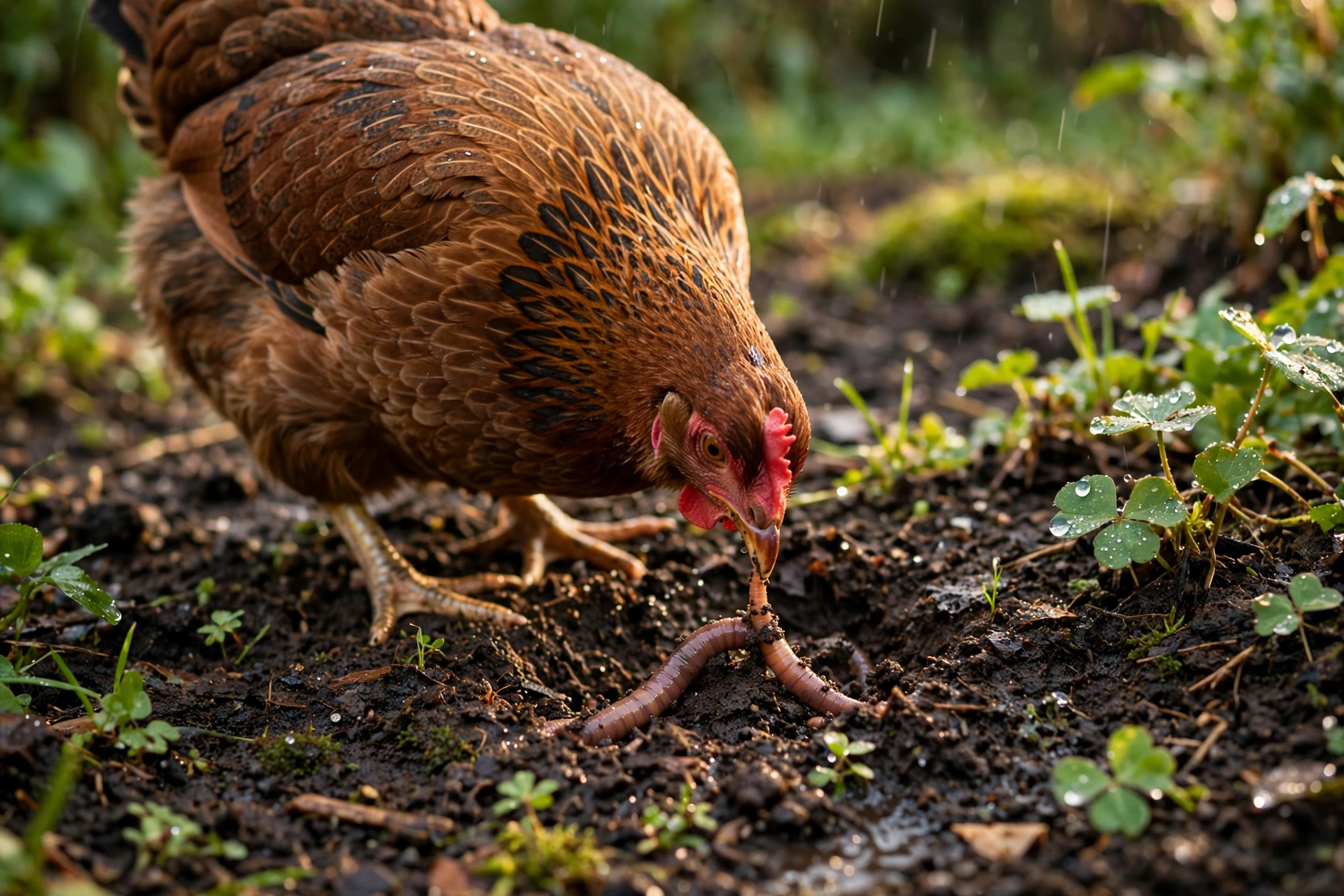
Watch a hen in damp soil after rain and you will see her scratch, pause, tilt her head and peck. She is hunting earthworms, and she is very good at it. Do chickens eat worms. Yes, they do, and they have done it for as long as chickens have scratched in the dirt. An earthworm is a moving mouthful of protein, and a hen that finds one will swallow it fast before another bird can steal it.
Earthworms are a natural treat, not a feed. They are rich in protein and they come free from the garden, the compost heap and any patch of damp ground your flock can reach. That does not mean every worm is safe, and it does not mean a hen should fill up on them. The source of the worm matters, the amount matters, and one real risk matters most of all.
This guide covers which earthworms are safe, where to get them, how many to give, when chicks can start, and the worms you should never feed. It also covers the gapeworm risk, which is the one thing every keeper who lets hens eat wild earthworms should know.

Table of Contents
Quick Facts
At a Glance Earthworms are a protein rich treat chickens hunt naturally by scratching. Red wigglers and nightcrawlers are both fine. Only ever offer worms from untreated soil.
One Real Risk Earthworms can carry gapeworms as intermediate hosts. Watch a flock that eats a lot of wild earthworms for gasping and neck stretching, and read the worms guide for what to do next.
Good to Know Keep worms as a treat under 10 percent of daily intake, never a staple. Chicks can have finely chopped worms from about 3 to 4 weeks old, with grit available.
Are Earthworms Safe for Chickens
Are earthworms safe for chickens. Yes, they are, with one condition that matters more than anything else in this guide. Our food checker lists earthworms as Safe, note “From untreated soil”. That one short note is the whole safety rule. A worm from clean, untreated ground is a safe treat. A worm from ground that has been sprayed or fed with chemicals is not.
An earthworm lives in the soil and eats the soil, so anything in that soil ends up in the worm. A worm from a lawn treated with fertiliser, weed killer or insecticide can carry those chemicals into your hen. The hen is small, the dose adds up over time, and the harm is not worth a free treat. If you are not sure whether a patch of ground has been treated, do not take worms from it. Take them from a spot you know is clean, such as your own untreated garden bed or your compost heap.
The worm itself is not the danger. Earthworms are not poisonous, they do not bite, and they do not carry the kind of harm a hen cannot handle. The danger is always the ground the worm came from, plus the gapeworm risk covered later in this guide. Get the source right and the worm is a fine treat.
Why Chickens Love Earthworms
A hen loves an earthworm for the same reason she loves any moving food. It is protein, it moves, and catching it is part of how she is built to eat. Watch a flock after rain and you will see the whole routine. One hen scratches the damp soil, finds a worm, and runs with it while the others chase her. The chase is not greed, it is instinct. A moving treat is worth more to a chicken than a still one.
Earthworms are a high protein treat, and protein is what a hen needs most when she is laying, moulting or growing. A laying hen uses protein to build eggs, and a moulting hen uses it to grow new feathers. Worms do not replace her feed, which is balanced for everything she needs, but they add a useful bit of extra protein on top of it. That is why hens get so excited about them.
Worms also give a hen something to do. A flock that spends its day scratching, hunting and chasing is a busy flock, and a busy flock is a calmer one. Hens that have nothing to hunt will pick at each other instead. A handful of worms tossed into the run is not just food, it is enrichment, and it costs nothing. Earthworms are not the only protein treat hens hunt for either. Our guide to black soldier fly larvae covers another insect treat that is rich in calcium as well as protein.
If you have never offered earthworms before, start with one or two per bird and watch what happens. Most hens will take them straight away. A hen that has never seen a worm may peck at it, drop it and come back to it, which is normal while she works out that it is food. Within a day or two she will be hunting them like the rest of the flock.
Red Wigglers and Nightcrawlers
Can chickens eat red wigglers. Yes, they can. Red wigglers are the small red compost worms that live in a compost heap or a worm bin, and they are one of the best worms you can offer. They are easy to find if you keep a compost heap, they breed fast, and hens love them. A handful of compost with red wigglers in it is a treat and a foraging game in one.
Can chickens eat nightcrawlers. Yes, they can. Nightcrawlers are the large dew worms that come out onto lawns and paths after rain, and they are just as safe as red wigglers as long as they come from untreated soil. They are bigger, so one nightcrawler is a bigger mouthful, and a hen may need a moment to swallow it. Some keepers chop a large nightcrawler in half for smaller hens, which is fine.
The two types are different in size and in where they live, but they are the same food to a hen. Red wigglers live near the surface in rich compost and leaf litter. Nightcrawlers live deeper in garden soil and come up at night or after rain. Either one is fine, and a hen will eat both with the same enthusiasm.
Do not worry about telling them apart with perfect accuracy. If the worm is a true earthworm from clean ground, it is safe. The worms to avoid are the ones that are not earthworms at all, and those are covered in the section on worms to never feed.
Where Safe Earthworms Come From
The safest earthworms come from ground you control. Your own compost heap is the best source of all, because you know exactly what went into it. Kitchen scraps, leaves and garden waste make a compost heap that red wigglers love, and a hen that gets a scoop of that compost gets worms, scratching material and a bit of fun all at once.
Your untreated garden beds are the next best source. A bed that has had no fertiliser, weed killer or insecticide on it is safe ground, and the worms in it are safe worms. Dig a forkful of soil after rain and you will usually find a few. Turn the soil over in front of the hens and let them do the hunting themselves.
Damp ground after rain is where hens find worms on their own. Rain brings earthworms up toward the surface, and a flock that free ranges after a shower will find them without any help from you. That is the most natural way for a hen to eat worms, and it needs no work at all from the keeper.
Never take worms from a lawn or a field you do not know. A neighbour’s lawn, a park, a roadside verge or a farm field may have been sprayed, and you will not know by looking at it. Chemicals do not change how a worm looks. The only safe rule is to take worms from ground you are sure about, and to leave the rest alone.

The Gapeworm Risk
Earthworms have one real risk, and it is worth knowing properly. Earthworms can carry gapeworms as intermediate hosts. That means a gapeworm uses the earthworm as a stepping stone on its way to a bird. A hen that eats an infected earthworm can pick up gapeworms, which live in the windpipe and make breathing hard.
A flock that eats a lot of wild earthworms needs watching. The signs to look for are gasping and neck stretching. A bird with gapeworms stretches her neck forward, opens her beak, gasps for air and may shake her head as if she is trying to clear something from her throat. Young birds are affected most often, and a heavy infection can block the windpipe. Gasping is an emergency sign even if the cause turns out not to be gapeworms, so a gasping bird needs a vet at once.
This does not mean you should stop feeding earthworms. Most worms are not infected, and most hens that eat worms never have a problem. It means you should know the signs and watch for them, especially in a flock that free ranges on damp ground and eats a lot of wild worms. The risk is higher on damp ground because that is where earthworms are thickest and where hens eat the most of them.
If you want the full picture on gapeworms and the other internal worms, read our guide on how to tell if chickens have worms. It covers the signs, the fecal test that confirms worms, and the safe treatment for a flock that needs it. Knowing what to watch for is the best protection your flock has.
Worms to Never Feed
Not every worm is an earthworm, and not every worm is safe. The two to keep out of the run are bait shop worms and hammerhead flatworms, and they are unsafe for different reasons.
Can chickens eat worms from a bait shop. No, they should not. Bait shop worms are often kept with chemical dyes or additives to make them brighter and more attractive to fish, and those chemicals are not meant for chickens. The worms may also have been kept in bedding treated with preservatives. A bait shop worm looks like a safe earthworm, but you cannot know what it has been kept in, so do not feed it. If you want worms for your hens, dig them from your own clean ground instead.
Hammerhead flatworms are not safe either. They are flat, slimy worms with a wide hammer shaped head, and they may carry parasites. Do not feed them to your hens, and do not spread them around the garden. If you find one, pick it up with a stick or a gloved hand, put it in a sealed bag and throw it away. Do not cut it in half, because the pieces can grow into new flatworms. Wash your hands after handling one.
Any worm you cannot identify should stay out of the run. A true earthworm is round, smooth and pink or brown, and it lives in soil or compost. If a worm looks flat, slimy, brightly coloured or strange in any way, leave it alone. There are plenty of safe earthworms to go around without taking a chance on one you do not recognise.
How Many Earthworms to Give
Keep worms as a treat under 10 percent of daily intake, not a staple. That is the same rule that applies to every treat, and it matters here because worms are rich and filling. A hen that fills up on worms eats less of her balanced feed, and her balanced feed is what keeps her laying well and staying healthy. Treats are the extra, never the main meal.
In practice, a small handful of worms per bird a few times a week is plenty. If your hens find their own worms while free ranging, that is part of the same allowance, and you do not need to add more on top. A flock that free ranges on damp ground after rain may already be eating a good number of worms on its own, so watch what they find before you offer extra.
Worms are best as an occasional treat rather than a daily habit. A few times a week keeps them special, and it keeps the hens excited about them. A hen that gets worms every day will still eat them, but the foraging game loses its spark, and the protein adds up more than it needs to.
If you keep a compost heap, you can use worms as a training reward too. Toss a few into the run when you want the flock to come back to the coop, or scatter them in a new patch of ground you want the hens to scratch over. A worm is a better reward than a grain treat, because it keeps the hens busy for longer.

Can Baby Chicks Eat Earthworms
Can baby chicks eat earthworms. Yes, they can, but not from day one. Chicks can have finely chopped worms from about 3 to 4 weeks old, with grit available. Before that age, a chick’s digestive system is still settling, and its starter feed is all it needs. Wait until the chick is feathering out and scratching properly, then offer a small amount.
Chop the worms finely for young chicks. A whole earthworm is too big for a small chick to swallow safely, and a long worm can be a choking risk. Cut it into small pieces, offer only a few, and watch the chicks eat them. They will be cautious at first, then they will chase the pieces around the brooder like tiny hunters.
Grit must be available when chicks eat worms. Chicks need grit in their gizzard to grind up food that is not starter crumb, and worms are no exception. Offer chick grit in a small dish from the time you start giving treats, and keep it available whenever treats are on offer. A chick that eats worms without grit can end up with a slow crop, so do not skip this step.
Keep the amount small for chicks. A few tiny pieces per chick, once or twice a week, is enough. Chicks grow fast on their starter feed, and treats should never push that feed aside. The worms are a taste of foraging and a little extra protein, not a meal.
Letting Hens Find Their Own
The easiest way to feed earthworms is to let the hens find them. A flock that free ranges on damp ground will hunt worms all by itself, and it will do it better than you can. All you need to do is give them access to ground where worms live, and let them scratch.
Rain is your friend here. After a shower, worms come up to the surface and hens know it. Let the flock out onto damp grass or a damp garden bed after rain and watch them work. They will scratch, listen, tilt their heads and peck, and they will find worms you would never have seen. This is foraging at its best, and it costs you nothing.
You can help by turning over a forkful of soil in front of them. Dig a small patch in the run or the garden, turn the soil, and step back. The hens will rush in and pick through it for worms and grubs. It is a quick job and it gives the whole flock something to do on a quiet afternoon.
If your hens live in a run with no access to soil, you can still bring the hunting to them. A scoop of compost with red wigglers in it, tipped into the run, gives them the same game. They will scratch through the compost, find the worms and turn the pile over for you. It is enrichment, feed and compost turning in one small job.

When to Skip the Worms
There are times when worms are best left alone, even from clean ground. The first is when a bird is already unwell. A sick hen needs her normal feed, fresh water and rest, not a rich treat that her gut has to work hard to digest. Wait until she is eating normally again before you offer worms.
Skip wild earthworms if your flock has had a gapeworm problem. A flock that has been treated for gapeworms should not go straight back to eating large numbers of wild worms from damp ground, because that is how the infection came in. Let the ground rest, keep the hens on drier ground for a while, and talk to your vet about when it is safe to let them forage freely again. Our guide on how to tell if chickens have worms covers the signs to watch for and the test that confirms it.
Skip worms from any ground that has been treated recently, even if it was treated a while ago. Fertiliser, weed killer and insecticide can linger in soil longer than people expect, and rain does not wash them all away. If a patch was sprayed this season, do not take worms from it. Wait until you are sure the ground is clean again, and use your compost heap in the meantime.
Finally, skip worms when the weather is very hot and dry. There will be few worms near the surface anyway, and digging for them in dry soil is hard work for little reward. The hens will find their own again after the next rain. Worms are a fair weather treat, and there is no need to chase them in a drought.
Frequently Asked Questions
Can chickens eat earthworms?
Yes, chickens can eat earthworms. Our food checker lists earthworms as Safe, note “From untreated soil”. Earthworms are a protein rich treat that chickens hunt naturally by scratching, and red wigglers and nightcrawlers are both fine. Only ever offer worms from untreated soil, never from lawns treated with fertiliser, weed killer or insecticide.
Can chickens eat red wigglers?
Yes, chickens can eat red wigglers. Red wigglers are the small red compost worms that live in a compost heap or a worm bin, and they are one of the best worms you can offer. They are easy to find if you keep a compost heap, they breed fast, and hens love them. A handful of compost with red wigglers in it is a treat and a foraging game in one.
Can chickens eat nightcrawlers?
Yes, chickens can eat nightcrawlers. Nightcrawlers are the large dew worms that come out onto lawns and paths after rain, and they are just as safe as red wigglers as long as they come from untreated soil. They are bigger, so one nightcrawler is a bigger mouthful, and some keepers chop a large one in half for smaller hens.
Can chickens eat worms from a bait shop?
No, chickens should not eat worms from a bait shop. Bait shop worms are often kept with chemical dyes or additives to make them brighter and more attractive to fish, and those chemicals are not meant for chickens. The worms may also have been kept in bedding treated with preservatives. Dig worms from your own clean ground instead.
Can baby chicks eat earthworms?
Yes, baby chicks can eat earthworms from about 3 to 4 weeks old, finely chopped and with grit available. Before that age, a chick’s starter feed is all it needs. Offer only a few tiny pieces at a time, once or twice a week, and keep chick grit in a small dish whenever treats are on offer.
Keep Reading
Chicken Care and Health and the pillar guide for keeping your flock healthy.
How to Tell if Chickens Have Worms and the gapeworm signs to watch for in a flock that eats wild earthworms.
Can Chickens Eat Mealworms and the other protein treat your hens will love.

Nusrat
Author, TheChickenPet.com