
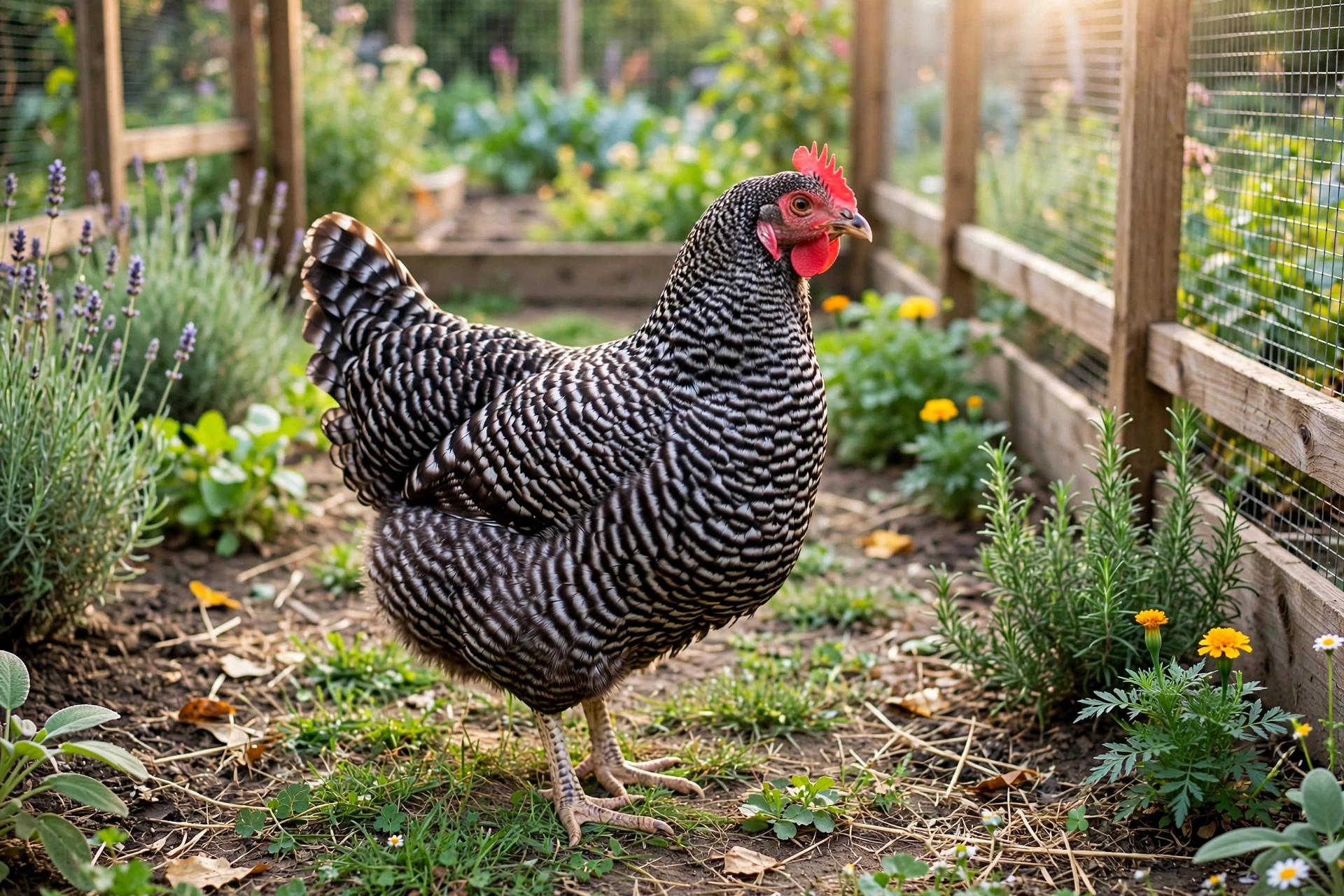
Plymouth Rocks are one of the oldest and most trusted breeds in the backyard world, and it is easy to see why keepers love them. They are calm, hardy, friendly and steady layers, and a keeper who brings home a Barred Rock hen usually finds she settles into the flock at once. She follows you around the garden, she lets the children pick her up, and she lays a steady supply of large brown eggs. It is no surprise that so many keepers ask how long she will be around.
A Plymouth Rock usually lives 6 to 8 years. That is the honest middle of the range, and it is a good life for a large dual purpose hen. Some birds live less, especially birds that were bred for fast laying or birds that are left open to predators, and some live longer. A well kept Plymouth Rock can reach 10 years, and a few keepers report birds living even longer than that, though that is rare.
This guide covers the Plymouth Rock lifespan in detail. You will learn how long Plymouth Rocks live, how heritage birds compare with hatchery birds, how long they lay for, what affects their lifespan, how broodiness changes the laying years, the signs of an ageing Plymouth Rock, and what you can do to help your birds live as long as possible.

Table of Contents
Quick Facts
At a Glance A Plymouth Rock usually lives 6 to 8 years. Well kept birds often reach 10 years, while birds that are overfed or bred for heavy laying often live less.
Laying Life Most hens lay well for 2 to 3 years, then slow down. Plymouth Rocks go broody less often than Buff Orpingtons, so they lay more steadily, and a hen can live several years after she stops laying altogether.
Good to Know The biggest threats to a Plymouth Rock are predators, reproductive problems and obesity from overfeeding. Good feed, a secure coop and regular checks add years to a bird’s life.
How Long Do Plymouth Rocks Live
How long do Plymouth Rock chickens live. A Plymouth Rock usually lives 6 to 8 years, and that is a fair answer for most backyard birds. Some live a little less, and some live a good deal longer. A well kept bird with good feed, a secure coop and a keeper who checks on her can reach 10 years, and some keepers report birds living to 11 or 12, though that is rare. A bird that is overfed, kept in a damp coop or left open to predators may only live 4 to 6 years.
The barred rock lifespan sits near the top of the range for common breeds. Plymouth Rocks live longer than the very high production breeds, which are bred to lay hard and often live only 4 to 6 years. They live about as long as other large dual purpose breeds, such as the Buff Orpington and the Rhode Island Red, which also live around 5 to 8 years. They live less long than some of the small, slow laying breeds, such as the Silkie, which can live 7 to 9 years or more.
Our guide on how long do Silkie chickens live covers the Silkie side of this comparison, and our guide on how long do Rhode Island Red chickens live shows a breed with a very similar lifespan. The pattern is the same in both. Breeds that lay fewer eggs tend to live longer, and breeds that lay the most tend to live shorter lives. The Plymouth Rock is a good balance, a bird that lays well and lives well, without pushing either side to the extreme.
These are averages, not promises. A chicken’s life depends on far more than her breed, and two Plymouth Rocks from the same hatchery can live very different lengths of life. The sections below explain what makes the difference, so you can give your birds the best chance of a long one.
The Plymouth Rock is one of the oldest American breeds, first developed in the 19th century, and it has been a backyard favourite ever since. The Barred Rock is the best known variety, with its neat black and white striped feathers, but the breed also comes in white, buff, partridge, silver penciled, blue and Columbian. Whatever the colour, the breed is the same underneath, a broad, sturdy, rectangular bird with a calm nature and a strong constitution. That long history as a farm bird is part of why the breed lives so well. It was bred to thrive on a farm, not just to lay fast, and that hardiness still shows in the birds you buy today.
Heritage or Hatchery Birds
The kind of Plymouth Rock you buy makes a real difference to how long she will live. Heritage Plymouth Rocks are the old type, bred to the traditional standard for size, hardiness and steady laying. Hatchery birds are bred in large numbers for the backyard market, and they are often smaller, lighter and quicker to lay than the heritage type.
Heritage birds are big and solidly built, with hens reaching around 7 to 8 lb and roosters reaching around 9 to 10 lb. They grow more slowly, they lay around 200 eggs a year, and they usually live longer, often 8 to 10 years. Hatchery birds are a little smaller and lighter, and they can lay 200 to 280 eggs a year in their first years. That heavier laying takes a toll on the body over time, and hatchery birds often slow down sooner and live on the shorter side of the range.
Most backyard keepers buy hatchery birds without knowing it, because hatcheries sell them as Plymouth Rocks and they are cheaper and easier to find. That is fine, and a hatchery bird can still be a wonderful hen, but it helps to know which kind you have, because it sets your expectations. If your hen is smaller than the breed standard and lays an egg almost every day in her first year, she is probably a hatchery bird, and you should expect her best laying years to be short and her life to be on the shorter side of the range.
The breed you choose should match what you want from your flock. If you want the most eggs possible and you are happy to replace your birds every few years, a high laying strain makes sense. If you want birds that will be with you for many years and you are happy with fewer eggs, a heritage bird makes more sense. The Plymouth Rock sits comfortably in the middle, which is why so many keepers choose it, and the heritage type is the better pick if a long life matters most to you.
Lifespan or Laying Life
Lifespan and laying life are two different things, and it helps to keep them separate. A Plymouth Rock may live 6 to 8 years, but she will not lay well for all of that time. Most hens lay best in their first two years, then slow down by about 10 to 20 percent each year after that. By the time a hen is four or five, she may lay only a few eggs a week, and by six or seven she may stop altogether.
So how long do Plymouth Rocks lay eggs. A Plymouth Rock hen usually lays well for 2 to 3 years, then slows down year by year. She lays about 200 to 280 large brown eggs a year in her first years, then fewer. Because Plymouth Rocks go broody less often than Buff Orpingtons, they lay more steadily through the year, and their total egg count over a lifetime is often higher than a broodier breed’s. Even so, no hen lays well forever, and a Plymouth Rock that lives to 8 or 10 will spend her last years as a pet rather than a layer.
That does not mean an old hen is useless. A hen that has stopped laying still eats bugs, turns the compost, keeps the flock calm and makes a good pet. Many keepers keep their retired hens for years after they stop laying, and those birds often live their longest, quietest years after the laying stops. Our guide on how long do hens lay eggs for covers the laying side of this in full, and it is worth reading if you are planning your flock around egg numbers.
Plymouth Rocks usually start laying at around 18 to 22 weeks old, which is about 4 to 5 months. Heritage birds often start a little later, and hatchery birds a little earlier. Our guide on when do chickens start laying eggs covers laying age across breeds.
If you want eggs every day for years, you will need to add young birds to the flock over time, because no hen lays well forever. A common pattern is to add two or three pullets every year or two, so the flock always has young layers alongside the older birds. That way the older hens can retire in peace while the young ones keep the egg basket full.
What Affects Their Lifespan
Feed is the first thing that affects the Plymouth Rock lifespan, and for this breed it matters a great deal. Plymouth Rocks are good foragers and they love food, and they will eat far more than they need if you let them. A hen that eats a balanced layer feed, with oyster shell on the side and clean water always available, has the building blocks for a long life. A hen that eats mostly scraps, scratch grain and kitchen leftovers will be short on protein and calcium, and at the same time she will put on too much fat. Treats are fine, but they should stay under 10 percent of what a hen eats in a day.
Obesity is the second thing, and it is one of the most common problems in pet Plymouth Rocks. A fat hen lays fewer eggs, she struggles in the heat, and she is more likely to suffer reproductive problems such as egg binding and internal laying. A Plymouth Rock should feel solid and well covered, not soft and wobbly, and you should be able to feel her breastbone through a thin layer of muscle. If you cannot feel it at all, she is too fat, and cutting back on treats and scratch is the kindest thing you can do for her.
Housing is the third. A coop that is dry, draught free, well ventilated and cleaned regularly keeps birds healthy, and a run with space to scratch, dust bathe and forage keeps them active. A crowded, damp or dirty coop breeds disease, and disease shortens lives. Plymouth Rocks are cold hardy birds, thanks to their full feathering and sturdy build, but no bird stays healthy in a wet, crowded coop, and a heavy bird needs a low perch and a ramp, because jumping down from a high perch can hurt her legs.
Predators are the fourth, and they are the most sudden threat. Plymouth Rocks are calm and fairly heavy, and they cannot run or fly away from danger the way a lighter breed can. A fox, a dog or a hawk can end a hen’s life in a moment, whatever her age. A secure coop with a buried wire skirt, a solid roof and a latch that a raccoon cannot open is the best protection a keeper can give. Many backyard hens do not die of old age at all, they die because something got into the run, and that is a loss that good housing can prevent.
Cold hardiness is a real strength of the breed, and it helps the Plymouth Rock lifespan in cold climates. These birds handle winter well, and they keep laying through the colder months better than many breeds. Even so, an old bird feels the cold more than a young one, and a draught free coop with deep dry bedding helps her through the cold months. In hot weather, a heavy bird can overheat, so give her shade, fresh cool water and good ventilation, and a shallow dish of water to stand in on the hottest days.
Stress is the last thing. A flock that is crowded, bullied, or constantly disturbed lays less and lives less well. Plymouth Rocks are calm birds, but they still need space, perches, and a pecking order that is allowed to settle. A hen that is chased from the feeder every day will eat less, and a hen that eats less will not live as long as she should. Good housing and a calm flock are not luxuries, they are the foundation of a long life.
Broodiness and Laying
Broodiness is a part of the Plymouth Rock, but it shapes her laying life less than it does in some other breeds. Plymouth Rocks do go broody, and a broody hen stops laying for weeks at a time while she sits on the nest. But they go broody far less often than Buff Orpingtons, which can go broody two or three times a year. A Plymouth Rock may go broody once a year, or not at all, and that steadier laying pattern is one reason keepers who want eggs choose this breed.
A broody hen eats and drinks very little while she sits, and she can lose a lot of weight over three weeks on the nest. That is why a broody hen needs a keeper who lifts her off the nest once or twice a day, sets her by the food and water, and makes sure she eats, drinks and has a dust bath before she settles back down. A hen that is left to sit without food or water will come off the nest thin and weak, and a weak hen is an easy target for illness and parasites.
Broodiness also changes the laying life in a different way. A hen that spends months of each year broody will lay fewer eggs in total over her life, even if she lives a long time. Because Plymouth Rocks go broody less often, they lay more eggs across the year than a broodier breed, and their laying life feels longer to the keeper. That is a trade off that suits most keepers, because they get steady eggs without giving up the option of hatching chicks. A broody Plymouth Rock can still make a good mother, and many keepers use her to hatch chicks for the flock.
The link between broodiness and lifespan is a gentle one. A hen that lays fewer eggs and rests more often is under less reproductive strain, and less strain usually means a longer life. At the same time, a hen that lays without a break puts more strain on her body year after year. The Plymouth Rock sits in a good middle place here too. She lays steadily without pushing her body to the limit, and she takes enough breaks to rest without losing months of laying to broodiness.
If you do not want chicks, break the broodiness gently by moving her to a wire bottomed cage with food and water for a few days, and she will usually return to laying within a week or two. Do not leave a broody hen sitting on an empty nest for weeks, because she will wear herself out for nothing, and a worn out hen is a short lived hen.

Signs of an Ageing Plymouth Rock
An ageing Plymouth Rock shows her years in small ways. She lays fewer eggs, and the eggs she does lay may be larger than they used to be. She may moult more slowly and grow her feathers back less neatly than she once did, and her neat black and white barring may look duller and less crisp. Her comb may look paler and less upright, and her legs may look rougher and more scaled than a young bird’s.
She will move more slowly too. An old hen still scratches and forages, but she takes longer to get going in the morning, she rests more during the day, and she may be the last one to the feeder. A heavy old bird finds jumping harder than she used to, so she may choose a lower perch at night, or sleep on the floor of the coop. None of this is a problem on its own. It is simply an old bird living at her own pace, and a low perch and a ramp make her evenings much easier.
Her place in the flock may change as well. A hen that was once near the top of the pecking order may slip down as she ages, and younger birds may push her away from food. That is normal flock behaviour, but it means an old hen needs a keeper who watches to make sure she is still eating and drinking enough. A second feeder and waterer, placed where the old hen likes to rest, can make a real difference, and it costs very little to set up.
Weight is worth watching in an old Plymouth Rock. A bird that was too fat in her middle years may struggle more as she ages, and a bird that loses weight quickly in old age may be carrying parasites or fighting an illness. Pick your old hen up now and then, feel her breastbone, and check that she still feels solid rather than thin and bony. A slow change is normal ageing, and a fast change is a reason to look closer.
Old Plymouth Rocks often stay friendly and calm to the end, and many keepers say their oldest hen is also their tamest. She knows the routine, she knows you, and she is happy to sit with you in the garden. Those quiet last years are a reward for good care, and they are one of the best reasons to keep a heritage breed.
How to Help Yours Live Longer
The best way to help a Plymouth Rock live longer is to feed her properly and not too much. Give her a good quality layer feed as the main part of her diet, keep oyster shell available at all times, and keep treats and scratch to a small share of what she eats each day. Measure the treats rather than guessing, because a handful here and a handful there adds up fast for a bird that loves food. A hen that stays at a healthy weight will lay better, move better and live longer than a fat hen.
Keep her moving. Plymouth Rocks are calm birds that are happy to sit around, and a bird that sits all day will put on weight. A run with space to scratch, fresh greens to peck at, and things to explore keeps her active without forcing her. Scatter her feed on the ground instead of putting it all in a feeder, so she has to scratch and search for it, and give her a dust bath area where she can clean her feathers and keep mites down. Plymouth Rocks are good foragers, so letting them range in the garden when it is safe is one of the best things you can do for them.
Protect her from predators, because a calm heavy bird cannot protect herself. Check the coop and run regularly for holes, loose wire and gaps under the fence, and lock the birds in at dusk every night. A Plymouth Rock that free ranges should have cover nearby, such as bushes or a table she can duck under, so a hawk overhead does not catch her in the open. A safe run is worth more than any supplement.
Check her regularly, and catch problems early. Look at her comb and wattles for colour, check under her wings and around her vent for mites and lice, watch her droppings for signs of worms, and feel her weight when you pick her up. A bird that is losing weight, has pale wattles or looks dull may be carrying parasites, even if she is still eating. A hen that stops laying suddenly, walks like a penguin, or has a swollen belly needs a vet, because those are signs of a reproductive problem, and those problems get worse fast without treatment.
Keep her warm in winter and cool in summer. Plymouth Rocks handle cold weather well, thanks to their full feathers and sturdy build, but an old bird feels the cold more than a young one, and a draught free coop with deep dry bedding helps her through the cold months. In hot weather, a heavy bird can overheat, so give her shade, fresh cool water and good ventilation, and a shallow dish of water to stand in on the hottest days. For more on keeping the whole flock healthy, the Chicken Care and Health pillar is a good place to start.
Plymouth Rock Rooster Lifespan
Plymouth Rock rooster lifespan is very similar to hen lifespan, and roosters often live a little longer. A Plymouth Rock rooster usually lives 6 to 8 years, and a well kept bird can reach 10 years, because he does not go through the strain of laying eggs. Roosters face their own risks, though, and a rooster that fights other roosters or spends his days defending the flock can wear himself out faster than a quiet bird.
Plymouth Rock roosters are known for being calm and gentle, and that temperament helps them live longer. A rooster that is not constantly fighting or stressed will eat well, keep his weight steady and stay in good condition. Some Plymouth Rock roosters are so gentle that they will sit with the hens and even help look after the chicks, and a calm rooster is a pleasure to keep.
A rooster still needs the same care as a hen. He needs good feed, clean water, a secure coop and regular checks for mites, lice and worms. He also needs space, because a heavy rooster that is crowded with other roosters will fight, and a fight can leave injuries that shorten his life. One rooster with a flock of hens is usually a happy arrangement, and two roosters need plenty of space and enough hens to share if they are to live together in peace.
As a rooster ages, he will crow less, move more slowly and lose some of his interest in guarding the flock. An old rooster may need a lower perch and a little extra feed in winter, just like an old hen, and he should be checked for the same signs of illness. A rooster that has looked after his flock for years deserves the same gentle care in old age that a hen gets, and he will reward it with a few more quiet years in the garden.


Frequently Asked Questions
How long do Plymouth Rock chickens live?
A Plymouth Rock usually lives 6 to 8 years. Well kept birds often reach 10 years, while birds that are overfed or bred for heavy laying often live less. Heritage birds usually live longer than hatchery birds, and roosters live about as long as hens, sometimes a little longer.
How long do Plymouth Rocks lay eggs?
A Plymouth Rock hen usually lays well for 2 to 3 years, then slows down year by year. She lays about 200 to 280 large brown eggs a year in her first years, then fewer. Because Plymouth Rocks go broody less often than Buff Orpingtons, they lay more steadily, and a hen can live several years after she stops laying altogether.
How long do Plymouth Rock roosters live?
A Plymouth Rock rooster usually lives 6 to 8 years, and a well kept bird can reach 10 years. Roosters often live a little longer than hens because they do not go through the strain of laying eggs, though a rooster that fights other roosters can wear himself out faster than a quiet bird.
Are Plymouth Rocks good for beginners?
Yes, Plymouth Rocks are a good breed for beginners. They are calm, friendly, cold hardy and easy to keep, and they are good with children. They are also good foragers and steady layers, so a beginner gets eggs without a lot of fuss. A beginner should be ready to keep treats to a small share of the diet and to give them a secure coop, because a slow heavy bird needs protection from predators.
What is the barred rock lifespan?
The barred rock lifespan is the same as the Plymouth Rock lifespan, because the Barred Rock is simply the barred variety of the Plymouth Rock. A Barred Rock usually lives 6 to 8 years, and a well kept bird can reach 10 years. The other varieties of the breed, such as white, buff and partridge, live about the same length of time.
When do Plymouth Rocks start laying eggs?
Plymouth Rocks usually start laying at around 18 to 22 weeks old, which is about 4 to 5 months. Heritage birds often start a little later, and hatchery birds a little earlier. Our guide on when do chickens start laying eggs covers laying age across breeds.
Do Plymouth Rocks go broody a lot?
No, Plymouth Rocks do not go broody a lot. They can go broody, and a broody hen stops laying for weeks at a time, but they go broody far less often than Buff Orpingtons. A Plymouth Rock may go broody once a year or not at all, which is one reason they lay so steadily. If you do not want chicks, move a broody hen to a wire bottomed cage with food and water for a few days and she will usually return to laying within a week or two.
What is the most common cause of death in Plymouth Rocks?
Predators are the most sudden cause, because Plymouth Rocks are calm and heavy and cannot run or fly away from danger. Over a longer life, reproductive problems and obesity from overfeeding are the main threats. A secure coop, a balanced diet with treats kept to a small share, and regular health checks are the best protection against all three.
Keep Reading
How Long Do Silkie Chickens Live and another breed lifespan question answered.
How Long Do Rhode Island Red Chickens Live and a breed with a similar lifespan.
How Long Do Buff Orpington Chickens Live and another gentle heritage breed.

Nusrat
Author, TheChickenPet.com