
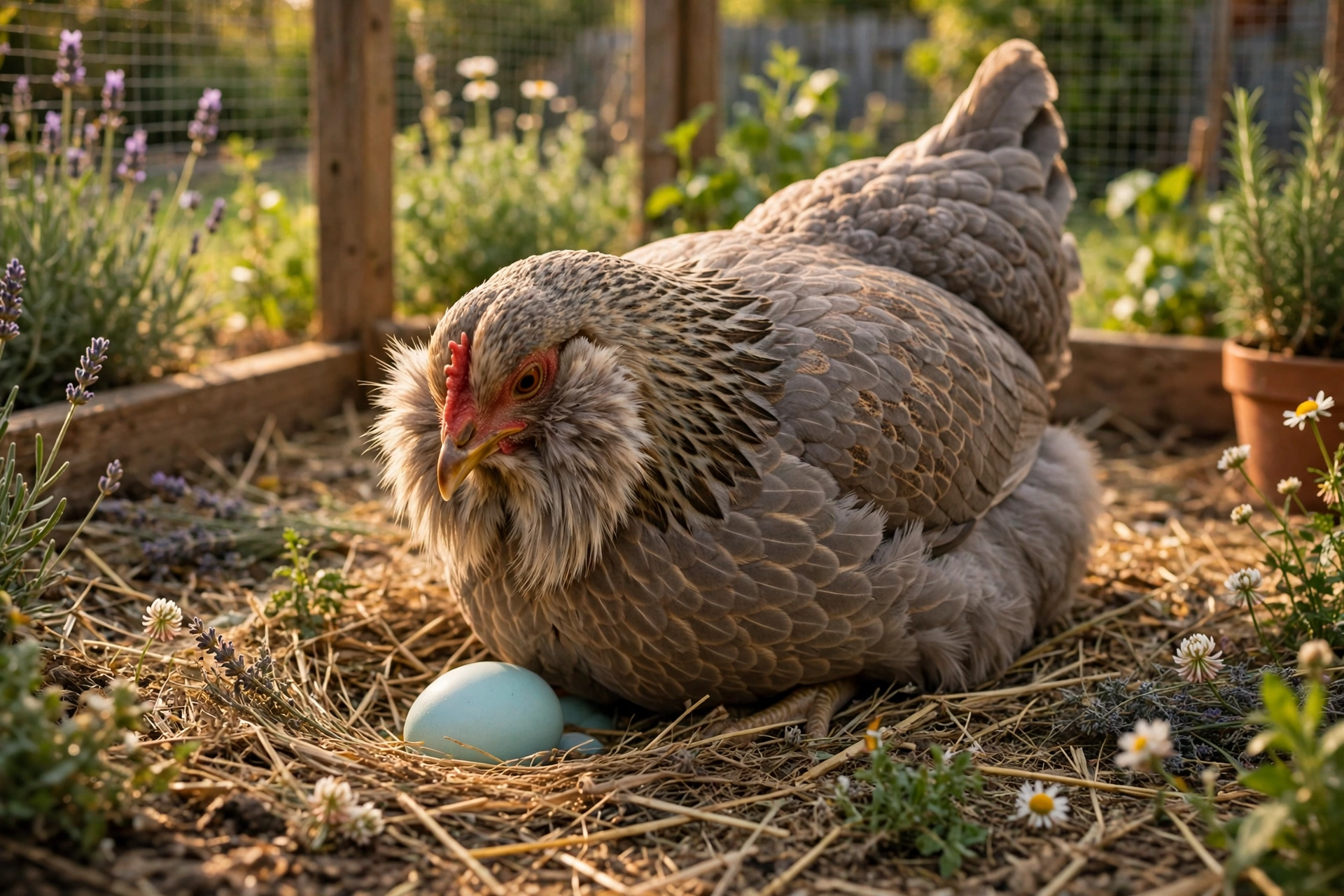
If you keep Easter Eggers, or you are thinking about adding them to your flock, one question comes up sooner or later, and that question is how long do Easter Egger chickens live in years. It is a fair question to ask before you bring home chicks, because a chicken is not a short term pet.
Most Easter Eggers live 5 to 8 years. That is the honest middle for a well kept backyard bird. Some live a shorter life because of illness, a predator, or a hidden health problem. Others live longer, and well kept birds can reach 9 or 10 years with good food, a safe coop, clean water and a keeper who notices small changes early. The Easter Egger lifespan is not a fixed number. It is a range, and where your bird lands in it depends on her genes, her care and a fair amount of luck.
Easter Eggers are loved for good reasons. They lay blue, green and sometimes olive eggs, they are usually friendly and calm, they forage well, and they cope with cold weather better than many other backyard breeds. They also suit families and first time keepers, because they are hardy and forgiving. This guide explains the lifespan in plain terms, what shortens it, what helps a bird live longer, how laying changes with age, how roosters compare, and the signs of ageing.

Table of Contents
Quick Facts
At a Glance
Easter Eggers usually live 5 to 8 years. Well kept birds can reach 9 or 10 years. They are hybrids, not a true breed, so individual birds vary more than birds from a standardised breed. They are cold hardy, good foragers and usually friendly with people.
Laying Life
Easter Eggers lay around 200 to 280 eggs a year in the first years. The eggs are blue, green or olive, and the colour comes from the blue egg gene they carry. Laying starts at about 5 to 6 months of age. Laying slows after the second or third year, and it often stops for a rest in winter and during the moult.
Good to Know
Cross beak, also called scissor beak, is the health note to watch for in this type of bird. It can make eating and drinking harder, so affected birds need a little extra care. Easter Eggers rarely go broody. They suit beginners and mixed flocks, and they do best with space to forage, a safe coop and a steady routine.
How Long Do Easter Egger Chickens Live
Most Easter Egger hens live 5 to 8 years. That range covers the great majority of backyard birds that are fed well, housed safely and checked often. A bird that reaches 5 years has already had a full laying life. A bird that reaches 8 years is doing very well. A bird that reaches 10 years is a grand old hen, and she will have slowed down a lot by then, even if she is still bright and interested in treats.
When people ask how long do Easter Eggers live in years, they often want one number. There is no single number that fits every bird, because Easter Eggers are not all the same underneath. Two birds from the same hatchery can look quite different, lay eggs of different colours, and live quite different lengths of life. That variation is normal for a hybrid, and it is why the honest answer is a range rather than a promise. For comparison, Silkies often live 7 to 9 years, as shown in our guide on how long Silkie chickens live. Rhode Island Reds often live 5 to 8 years, as shown in our guide on how long Rhode Island Red chickens live. Buff Orpingtons often live 8 to 10 years, as shown in our guide on how long Buff Orpington chickens live.
Age changes what a keeper should expect. In the first year, an Easter Egger is growing, feathering out, learning the flock, and starting to lay. In the second and third years, she is at her best for laying, and she is usually strong, active and full of character. From about 4 years onward, laying slows, the moult may take longer, and she may rest more. By 7 or 8 years, she is an old hen. She may still lay a few eggs, or she may have stopped laying altogether, and that is normal. Lifespan is how long the bird lives. Laying life is how long she lays eggs well. The two overlap, but they are not the same thing, and an Easter Egger can live several happy years after her best laying years are behind her.
True Breed or Hatchery Mix
Easter Eggers are not a true breed. That fact matters for lifespan, because it changes what you can expect. A true breed has a written standard, a set appearance, and generations of breeding toward that standard. An Easter Egger does not have any of that. The name describes a type of chicken, not a breed, and it covers a wide mix of birds that carry the blue egg gene. Most Easter Eggers come from Ameraucana or Araucana stock crossed with other laying breeds. The blue egg gene comes from the Ameraucana or Araucana side, while her size, colour, comb, temperament and laying rate come from the other breeds in the mix.
Hatchery birds vary widely, and that is the normal pattern for Easter Eggers. A hatchery produces large numbers of chicks for backyard keepers, and it selects mainly for egg colour, laying rate and hardiness, not for a show standard. That can be a strength, because a wide gene pool can bring vigour and resilience. It can also be a weakness, because there is less control over hidden faults. A keeper who buys from a hatchery should expect variety, and should judge each bird on her own health and character. One Easter Egger can be a small grey hen with a pea comb and a big muff, while another can be a larger reddish hen with no muff at all.
True Ameraucana parentage versus mixed parentage is worth understanding, because the two are often confused. A true Ameraucana is a recognised breed with a standard and a blue egg, and an Araucana is a separate recognised breed, also with a blue egg. An Easter Egger is neither. She may have an Ameraucana parent or grandparent, and she may look a lot like an Ameraucana, with a muff and beard and a pea comb, but she is still a mix. Sellers sometimes use the names loosely, and a bird sold as an Ameraucana may in fact be an Easter Egger. That does not make her a bad bird, but you should not judge her lifespan by Ameraucana figures alone.
There is no breed standard for an Easter Egger, so the usual heritage versus hatchery comparison does not work the same way here. For a true breed, a heritage bird from a careful breeder may live longer than a hatchery bird, because the breeder has selected for health and longevity over many generations. For an Easter Egger, there is no heritage line in that sense. The difference between breeders and hatcheries here is more about the care and selection behind each chick than about a heritage label. A well raised chick from a good source, with strong parents and good early care, has a better start in life than a chick from a poor source, whatever the label on the box.
Lifespan or Laying Life
Easter Eggers lay around 200 to 280 eggs a year in the first years. That is a good laying rate for a backyard bird, and it is one of the reasons they are so popular. A basket with blue, green and olive eggs looks wonderful, and the birds lay well enough to keep a family in eggs for much of the year. The first laying year is usually the best. The second year is still strong. After that, the numbers fall away gradually, and the eggs may get a little larger and a little less frequent.
How long do Easter Eggers lay eggs is a different question from how long they live, and it deserves its own answer. Most hens lay well for 2 to 3 years. After that, they still lay, but the rate drops, and the breaks between laying spells get longer. A 4 year old may lay 3 or 4 eggs a week in the good months and very few in winter. A 6 year old may lay a handful of eggs in spring and then stop for a long rest. A 7 or 8 year old may lay only a few eggs a year, or none at all. That is normal ageing, not a fault. You can read more about the general pattern in our guide on how long hens lay eggs for.
When do Easter Eggers start laying eggs. Most start at about 5 to 6 months of age, though some start a little earlier and some a little later. The first eggs are often small, and you will not know until she lays whether her eggs will be blue, green or olive. A bird that has not started by 7 or 8 months is not necessarily a problem, especially if she hatched late in the season or if the days are short. You can read more in our guide on when chickens start laying eggs. Egg colour does not tell you how long a bird will live, or how many eggs she will lay. The colour comes from the blue egg gene and from the brown tint laid over it, and it is a matter of genetics, not health.
The laying year has a rhythm. Easter Eggers lay best in spring and early summer, when the days are long and the weather is kind. They slow in late summer, they often stop during the autumn moult, when they lose old feathers and grow new ones, and they lay little or nothing in the darkest part of winter unless you add light. A moult can look alarming to a new keeper, because the bird loses feathers, looks ragged, and stops laying, but it is a normal and healthy process. A simple note on the calendar when a bird stops and starts again shows you her pattern, so you can tell a normal winter rest from a real problem.
What Affects Their Lifespan
Genes set the starting point for the Easter Egger lifespan, and care decides how close a bird gets to the top of her range. A bird with strong genes, a good start in life, and steady care has the best chance of reaching 8 years or more. The keeper cannot change the genes, but the keeper controls almost everything else. Food comes first. Easter Eggers need a balanced layer feed once they are laying, with enough protein and enough calcium for strong shells. They also need clean water at all times, and grit to help them digest their food. Treats are fine in small amounts, but they should stay a small part of the diet, because a bird that fills up on treats eats less of the balanced feed she needs.
Housing comes next. Easter Eggers are cold hardy, and they cope with cold weather better than many breeds, but they still need a dry, draught free coop with good ventilation, a dry floor, and a safe roost. Damp and draught are a bigger threat than cold alone. A coop that is wet in winter, or that traps damp air, will bring respiratory problems. Space matters too. A crowded coop brings stress, feather pecking and disease, while a coop with room to move and roost keeps the flock calmer. A run with shade, dust bathing space and room to forage helps just as much.
Predators are a real threat to lifespan, and they are often the reason a backyard bird dies young. A fox, a dog, a hawk, or a rat can take a bird in minutes, and a single weak point in a fence or a coop door is enough. Easter Eggers are good foragers, and they like to range, but ranging brings risk. A secure coop at night, a run with a roof or netting where hawks are a problem, and a fence that is dug in or skirted at the base will save more birds than any supplement. Check the coop often, and fix a loose wire or a gap the day you find it, not next week. Disease and parasites wear a bird down too. Worms, mites, lice and coccidiosis are common in backyard flocks, and regular checks, clean bedding, a dry coop and a dust bath help a lot. Our care pillar on chicken care and health covers the basics.
Cross beak, also called scissor beak, is the breed specific health note to watch for in Easter Eggers. In a bird with cross beak, the upper and lower beak do not meet neatly, and they cross to one side. A mild case may cause little trouble. A severe case can make it hard for the bird to pick up feed, and the bird may lose weight, grow slowly, or struggle to drink. Cross beak is often present from a young age, and it may get more obvious as the bird grows. It cannot be cured, but it can be managed with a deep dish of feed rather than a shallow one, with crumble or mash rather than large pellets, and with water that is easy to reach. The beak may need a gentle trim from time to time, and that is a job for someone who knows how to do it safely, or for a vet. Stress shortens life in quiet ways as well, so Easter Eggers do best with a steady routine, the same coop, the same feeding time, and the same gentle handling.
Broodiness and Laying
Do Easter Eggers go broody a lot. The short answer is no. Easter Eggers rarely go broody, and most hens will never show a strong broody spell at all. A broody hen wants to sit on eggs and hatch them, and she will sit in the nest box, puff up, growl when you reach for her, and stop laying while she sits. Some breeds, like Silkies and Cochins, go broody often and make devoted mothers. Easter Eggers are at the other end of the scale. They were bred for laying, not for sitting, and broodiness has been bred down in most lines.
That is good news for a keeper who wants eggs, because a broody hen stops laying, and a flock with several broody hens will have an empty egg basket for weeks. It is less good news for a keeper who wants a hen to hatch chicks naturally, because an Easter Egger is not the bird to rely on for that job. If you want to hatch chicks, an incubator or a broody hen from a broody breed is a more reliable plan. If your Easter Egger does go broody, it is usually a short and half hearted spell, and she will often give up on her own. Broodiness is not a health problem. She is following an instinct, and she needs food, water and a break from the nest so she does not lose too much condition.
Signs of an Ageing Easter Egger
Ageing creeps up slowly, and the signs are easy to miss if you see the birds every day. A keeper who knows what to look for will spot the change early, and can adjust the care to match the bird. The first sign is often in the laying. An old hen lays less often, and her eggs may be thinner shelled, paler, or oddly shaped. She may lay for a few weeks in spring, then stop for a long rest, then lay a few more, then stop again. That stop start pattern is normal for an old hen. Her comb and wattles may shrink a little and lose some of their bright red colour, especially when she is not laying.
The second sign is in the body. An old Easter Egger may feel lighter in the hand, and her breast bone may feel sharper. Her legs may look thicker and rougher, with larger scales, and her feet may be a little stiffer. Her feathers may look duller, and she may take longer to grow new feathers after a moult. None of these changes on its own means the bird is ill. She may also roost a little lower, walk more slowly, and spend more time resting in the sun or in a quiet corner of the run. She may drop down the pecking order, and the younger birds may push her away from the feeder. A second feeder and a second drinker will help her eat and drink without a fight.
It is worth learning the difference between normal ageing and illness, because the two can look alike at first. An old hen that is resting more but still eating, drinking and dust bathing is probably just old. A hen that is hunched, dull, off her food, or sitting alone with her eyes closed in the middle of the day is probably ill, whatever her age. A hen that has a swollen belly, laboured breathing, or a sudden change in droppings needs a closer look the same day. Old hens have less reserve than a young bird, so early action matters more.
How to Help Yours Live Longer
There is no secret trick that guarantees a long life, but there are a dozen small things that add up to years. Give a good quality layer feed, keep it fresh and dry, and keep clean water available at all times. Offer oyster shell or another calcium source in a separate dish, so a laying hen can take what she needs. Give treats in small amounts, and make them useful, like leafy greens, a little fruit, or a handful of mealworms, rather than bread and cake. Keep the coop dry, clean and well ventilated, change the bedding often, and give the birds room to roost and room to move. Give them a run with shade in summer, shelter in winter, and a dust bath all year round, because a dust bath helps keep mites down.
Lock the coop at night, every night, without exception. Check the wire, the door, the roof and the fence often, and fix any gap at once. If you let the birds free range, do it when you are around, or in a fenced area that is as safe as you can make it. A hawk can strike in daylight, and a fox can strike at dusk, so a run with a roof or netting is worth the effort where predators are a problem. Handle your birds often, and learn what each one feels like. A bird that feels light, has a pale comb, or has mites on the skin needs attention. Quarantine any new bird before you add her to the flock, because a two week quarantine in a separate pen is a small price to pay for the safety of the whole flock.
Easter Eggers are usually friendly, and they often enjoy being held, talked to and hand fed. That trust makes health checks easier, and it makes the birds calmer. Are Easter Eggers good for beginners. Yes, they are one of the best choices for a first flock, because they are hardy, friendly and forgiving. An old Easter Egger needs a little more help. Give her a lower perch, or a ramp, so she can roost without a jump. Give her a second feeder and drinker, so she does not have to fight for food. Give her a sheltered spot in the run where she can rest in the sun without being pecked. Keep her warm in winter, with dry bedding and protection from draughts, and keep her cool in summer, with shade and fresh water.
Easter Egger Rooster Lifespan
Easter Egger rooster lifespan is a question that comes up often, and the answer is close to the answer for hens, with a few differences. Most Easter Egger roosters live 5 to 8 years, the same range as the hens. Some live a little shorter, because a rooster’s life has extra risks. Some live a little longer, because a rooster does not have the strain of laying eggs. A rooster may fight with another rooster, and a serious fight can cause injury or infection. He may be more likely to face a predator, because he will often put himself between the flock and danger. He may also be more likely to be rehomed, because many keepers cannot keep a rooster, and a rehomed bird faces a new flock, new stress and new risks.

Easter Egger roosters are usually friendly and calm, and they are often good with children, though every rooster is an individual, and a rooster should always be watched around small children. A good rooster will watch the sky, call the hens to food, break up squabbles in the flock, and stand guard while the hens dust bathe. He needs the same good food, the same safe coop, and the same health checks. Feeding a rooster is a little different from feeding a laying hen. A rooster does not need the high calcium in layer feed, and too much calcium over a long time can strain his kidneys. Many keepers feed the whole flock a flock raiser or all flock feed, and offer oyster shell in a separate dish for the laying hens.
An old rooster slows down in the same way an old hen does. He may crow less, he may walk more slowly, and he may be less keen to patrol the run. His comb may shrink a little, his feathers may dull, and his spurs may grow long and need a careful trim. A keeper who gives an old rooster his own space, his own feeder, and a little extra care will help him age with dignity. If you keep a rooster, think about the neighbours as well as the bird. A rooster crows, and he crows early, and he crows often. A rooster that is kept in a dark, quiet coop until a reasonable hour may crow less, but he will still crow, and he still needs fresh air and space while he waits. A keeper who talks to the neighbours before bringing a rooster home will have fewer problems, and the rooster will have a more settled home.

Frequently Asked Questions
How long do Easter Egger chickens live?
Most Easter Egger chickens live 5 to 8 years. With good food, a safe coop and a keeper who notices small changes early, some reach 9 or 10 years. The range is wide because Easter Eggers are hybrids, not a true breed, so individual birds vary in genes, size and health. Good food, a safe coop, clean water and early care for illness give a bird the best chance of reaching the top of that range.
How long do Easter Eggers lay eggs?
Easter Eggers lay around 200 to 280 eggs a year in the first years, and they lay well for 2 to 3 years. After that, laying slows year by year. A 4 year old may lay 3 or 4 eggs a week in the good months. An older hen may lay only a few eggs in spring, or none at all. Laying stops for a rest in winter and during the moult.
Are Easter Eggers good for beginners?
Yes, Easter Eggers are good for beginners. They are hardy, cold hardy, friendly and forgiving, and they cope well with a keeper who is still learning. They forage well, they are usually calm with children, and they lay a good number of blue, green or olive eggs. A beginner should still give them a safe coop, good layer feed, clean water and regular checks.
When do Easter Eggers start laying eggs?
Most Easter Eggers start laying at about 5 to 6 months of age. Some start a little earlier, and some a little later, especially if they hatched late in the season or if the days are short. The first eggs are often small. You will not know the egg colour until she lays, because one bird may lay blue eggs, another may lay green eggs, and another may lay olive eggs.
Do Easter Eggers go broody a lot?
No, Easter Eggers rarely go broody. Most hens will never show a strong broody spell. A broody hen sits in the nest box, puffs up, growls and stops laying, but that pattern is uncommon in this type of bird. If your Easter Egger does go broody, it is usually short, and she will often give up on her own. An incubator or a broody breed is a better choice if you want to hatch chicks.
What is cross beak in Easter Eggers?
Cross beak, also called scissor beak, is a condition where the upper and lower beak do not meet neatly and cross to one side. It is the health note most often linked with Easter Eggers. A mild case often causes little trouble and the bird eats and drinks normally. A severe case can make eating and drinking hard, and the bird may need a deep dish of feed, crumble or mash rather than large pellets, easy to reach water, and a gentle beak trim from someone who knows how to do it safely.

Keep Reading

Nusrat
Author, TheChickenPet.com