
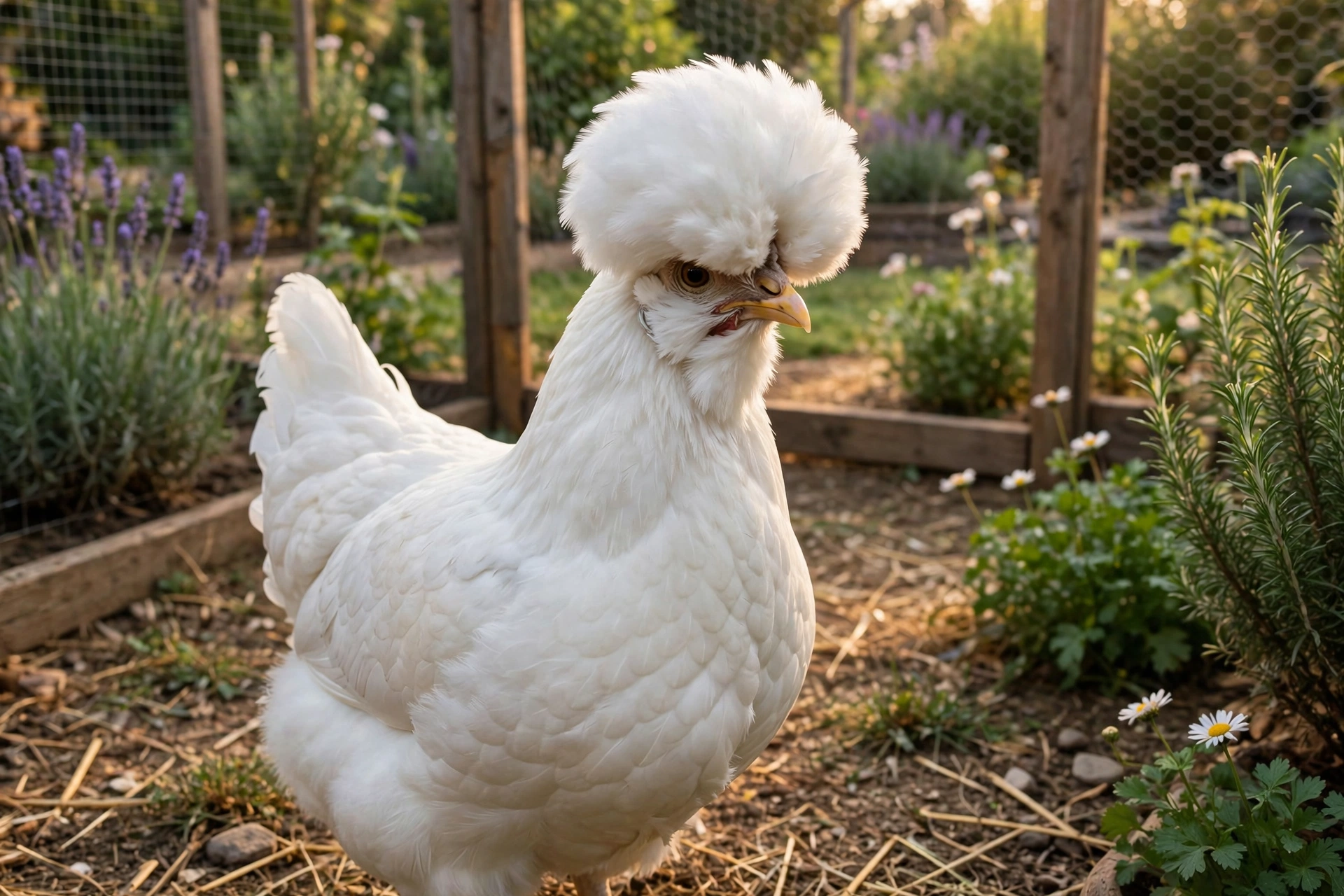
Polish chickens are hard to miss. That big round crest of feathers on top of the head looks like a powder puff, and it gives the breed a friendly and slightly comical look that many keepers love at first sight. They are ornamental birds first and foremost, kept for their looks and their gentle nature, yet they also lay a useful number of white eggs. If you are thinking of adding Polish chickens to a backyard flock, or if you already have one and want to know what to expect, the first question is usually a simple one, and that is how many years you can expect to share with them.
The honest answer for Polish chicken lifespan is 5 to 8 years for most birds in a well kept backyard flock. That is the middle ground that most keepers report, and it is the figure to plan around. Some birds live shorter lives, often because of predators or accidents rather than old age, while others live longer. Well kept birds can reach 10 years, and a few may go a little beyond that when they have safe housing, good food, clean water and a keeper who watches them closely. A white crested Polish lifespan is not very different from the lifespan of other Polish colours, because the colour of the crest does not change the health of the bird underneath it.
What makes Polish chickens different from many other breeds is not their body or their laying ability. It is their crest. The crest blocks their vision, especially from above and from the sides, and that changes how they live every day. A Polish hen cannot always see a hawk coming, a dog approaching or a flock mate pecking at her crest. She startles more easily, she may miss food that other birds find quickly, and she may walk into things that a clear sighted bird would avoid. That poor vision is the main reason Polish chickens need extra care, and it is also the main reason their lifespan depends so much on the keeper. In a safe run with a trimmed crest and a calm flock, a Polish chicken can live a long and happy life. In an open garden with no cover and no protection, the same bird is at much greater risk.

Table of Contents
- Lifespan 5 to 8 years for most birds, with well kept birds reaching 10
- Size Small to medium, hens around 4 to 5 pounds and roosters around 5 to 6 pounds
- Temperament Gentle, calm and a little nervous, best in a quiet flock
- Main risk Poor vision from the crest, which makes predators the number one danger
- Eggs Around 150 to 200 white eggs a year in the first years
- Egg colour White, medium sized
- Laying start Around 5 to 6 months old
- Laying years Strongest in the first two to three years, then slowly fewer eggs each year
- Crest care Keep the crest dry and trimmed so the bird can see
- Broodiness Rarely broody, so do not count on a Polish hen to hatch chicks
- Cold and heat Fairly cold hardy when dry, but they need shade and water in heat
- Beginners Can suit beginners who have a secure run and time for crest care
How Long Do Polish Chickens Live
Most Polish chickens live 5 to 8 years. That range covers the majority of birds kept in backyards, and it is the best answer to give when someone asks how long do Polish chickens live. It is shorter than the lifespan of some hardy dual purpose breeds, and longer than the lifespan of many birds that are pushed hard for eggs in commercial systems. Polish chickens sit in the middle. They are not bred for extreme laying, so their bodies are not worn out as quickly as a high production layer, yet they carry a special risk that can cut a life short, and that risk is their limited vision.
It helps to compare Polish chickens with other breeds so the number means something. Silkie chickens, another ornamental breed with a crest and a gentle nature, live a similar length of time, and you can read more in our guide to how long Silkie chickens live. Rhode Island Reds and Buff Orpingtons often live a little longer on average, partly because they can see clearly and react faster to danger. That comparison does not make Polish chickens fragile. It simply shows that their lifespan is shaped less by their body and more by how well their vision problem is managed. Give a Polish chicken a safe home and she can live just as long as many other backyard hens.
Heritage or Hatchery Birds
Where your Polish chicken comes from can affect how long it lives. Heritage birds from a breeder who selects for health, vigour and good type often live longer than hatchery birds bred mainly for numbers and looks. A breeder bird may cost more, and it may take longer to find, but it often has a stronger body, a better immune system and a crest that is full without being so heavy that the bird cannot see at all. A hatchery bird can still live a long life, and many do, but hatchery flocks vary more, so one bird may be hardy while another is weaker from the start. When you buy Polish chickens, ask the seller about the parent birds, how old they are, and whether they have had health problems. A seller who can answer those questions clearly is usually a better bet than one who cannot.
Colour does not make a big difference to lifespan. White Crested Black Polish, Buff Laced Polish, Silver Laced Polish, Golden Laced Polish and White Polish all share the same basic body and the same crest problem. A white crested Polish lifespan is therefore much the same as the lifespan of any other Polish colour. What matters more is the size and shape of the crest on the individual bird. A very large and heavy crest blocks more vision and soaks up more water in rain, while a smaller and tidier crest is easier to manage. When you choose a bird, look for bright eyes, clean legs and a bird that moves with confidence rather than bumping into things.
Lifespan or Laying Life
Lifespan and laying life are two different things, and it helps to keep them separate. Lifespan is how long the bird lives. Laying life is how long the bird lays eggs at a useful rate. A Polish hen may live for 8 years but only lay well for 3 or 4 of those years, and that is normal. Many keepers are surprised by this, especially if they are used to breeds that lay strongly for longer, but it is part of owning an ornamental breed. Polish chickens are excellent layers for an ornamental breed, yet they are not production layers, and their laying slows down as they age.
A Polish hen usually lays around 150 to 200 white eggs a year in the first years. That is a good result for a crested ornamental bird, and it means you can expect 3 to 4 eggs a week from a young hen in her first laying season. The eggs are white and medium sized, with a clean shell and a neat shape. Laying starts at around 5 to 6 months old, though some birds start a little earlier and some a little later. The first eggs may be small, and the hen may lay irregularly for a few weeks while her body settles into a rhythm. That is normal, and it is not a sign of a problem unless it goes on for a long time or the hen looks ill.
If you want the wider picture on laying, our guide to how long hens lay eggs for explains how laying changes with age across breeds, and our guide to when chickens start laying eggs covers the signs that a pullet is close to her first egg. For Polish chickens specifically, the pattern is simple. The first year of laying is usually the best, the second year is still strong, and from the third year onwards the number of eggs drops a little each year. By 4 or 5 years old, a Polish hen may lay only a few eggs a week in spring and summer, and she may stop for longer in winter or during moult.
So how long do Polish chickens lay eggs for in a practical sense. Most keepers get useful laying for 3 to 4 years, with a few eggs after that for another year or two. Some hens keep laying an egg now and then at 6 or 7 years old, which is a pleasant surprise, but it is not something to plan around. If eggs are your main goal, a Rhode Island Red will lay more eggs for longer, and you can compare the two breeds in our guide to how long Rhode Island Red chickens live.

What Affects Their Lifespan
The crest is the single biggest factor in Polish chicken lifespan, and it affects almost everything else. A full crest blocks vision from above, which is exactly where hawks attack from, and it blocks side vision too, which makes it harder for the bird to spot a dog, a fox or a cat. A Polish chicken may not see a predator until it is very close, and by then it may be too late to run. This is why predators are the number one cause of early death in Polish chickens, ahead of disease and old age. It is not that Polish chickens are weak. It is that they cannot see the danger that other chickens would spot and flee from.
Crest care is therefore not cosmetic. It is a lifespan issue, and it is the reason why do Polish chickens need crest care is one of the most useful questions a new keeper can ask. A wet crest is heavy, cold and uncomfortable, and it can lead to chilling in winter and to eye problems if it stays damp. A dirty crest can hide mites, lice and skin problems, and it can matt together so the bird can see even less. A very long crest can fall over the eyes completely, leaving the bird almost blind. Trimming the feathers around the eyes, keeping the crest dry, and checking it weekly for parasites and tangles all help the bird see better and stay healthier. A bird that can see eats better, drinks better, avoids bullies and escapes danger faster, and all of those things add up to a longer life.
Housing matters just as much. Polish chickens need a secure coop and a covered run, with hardware cloth rather than chicken wire, a solid roof or netting overhead, and no gaps where a predator can reach in. A covered run is especially important for this breed, because it protects against hawks during the day when Polish chickens are most at risk. Inside the coop, they need dry bedding, good ventilation without draughts, and enough space to move without bumping into feeders and walls. Perches should be low and easy to reach, because a Polish bird with limited vision may miss a high perch or fall when jumping down.
Food, water and health care form the next layer. Polish chickens need a balanced layer feed once they start laying, with oyster shell available for strong shells, plus clean water every day. Treats are fine in small amounts, but they should not replace the main feed. Parasites should be checked for regularly, and any bird that looks off should be separated and watched closely. Polish chickens are not especially prone to one single disease, but they are more likely to suffer from eye infections, head injuries from pecking, and chilling when the crest gets wet, so those are the problems to watch for first. Our chicken care and health pillar covers the daily and weekly checks that keep any flock healthy.
Flock mates and stress also shape lifespan. Polish chickens are gentle and a little nervous, and they do badly in a flock with bold and pushy breeds that peck at crests. A pecked crest bleeds easily, and once blood shows, other birds may peck more, which can lead to a serious head injury. Keeping Polish chickens with other gentle breeds, or in a Polish only group, usually works best. They also need a calm routine, with the same feeding times, the same housing and no sudden changes. A stressed bird eats less, lays less and gets ill more easily, so calm is not a luxury for this breed. It is part of good care.
Cold and heat both need thought. Polish chickens are fairly cold hardy when they are dry, because their body feathers keep them warm, but a wet crest in cold weather is a real risk. In winter, keep them dry, keep the coop free of damp, and check the crest after rain or snow. In hot weather, they need shade, cool water and good airflow, because a heavy crest can trap heat around the head. Heat stress shows as panting, holding the wings away from the body and looking dull, and it needs shade and water straight away.
Broodiness and Laying
Do Polish chickens go broody a lot. The short answer is no, they rarely go broody. Broodiness is when a hen wants to sit on eggs to hatch them, and she stops laying, stays on the nest and gets defensive when you try to move her. Some breeds go broody often, and some hardly ever do, and Polish chickens sit firmly in the hardly ever group. This is good news if you want eggs, because a broody hen stops laying for weeks, but it is not helpful if you want a hen to hatch chicks for you. If you want to hatch Polish eggs, you will usually need an incubator or a broody hen of another breed.
The reason Polish chickens rarely go broody is partly breeding. They were bred for looks and for laying, not for mothering, and the broody instinct has been bred down over many generations. Their poor vision may also play a part, because a hen that cannot see well may be less confident sitting alone on a nest for weeks. Whatever the cause, most Polish keepers will never see a truly broody Polish hen, and the occasional bird that does go broody usually gives up after a few days.
When do Polish chickens start laying eggs. Most pullets start at around 5 to 6 months old, with some starting at 5 months and others waiting until 6 or 7 months. The exact timing depends on the time of year, the amount of daylight, the quality of feed and the individual bird. Pullets that mature in spring and summer often start earlier than those that mature in the dark days of winter, because daylight triggers laying. A pullet close to laying will have a redder comb and wattles, she will squat when you reach towards her, she will spend time investigating the nest boxes, and she may become more vocal. Those signs are the same as in other breeds, and they are worth watching for so you know when to switch to layer feed and put oyster shell out.
Once laying starts, the pattern is steady rather than spectacular. A young Polish hen lays 3 to 4 white eggs a week in her first season, with a break during moult and a slowdown in winter when daylight is short. Some keepers add light in winter to keep laying going, but many prefer to let the bird rest, because a winter rest helps the hen recover and may help her live longer. The key point for lifespan is that laying takes energy, and a hen that lays hard without enough calcium, protein and rest will wear out faster.
Signs of an Ageing Polish
Ageing in Polish chickens is gradual, and it is easy to miss if you are not looking for it. The first sign is usually laying. A hen that once laid 4 eggs a week may drop to 2, then to 1, then to an egg now and then. That change is normal from 3 or 4 years old onwards, and it is not a sign of illness on its own. The bird may also moult for longer, take more time to grow new feathers back, and look a little rough for a while after moult. Her crest may thin a little, and her legs may look paler and rougher than they did when she was young. A similar pattern of slower laying and more rest with age is seen in Buff Orpingtons, and you can compare the two in our guide to how long Buff Orpington chickens live.
Behaviour changes too. An older Polish hen moves more slowly, rests more often, and may choose a sunny spot to sit in rather than foraging all day. She may be less interested in treats that once excited her, and she may go to roost earlier in the evening. Her vision may get worse as her crest grows heavier with age or as her eyesight fades, so she may bump into things more often or startle more easily. That is a sign to trim the crest a little more, move feeders and drinkers to easy spots, and make sure she is not being pushed away from food by younger birds.
The body also changes. Older hens often lose a little weight, or they may gain weight if they stop laying but keep eating the same amount, so weight should be checked by feel rather than by eye. The keel bone may feel sharper, the abdomen may feel softer, and the vent may look a little looser. These changes are normal with age, but a sudden change in weight, a swollen abdomen, laboured breathing, a pale comb, runny eyes or a bird that stops eating are all signs to act on straight away. Old age is not a disease, but older birds get ill more easily, and they recover more slowly, so early attention matters even more in the later years.

How to Help Yours Live Longer
Helping a Polish chicken live longer is mostly about managing vision and safety. Start with the crest. Check it every week, keep it clean and dry, and trim the feathers that fall over the eyes so the bird can see forwards and sideways. Use small and sharp scissors, trim a little at a time, and stop if the bird gets stressed. Some keepers tie the crest up loosely with a soft band on show days, but for daily life a trim is kinder and safer. After rain, check that the crest is not soaked, and if it is, bring the bird into a dry shelter and let it dry before night. A dry crest is a warm crest, and a warm bird is a healthy bird.
Next, make the run predator proof. Use hardware cloth with small holes, bury it or bend it outwards at the base so diggers cannot get under it, cover the top with netting or a solid roof, and lock the coop at night with a latch that raccoons cannot open. Do not rely on chicken wire, because it keeps chickens in but it does not keep predators out. If you free range your Polish chickens, do it only when you are outside to watch them, and provide bushes, tables or other cover they can run under when a hawk flies over.
Food and water should be simple and steady. Give a good quality layer feed, keep oyster shell in a separate dish, change the water daily, and keep feeders and drinkers in the same place so a bird with poor vision can find them by habit. Add a little variety with greens, vegetables and a few treats, but keep treats to a small part of the diet. Keep the coop clean and dry, change bedding regularly, and check for mites and lice, especially around the crest and the vent. A weekly check takes only a few minutes, and it catches problems while they are still small. Our chicken care and health pillar has a simple routine you can follow.
Choose flock mates with care. Polish chickens do best with other gentle breeds such as Silkies, Cochins, Orpingtons and other Polish chickens. Avoid keeping them with very bold breeds that peck at crests, and provide more than one feeder and drinker so a shy Polish bird is not pushed away from food.
Finally, watch the bird, not just the calendar. A Polish chicken that is eating well, moving well and interested in the flock is doing well, whatever her age. A bird that hides, stops eating, looks puffed up, has runny eyes or a dirty vent needs attention the same day. The keepers whose Polish chickens live to 9 or 10 years are rarely doing anything fancy. They are doing the basics well, every day, and they are paying attention to the crest, the run and the bird in front of them.

Polish Rooster Lifespan
Polish rooster lifespan is much the same as hen lifespan, at around 5 to 8 years, with well kept roosters also able to reach 10. Roosters do not lay eggs, so they do not face the wear of laying, and that can help them live a little longer in some cases. On the other hand, roosters face risks that hens do not, and those risks can balance the picture out. A rooster may fight with other roosters, injure himself defending the flock, or draw a predator towards himself while he calls an alarm. A Polish rooster with a big crest has the same vision problem as a hen, so he may not see a hawk until it is close, and he may be slower to lead the hens to cover.
Roosters also age in a similar way to hens. An older rooster crows less, moves more slowly, and may lose interest in mating. His crest may thin, his spurs may grow long and need trimming, and his legs may get stiff. Keep perches low, keep spurs trimmed if they curl, and watch for bullying from younger roosters. An older rooster that is respected by the flock and kept safe can live a long and useful life, and many keepers keep a favourite rooster long after his breeding days are over, simply because he is part of the flock.
Frequently Asked Questions
How long do Polish chickens live on average
Most Polish chickens live 5 to 8 years. Well kept birds can reach 10 years, and a few live a little longer. The average is pulled down by predators and accidents, especially in birds whose crest blocks their vision, so a safe and covered run makes a real difference to how long your bird lives.
How long do Polish chickens lay eggs
A Polish hen lays around 150 to 200 white eggs a year in her first years, with the best laying in the first two to three years. Useful laying usually lasts for 3 to 4 years, then the number of eggs drops each year.
When do Polish chickens start laying eggs
Most Polish pullets start laying at around 5 to 6 months old. Some start a little earlier and some a little later, depending on daylight, feed and the individual bird. Look for a redder comb, squatting behaviour and interest in the nest boxes as signs that the first egg is close.
Do Polish chickens go broody a lot
No, Polish chickens rarely go broody. They were bred for looks and laying rather than for hatching, so most hens will never sit on eggs for long. If you want to hatch Polish eggs, plan to use an incubator or a broody hen of another breed.
Why do Polish chickens need crest care
Polish chickens need crest care because the crest blocks their vision and can get wet, dirty and matted. Trimming the feathers around the eyes helps the bird see predators, find food and water, and avoid accidents. Keeping the crest dry and clean also helps prevent chilling, eye problems and parasites, all of which can shorten a life.
Are Polish chickens good for beginners
Yes, Polish chickens can be good for beginners who have a secure run and time for crest care. They are gentle, calm and friendly, and they lay a good number of white eggs for an ornamental breed. They are not the best choice for a beginner who wants to free range without cover or who keeps them with bold and pushy breeds, because their poor vision makes them easy prey.
How long do Polish roosters live
Polish roosters usually live 5 to 8 years, much the same as hens, with well kept birds reaching 10. Safe housing and a trimmed crest matter just as much for roosters as for hens.
 Nusrat
Author, TheChickenPet.com