
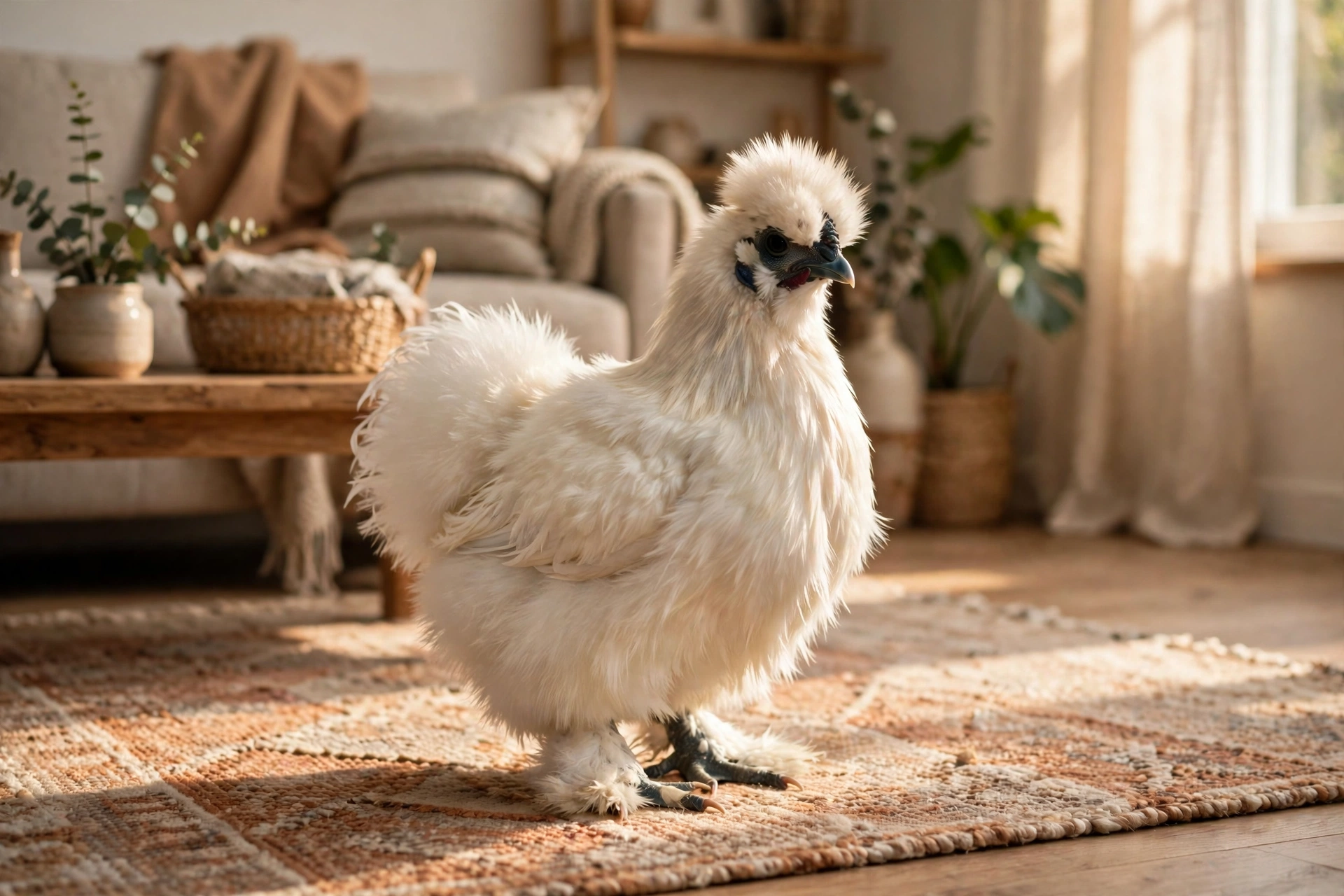
Yes, you can keep a chicken indoors as a pet, and for the right keeper with the right bird it works well. A house hen is not a cat and she is not a dog, so the honest answer comes with rules. She needs a diaper when she is loose in the house, a proper night cage to sleep in, time outside every day, and company, because a chicken is a flock animal even when the flock is you. Get those four things right and a calm bantam hen can be a lovely

Table of Contents
- The Short Answer
- What a House Chicken Needs Every Day
- Chicken Diapers and How Often to Change Them
- Best Chicken Breeds for Indoors
- The Night Cage and Where She Sleeps
- Hygiene and Keeping the House Clean
- The Indoor Dust Bath Station
- Feeding a House Hen
- A Single Indoor Hen Still Needs a Companion
- Local Rules and What to Check First
- When Indoors Is Not the Right Choice
- Frequently Asked Questions
Quick Facts
- At a Glance. A house hen needs a diaper changed every 3 to 4 hours, a night cage to sleep in, time outside every day, and company.
- Egg Laying. A laying hen still lays indoors. Most laying breeds give an egg most days in season, so the night cage needs a small nest area or a folded towel she can settle on.
- Good to Know. Bantams, Silkies and Seramas suit indoor life best. A single hen still needs a companion, human or chicken. Check local rules before you start.
The Short Answer
You can keep a chicken indoors as a pet, and plenty of keepers do, usually with one small hen rather than a whole flock. The bird that suits it best is a calm bantam hen, a bird that likes people, tolerates handling and is happy to sit near you. A large flighty layer breed is a poor choice for a living room, and a rooster is a poor choice for a house in almost every case, since he crows at dawn and most neighbourhoods will not allow him.
Indoor living works when you treat it as a real setup, not as a novelty. That means a diaper for floor time, a cage for the night, a dust bath tray, fresh food and water, daily outdoor time in a safe run or on a harness, and somebody around for most of the day. If you work long hours away from home and the house would sit empty, an indoor hen is not the right pet for you, because a hen left alone all day gets lonely and bored, and a bored hen pecks at furniture, calls loudly and pulls her own feathers.
What a House Chicken Needs Every Day
A house chicken has the same daily needs as a coop chicken, only the setting changes. She needs fresh water all day, layer feed or a balanced ration, a little grit, a dust bath, a safe place to sleep, and company. The difference is that you are her whole world, so you have to provide the things a flock and a yard would normally provide.
Her day should have a shape. Mornings are for fresh water and feed, a clean diaper and time out of the cage. Midday is for a dust bath and some outdoor time, even if that only means a secure run or a supervised wander on the lawn. Evenings are for a last feed, a fresh diaper change and settling into the night cage before dark. Chickens follow the light, so she will want to roost as the room darkens, and keeping her routine steady keeps her calm.
Space matters more than most new keepers expect. A hen that lives in a small cage all day is not an indoor pet, she is a caged bird, and she will suffer for it. The night cage is for sleeping only. During the day she should be out in the house with you, moving around, scratching in her dust bath tray and resting near you. If your home cannot give her that daytime freedom, keep her in a coop outside instead, where she has room and flock mates.
Chicken Diapers and How Often to Change Them
Chicken diapers for house chickens are the one item that makes indoor keeping possible, and they are also the item new keepers ask about most. A chicken diaper is a small washable pouch that fits around the hen’s vent and holds a disposable liner. It catches droppings while she walks around the house, and it lets her sit on your lap or on the sofa without leaving a mess behind.
Fit matters more than brand. The diaper should sit snugly enough that it does not slip, but loosely enough that it does not rub her skin or press on her legs. Most keepers measure around the bird’s body just in front of the legs and buy the size that matches. A bantam needs a small size and a standard hen needs a medium, and a good fit means the pouch sits under the vent with the straps over her back. If the diaper twists or slides to one side, it is the wrong size or the straps need adjusting.
Change the diaper every 3 to 4 hours, and always change it straight away if it is soiled through. A wet liner left against her skin causes sore skin and feather damage, and it smells. Keep two or three washable diapers in rotation so one is always clean, and wash soiled ones promptly in warm water with a mild detergent. Never leave a hen in a diaper overnight. The night cage is for sleeping, and she should sleep diaper free on clean bedding, because a diaper worn all night traps moisture against her skin for hours.
Some hens accept a diaper at once and some need a few short sessions to get used to it. Put it on for half an hour, give her a treat, take it off, and build up from there. If she freezes, lies down and refuses to move, the fit is wrong or she needs more time. Never force it, and never leave a new diaper on an unsupervised bird until you know she moves normally in it.

Best Chicken Breeds for Indoors
The best chicken breeds for indoors are small, calm and friendly, and they tolerate handling without panic. Size comes first, because a small bird makes less mess, needs a smaller cage and is easier to carry. Temperament comes second, because a nervous bird will not settle in a living room no matter how small she is.
Silkies are the classic house chicken. They are small, gentle, famously calm and happy to be held, and their fluffy feathers make them look like a toy. They are poor flyers, which is a blessing indoors, and they tend to stay where you put them. A Silkie hen is the safest first choice for indoor keeping.
Seramas are the smallest chicken breed of all, often under half a kilo, and they are confident little birds that bond closely with their keeper. Their tiny size makes them easy to house, but it also makes them fragile, so they suit a careful adult keeper rather than a busy household with small children.
Bantam Cochins are another good choice. They are round, fluffy, docile and slow moving, and they love to sit on a lap. Bantam Brahmas and bantam Orpingtons are similar in nature, calm and heavy for their size, though they are bigger than a Silkie or a Serama.
Avoid large active layers for indoor life. A Leghorn or a Rhode Island Red is a wonderful outdoor hen, but she is too big, too busy and too loud for a living room, and she will be unhappy without space to roam. The Friendliest Breeds guide on this site is a good place to start if you want to compare temperaments before you choose, and you can find it linked at the end of this article.
The Night Cage and Where She Sleeps
Every house chicken needs a night cage, a safe enclosed place where she sleeps. A large dog crate works well for a bantam, with soft bedding on the floor, a low roost bar and a small nest area made from a folded towel or a shallow box. The cage should stand in a quiet corner away from draughts, and it should be big enough for her to turn around, stretch her wings and stand fully upright.
Cover the cage at night with a light cloth if the room stays bright, because chickens sleep best in the dark and wake with the light. She will settle herself as dusk falls, so put her in at roughly the same time each evening and let her out at roughly the same time each morning. A steady routine is one of the kindest things you can give a house hen.
The cage is for sleeping, not for daytime storage. A hen that spends her days locked in a crate will grow bored and stressed, and a stressed hen stops laying, pulls feathers and calls loudly. If you need to leave the house for a few hours, the cage is fine for that short stretch, but if you are out all day, an indoor hen is not the right setup, and she would be happier in an outdoor coop with flock mates.
Hygiene and Keeping the House Clean
House chicken care lives or dies on hygiene. A hen makes dust, drops feathers and scatters feed, and her droppings carry bacteria, so the routine has to be steady. Change cage bedding every day or two, wipe food and water dishes daily, and sweep or vacuum the area where she spends her time each evening. Wash your hands after handling her, and keep her away from food preparation areas and from the beds of small children.
Feathers and dander are the part new keepers underestimate. Chickens produce a fine dust from their feathers, and in a closed room it settles on everything. A weekly deep clean of her corner, plus an air purifier if you have one, keeps it manageable. If anyone in the house has asthma or a feather allergy, think hard before bringing a hen indoors, because the dust will not go away.
A healthy hen that is diapered and cleaned after is not a dirty animal, but she is still a farm animal in a living room, and the house has to be cleaned like one. If that sentence puts you off, that is useful information, and an outdoor coop is the better choice for you.
The Indoor Dust Bath Station
A dust bath is not a luxury for a chicken, it is how she keeps her feathers clean and her skin free of parasites, and a house hen needs one just as much as an outdoor hen. Set up a shallow tray, a cat litter tray works well, filled with dry sand, a little dry soil and a handful of wood ash. Put it in a corner where she can use it daily, and expect some sand on the floor around it, because dust bathing is a gloriously messy business.
Let her bathe for twenty minutes or so each day. She will flop on her side, kick sand through her feathers and shake it out, and she will look ridiculous and delighted while she does it. That is normal and healthy. If she stops dust bathing, check her for mites and lice, and check that the sand is dry, because damp sand goes unused.
The full guide to building a dust bath is in our article on how to make a dust bath for chickens, and the indoor tray in this article follows the same mix, only smaller and placed on a washable mat to catch the scatter.
Feeding a House Hen
A house hen eats the same food as any laying hen, and indoor life does not change the ration. Her main feed should be a balanced layer feed, available through the day, with fresh water always beside it. Treats are for training and bonding, a few mealworms, a little chopped greens or a few berries, and they should stay a small part of the diet, not the main event.
Keep her away from the foods that harm chickens, and keep her off the kitchen counter while you cook, because a curious hen will peck at anything, including chocolate, salty snacks and raw beans. The feeding pillar on this site, what can chickens eat, covers the safe and unsafe foods in detail, and it is worth reading before your hen moves in.
Feed her in her own dish in her own corner, not scattered across the living room floor. Scattered feed draws her to scratch where you do not want her to, and it ends up under the sofa. A heavy ceramic dish she cannot tip over, placed on a washable mat, keeps the mess in one place.
A Single Indoor Hen Still Needs a Companion
This is the part of keeping chickens indoors as pets that new keepers get wrong most often. Chickens are flock animals, and a single hen kept alone indoors still needs a companion, human or chicken. You can be that companion if you are home for most of the day, talking to her, letting her sit near you and giving her things to do. If you are out for long stretches, one hen alone in a quiet house will get lonely, and a lonely hen calls, paces and pulls her own feathers.
Two hens are better than one if your home and your local rules allow it, because they keep each other company while you are out. Two bantams in a living room are still small, still quiet and still manageable, and they are far happier together than one hen alone. The social floor is one of the first things to understand about chickens, and our article on can you keep just one chicken explains why a lone hen struggles and what to do about it.
Children can be wonderful companions for a calm hen, but only with an adult watching. A hen is fragile, and a well meaning hug can hurt her. Teach children to hold her low, support her body, and put her down gently, and never let a small child carry her around the house unsupervised.
Local Rules and What to Check First
Before you bring a hen indoors, check the rules where you live. Many towns allow hens but ban roosters, some ban poultry outright, and some allow hens only in a coop in the garden, not in the house. The rules vary street by street, so check with your local council or housing association rather than guessing, and check your rental agreement too, because a landlord who allows a cat may still say no to a chicken.
Neighbours matter as well. A hen is quieter than a dog, but she still clucks, and an early morning egg song through an open window can wake a light sleeper next door. Talk to your neighbours before she arrives, not after the first complaint, and keep her indoors at night so the dawn chorus stays inside your walls.
If you keep a hen indoors because you are nursing her back to health, the rules are usually kinder, because a sick bird in the house is temporary. Our first aid kit guide covers that situation, and you can find it in what to put in a chicken first aid kit, which explains the indoor sick bay setup and the supplies worth keeping on hand.
When Indoors Is Not the Right Choice
Indoor keeping is not for every home and not for every bird, and it is better to admit that before the hen arrives than after. If you work full time away from home, if your house is small and busy, if someone in the family has asthma or a feather allergy, or if your local rules say no, then an outdoor coop with a small flock is the kinder choice, and your hen will be happier there.
A hen that paces, calls constantly, pulls feathers or refuses food is telling you something is wrong, and the answer is usually more space, more company or more outdoor time. Listen to her. A chicken that thrives indoors is calm, curious, eats well, lays regularly and seeks you out. A chicken that does not thrive should go back outside, and that is not a failure, it is good keeping.
The honest test is simple. If you can give her a diaper routine, a night cage, daily outdoor time and company, indoors can work beautifully. If you cannot give her all four, keep her outside, and visit her there instead.

Frequently Asked Questions
Can a chicken live indoors full time?
Yes, a small calm hen can live indoors full time, provided she gets a diaper for floor time, a night cage for sleeping, time outside every day and company for most of the day. A hen that never goes outside and never meets another living creature will get bored and stressed, so full time indoors still means daily outdoor time in a run or on a harness.
How often do you change a chicken diaper?
Change a chicken diaper every 3 to 4 hours, and straight away if it is soiled through. Never leave a hen in a diaper overnight, and keep two or three washable diapers in rotation so one is always clean. A wet liner left against her skin causes sore skin and feather damage.
Do indoor chickens smell?
A healthy hen that is diapered, cleaned after and kept on fresh bedding does not make a house smell, but her cage will smell if the bedding is left unchanged, and her dust bath area will scatter sand. The smell people associate with chickens comes from damp bedding and built up droppings, not from the bird herself, so daily cleaning keeps it away.
What is the best breed for a house chicken?
Silkies are the best first choice for most keepers, because they are small, calm, friendly and happy to be held. Seramas suit a careful adult keeper, and bantam Cochins suit a family that wants a lap hen. Avoid large active layers such as Leghorns, because they need space and activity that a living room cannot give them.
Can I keep just one chicken indoors?
You can, but only if you are home for most of the day and you are ready to be her flock. A single hen alone in an empty house gets lonely, calls loudly and pulls her feathers. Two hens are better if your home and local rules allow it, and our article on can you keep just one chicken explains the social floor in full.

Nusrat
Author, TheChickenPet.com
Keep Reading
Friendliest Chicken Breeds That Make Great Pets, compare calm, friendly breeds before you choose a house hen.
What Can Chickens Eat, the safe foods and the foods to keep away from a house hen.
Can You Keep Just One Chicken, why a lone hen struggles and what to do about it.