
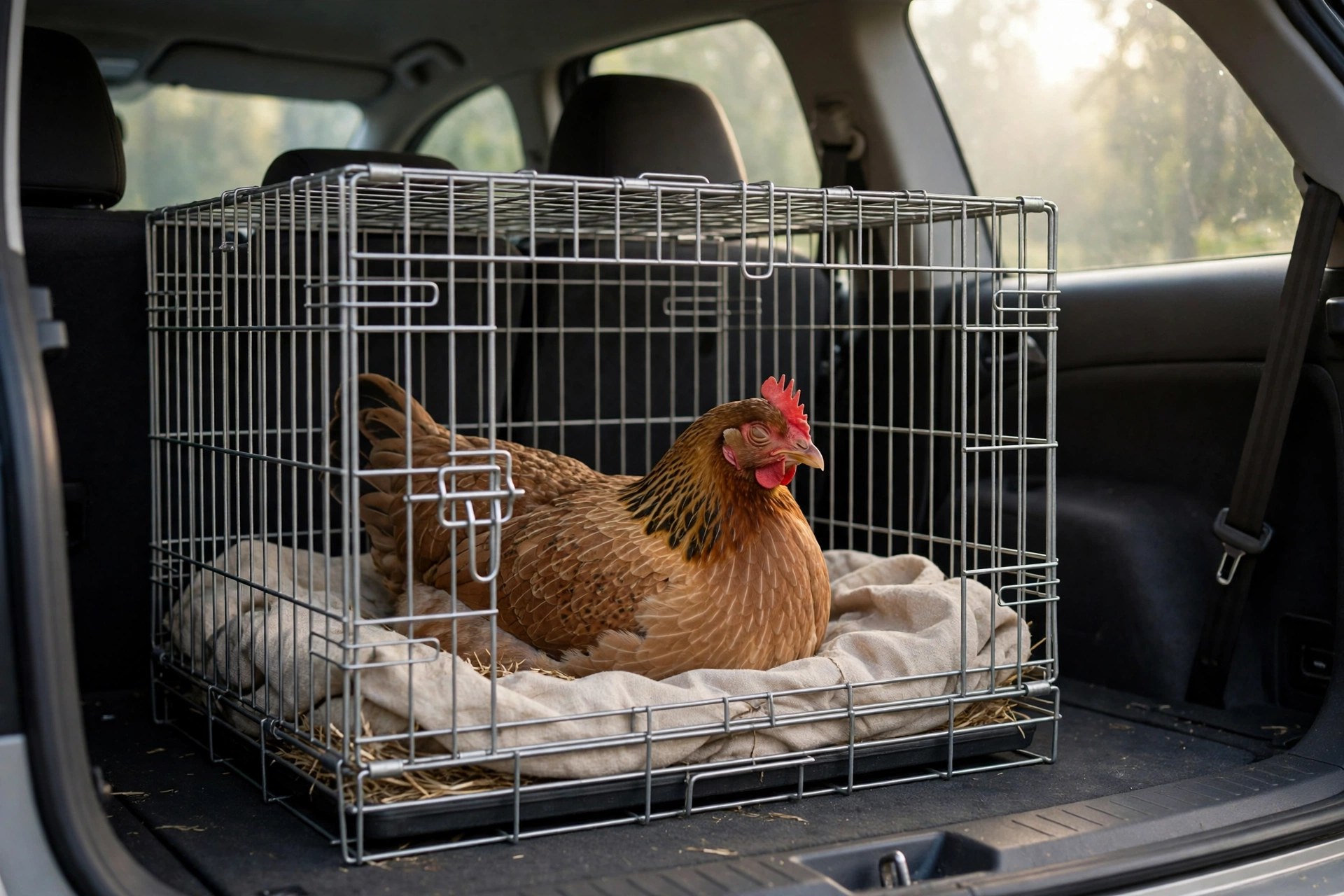
Moving house is stressful enough without a flock of hens to carry along, and the question most keepers ask first is how to move chickens to a new home without losing any of them. The short answer is to plan the move like a short road trip for animals that cannot tell you when they are hot, thirsty or scared. Use a ventilated crate, load the birds calmly, keep the trip short and cool, and have the new coop ready before the first bird arrives. Do that and most moves go smoothly, even for keepers who have never moved a chicken before.
By the end of this guide you will know how to move chickens to a new home, from the first crate to the first morning in the new coop. You will pick the right crate, catch and load the birds without a chase, drive them safely, handle the rules for moving chickens across state lines, and settle them into their new home.
Table of Contents
- Plan the Move Before You Touch a Bird
- The Best Crate for Transporting Chickens
- How to Catch and Load Your Chickens Calmly
- How to Transport Chickens Safely on the Road
- Moving Chickens Across State Lines and the Rules to Check
- Moving House With Chickens in Hot Weather and Cold Weather
- Settling Your Chickens Into Their New Home
- What to Do If a Chicken Escapes on Moving Day
- Common Mistakes That Cost Keepers Birds
- Frequently Asked Questions
Plan the Move Before You Touch a Bird
A good move starts the day before, not on the morning you load the car. Walk through the whole trip first. How far is the drive, how long will the birds be in crates, and what will the weather be at the hottest part of the day. A thirty minute drive across town is a different job from a six hour drive to a new state.
Start by counting your birds and your crates. A standard dog crate holds three average hens comfortably. Six hens means two crates and nine hens means three. A rooster should travel alone or with one calm hen at most, since a stressed rooster in a crowded crate will pick fights.
Next, get the new coop ready before moving day, clean and dry, with fresh bedding, a full feeder and a full waterer waiting. If the new coop is not ready, the birds arrive with nowhere safe to go, and that is when birds get lost. Our guide to predator proofing a chicken coop walks through the checks that matter most at a new place. Run those checks the day before, not while the birds sit in crates in the sun.
If you are moving chicks rather than adult hens, the new home needs warmth first. Our guide to setting up a brooder for baby chicks covers the heat and bedding a young bird needs. A new home is only ready when food, water, warmth and shelter are all in place before the birds arrive.
Finally, pick your moving window. Early morning is best in warm weather, because the car stays cool and the birds are calm after a night on the roost. Load at first light and arrive before the heat of the day.
The Best Crate for Transporting Chickens
The best crate for transporting chickens is one built for animals, with solid airflow, a door that latches firmly and enough room for the birds to stand and turn around. Two options cover almost every move.
A wire dog crate is the first choice for most keepers. It gives airflow from every side, the door latches securely, and the size range fits any flock. A medium crate suits two to three hens and a large crate suits three to four. Cover the crate with a light sheet on three sides during the drive. The sheet calms the birds by dimming the light, while the uncovered side keeps air moving.
A rabbit carrier or small pet carrier is the second choice and works well for one or two birds, or for a single hen that needs to travel apart from the flock. Pick a hard sided carrier rather than a soft fabric one, since a hard carrier holds its shape, vents properly and cannot be chewed open.
Three birds per crate is the rule. More than that and the birds overheat and crush each other when the car turns. Large breeds like Brahmas and Jersey Giants need more room, so two per crate is safer.
What not to use matters just as much. A cardboard box is fine for a ten minute trip to the vet and a bad idea for anything longer, because it soaks up droppings, collapses when damp and gives almost no airflow. A laundry basket with a loose lid is worse, since a hen can push the lid off. Never carry birds loose in the car, no matter how tame they are. A loose hen will fly at the windscreen or bolt out of an open door at a fuel stop, and a loose rooster in a moving car is a danger to everyone inside it.
Line every crate with old towels, straw or a rubber mat, which gives the birds grip and soaks up droppings. Skip newspaper on its own, since it turns slippery the moment it gets damp.
How to Catch and Load Your Chickens Calmly
Catching chickens is the part most keepers dread, and it is also the part where most birds get hurt. A chase around the garden stresses the whole flock, and a bird that is grabbed by one leg or one wing can be injured before the move even starts. The trick is to catch them when they are already calm, which means at night or at first light.
The easiest method is to load the birds the night before, after they have gone to roost. Wait until the coop is dark and quiet, then lift each bird gently off the roost with both hands, one hand under the body and one over the wings. Carry her straight to the crate in the dark, set her inside and latch the door. Birds handled this way barely wake up. Keep the crated birds in a cool, quiet and predator safe place overnight, and never leave crates outside where a fox or dog can reach them.
If you must load in the morning, work quietly and slowly. Take the birds one at a time from the roost before they come down to feed. Never chase birds around the run, and never grab a hen by the legs and carry her upside down, since that can injure her hips and terrify her.
Handle roosters with extra care. A cornered rooster will spur, so wear long sleeves and gloves, approach him calmly and keep his wings pinned gently against his body while you carry him. Crate roosters separately, since two roosters in one crate will fight, and a fight in a small space can leave both birds bloody.
Count the birds as each crate is loaded and write the count on the crate with masking tape. A written count takes ten seconds and saves a return trip. Do a final walk through the old coop and run before you drive away, and check the nesting boxes too, since a broody hen will sit tight in a dark box while the whole flock is loaded around her.
How to Transport Chickens Safely on the Road
How you drive matters as much as how you load, so set the car up for the birds before you set off. A car is the best way to move chickens for most pet keepers, because it gives you control over temperature and airflow, and the birds stay with you the whole way.
Put the crates on a flat surface in the car, not stacked on top of each other. The boot of a hatchback or the flat load area of an estate car works well, and the back seat works too if the crates sit level and cannot slide. Wedge the crates with rolled towels or luggage so they do not shift when you brake.
Keep the car cool and the air moving. Air conditioning is ideal, and if you do not have it, open the windows a crack on both sides so air flows through without blasting directly onto the crates. Never put crates in a closed boot with no airflow, and never leave the car parked in the sun with the birds inside, not even for a few minutes. A car in summer sun heats up fast enough to kill crated birds.
Drive smoothly. Take corners gently, brake early and avoid sudden stops. If a bird starts flapping hard inside a crate, pull over somewhere safe and wait for her to settle before you carry on.
Food and water need a plan of their own. Birds should not go without food or water for more than 8 hours, so for any trip longer than that you must stop and offer both. A small clip on waterer fixed to the crate door works well at a stop, or offer water from a shallow dish held steady while the crate door stays mostly shut. For short trips under two hours, the birds will be fine without food and water, as long as they had a full crop and a good drink before loading. Water in a dish inside a moving crate will spill and soak the bedding, so save the water for stops. A healthy adult hen rides comfortably for 4 to 6 hours in a ventilated crate.

Moving Chickens Across State Lines and the Rules to Check
Moving chickens across state lines is where the move stops being a simple drive and starts needing paperwork, so check the rules before moving day, not at a state border. The rules exist to stop poultry disease spreading between flocks, and they are enforced more often than keepers expect.
Start with the destination state. Most states ask for a health certificate from a vet, signed within 30 days of the move, and many ask for proof that the flock is free of pullorum and typhoid, usually through NPIP certification. NPIP is the National Poultry Improvement Plan, a testing programme that certifies flocks against certain diseases. If your flock is not certified, ask your state vet or your local extension office what testing is needed, since blood testing can take days to arrange.
Some states have extra rules for certain birds. A few restrict the movement of roosters, game birds or specific breeds, and a few ask for a permit number on top of the health certificate. A quick call to the destination state’s department of agriculture will give you the exact list, and that call costs nothing compared with having birds turned back at a border.
Keep the paperwork where you can reach it. Put the health certificate and any permit in a folder on the passenger seat, not buried in a box in the removal van.
If the move is within one state, the rules are usually lighter, but still check. Some counties have their own rules about flock size and permits, and a new town may cap the number of hens you can keep. Knowing the local cap before you move saves rehoming birds after you arrive.
Do you need a permit to move chickens. It depends on where you are going. A move across town usually needs nothing, a move across a state line usually needs a health certificate and sometimes a permit, and a move to a new country needs a vet, an import permit and quarantine.
Moving House With Chickens in Hot Weather and Cold Weather
Weather decides the timing of the move, and getting it wrong is the fastest way to lose a bird.
In hot weather, move in the morning. Load at first light, when the air is coolest, and aim to have the birds out of the crates and into shade with cold water before midday. A crate in a hot car can pass 40 degrees in minutes, and a hen cannot sweat, so she pants to cool down and can collapse quickly. Offer cold water at every stop and never cover the crate fully, since a sealed cover traps heat. If the forecast shows extreme heat, move the birds a day earlier or later. The furniture can wait, the hens cannot.
Watch for the signs of heat stress during the trip. A hen panting with her beak open and her wings held away from her body is too hot. Pull over, move the crate into shade, offer cool water and let her settle before you drive on.
In cold weather, the risks are different. A healthy adult hen handles cold well, but a crated bird cannot huddle, scratch or move to keep warm, so she chills faster than a free bird. Line the crate with thick dry straw, block drafts with a sheet over the windward side and keep the car warm. Skip the water dish inside the crate in freezing weather, since spilled water soaks the bedding and chills the birds fast. Offer water at stops instead, and check combs and wattles for pale or blackened patches, which are early frostbite.
Moving chickens in winter also means shorter days, so load early and arrive with daylight to spare.
Settling Your Chickens Into Their New Home
Arrival is not the end of the move. The first three days in the new home decide whether your hens settle, and the work you do on arrival matters more than the drive.
Start by putting the birds straight into the new coop, not the run. Open one crate at a time inside the coop, set the bird down gently and let her find the feeder and waterer on her own. Keep the whole flock inside the coop for the first two to three days, with the run door closed. This teaches them that the new coop is home. Hens let straight into a big new run often refuse to come back at dusk, and then spend the night outside where predators can reach them.
Make sure food and water are the first things the birds find. A full feeder and a full waterer inside the coop, plus a second waterer in the run once they are let out, will keep every bird drinking.
Watch the birds closely for the first few days. Some hens will stop laying for a week or two after a move, and that is normal. Stress pauses laying, and it returns on its own once the flock settles. What is not normal is a bird that will not eat or drink, sits puffed up in a corner or has watery droppings for more than a day. Separate her into a quiet crate with food and water and watch her for 24 hours.
If the new home already has chickens, do not mix the flocks on arrival day. New birds should be kept apart for at least two weeks so you can watch for illness, and then introduced slowly through a fence before they share a coop. Our guide to introducing new chickens to your flock covers the quarantine period and the see but do not touch method. Rushing an introduction on moving day, when every bird is already stressed, is how fights and injuries happen.
Give the flock a few days of quiet. Keep visitors and dogs away from the run and let the birds learn the new garden at their own pace. By the end of the first week, most flocks are eating, laying and dust bathing as if they had always lived there. Some keepers move a hen indoors instead, and our guide to keeping a chicken indoors as a pet covers the diaper, the night cage and the rules to check first.
What to Do If a Chicken Escapes on Moving Day
Even a careful move can go wrong, and an escaped bird on moving day is frightening because she does not know the new garden yet. Stay calm and act slowly, since a panicked chase will drive her further away.
First, stop and watch where she goes. A loose hen usually runs for the nearest cover, a bush, a fence line or under a shed. Move toward her slowly, in a wide arc, so you guide her back toward the coop rather than pushing her toward the road.
Second, use food. Shake a tub of grain or mealworms, crouch down and let her come to you. A hen that has just travelled is hungry, and most will walk back to a keeper holding food.
Third, if she has vanished, search at dusk with a torch. A hen that cannot find the coop will roost wherever she is, and her shape on a low branch is easier to spot at dusk. Bring a crate with you so you can carry her straight back.
Common Mistakes That Cost Keepers Birds
Most moving day losses come from a short list of avoidable mistakes.
Moving the birds before the coop is ready is the first mistake. Birds that arrive to a half built coop end up in temporary housing, and that is where birds escape or get taken by predators. Finish the coop first, then move the birds.
Overcrowding the crates is the second. Four or five hens in a crate built for three will overheat on a warm day, and a rooster crated with hens he does not know will fight. Three per crate is the rule, two for large breeds, and roosters travel alone.
Leaving birds in a parked car is the third, and the most dangerous. Even a few minutes in a sunny car can kill a crated hen, and a car in shade still warms up fast. If you must stop, take the crates out of the car and into the shade.
Forgetting water on a long trip is the fourth. Birds should not go without food or water for more than 8 hours, so plan a water stop before you leave, not when the birds are already panting.
Skipping the head count is the fifth. A hen left behind at the old house will have no food, no water and no flock. Count the birds into the crates, count them out of the car and count them into the new coop, every time.
Finally, mixing flocks on arrival day is a mistake that causes injuries. New birds and old birds need quarantine and a slow introduction, not a shared coop on a day when every bird is already stressed.
Frequently Asked Questions
How long can chickens travel in a crate?
A healthy adult hen travels comfortably for 4 to 6 hours in a ventilated crate, and 8 hours is the practical limit before food and water must be offered. Longer trips need a proper break with food and water in a safe pen. Chicks, old hens and sick birds should travel for under 3 hours where possible.
Can chickens travel in a car?
Yes, a car is the best way to move chickens for most pet keepers. Crate the birds, latch every door, keep the car cool, drive smoothly and never leave the birds alone in a parked car.
Do chickens get stressed when moving?
Yes, most hens are stressed by a move, and that is normal. Signs include panting, restlessness and a pause in laying for a week or two. The stress fades once the flock is settled in a ready coop with food, water and a few quiet days. A bird that will not eat or drink for more than a day after arrival needs to be separated and watched.
Can I move chickens at night?
Night is the best time to catch and load them, since birds are calm on the roost after dark. The drive itself is best done in daylight, so load at night or first light and drive in the morning.
Do I need a permit to move chickens across state lines?
It depends on the destination. A move across town usually needs nothing, while a move across a state line usually needs a health certificate and sometimes a permit or NPIP test results.

Nusrat
Author, TheChickenPet.com
Keep Reading
How to Introduce New Chickens to Your Flock, the quarantine period and the slow introduction that keeps a settled flock calm.
How to Predator Proof a Chicken Coop, the checks that matter most at a new place.
How to Set Up a Brooder for Baby Chicks, the heat and bedding a young bird needs in a new home.