
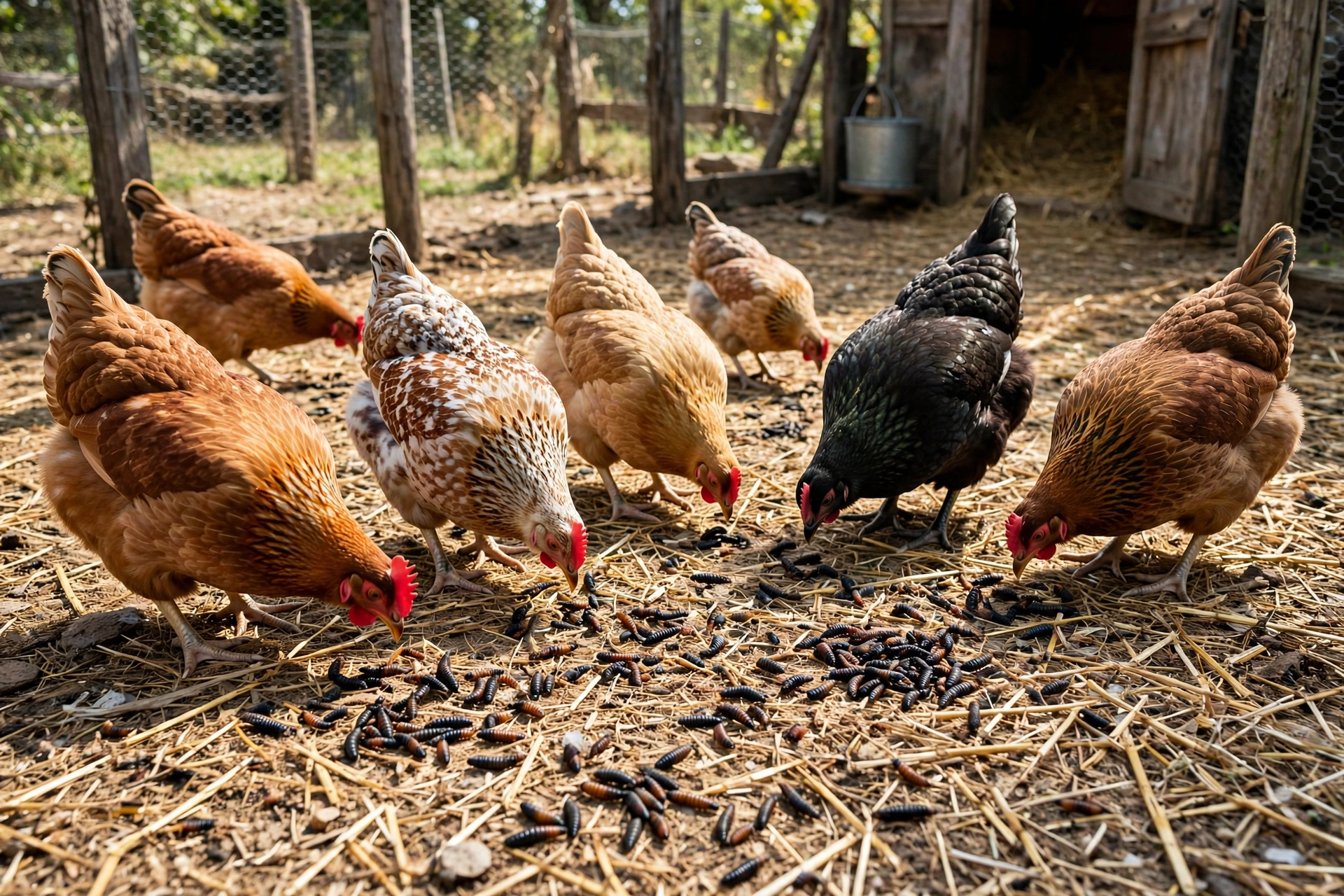
Yes, chickens can eat black soldier fly larvae, and most hens go wild for them. Black soldier fly larvae, often shortened to BSFL, are a protein rich treat that is also unusually rich in calcium, which sets them apart from almost every other treat you can offer a flock. They come fresh, live or dried, they store well, and they are easy to scatter in the run so your hens can forage for them the way they would hunt for insects in the wild. This guide covers whether they are good for chickens, how they compare with mealworms, dried versus live, how much to feed, and when baby chicks can start having them.
Table of Contents
Quick Facts
At a Glance Black soldier fly larvae are safe for chickens, fresh or dried, and they are rich in calcium and protein.
Calcium Dried larvae are roughly 3 percent calcium with 40 to 45 percent protein, far more calcium than mealworms offer.
Good to Know Treats should stay under about 10 percent of the diet, chicks can start from 2 weeks old, and larvae must never come from manure or chemical waste.
The Short Answer
Yes, chickens can eat black soldier fly larvae, and they are one of the best treats you can offer a flock. The food checker on this site lists black soldier fly larvae as Safe, with the note “Calcium-rich; fresh or dried”, and that verdict covers both fresh and dried larvae. Hens love the taste, and the larvae give them a useful boost of protein and calcium at the same time, which is rare in a single treat.
Black soldier fly larvae are the larvae of the black soldier fly, a harmless fly that does not bite, sting or spread disease the way houseflies do. The larvae are raised on plant based food waste, then harvested, cleaned and dried or sold live. They look like small dark grubs, about the size of a large mealworm, and chickens treat them the same way they treat any insect they find while scratching, as a prize worth chasing.
They are a treat, not a feed. A balanced layer feed should still be the main food your hens eat every day, because it is balanced for everything a laying hen needs, and no single treat can replace it. Larvae work best as a supplement, a training reward, a boredom buster scattered in the run, or a protein and calcium top up during molt and laying. Keep them to a small part of the diet and they are a genuinely useful addition to the flock menu.
Are Black Soldier Fly Larvae Good for Chickens
Yes, black soldier fly larvae are good for chickens, and the reason is their unusual nutrition. Most insect treats give protein and little else, but black soldier fly larvae give protein and calcium together. Dried larvae are roughly 40 to 45 percent protein, which supports feather growth, muscle maintenance and egg production, and roughly 3 percent calcium, which supports strong bones and strong eggshells. That combination is what makes them stand out.
The calcium comes from the larva’s hard exoskeleton, which is naturally rich in calcium in a way that soft bodied insects are not. Hens that lay eggs every day draw heavily on their calcium stores, and a treat that tops those stores up while also giving protein is worth more than a treat that gives protein alone. The larvae also contain healthy fats, including lauric acid, which suppliers often mention as a natural support for gut health, though it is not a medicine and should never be presented as one.
They are also good for behaviour. Chickens are natural foragers, and scattering larvae in straw or on the ground of the run keeps them busy, scratching and pecking for far longer than the same treat served in a dish. That kind of foraging is good for a flock, because a busy hen is a calm hen, and a bored hen is the one that starts feather pecking and bullying. A handful of larvae scattered at the end of the day is one of the cheapest forms of enrichment you can give.
None of this makes larvae a feed replacement. They are high in fat as well as protein, and too many will unbalance the diet and can lead to overweight hens that lay less well. The right way to think of them is as a supplement to a balanced feed, a small daily handful that adds protein and calcium while giving the flock something to hunt for. The feeding pillar on this site, what can chickens eat, sets out the treat rule in full, and larvae fit squarely inside it.
Black Soldier Fly Larvae vs Mealworms
Black soldier fly larvae vs mealworms is the comparison every keeper asks about, because mealworms are the classic chicken treat and larvae are the newer rival. Both are safe, both are loved by hens, and both are high in protein, but they are not the same food, and the difference that matters is calcium.
Mealworms are about 50 percent protein, which is slightly higher than larvae, but they are very low in calcium and high in phosphorus. That ratio matters, because a diet high in phosphorus and low in calcium can work against shell strength if the treat is fed in large amounts. Larvae are the opposite, with roughly 3 percent calcium and a much healthier calcium to phosphorus balance, and suppliers often describe them as having many times the calcium of mealworms. For a laying flock, that calcium is the deciding factor.
Mealworms are softer and a little easier for very young chicks to manage, and they are often cheaper and easier to find in small bags. Larvae have a harder shell, which is where the calcium lives, and they are usually sold dried in larger bags that store well. Hens will eat either with enthusiasm, so the choice is less about taste and more about what your flock needs. A flock in lay, a flock in molt, or a flock with thin shells will get more from larvae, while a flock that already gets plenty of calcium from oyster shell may do just as well on mealworms.
There is no need to pick one forever. Many keepers rotate the two, offering mealworms one day and larvae the next, and that variety is good for the flock. If you want the full picture on the other insect treat, our article on can chickens eat mealworms covers mealworms in detail, including how much to feed and when to be careful with them. This article covers black soldier fly larvae only, and the short version of the comparison is simple, for protein alone either works, and for calcium larvae win clearly.
Dried Black Soldier Fly Larvae for Chickens
Dried black soldier fly larvae for chickens are the form most keepers buy, and they are the easiest way to start. Dried larvae are shelf stable, they keep for months in a sealed bag or tub, they do not smell, and you can scatter them straight from the bag with no preparation. They are also the form the checker verdict covers alongside fresh larvae, so either is safe, and dried is simply the more practical choice for most households.
Live larvae are available too, usually sold in tubs from reptile or poultry suppliers. Hens love live larvae even more, because they move, and a moving treat triggers the full hunting instinct. Live larvae need to be used quickly, kept cool, and stored in the tub they came in, so they suit keepers who buy small amounts often. Dried larvae suit everyone else, and nutritionally the two are close enough that the choice is about convenience rather than health.
Storage is where dried larvae earn their keep. Keep them dry, sealed and out of direct sunlight, and they will last for months. A bag left open in a damp shed will go soft and can go mouldy, so transfer them to a sealed tub with a lid if the original bag does not reseal well. Never feed larvae that smell off, look mouldy or feel damp and clumped, because mouldy feed of any kind is not safe for chickens. Fresh larvae from a trusted supplier can be fed as they are, and frozen larvae can be thawed before feeding, though most keepers find dried simpler.
When you buy, choose a supplier that raises larvae on clean plant based feed and says so on the label. Reputable suppliers state what their larvae were raised on, and they test their product. Avoid cheap unlabelled bags with no source information, because the safety of larvae depends entirely on what they were fed while they were growing, and that is covered in the what to avoid section below.

How Much to Feed and How Often
The treat rule applies to larvae just as it applies to every other treat, and it is simple, treats should stay under about 10 percent of what a hen eats in a day. For a standard laying hen, a small handful of dried larvae per bird per day is plenty, roughly a tablespoon or two, and you can offer that daily or a few times a week. A larger handful once a week works too, and hens will not mind the wait.
It helps to think of larvae as a supplement to the main feed rather than a meal. Scatter them in the run in the afternoon, after the hens have eaten their main feed, so the larvae do not displace the balanced ration. Scattering also spreads them out, so every bird gets a share instead of the boldest hen eating the lot from one dish. If you keep them in a dish, use a shallow one and expect the top hen to claim it first, which is normal flock behaviour.
Overfeeding is the main risk, and it is an easy mistake to make because hens beg so convincingly. Too many larvae means too much fat and protein and too little of the balanced feed, and that can lead to overweight hens, fewer eggs and, over time, fatty liver problems. It also means wasted money, because larvae are a premium treat and the benefit flattens out once the daily handful is reached. If your hens are getting larvae every day and their feed intake is dropping, cut the larvae back to a few times a week.
The same 10 percent rule applies during molt and lay, when the temptation to feed more is strongest. A hen in molt does need extra protein, and larvae are a good way to give it, but a slightly larger handful is enough, not a whole bowl. A balanced feed plus a modest helping of larvae plus free choice oyster shell will do more for her than larvae alone ever could.
Can Baby Chicks Eat Black Soldier Fly Larvae
Yes, baby chicks can eat black soldier fly larvae, but not from day one. Chicks can start having them from about 2 weeks old, once they are eating starter crumb confidently and have access to chick grit. Before 2 weeks their digestive system is still settling, and their starter feed should be the only food they get, because it is balanced for their growth and they need every bite of it.
From 2 weeks, offer larvae as a tiny treat, not a meal. A few small dried larvae per chick, crushed or broken into smaller pieces, is enough to start with, and watch to make sure every chick can swallow them comfortably. Dried larvae are hard, so crushing them for young chicks makes them easier to eat and easier to digest. Live larvae can be offered whole to older chicks, but for a 2 week old chick the crushed dried form is the safer start.
Chick grit matters here. Chicks need fine grit to grind any food that is not starter crumb, and larvae are no exception. If your chicks have not had grit yet, give them a small dish of chick grit a day or two before their first larvae, and keep it available while they are eating treats. Without grit, hard food can sit undigested in the crop, and that is a problem you can avoid with a dish that costs almost nothing.
Keep the amount small for chicks, just a pinch per bird a few times a week, and never let treats displace starter feed. Growing chicks need the protein, vitamins and minerals in their starter crumb far more than they need any treat, and a chick that fills up on larvae will grow more slowly. By 6 to 8 weeks the chicks can handle whole dried larvae easily, and by the time they join the main flock they can eat the same handful as the adults.
Molt and Eggshell Support
Molt and eggshell support is where black soldier fly larvae earn their reputation, because both jobs need exactly what larvae provide, protein and calcium at the same time. During molt a hen drops her old feathers and grows new ones, and feathers are almost entirely protein. A hen in molt looks rough, feels tired and usually stops laying, and a daily handful of larvae gives her the protein she needs to regrow feathers without robbing her body of the reserves she needs for everything else.
Eggshells are the other half of the story. A hen lays an egg most days in season, and every shell draws calcium from her body. If the calcium runs short, shells come out thin, soft or wrinkled, and in bad cases she may lay a shell less egg. Larvae help here because their calcium is built into the shell of the larva itself, and it is available to the hen in a natural form. They are not a replacement for oyster shell, which should always be available free choice, but they are a useful addition on top of it, and the two work better together than either does alone.
The full picture on grit and calcium is in our article on do chickens need grit and oyster shell, which explains why grit and oyster shell are different jobs and why both need to be available. Larvae sit alongside those two, not instead of them, and a flock that gets all three will lay stronger shells than a flock that gets larvae alone.
If your hens are losing feathers outside the normal molt season, that is a different question, and our article on why is my chicken losing feathers covers the other causes, from pecking and parasites to stress and illness. Larvae will help a molting hen, but they will not fix feather loss caused by mites, bullying or a lack of space, so check the cause before you reach for the treat bag.

How to Feed Them
Feeding black soldier fly larvae is simple, and the best method is the one that makes your hens work a little for them. Scatter a handful across the straw or the ground of the run and let the flock hunt, because foraging keeps them busy and spreads the treat fairly. A scattered feed also slows the boldest hens down, so the quieter birds at the bottom of the pecking order get their share.
A shallow dish works well too, especially on wet days when the ground is muddy, or for chicks that are still learning. Put the dish in the run, not inside the coop, so the hens associate the run with good things and the coop stays clean. Some keepers use larvae as a training reward, calling the flock and offering a few from the hand, and hens learn the call quickly, which is handy when you need to get them back into the run at dusk.
You can also mix a small amount into a warm mash on a cold morning, or stir them into fermented feed if that is part of your routine. They soften slightly in the mash and the hens pick them out first, which is fine, because the point is the treat, not hiding it. Do not cook larvae before feeding them, and do not soak dried larvae for long periods, because they go soggy and lose the crunch that hens enjoy, and soaked feed left sitting can sour.
The simplest routine is the best one. A handful scattered in the run in the afternoon, a few times a week, after the main feed has been eaten. That is all it takes, and it gives your hens protein, calcium, foraging and fun in one small gesture.
What to Avoid
Larvae are safe when they come from a clean source, and the source is the one thing you must check. Never feed your chickens larvae raised on manure, human waste, chemical waste or rotting animal remains. Larvae absorb what they eat, and larvae raised on filthy or toxic material can carry bacteria, heavy metals or chemical residues into your flock, and from there into the eggs. Buy only from a supplier that states clearly what the larvae were fed, and if the label does not say, ask the seller or choose another brand.
Never collect wild larvae from a compost heap or a manure pile and feed them to your chickens. Wild larvae may look the same, but you have no idea what they have been eating, and a compost heap can contain anything from kitchen scraps to treated wood, pesticides and old medicines. The risk is not worth the saving, and a bag of dried larvae from a known supplier is cheap enough that there is no reason to take it.
Do not present larvae as a medicine or a cure. They are a nutritious treat, not a treatment for illness, parasites or egg problems. A hen that is sick, lethargic, off her feed or laying soft shells every day needs a proper check, not a bigger handful of larvae, and the same goes for a hen with mites, worms or a respiratory problem. Good feed supports a healthy bird, it does not fix a sick one.
Finally, do not let larvae replace the main feed or the oyster shell. A flock fed mostly on treats, however good the treats are, will end up with an unbalanced diet, and the first signs are fewer eggs, thinner shells and overweight hens. Keep the balanced layer feed as the base, keep oyster shell available free choice, and let larvae do what they do best, which is to top up protein and calcium and give the flock something to hunt for.

Frequently Asked Questions
Can chickens eat black soldier fly larvae every day?
Yes, a small handful per bird per day is fine, as long as treats stay under about 10 percent of the diet. A tablespoon or two of dried larvae per hen per day gives protein and calcium without displacing the balanced layer feed. If feed intake starts to drop, cut back to a few times a week.
Are black soldier fly larvae better than mealworms for chickens?
For calcium, yes, clearly. Dried larvae are roughly 3 percent calcium, while mealworms are very low in calcium and high in phosphorus. Mealworms are slightly higher in protein, so both have a place, but a laying flock or a molting flock gets more from larvae. Our article on can chickens eat mealworms covers the other insect treat in full.
Can baby chicks eat dried black soldier fly larvae?
Yes, from about 2 weeks old, once they are eating starter crumb well and have access to chick grit. Start with a few larvae crushed into small pieces per chick, a few times a week, and keep the amount small so starter feed stays the main food. By 6 to 8 weeks they can handle whole dried larvae easily.
Do black soldier fly larvae help with eggshells?
They help, because they are rich in calcium and protein, and both support strong shells. They are not a replacement for oyster shell, which should always be available free choice, and the two work better together. If shells stay thin despite larvae and oyster shell, check the layer feed, the hen’s age and her health, because thin shells have more than one cause.
How should I store dried black soldier fly larvae?
Keep them dry, sealed and out of direct sunlight, and they will last for months. Transfer them to a sealed tub with a lid if the original bag does not reseal well, and never feed larvae that smell off, look mouldy or feel damp and clumped. A bag left open in a damp shed will go soft and can go mouldy, so a sealed container is worth the effort.
Keep Reading
Can Chickens Eat Mealworms and the full guide to the other insect protein treat.
Do Chickens Need Grit and Oyster Shell and why both matter for digestion and strong shells.
Why Is My Chicken Losing Feathers and how to tell molt from pecking, parasites and stress.

Nusrat
Author, TheChickenPet.com