
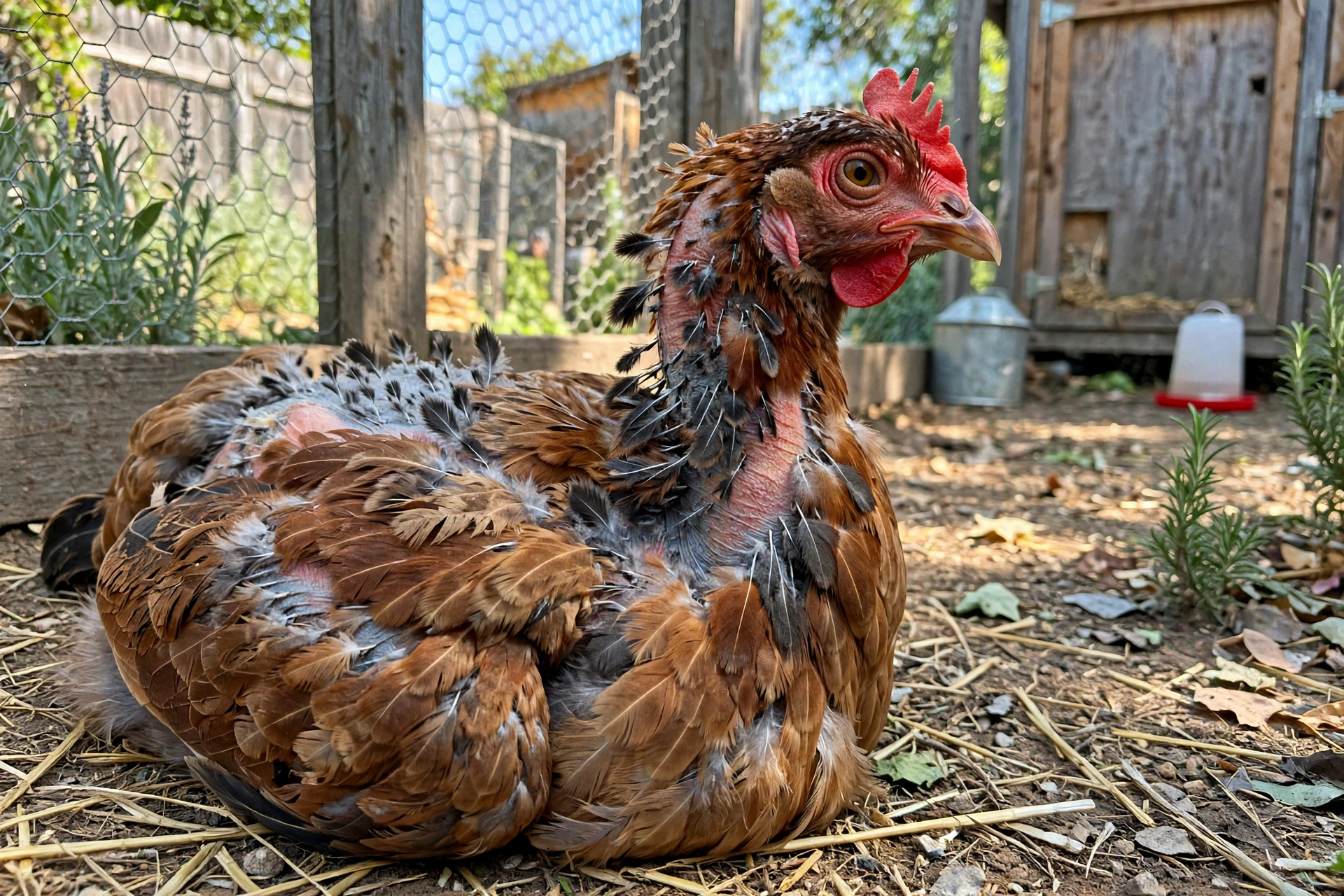
A hen that was fully feathered last week and looks half plucked today alarms most keepers the first time they see it. The good news is that most feather loss in a healthy adult hen is a molt, a normal yearly shed and regrow of feathers. But not every bare patch is a molt. Mites, feather pecking, rooster damage and illness all take feathers too, and each one needs a different fix. This guide starts with the diagnostic the other pages bury, how to tell a molt from everything else, then covers molting chickens care, how long molting lasts, and the checklist to run when it is not a molt.
Table of Contents
- The Short Answer. Most Feather Loss Is a Molt
- What Molting Looks Like and the Head and Neck First Pattern
- Chicken Molting Season and How Long Does Molting Last in Chickens
- Pin Feathers and What Not to Touch
- Do Chickens Stop Laying When Molting
- Molting Chickens Care, Food Water and Comfort
- The Protein Lift and the Mealworm Treat
- When It Is Not a Molt, the Checklist
- Rooster Damage and Feather Pecking, How to Tell Them Apart
- FAQs
Most feather loss in a healthy adult hen is a normal molt.
A molt starts at the head and neck, then moves down the body.
Bare skin with no pin feathers and no pattern is not a molt.
A full molt lasts about 8 to 16 weeks.
Hens usually stop laying while they molt.
New pin feathers are tender, so handle a molting hen gently.
Lift protein to about 20 percent during a molt.
Check for mites first when the loss does not match the molt pattern.
The Short Answer. Most Feather Loss Is a Molt
Why is my chicken losing feathers? In most cases, because she is molting. A molt is the normal yearly process where a hen sheds old worn feathers and grows fresh ones. It usually starts in late summer or autumn, at the head and neck first, and runs for about 8 to 16 weeks. A molting hen looks rough, she often stops laying, and she can look half naked at the worst of it. All of that is normal. But a molt has a pattern, and the pattern is the diagnostic. Feather loss that starts at the head and neck and moves down the body in an orderly way, with new pin feathers coming through the bare skin, is a molt. Feather loss that does not fit that pattern needs a closer look. Bare patches on the back only, feathers missing around the vent, a bald head with angry red skin, or a bird that is losing feathers and also looks sick, are not a molt, or not only a molt. So the first job is not to treat anything. It is to look. Read the next two sections, match what you see against the molt pattern, and only then decide what she needs.
What Molting Looks Like and the Head and Neck First Pattern
A molt follows an order, and that order is the easiest way to tell it from every other cause. It starts at the head and neck, then moves down the body to the breast, the back, the wings and finally the tail. A hen in full molt looks patchy all over, but the loss spreads in that head to tail direction, not in one spot. The second sign is what grows back. As the old feathers fall, new pin feathers push through the skin. Pin feathers look like small stiff quills, often with a waxy coating, and are full of blood while they grow. They are tender, so a molting hen may flinch or squawk when you pick her up. That tenderness is normal, and it is a good sign, because it means new feathers are on their way. The third sign is what is not there. A molting hen has no raw red skin, scabs or crawling insects at the feather base, and the loss is not stuck in one spot. If you see sore red skin or loss in one patch only, skip to the not molt checklist in section 8.

Chicken Molting Season and How Long Does Molting Last in Chickens
Chicken molting season is usually late summer into autumn, when the days start to shorten. That shortening daylight is the trigger, so she grows a fresh set of feathers before winter. Young birds have their first molt at about 16 to 18 months old, then once a year after that. How long does molting last in chickens? A full hard molt lasts about 8 to 16 weeks, with most hens finishing in about 8 to 12 weeks. A hard molt is the dramatic one, where the hen loses feathers fast and looks almost naked. A soft molt is slower and lighter, where she loses feathers a few at a time and never looks that bad. Either way, the clock is roughly the same, and a molt that drags past 16 weeks with no new feathers coming through is worth a closer look at feed, light and health. Do not try to stop a molt or rush it. It is a rest and rebuild cycle, and the hen needs it. Support it with the care in sections 6 and 7, and let her rest through it.
Pin Feathers and What Not to Touch
Pin feathers are the new feathers growing in, and they are the most delicate part of a molt. Each pin feather is a stiff quill with a live blood supply inside, wrapped in a waxy sheath that the hen preens away as the feather opens. While they are growing, they are tender and they bleed if they break. So handle a molting hen as little as you can, and when you must pick her up, be slow and gentle, with both hands supporting her body and no grabbing at her back or wings. Do not pull at pin feathers or pick at the waxy sheaths. She will preen them off herself as the feathers open. A broken pin feather, called a broken blood feather, bleeds fast and looks worse than it is. If one breaks, apply styptic powder or plain cornstarch with firm pressure until the bleeding stops, and keep the bird calm. Do not pull the broken feather out yourself unless a vet has told you to. And while she is molting, skip the wing clipping too, because clipping during an active molt risks cutting a blood feather, which is a job for another time of year.

Do Chickens Stop Laying When Molting
Do chickens stop laying when molting? Yes, most do. Growing a whole new set of feathers takes a huge amount of protein, and the hen’s body cannot grow feathers and lay eggs at full speed at the same time. So laying slows, then stops, for the length of the molt, and it starts again once the new feathers are in. This is normal, and it is not a problem to fix. Do not add extra light to force her back into lay during a molt. The rest is part of the cycle, and hens that are allowed to rest through the molt lay better in the season that follows. Our guide to winter light covers the same rest point for the dark months, and the rule is the same in both cases, let her rest. When laying does not come back after the molt is finished, look at the other causes. Age, short daylight, stress, illness and poor feed all hold laying back, and our guide to hens that stop laying works through them one by one.
Molting Chickens Care, Food Water and Comfort
Molting chickens care is mostly comfort and good feed. The hen is tender, she is using a lot of energy, and she needs a calm run and a full feeder. Keep the routine steady, keep handling to a minimum, and make sure she always has clean water and a dry sheltered place to rest. Reduce stress wherever you can. Do not introduce new birds during a molt, do not move the coop, and do not change the feed all at once. A stressed molting hen grows feathers more slowly and can pick at her own new pin feathers. Keep the run clean and dry, and keep the dust bath full, so she can keep her skin and new feathers clean herself. Watch her weight and her mood. A molting hen eats a little less some days and a little more on others, and that is fine. A hen that stops eating, sits hunched and fluffed up, or has runny droppings alongside the feather loss is not molting anymore, she is ill, and she needs the checklist in section 8.
The Protein Lift and the Mealworm Treat
Feathers are almost all protein, so a molting hen needs more protein than a laying hen. Lift her protein to about 20 percent during the molt, simplest by switching to a higher protein feed such as a grower or all flock feed, then switching back to layer feed once she is laying again. Treats can help too, and mealworms earn their place here. Mealworms are about half protein, hens love them, and a small daily handful is an easy way to add protein without changing the whole feed. Our guide to mealworms covers the amount, the age rules and the dried versus live choice, so use it for the details and keep this article to the molt itself. Do not overdo the treats. A handful of mealworms a day is plenty, and the main feed should still do most of the work. Too many treats push the balanced feed out and leave her short on the vitamins and minerals feathers need. Keep treats to about a tenth of what she eats each day.

When It Is Not a Molt, the Checklist
When the feather loss does not match the molt pattern, work through this checklist in order. Start with mites, because they are the most common not molt cause and the easiest to miss. Part the feathers at the vent, under the wings and around the neck, and look at the skin. Tiny moving specks, grey or red, or clusters of pale eggs at the base of the feather shafts, mean mites. Our guide to chicken mites covers the check, the treatment and the coop clean in full, and it is the first thing to rule out. Next, look for illness. A hen losing feathers that is also hunched, sleepy, off her feed or has runny droppings is sick, not just molting. Isolate her, keep her warm and dry, and call a vet if she does not perk up in a day or two. Then look at the feed. A poor diet or a sudden feed change can cost feathers through stress. Fix the feed first and give her a week to settle. Finally, check the flock. If one hen is losing feathers and the rest are fine, it is probably not a flock wide molt. That points to pecking or rooster damage, covered next.
Rooster Damage and Feather Pecking, How to Tell Them Apart
Rooster damage and feather pecking both take feathers from the back, and keepers mix them up, but they leave different marks. Rooster damage sits on the hen’s back and the back of her neck, where the rooster grips with his feet and beak while mating. The feathers there break off short and the skin can look rubbed and red. The fix is the rooster to hen ratio, about 1 rooster to 8 to 12 hens, so no one hen takes all his attention, or a hen saddle to protect her back while the feathers regrow. Feather pecking is different. It is one hen pulling feathers out of another, and it leaves bare patches where the pecker can reach, usually the back, the vent and the tail. You will often see it happening if you watch the flock for a few minutes, and you will see the pulled feathers on the ground. It is a boredom, crowding or protein problem. Our guide to why chickens peck each other covers the causes and the fixes, more space, more to do, and a protein check, in full.

FAQs
Why is my chicken losing feathers on her back only.
The most likely causes are rooster damage or feather pecking, not a molt. A molt starts at the head and neck and spreads down the body. A bare back points to a rooster gripping during mating, or another hen pulling feathers.
How long does molting last in chickens.
A full molt lasts about 8 to 16 weeks, with most hens finishing in about 8 to 12 weeks. A soft molt is lighter and slower but runs on about the same clock. A molt with no new feathers after 16 weeks needs a closer look at feed, light and health.
Do chickens stop laying when molting.
Yes, most hens stop laying during a molt, because growing feathers takes the protein laying would use. Laying starts again once the new feathers are in. Do not add light to force her back into lay while she is still molting.
What should I feed a molting chicken.
Lift protein to about 20 percent, usually by switching to a grower or all flock feed for the length of the molt. A small daily handful of mealworms helps too. Keep treats to about a tenth of what she eats each day, and switch back to layer feed once she is laying again.
When should I worry about feather loss.
Worry when the loss does not match the molt pattern, or when it comes with other signs. Bare skin with red sores, mites at the feather base, a hen that is hunched, off her feed or losing weight, and feather loss past 16 weeks with no regrowth, all need action, and a sick bird needs a vet.
Also see How to Set Up a Brooder for Baby Chicks Step by Step

Author, TheChickenPet.com