
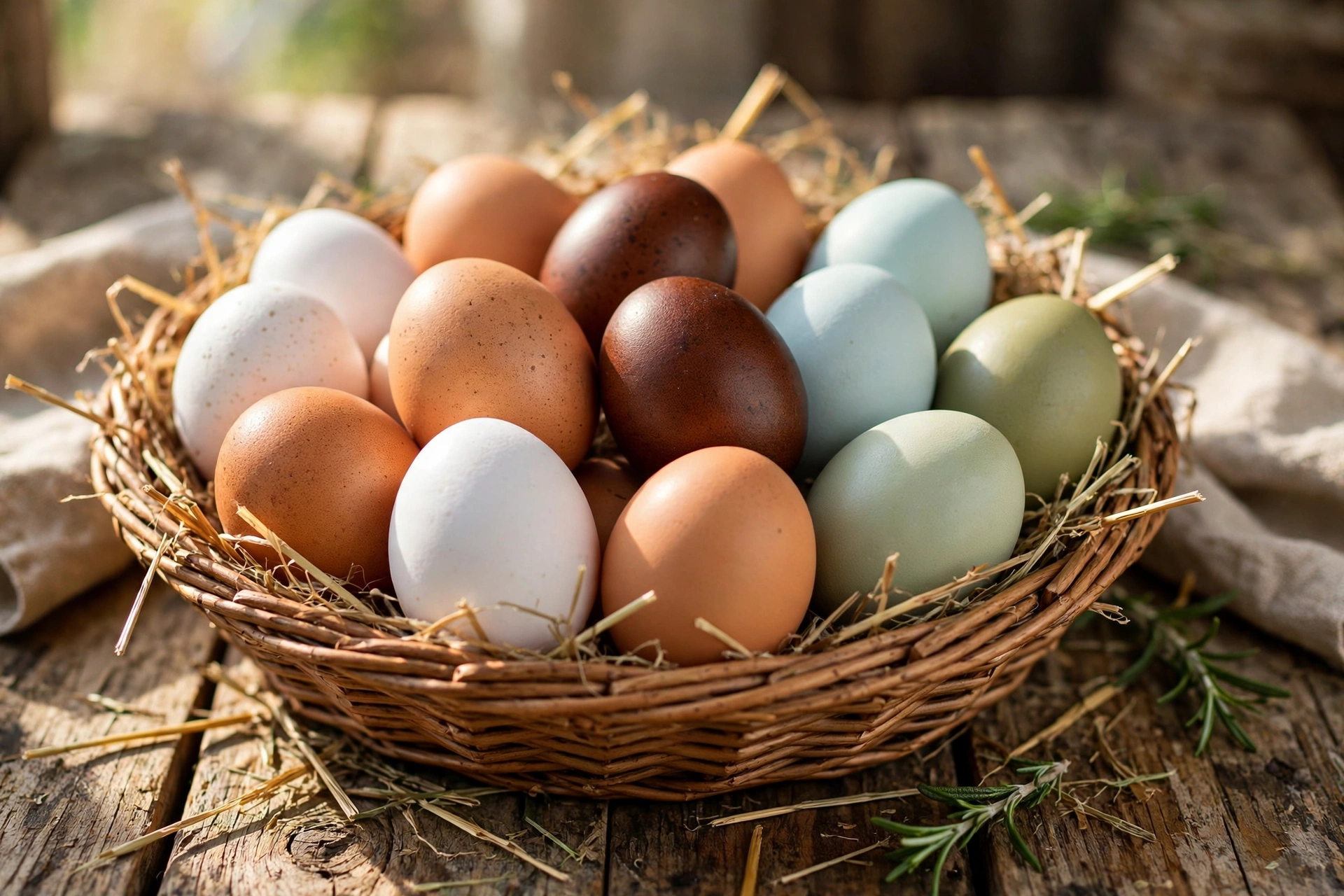
Open a basket of eggs from a mixed flock and you may see white, cream, brown, dark chocolate, blue and green shells sitting side by side, all laid by hens that eat the same feed and live in the same coop. It looks like magic, but it is simple biology, and once you know how it works you can tell a lot about a hen from the egg she lays.
Every eggshell starts white. The colour is painted on near the end of the roughly 24 hour egg making process, and the paint comes from just two pigments. One pigment makes brown, the other makes blue, and green comes from the two working together. The breed of the hen decides which pigments she uses, so the colour of the shell is written in her genes long before she lays her first egg.
Shell colour changes nothing about what is inside the egg. A brown egg, a white egg and a blue egg from healthy hens fed the same diet are the same in nutrition, taste and safety. Colour is a shell story only, and it is a good one, so this guide walks through the two pigments, the breed chart, the speckles, the shade changes and the myths, so you know exactly why your hens lay the colours they do.

Table of Contents
- All Eggshells Start White
- Two Pigments Paint the Shell
- Why Brown Eggs Are White Inside
- Why Blue Eggs Are Blue All the Way Through
- Green and Olive Eggs
- What Colour Eggs Do Chickens Lay
- Why Are Some Eggs Speckled
- Why the Shade Changes
- Can Feed Change Egg Colour
- Do Brown Eggs Taste Different
- The Earlobe Hint
- The Bloom and Why an Egg Looks Duller
- Frequently Asked Questions
Quick Facts
At a Glance All shells start white because they are calcium carbonate. Two pigments add the colour, protoporphyrin IX for brown and biliverdin for blue.
Brown or Blue Brown pigment goes on late and sits on the outside, so a brown shell is white inside. Blue pigment goes right through the shell, so a blue shell is blue inside too.
Good to Know Shell colour is set by breed genetics and feed cannot change it. Colour does not change nutrition, taste or safety.
All Eggshells Start White
Every egg a hen lays begins as a white shell, whatever colour it ends up. The shell is made of calcium carbonate, the same mineral that makes up chalk and seashells, and calcium carbonate is naturally white. The hen builds that shell in the shell gland, the last part of her reproductive tract, over about 20 hours of the roughly 24 hour egg making process.
Colour only enters the picture in the final few hours, when the shell is nearly finished. That is when the hen’s body adds pigment to the shell, and the timing of that pigment is what decides the final colour. Pigment added early soaks through the whole shell, and pigment added late sits on the surface like a coat of paint.
This is why the inside of a shell tells you so much. Crack a brown egg and the inside of the shell is white, because the brown pigment never reached the inner layers. Crack a blue egg and the inside is blue, because the blue pigment was there from the start. Once you know that one detail, the whole colour system starts to make sense.
A pullet that has just started laying may give you small eggs with uneven colour at first, and that is normal while her shell gland settles into a steady rhythm. You can read about when that first egg usually arrives in our guide on when do chickens start laying eggs.
Two Pigments Paint the Shell
Only two pigments are responsible for every eggshell colour you will ever see. The first is protoporphyrin IX, and it makes brown. The second is biliverdin, also called oocyanin, and it makes blue. There is no third pigment, and there is no green pigment at all, which matters for understanding green eggs later in this guide.
Protoporphyrin IX is made from haemoglobin, the same substance that carries oxygen in blood, and the hen’s shell gland deposits it on the shell in the last few hours before laying. The more of it she deposits, the darker the brown. A light tan egg has a thin coat, and a deep chocolate egg has a heavy one.
Biliverdin is made when old red blood cells are broken down, and it is the same pigment that gives a fading bruise its blue green tint. The shell gland adds it early in the shell building process, so it mixes into the calcium carbonate itself and colours the shell right through.
A hen’s breed decides which of these pigments her shell gland produces, and how much. That is a matter of genetics, fixed for her whole life, and it is why a Leghorn will never lay a brown egg and a Rhode Island Red will never lay a blue one, no matter what either bird is fed.
Why Brown Eggs Are White Inside
Brown is the most common eggshell colour in backyard flocks, and it is also the easiest to understand once you know the timing. The brown pigment protoporphyrin IX is deposited in the last few hours of shell making, after the shell itself is already formed. It lands on the outside of the shell and stays there, like paint on a wall.
That is why the inside of a brown eggshell is white. Peel the thin inner membrane away from a cracked brown egg and the shell underneath is plain white calcium carbonate. The brown never soaked in, because it arrived too late to do so. If you wash a brown egg very hard, you can even scrub a little of the colour off, since the pigment sits on the surface.
The depth of the brown depends on how much pigment the hen deposits. A light brown egg has a thin coat, and a dark brown egg has a heavy one, and the same hen can lay slightly different shades from day to day. The darkest browns come from breeds like the Marans, whose shell glands lay down a particularly thick coat of protoporphyrin IX. Sometimes the coat lands unevenly, because the pigment is applied as the egg turns slowly in the shell gland, and that is a normal quirk of the process, not a fault in the hen.
Why Blue Eggs Are Blue All the Way Through
Blue eggs work the opposite way from brown ones. The blue pigment biliverdin, also called oocyanin, is added early, while the shell is still being built, so it mixes into the calcium carbonate itself. The whole shell is blue, inside and out, from the first layer to the last.
You can test this at home. Crack a blue egg, peel back the inner membrane, and the shell underneath is blue, not white. That is the simplest way to tell a true blue egg from a brown egg that only looks bluish in certain light. A true blue shell is blue all the way through.
The blue egg gene comes from a small group of breeds, and it is passed on in a straightforward way. A hen that carries the gene lays blue eggs, and a hen that does not carry it never will. The gene is dominant, which means that crossing a blue egg layer with a brown egg layer often produces hens that lay green eggs, and that cross is exactly how the popular Olive Egger and Easter Egger came about.
Blue eggs have been part of chicken keeping for a very long time. The Araucana, one of the original blue egg breeds, comes from Chile, where the Mapuche people kept blue egg laying chickens for centuries before the birds reached the rest of the world. The Ameraucana was later developed in the United States from Araucana stock, and it is now the most common blue egg breed in backyard flocks.

Green and Olive Eggs
There is no green pigment in eggshells, and there is no green gene. Every green or olive egg is a blue egg with a brown coat on top of it. The hen first builds a blue shell, with biliverdin mixed right through it, and then her shell gland adds a layer of brown protoporphyrin IX on the outside in the final hours, just as it does for a brown egg.
A light brown coat over a blue shell gives a mint green or sage egg. A heavy brown coat over a blue shell gives a deep olive egg. The exact shade depends on the strength of the blue underneath and the thickness of the brown on top, so the same flock can produce a whole range of greens and olives, from pale sage to dark army green.
This is why Olive Eggers and Easter Eggers are so popular with backyard keepers. An Olive Egger is a cross between a dark brown egg layer, usually a Marans, and a blue egg layer, usually an Ameraucana or a Cream Legbar. The cross inherits the blue shell from one parent and the heavy brown coat from the other, and the result is a deep olive egg. An Easter Egger is a similar mixed cross, and her eggs can be blue, green, or sometimes even pinkish, depending on which genes she inherited.
If you crack a green egg, the inside of the shell is blue, not green, because the green is only the combination of blue shell and brown surface coat. That one check settles the whole question, and it is a fun thing to show children who are curious about where the colour comes from.
What Colour Eggs Do Chickens Lay
What colour eggs do chickens lay depends entirely on the breed, and the chart below covers the main colour families and the breeds most keepers will meet. If you are choosing hens for a colourful egg basket, pick one breed from each family, and your basket will look like a rainbow without any two eggs alike.
White eggs come from the Mediterranean breeds, which were developed for high egg production in warm climates. The Leghorn is the classic white egg layer, and she is the breed behind almost every white egg in a supermarket. White Leghorns, Anconas and Minorcas all lay white eggs.
Brown eggs are the most common in backyard flocks, and a long list of popular breeds lays them. Rhode Island Reds lay a rich light brown egg, Plymouth Rocks lay a light to medium brown, Orpingtons lay a light brown egg, and Australorps lay a light brown egg too. These are all dependable layers, and they are the reason brown eggs feel like the normal egg to so many keepers.
Dark brown eggs are the showpiece of the egg basket, and two breeds stand out. Marans lay the darkest brown eggs of any common breed, a deep chocolate colour that looks almost red in good light. Welsummers lay a rich terracotta brown egg, often with darker speckles, and their eggs are sometimes called the prettiest in the chicken world.
Blue eggs come from a small family of breeds. Ameraucanas lay a clear sky blue egg, and they are the most popular blue egg breed in backyard flocks. Araucanas lay a blue egg too, and they are the older South American breed the Ameraucana was developed from. Cream Legbars lay a blue egg as well, and they are easy to sex at hatching, which makes them a favourite with small breeders.
Green and olive eggs come from crosses rather than from a single pure breed. Olive Eggers lay deep olive eggs, and Easter Eggers lay green, blue or sometimes pinkish eggs. Both are crosses between a blue egg breed and a brown egg breed, and the exact shade varies from hen to hen, which is part of their charm.
Cream and tinted eggs sit between white and brown, and they come from several breeds. Silkies lay a small cream egg, and their eggs are often the palest in a mixed basket. Polish hens lay a white to cream egg, and Faverolles lay a light cream to pinkish tinted egg. These pale tints are easy to miss next to a bright white Leghorn egg, but they are there if you look closely.
A hen lays the colour her breed lays for her whole life. A Rhode Island Red will not suddenly start laying blue eggs, and a Leghorn will not suddenly start laying brown ones. The only thing that changes is the shade, and that is covered in the section on why the shade changes. For a wider look at the breeds in this chart and how they fit into a care routine, the Chicken Care and Health pillar is a good place to start.

Why Are Some Eggs Speckled
Speckles are extra deposits of calcium on the shell, and they are one of the most common egg oddities a keeper will see. As the egg passes through the shell gland, small extra lumps of calcium carbonate can land on the surface and harden there, leaving spots, freckles or sometimes a raised rough patch. The speckles are part of the shell itself, and they do not wash off.
Some breeds speckle more than others. Welsummers are famous for dark brown speckles on a terracotta egg, and Marans eggs often carry darker flecks too. Other breeds lay a speckled egg now and then without any pattern to it, and that is normal as well.
Speckles can also appear when a hen is stressed, when she is at the start or the end of her laying cycle, or when she has had a small disturbance while the egg was forming. A sudden loud noise, a fright, or a brief illness can interrupt the shell gland for a moment, and the result is a speckled or rough shelled egg. One speckled egg is nothing to worry about. A whole run of rough or thin shelled eggs from the same hen is worth a closer look at her diet, her calcium supply and her general health.
A speckled egg is just as good to eat as a plain one, and many keepers think speckled eggs are the prettiest in the basket. They are also completely different from the other egg oddities, and if you have ever found a double yolk in your basket, that is a different story, covered in our guide on why do chickens lay double yolk eggs.
Why the Shade Changes
The colour family a hen lays never changes, but the shade does, and several things can shift it. Age is the biggest one. A young hen at the peak of lay often produces the darkest, richest colour, and as she gets older the pigment thins out and the eggs grow paler. A Marans that laid deep chocolate eggs in her first season may lay a much lighter brown by her third.
Stress plays a part too. A hen that has been frightened, moved to a new coop, or bothered by a predator will often lay a paler egg the next day, because stress shortens the time the egg spends in the shell gland, and less time means less pigment. The colour usually returns to normal once she settles.
Place in the laying cycle matters as well. The first eggs after a break, such as after a moult or a broody spell, are often darker, because the pigment glands are fresh and full. As the laying cycle goes on, the pigment supply thins and the eggs grow steadily paler, until the next break resets the cycle. A hen that lays every day will fade faster than a hen that lays three eggs a week, because she is using up pigment faster.
The time of day can make a small difference too. An egg laid early in the morning has usually spent the full time in the shell gland, while an egg laid later in the day may have been rushed through a little faster. The difference is small, but keepers who collect eggs twice a day sometimes notice it.
None of this is a problem. A paler egg from an older hen or a hen near the end of her cycle is still a perfectly good egg, and the shade will come back after her next break. Only a sudden and lasting change, such as eggs that go from dark brown to almost white and stay that way, is worth checking with a vet or a closer look at her feed and calcium.
Can Feed Change Egg Colour
Feed cannot change shell colour, and no food or supplement will turn a white egg brown or a brown egg blue. The pigments come from the hen’s own body, and her genes decide which pigments her shell gland makes. A Leghorn fed on the richest diet in the world will still lay a white egg, and a Marans fed on plain layer feed will still lay a dark brown one.
This is a common myth, and it is easy to see where it comes from. Feed does change the colour of the yolk, and that is real. Hens that eat a lot of green plants, corn or marigold petals lay eggs with a deeper orange yolk, and hens on a plain grain diet lay a paler yellow yolk. That is yolk colour, not shell colour, and the two are completely separate.
Some sellers advertise supplements that claim to deepen shell colour, and the honest answer is that they do not work. What a good diet does do is keep the shell strong and the hen healthy, and a healthy hen lays her best coloured eggs. A hen short on calcium lays thin shells, and a hen short on protein lays fewer eggs, but neither shortage changes the colour family she was born with.
If your Marans eggs are paler than you expected, the answer is almost always age, stress or place in the laying cycle, not the feed. Check the shade section above first, and give her time. Chasing a darker shell with supplements wastes money and can unbalance her diet.
Do Brown Eggs Taste Different
Do brown eggs taste different from white eggs. No, they do not. Shell colour has no effect on taste, nutrition or safety, and a brown egg and a white egg from hens of the same breed, fed the same diet and kept the same way, taste exactly the same. The same is true of blue and green eggs. The colour is only on the shell, and the shell is not eaten.
The taste of an egg comes from the hen’s diet and from freshness, not from the colour of the shell. A hen that ranges freely and eats grass, insects and varied feed lays an egg with a richer yolk and a fuller flavour than a hen kept on plain grain, whatever colour her shell is. A fresh egg tastes better than a stale one, whatever colour its shell is. Once the eggs are collected, how you store them matters more than their colour, and our guide on how long do fresh eggs last covers that in full.
So why do so many people think brown eggs taste better. Part of it is the price, since brown eggs often cost more in shops, and people expect a dearer egg to taste better. Part of it is the look, since a brown egg feels more natural and farm fresh to many shoppers. And part of it is that the brown egg breeds sold in shops, such as Rhode Island Reds and Plymouth Rocks, are often kept on smaller farms with better feed, so their eggs really do taste better, but the reason is the feed and the farming, not the shell.
The same myth follows blue and green eggs, which sometimes sell for a premium at farmers markets. They are beautiful, and they are fun to collect, but they are not healthier or tastier than a plain white egg from a well fed hen. Buy them for the colour and the joy of the basket, not for a difference you will never taste.
The Earlobe Hint
There is an old keeper’s trick for guessing egg colour, and it is the earlobe. The earlobe is the small patch of skin just below the hen’s ear, and in many breeds its colour matches the colour of the eggs she lays. A hen with white earlobes often lays white eggs, and a hen with red earlobes often lays brown eggs. Leghorns have white earlobes and lay white eggs, and Rhode Island Reds have red earlobes and lay brown eggs, and the rule holds for a surprising number of breeds.
It is a rough guide, not a rule, and there are plenty of exceptions. Ameraucanas have red earlobes and lay blue eggs, and that alone breaks the rule. Some breeds have earlobes that are neither clearly white nor clearly red, and some hens have earlobes that change shade with the season. The earlobe hint is useful as a party trick and as a rough guess when you meet a new breed, but it is not reliable enough to choose a hen by.
If you want to know what colour eggs a hen will lay, the breed is the answer, not the earlobe. Check the breed chart in this guide, or ask the breeder, and you will know before she lays her first egg. The earlobe is a fun clue, and nothing more.
The Bloom and Why an Egg Looks Duller
Every freshly laid egg is coated in a thin invisible layer called the bloom, or cuticle, and it is the last thing the hen adds before the egg leaves her body. The bloom is a natural protective coating that seals the tiny pores in the shell and keeps bacteria out, and it is the reason unwashed eggs stay fresh longer than washed ones.
The bloom can also change how an egg looks. A fresh egg with its bloom intact often looks duller, darker or slightly cloudy, because the bloom scatters the light. As the egg is handled, the bloom wears off in places, and the true shell colour shows through more brightly. That is why an egg can look darker in the nest box than it does on the kitchen counter, and why two eggs from the same hen can look slightly different if one has been handled more than the other.
Washing an egg removes the bloom, and the egg underneath usually looks brighter and glossier. That brighter look comes at a cost, because the washed egg loses its natural seal and needs to go in the fridge straight away.
The bloom is also why a blue egg sometimes looks greenish when it is first laid. The bloom over a blue shell can give it a slightly green tint, and the blue shows clearly once the bloom wears off. If your Ameraucana eggs look greener than you expected on the day they are laid, check them again a day later, and the true blue will be there.

Frequently Asked Questions
Why are chicken eggs different colours?
Chicken eggs are different colours because different breeds use different pigments when they build the shell. All shells start white, because they are calcium carbonate. Brown comes from the pigment protoporphyrin IX, laid on late so it sits on the outside, and blue comes from biliverdin, also called oocyanin, which goes right through the shell. Green eggs are blue shells with a brown coat over them. The breed decides the pigment, so the colour is set by genetics.
What colour eggs do chickens lay?
What colour eggs do chickens lay depends on the breed. Leghorns lay white eggs, Rhode Island Reds, Plymouth Rocks, Orpingtons and Australorps lay brown eggs, Marans and Welsummers lay dark brown eggs, Ameraucanas and Araucanas lay blue eggs, and Olive Eggers and Easter Eggers lay green or olive eggs. A hen lays the colour her breed lays for her whole life, and only the shade varies.
Do brown eggs taste different from white eggs?
No, brown eggs do not taste different from white eggs. Shell colour has no effect on taste, nutrition or safety. The taste of an egg comes from the hen’s diet and from how fresh the egg is, not from the colour of the shell. A brown egg and a white egg from hens fed the same diet taste exactly the same.
Which breeds lay blue chicken eggs?
The main blue chicken egg breeds are the Ameraucana, the Araucana and the Cream Legbar. The Ameraucana is the most common in backyard flocks and lays a clear sky blue egg. The Araucana is the older South American breed, and the Cream Legbar lays a blue egg and is easy to sex at hatching. A blue shell is blue inside too, because the pigment biliverdin goes right through the shell.
Why are some eggs speckled?
Some eggs are speckled because extra deposits of calcium land on the shell as it forms in the shell gland, leaving spots, freckles or a rough patch. Some breeds, such as Welsummers and Marans, speckle more than others. Speckles can also appear when a hen is stressed, or at the start or end of her laying cycle. A speckled egg is just as good to eat as a plain one.
Keep Reading
Chicken Care and Health and the full care pillar for keeping your layers healthy.
Why Do Chickens Lay Double Yolk Eggs and the other great egg oddity.
When Do Chickens Start Laying Eggs and when your pullets will give you that first coloured egg.

Nusrat
Author, TheChickenPet.com