
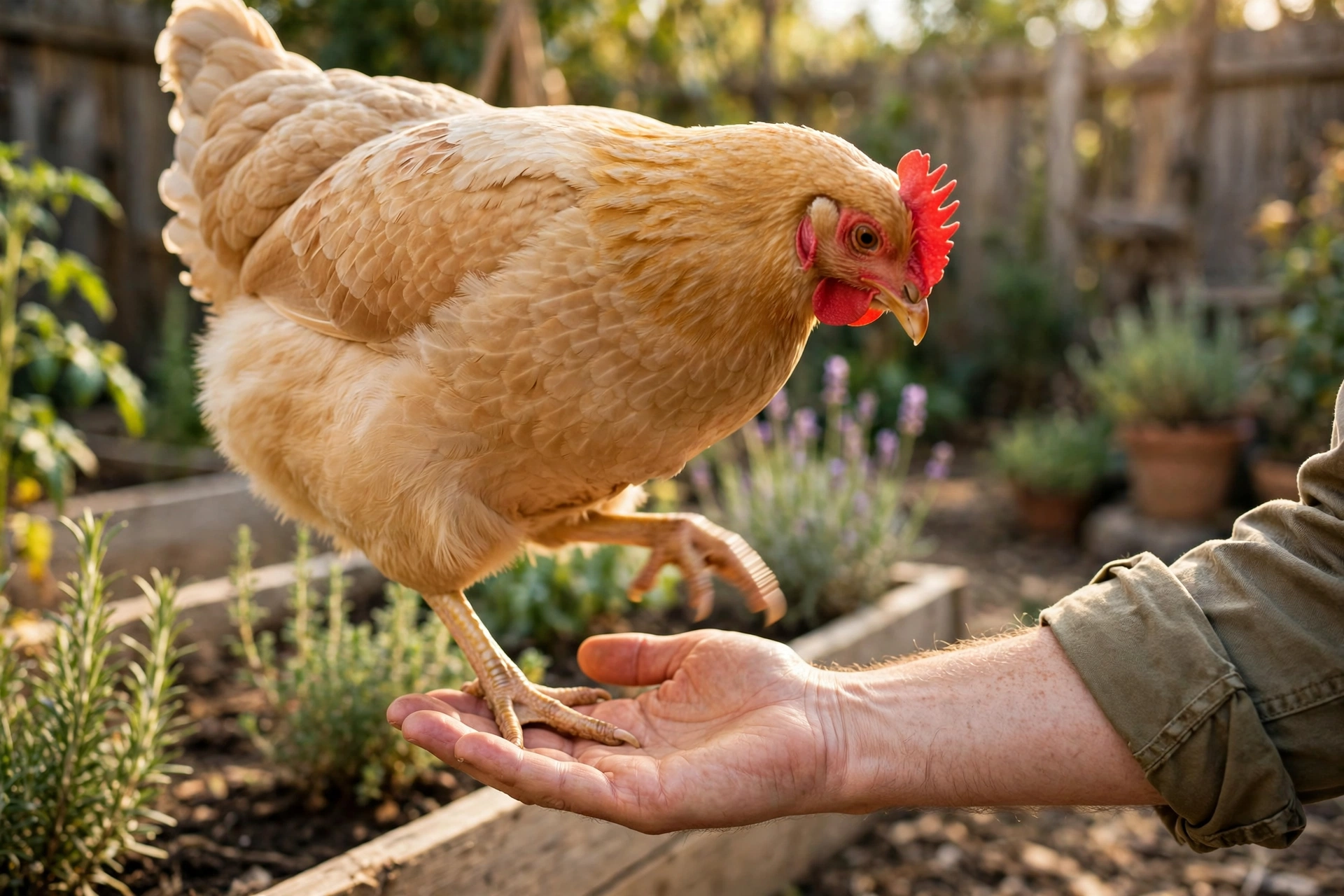
Yes, you can train a chicken, and most keepers are surprised by how fast she learns. A hen is not a dog and she will never fetch your slippers, but she can learn to come when called, step onto your hand, peck a target, jump for a treat and even jump through a hoop. Training a chicken is practical pet keeping, not a circus act. A bird that comes when called is easier to put away at dusk and easier to keep safe when a dog or a hawk appears. The whole secret is simple. You reward the behaviour you want, at the exact moment she does it, with a treat she loves, and you never punish the behaviour you do not want.

Table of Contents
- The Short Answer
- How Chickens Learn
- What You Need Before You Start
- Taming Comes Before Training
- Hand Feeding Chicks From One Week Old
- Target Training With a Stick or a Hand
- How to Train Chickens to Come When Called
- How to Train a Chicken to Step Up Onto a Hand
- Jump for a Treat
- How to Train a Chicken to Jump Through a Hoop
- Chicken Clicker Training Step by Step
- Can Chickens Learn Tricks
- Best Breeds for Training
- Short Sessions and Ending on a Win
- Mistakes to Avoid
- When Training Does Not Work
- Frequently Asked Questions
Quick Facts
At a Glance Chickens learn fast with positive reinforcement. A favourite treat, a clear signal and short sessions are all it takes.
Session Length Keep sessions to 5 to 10 minutes, once or twice a day, and always end on a win.
Good to Know Calm friendly breeds such as Orpingtons, Australorps and Rhode Island Reds learn fastest. Never punish a chicken, never chase her and never train a frightened bird.
The Short Answer
Can you train a chicken. Yes, you can, and she will probably learn faster than you expect. Chickens are food motivated, curious and good at linking an action to a reward, which is exactly what training needs. A hen that has learned that a certain sound means a treat will cross the yard to reach you, and a hen that has learned to peck a target will follow that target almost anywhere. That is real learning, not a trick of luck, and it holds from one day to the next.
Be honest about the limits too. A chicken will not learn like a dog. She will not obey because she wants to please you, and she will not keep working once the treats stop. She learns because the reward is worth the effort, and on a day when she is moulting, broody or simply not interested, she will walk away. That is normal, not a failure.
How Chickens Learn
Chickens learn by linking an action to a result. When a hen pecks a target and a treat follows at once, she records that pecking the target brings food. When she hears your call and a treat follows, she records that coming to your call brings food. Repeat the link a few times and the behaviour becomes reliable. This is positive reinforcement, and it is the only training method that is safe and kind for a chicken.
The link only works if the reward comes fast. A treat given five seconds late is a treat for whatever she happened to be doing five seconds later, which might be scratching the ground or looking at a bug. That is why trainers use a bridge signal, a short sound that marks the exact moment she gets it right. The sound can be a click from a clicker or a short word such as yes, said in the same bright tone every time. The signal means you got it right, and the treat follows at once. Once the hen understands the signal, you can mark a correct peck or a correct step from a little further away, and she still knows exactly which moment earned the reward.
Timing matters more than skill. You do not need perfect technique. You need a treat in your hand, a clear signal, and the discipline to reward the right moment and ignore the wrong ones.
What You Need Before You Start
You need very little to train a chicken, and most of it is already in your kitchen. The first thing is motivation, a favourite treat that your hen loves enough to work for. Small pieces work best, because a big treat takes too long to eat and breaks the flow of the session. Mealworms, small bits of watermelon, sweetcorn kernels, peas and tiny pieces of bread all work well. Find the treat your bird goes wild for and save it for training only, so it stays special.
The second thing is a bridge signal. A small clicker from a pet shop gives a sharp consistent sound, but a short word such as yes works just as well if you say it the same way every time. Pick one and stick to it, because changing the signal halfway through confuses the bird. If you use a clicker, charge it first by pairing the click with a treat a dozen times, so the hen learns that the click always means food is coming.
The third thing is a target, a stick with a bright tip that the hen can peck. A chopstick with a small coloured ball on the end works, and so does a short dowel with a dot of paint. A hen that has learned to peck the target will follow it anywhere you put it. Train in a quiet familiar place where nothing will startle her. A calm hen learns. A frightened hen does not.
The Care pillar on this site, Chicken Care and Health, covers the daily care that keeps a bird settled enough to learn, and a settled bird is the starting point for everything in this guide.
Taming Comes Before Training
Training builds on a tame bird, so taming comes first. A hen that runs from your hand cannot learn from your hand, and no amount of treats will fix that in a single session. She needs to trust you before she can work with you. That trust comes from calm, slow, regular contact, sitting near the flock, talking softly, offering treats from an open palm and letting her come to you. Never grab a hen out of the blue, and never chase her around the yard to catch her, because every chase teaches her that you are something to run from.
If your bird is not tame yet, work on that first and come back to this guide when she eats from your hand without flinching. Our article on how to tame a chicken walks through the whole process. This article covers training tricks and commands only, and it assumes the bird already trusts you.
Hand Feeding Chicks From One Week Old
The easiest training you will ever do starts when your birds are chicks, from about one week old. Chicks that are hand fed from their first week grow into hens that run towards people instead of away from them, and that early trust makes every later lesson easier. Sit beside the brooder, rest your hand inside it, and let the chicks peck tiny bits of treat from your palm. Move slowly, speak softly, and keep your hand still so they learn that it is safe.
Start with very small treats, a crumb of hard boiled egg yolk or a few rolled oats, and offer them only from your hand, never scattered on the brooder floor. The chicks learn that your hand brings good things and that they should come to you to get them. Five minutes a day is enough.
Do not hand feed chicks younger than about a week old, because very young chicks need to settle into eating and drinking on their own first. By the time those chicks move out to the coop, the hand fed ones will already be the friendliest birds in your flock, and the easiest to train.
Target Training With a Stick or a Hand
Target training is the foundation of almost every chicken trick, and it is the best place to start. The idea is simple. The hen learns to peck a target, and then you move the target to guide her where you want her to go. Once she follows the target, you can lead her onto a perch, through a doorway, onto a scale or into a carrier without ever picking her up.
Start by holding the target stick a few centimetres from her beak. Most hens will peck it out of curiosity. The instant her beak touches it, make your bridge signal and give her a treat at once. Repeat that a few times until she pecks the target the moment she sees it.
Next, move the target a little to the side so she has to take a step to reach it. Mark and reward. Then move it a little further, so she has to walk to it. Within a few sessions she will follow the target across the yard. You can also use your hand as the target, holding out two fingers for her to peck. Keep the target still while she decides, and never push it towards her beak, because a hen that feels crowded will back away instead of pecking.
How to Train Chickens to Come When Called
Recall, coming when called, is the single most useful thing you can teach a chicken. A bird that comes to your call can be gathered at dusk without a chase and called away from a road or a neighbour’s garden. It is also the easiest lesson in this whole guide, because it is just a sound paired with food.
Pick a call and use it every time. A short phrase such as come on girls, a whistle, or a shake of the treat tin all work. What matters is that it is always the same sound and it is always followed by treats. Start close to the flock, make the call, and scatter a few treats at your feet. The hens will come running. Repeat it a few times a day for a week, and always pay them when they arrive.
Then start calling from further away. Stand across the yard, make the call, and wait. The first time they come, reward them generously. If they do not come, walk closer and try again rather than shouting louder. Never call them and then do something unpleasant, such as catching one for treatment, because they will learn that the call means trouble and stop coming.
New keepers often teach recall in their first week with a flock. Our article on how many chickens should a beginner start with helps you choose a first flock size that is easy to bond with and easy to train.
How to Train a Chicken to Step Up Onto a Hand
Step up is the trick that turns a hen into a real pet, because it lets her choose to come onto your hand instead of being picked up. Hold your flat hand out in front of her, just below chest height, with a treat visible in your fingers. Most hens will step onto your hand to reach the treat. The instant both feet are on your hand, make your bridge signal and give her the treat.
If she will not step up, do not lift her onto your hand, because that teaches her nothing and it may frighten her. Instead, make it easier. Lower your hand, hold the treat closer to her beak, and reward even a single foot on your hand. That small step is progress, and you can build on it. Once one foot is reliable, wait for the second foot before you mark and reward. Within a few sessions most tame hens will step up confidently.
Keep your hand steady and low while she learns. A hand that wobbles or rises too fast feels unsafe, and she will jump off. Once she steps up well, you can slowly raise your hand a little higher, always keeping it flat and still. Step up is also a gentle way to lift a hen for a health check, because a bird that steps onto your hand on her own is far calmer than a bird that has been grabbed.
Jump for a Treat
Jumping for a treat is a natural step after step up, because hens already jump for food in the yard. Hold a treat just above her head, high enough that she has to stretch, and let her take it. Then hold it a little higher, so she has to hop to reach it. Mark and reward every hop. Raise the height a tiny bit at a time over several sessions, because a hen that misses repeatedly will give up.
Keep the jumps low and safe. A few centimetres off the ground is plenty, and the landing surface should be soft grass or deep bedding, never a hard floor or a slippery surface. Train on level ground with nothing she can crash into, and stop if she looks tired or loses interest. A hen that jumps happily for a treat is playing. A hen that is made to jump until she is exhausted is not.

How to Train a Chicken to Jump Through a Hoop
The hoop jump looks impressive, but it is really just target training with a hoop in the middle. Start with the hoop lying flat on the ground, and use your target stick to lead the hen across it. Mark and reward every time she walks through the circle. Once she walks through happily, raise the hoop a couple of centimetres off the ground. Mark and reward.
Raise the hoop slowly over many sessions, a centimetre or two at a time, and only when she is stepping through confidently at the current height. Hold a treat on the far side of the hoop so she has a reason to go through it, and keep your target stick visible to guide her. If she walks around the hoop instead of through it, do not block her or push her back. Just reset, lower the hoop, and make the easy version pay well again. She will choose the hoop when the hoop is the easiest way to the treat.
Use a hoop at least 30 centimetres across for a standard hen, and never use one with a sharp edge or a narrow opening. Keep the height low, because a high hoop is a risk to her legs if she catches it. Stop the session while she is still keen, and always end with a success at a height she can manage easily.
Chicken Clicker Training Step by Step
Chicken clicker training is positive reinforcement with a clicker as the bridge signal, and it works because the click is fast, sharp and always the same. Chickens are among the quickest clicker learners of all, because they are so food motivated. Here is the whole method in order.
First, charge the clicker. Sit with your hen, click once, and give her a treat at once. Repeat that about a dozen times over a day or two, until she perks up and looks for the treat the moment she hears the click. The click now means food is coming, and that is the foundation of everything that follows.
Second, pick one small behaviour and wait for it. A good first behaviour is pecking the target stick. Hold the target out, wait for the peck, click the instant her beak touches it, and give the treat. Repeat until she pecks on sight. Third, add the cue. Once she pecks reliably, say your cue word, such as target, just before you present the stick. After a few sessions she will link the word to the action. Fourth, shape the behaviour further. Move the target, raise it, or ask for two pecks before the click, building the trick in small steps.
Keep clicker sessions to 5 to 10 minutes, and keep the treats tiny so she stays keen. End the session after a success, never after a failure. If you click without treating, even once or twice, the click starts to lose its power, so treat every single click without exception.
Can Chickens Learn Tricks
Can chickens learn tricks. Yes, they can, and researchers have trained chickens to do far more than most keepers realise. In laboratory studies chickens have learned to peck coloured keys in a set order, to find hidden food by following a cue, and to tell shapes and numbers apart. The backyard version is the same skill, a bird that links a cue to an action and repeats it for a reward.
The tricks that suit a backyard hen best are the ones that build on things she already does. Coming when called builds on her instinct to run towards food. Stepping up builds on her instinct to perch. Jumping builds on her instinct to reach for a tasty leaf. The hoop builds on target training, which builds on her instinct to peck. Tricks that fight her nature, such as standing still for a long time or doing the same action over and over without a reward, will fail, and that is the trick’s fault, not the bird’s.
Keep your expectations honest. A hen can learn a handful of simple tricks, and she will perform them when she feels like it and when a treat is on offer. She will not perform on command for an audience, and she will not keep a trick she has not practised for months. Train for the joy of it and for the bond it builds, and the tricks themselves are a bonus.
Best Breeds for Training
Some breeds learn faster than others, and the difference is mostly temperament. Calm friendly birds that like people and love food are the easiest to train, because they stay near you, they are not easily startled, and they keep working for treats. Flighty nervous birds can learn too, but they need more patience, shorter sessions and a quieter setting.
Orpingtons are one of the best training breeds. They are big, calm, gentle and famously friendly, and they will follow a keeper around the yard in the hope of a treat. Australorps are another excellent choice. They are calm, curious and intelligent, and they bond closely with their keeper. Rhode Island Reds are confident and bold, and their love of food makes them keen workers, though they can be a little pushy at treat time, so keep your fingers clear.
Silkies are calm and gentle, and they suit ground level tricks such as target training and recall, though their crests can limit their vision, so keep the target where they can see it. Avoid very flighty breeds such as Leghorns, because a bird that startles at every sound will spend the session watching the sky instead of watching you.
If you are still choosing your flock, our article on the friendliest chicken breeds that make great pets covers Orpingtons, Australorps and Rhode Island Reds in detail, and it will help you pick a bird that suits training as well as pet keeping.
Short Sessions and Ending on a Win
Short sessions are the golden rule of chicken training. Keep each session to 5 to 10 minutes, once or twice a day, and stop while your hen is still keen. A hen that is drilled until she is bored or full will walk away from the next session before it starts.
End every session on a win. That means finishing with a behaviour she knows well and can do easily, marking it, and giving her a generous treat. If you are teaching something new and she gets it right twice, stop there and celebrate it. If she gets it wrong three times in a row, go back to something easy, reward that, and end the session. Never end on a failure, because the last thing that happens in a session is the thing she remembers most.
Train when she is a little hungry, not straight after a big feed, because a full hen has no reason to work for treats. Morning sessions often work best, before the main feed of the day. Skip training on very hot days, on moulting days when she is sore and grumpy, and on any day when she seems off colour.

Mistakes to Avoid
The biggest mistake in chicken training is punishment, and it has no place in this work at all. Never hit a chicken, never flick her beak, never spray her with water, and never shout at her. Punishment does not teach a chicken what to do, it only teaches her to fear you, and a frightened bird stops learning entirely. If she does the wrong thing, simply wait, reset, and reward the right thing when it happens.
Never chase a chicken to catch her for training, and never force her into a position or hold her still. Forcing a bird creates fear, and fear blocks learning. If she walks away, let her go. You can try again tomorrow.
Never train a frightened bird. If a hen is crouching, freezing, panting or trying to escape, the session is already over, and your job is to make her feel safe again, not to push on. Put the treats down, step back, and let her settle.
Never withhold food and water as a training method. A hen should always have access to fresh water, and she should never go hungry so that she will work for treats. Train when she is a little peckish before a normal feed, never by skipping a feed.
When Training Does Not Work
Sometimes training does not work, and that is worth saying plainly. Some birds are simply not interested. A hen that would rather dust bathe than follow a target is not a stupid bird, she is a bird with other priorities, and no training method will change that. Older hens that have never been handled may take weeks to trust a hand, and some never do. She can still be a happy healthy hen without ever learning a trick.
A chicken will not learn like a dog, and expecting her to is a recipe for disappointment. A dog works for praise and for the joy of the game. A chicken works for food, and when the food stops, the work stops. She will not come when called if she is busy with something better, and she will forget a trick she has not practised for a while. That is not disobedience. That is a chicken being a chicken.
If training is not working, check the basics first. Is she tame enough. Is she hungry enough to care about the treat. Is the treat good enough. Is the session short enough. Is the place quiet enough. Fix those before you blame the bird. And if the answer is still no, accept it gracefully. The goal was never a performing chicken. The goal was a bird that trusts you and enjoys your company, and that is worth more than any trick.
Frequently Asked Questions
Can you really train a chicken?
Yes, you can train a chicken, and most hens learn fast with positive reinforcement. A hen can learn to come when called, step onto your hand, peck a target, jump for a treat and jump through a hoop. Keep sessions short, reward the exact moment she gets it right, and never punish her.
How to train chickens to come when called?
Pick one call, such as come on girls or a whistle, and use it every time you bring treats. Start close to the flock, make the call, and scatter treats at your feet. Repeat it a few times a day for a week, then call from further away and reward generously when they arrive.
Does chicken clicker training work?
Yes, chicken clicker training works very well, and chickens are among the quickest clicker learners because they are so food motivated. First charge the clicker by pairing each click with a treat a dozen times, then click the exact moment she does the right thing and follow every click with a treat.
Can chickens learn tricks?
Yes, chickens can learn tricks, and researchers have trained them to peck keys in a set order and to tell shapes apart. In the backyard, the best tricks build on natural behaviour, such as recall, step up, jumping for a treat and the hoop. Keep expectations honest, because a hen performs when she feels like it and when a treat is on offer, not on command for an audience.
How long does it take to train a chicken?
Most hens learn a simple behaviour such as pecking a target or coming when called within a few short sessions over a week. A full trick such as the hoop takes longer, because it is built in small steps over several weeks. Calm friendly breeds such as Orpingtons and Australorps learn fastest.
Keep Reading
How to Tame a Chicken and how to build trust before you start training.
How Many Chickens Should a Beginner Start With and how to choose a first flock that is easy to bond with.
10 Friendliest Chicken Breeds That Make Great Pets for Beginners and how to pick a calm trainable breed.

Nusrat
Author, TheChickenPet.com