
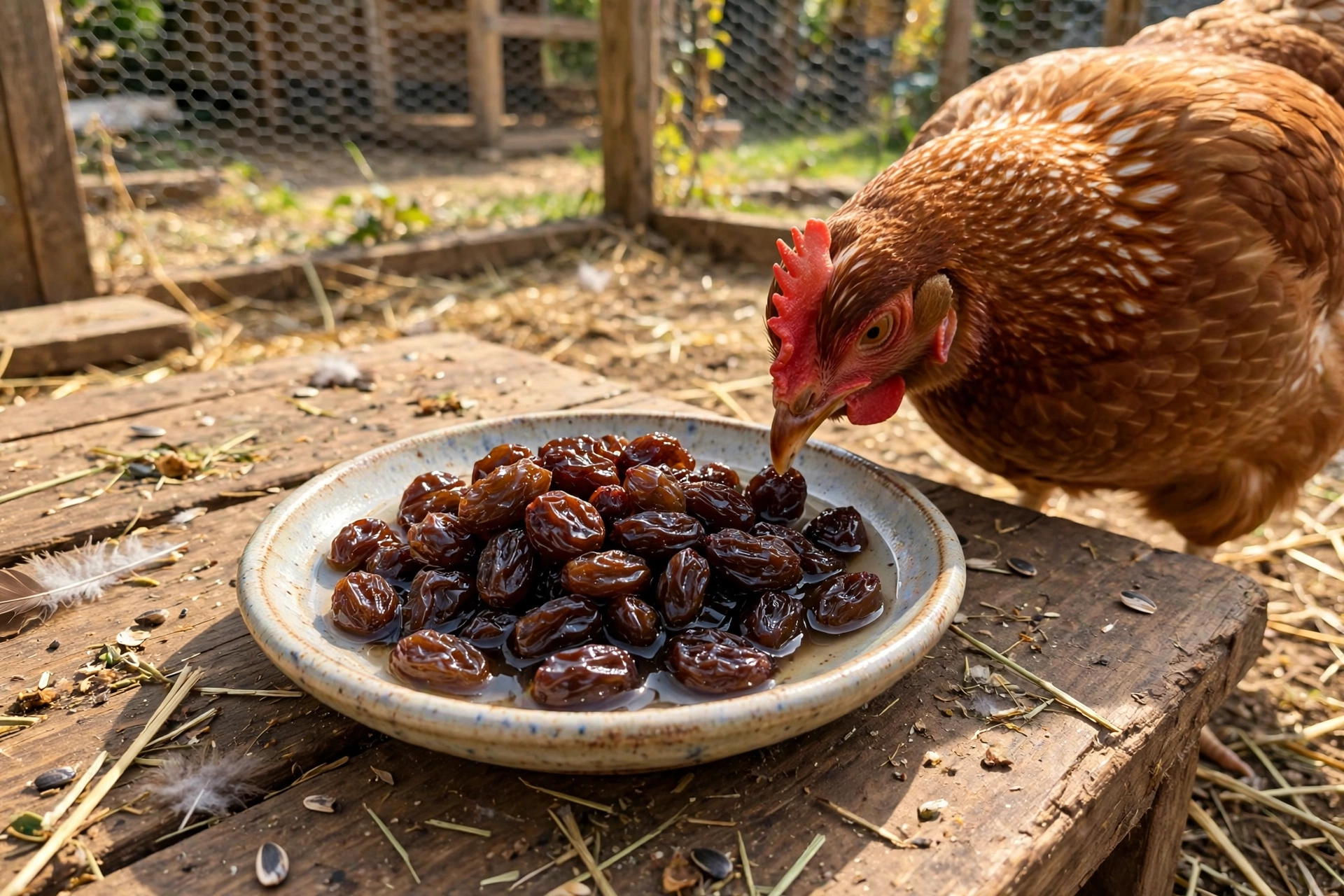
Yes, chickens can eat raisins, and most hens love them. A raisin is simply a dried grape, so it carries the same sweet flavour your flock already enjoys from fresh grapes, only in a much smaller and much sweeter package. That small size is the whole story of this treat. Raisins are safe for chickens as an occasional treat, but the sugar in them is concentrated by drying, so the portion has to stay tiny and the treat has to stay rare.
This guide answers the questions keepers ask most about raisins. How many raisins can a chicken eat, are raisins safe for chickens, can chickens eat dried grapes and sultanas, and what about the famous dog warning. You will also learn why soaking raisins for 10 to 15 minutes first makes them safer and easier to eat, which raisins to never offer, and why chicks should not get them at all.
Table of Contents
Quick Facts
At a Glance Raisins are safe for chickens as an occasional treat only, because they are sugary. Offer 2 to 3 raisins per hen, soaked for 10 to 15 minutes first, no more than once or twice a week.
Good to Know Raisins are toxic to dogs, but poultry are not dogs and there is no kidney failure mechanism in chickens, so the dog warning does not carry over. Never feed chocolate covered or yogurt covered raisins, and never feed raisins to chicks.
Related Treat Fresh grapes are the closest comparison, and our guide to fresh grapes is linked at the end of this article.
The Short Answer
Yes, chickens can eat raisins. Raisins are dried grapes, and grapes are a safe and popular treat for chickens, so the dried form is safe too. The catch is the sugar. Drying a grape removes most of its water and leaves the natural sugars behind in a much smaller package, so a raisin is far sweeter and far more calorie dense than a fresh grape of the same weight. That is why the checker verdict is Safe with a clear condition attached, occasional treat only, because the treat is sugary.
The rule for raisins is simple. Give 2 to 3 raisins per hen, soak them for 10 to 15 minutes first, offer them once or twice a week at most, and never let raisins replace proper feed. Follow that rule and raisins are a harmless, much loved little reward. Break it and you are feeding your hens a lot of sugar for no good reason, which can lead to weight gain and can crowd out the balanced layer feed they actually need.
Are Raisins Safe for Chickens
Are raisins safe for chickens is the question most keepers start with, and the answer is yes, with the portion kept small. The site’s food checker lists raisins as Safe, with the note “Occasional treat only — sugary”. That verdict is the basis for everything in this article, and the publishing run will read the live checker first, so if the live checker ever changes, the live checker wins.
Raisins bring a little of what chickens like about fruit. They are sweet, soft once soaked, easy to peck up and small enough to scatter as a foraging reward. They also carry small amounts of iron, potassium and fibre, but nobody should feed raisins for the nutrition. The amounts are far too small to matter, and the sugar is the part that counts. Think of raisins as a sweet, not as a health food.
The treat rule from the feeding pillar applies here exactly as it does to every other treat. Treats should stay under 10 percent of what your hens eat in a day, and the rest should be balanced layer feed with fresh water. A handful of raisins scattered in the run is a treat. A bowl of raisins in place of feed is a mistake. The full treat rule is explained in our feeding pillar, what can chickens eat, which is worth reading if you offer treats often.
One more safety point is worth stating plainly. Raisins themselves are safe for chickens, but a raisin is small and sticky, and a dry raisin can be hard for a hen to swallow comfortably. That is why soaking matters, and the soaking section below explains exactly how to do it.
What About the Dog Warning
Every keeper who searches for raisins has seen the dog warning, and it is a frightening one. Raisins and grapes can cause sudden kidney failure in dogs, and even a small amount can be dangerous for them. It is natural to wonder whether the same danger applies to chickens, and the answer is no.
Poultry are not dogs. The kidney failure mechanism that makes raisins and grapes toxic to dogs does not exist in chickens in the same way, and chickens have eaten grapes and raisins for years without the kidney problems seen in dogs. There is no evidence that raisins harm a chicken’s kidneys, and the checker verdict of Safe reflects that. The dog warning is real and serious, but it belongs to dogs, and it does not carry over to your flock.
That said, the dog warning still matters in a mixed household. If you have a dog, keep raisins and grapes well away from the dog, and never scatter raisins where the dog can reach them. Feed your hens their raisins inside the run or in a place the dog cannot get to, and pick up any leftovers. A treat that is safe for the hens can still be dangerous for the dog that shares your yard.
How Many Raisins Can a Chicken Eat
How many raisins can a chicken eat is the question that decides whether this treat helps or harms your flock, and the answer is 2 to 3 raisins per hen, once or twice a week. That sounds like almost nothing, and it is meant to. A raisin packs the sugar of a whole grape into a package the size of a pea, so a small number goes a long way.
For a flock of six hens, that means 12 to 18 raisins in total for one treat session. Scatter them across the run so every hen gets a fair chance and the boldest bird does not eat them all. For a larger flock, scale up by the same 2 to 3 per bird, and keep the weekly frequency the same. Once or twice a week is plenty, and daily raisins are too much sugar for a bird that also eats layer feed and other treats.
Watch what happens after you offer them. Hens usually go straight for raisins and eat them fast, which is a sign they enjoy them, not a sign they need more. If a hen starts to look heavy, or if she is eating fewer pellets and waiting for treats instead, cut the treats back. A hen that fills up on sweet treats and skips her feed will lay less well and will miss the calcium and protein her body needs for eggs and feathers.
Keep a simple habit. Count the raisins as you soak them, so you know exactly how many you are offering, and do not top up the dish because the hens look keen. Two to three per hen is the treat, and the hens will be just as happy with three as they would be with ten.

Why Soak Raisins First
Soaking raisins for 10 to 15 minutes before you offer them is a small step that makes a real difference. Put the raisins in a small bowl, cover them with clean water, and leave them for 10 to 15 minutes. They will swell, soften and turn plump, and then you can drain the water and scatter them for the hens.
Soaking helps in three ways. First, a soft raisin is easier to swallow than a hard dry one, and there is less chance of a hen struggling with a sticky piece. Second, the soaked raisin is less likely to stick to the beak or to the inside of the mouth. Third, the extra water helps balance the concentrated sugar a little, since the raisin takes up water as it softens. It does not wash the sugar away, so the portion still has to stay small, but it makes the treat gentler to eat.
Use plain clean water for soaking, and throw the soaking water away afterwards rather than offering it to the hens, since it will be sweet and sticky. Offer the soaked raisins straight away, while they are soft and fresh. Do not leave soaked raisins sitting out for hours, and do not store a bowl of soaked raisins in the run, because warm damp fruit spoils quickly and can attract flies.
If you are short on time, a shorter soak is better than no soak at all, but 10 to 15 minutes is the sweet spot. The raisins go from hard and wrinkled to soft and plump in that time, and your hens will eat them more easily.
Sultanas and Currants Follow the Same Rule
Can chickens eat sultanas is a question that comes up right after the raisin question, and the answer is yes, under the same rule. Sultanas are dried grapes too, made from a different grape variety and usually a little lighter and sweeter than raisins, but for your hens they are the same thing. Offer 2 to 3 sultanas per hen, soaked for 10 to 15 minutes first, once or twice a week, and treat them exactly as you treat raisins.
Dried currants follow the same rule as well. Currants are smaller and tarter than raisins, but they are still dried grapes, still sugary, and still a treat rather than a feed. The same 2 to 3 per hen portion applies, and the same soaking step helps. Do not mix up currants with fresh blackcurrants or redcurrants, which are different fruits, though those are also safe treats in small amounts.
The simple way to remember it is that any dried grape, whatever name it is sold under, is a raisin for feeding purposes. The name on the packet does not change the sugar, the portion or the soaking step. If it is a dried grape, the raisin rule applies.
Raisins to Never Feed Your Chickens
Most raisins are fine, but some raisin products should never reach your flock. Chocolate covered raisins are the clearest danger. Chocolate is toxic to chickens, as it is to many animals, and a chocolate coating turns a safe treat into a harmful one. Never offer chocolate covered raisins, and keep them out of the run entirely.
Yogurt covered raisins are also off the list. The coating is full of sugar and often contains oils and additives that chickens do not need, and the combination is far too sweet for a small bird. A yogurt coating does not make a raisin healthier, it makes it worse, so skip it.
Raisin products with added salt, added sugar or flavourings are not suitable either. Some trail mixes and baked goods contain raisins mixed with salted nuts, chocolate chips or candied fruit, and that mix is not a chicken treat. Offer plain raisins only, with nothing added and nothing coating them.
Finally, check the packet before you buy. Some dried fruit is treated with sulphur dioxide to keep its colour, and while a small amount is not a known danger to chickens, plain unsulphured raisins are the safer and simpler choice. If the only raisins you have are coated, salted or mixed into something else, leave them for the humans and buy plain ones for the hens.

Can Chicks Eat Raisins
No, chicks should not eat raisins. Chicks under 8 weeks old need chick starter feed and nothing else, because their tiny digestive systems are still developing and they need the exact balance of protein and nutrients that starter feed provides. A raisin is too sweet, too sticky and too big for a young chick, and it can cause digestive upset or a choking risk.
Wait until your birds are at least 8 weeks old before offering any fruit treat, and even then start with a single small piece and watch how they handle it. Young pullets can have the same 2 to 3 raisin portion as an adult hen once they are eating grower feed and foraging normally, but there is no rush. The hens will enjoy raisins just as much at 12 weeks as they would at 8, and waiting keeps them safe.
The same rule applies to any dried fruit treat, not just raisins. Dried apricots, dried figs and other dried fruits are all treats for adult birds, not for chicks. Our guide to dried apricots follows the same approach, and you can read it in can chickens eat apricots, which covers the dried fruit style of treat in the same way.
How to Serve Raisins to Your Flock
Serving raisins well is easy, and the best way is to make the hens work a little for them. Scatter the soaked raisins across the run or the lawn, so the hens scratch and peck for them the way they would forage for fallen fruit. That turns a small treat into enrichment, and it stops one bold hen from eating the whole portion while the others watch.
You can also mix a few soaked raisins into a small handful of scratch grains, or hide them in a pile of straw or dry leaves for the hens to dig through. A treat ball or a hanging cabbage with a few raisins tucked in works well too, and it keeps the flock busy on a dull day. The goal is to make three raisins feel like a game, not like a meal.
Use raisins as a training reward as well. A hen that comes when called or lets you pick her up can earn a raisin, and most hens learn fast when a sweet treat is involved. Keep the training rewards inside the same weekly limit, so a training session does not quietly turn into a second or third treat day.
One last serving note. Do not leave uneaten raisins in the run overnight. Pick up anything left after the hens have had their turn, because damp fruit left out attracts flies and can grow mould. A clean run is part of good keeping, and a treat should never become litter.

Frequently Asked Questions
Can chickens eat dried grapes?
Yes, chickens can eat dried grapes, because a dried grape is a raisin, and raisins are safe for chickens as an occasional treat. Offer 2 to 3 per hen, soaked for 10 to 15 minutes first, once or twice a week. The drying concentrates the sugar, so the portion stays small even though the fruit is safe.
Are raisins safe for chickens?
Yes, raisins are safe for chickens. The food checker lists raisins as Safe, with the note “Occasional treat only — sugary”. The only risk is the sugar, which is why the portion is 2 to 3 raisins per hen and the treat is offered once or twice a week. Never feed chocolate covered or yogurt covered raisins, and never feed raisins to chicks.
Can chickens eat sultanas?
Yes, chickens can eat sultanas, and the rule is the same as for raisins. Sultanas are dried grapes, so offer 2 to 3 per hen, soaked for 10 to 15 minutes first, once or twice a week. Dried currants follow the same rule too, since they are also dried grapes.
How many raisins can a chicken eat?
A chicken can eat 2 to 3 raisins at a time, once or twice a week. For a flock of six hens that means 12 to 18 raisins in total per treat session. Daily raisins are too much sugar, and a larger portion crowds out the layer feed your hens need for eggs and feathers.
Are raisins bad for chickens because they are bad for dogs?
No, raisins are not bad for chickens just because they are toxic to dogs. Raisins and grapes can cause kidney failure in dogs, but poultry are not dogs and there is no kidney failure mechanism in chickens. The dog warning is real for dogs, but it does not carry over to chickens. Keep raisins away from any dog in your household, and feed your hens inside the run where the dog cannot reach.
Keep Reading
What Can Chickens Eat and the treat rule every keeper should know.
Can Chickens Eat Grapes and the fresh fruit behind every raisin.
Can Chickens Eat Apricots and the other dried fruit style treat.

Nusrat
Author, TheChickenPet.com