
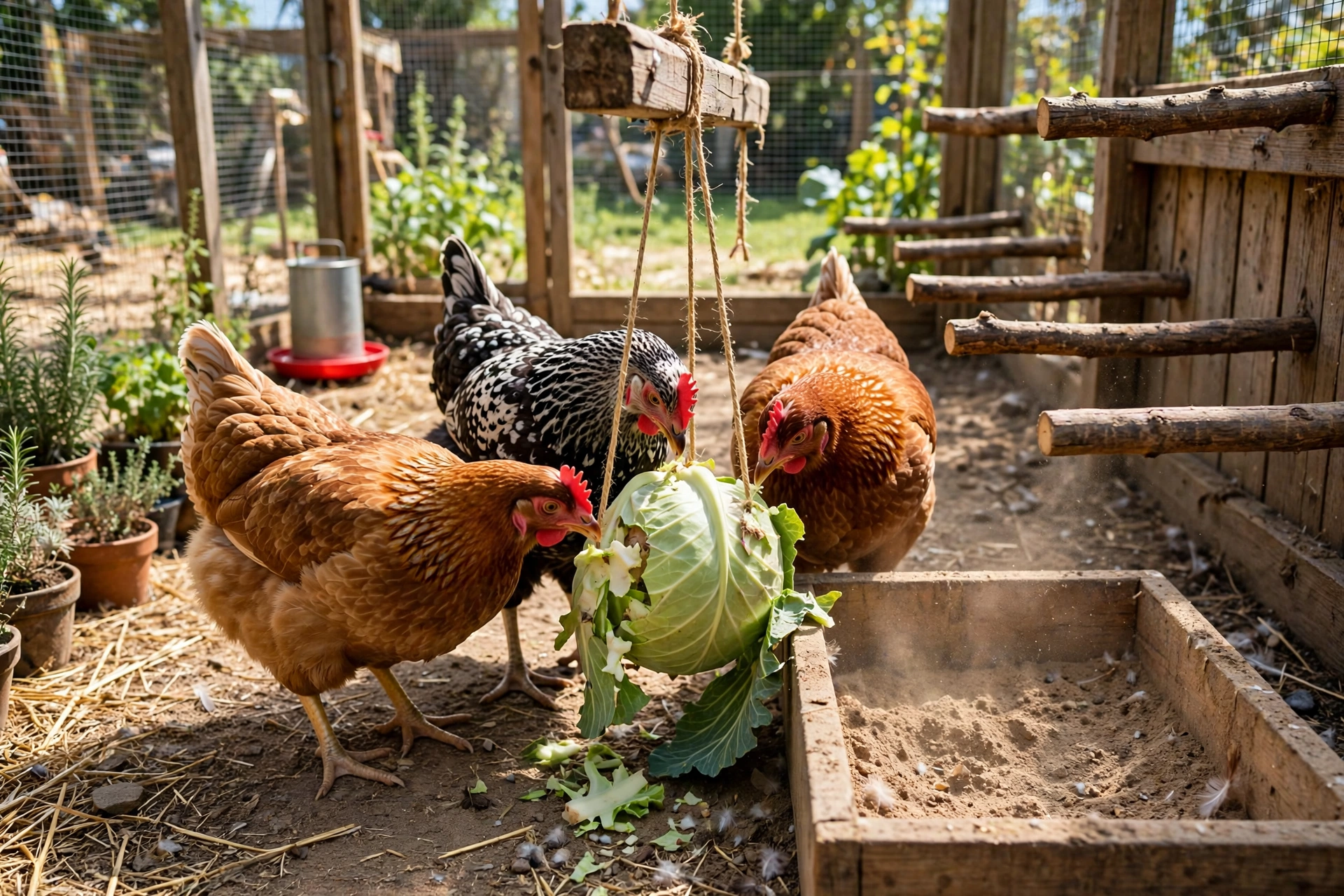
A bored hen is a busy hen in all the wrong ways. She pecks at her flock mates, she pulls feathers, she eats eggs, she paces the fence, and she picks at the same bare patch of ground until there is nothing left to find. None of that means she is a bad hen. It means she has nothing better to do, and a chicken with nothing to do will invent her own entertainment, usually at the expense of the flock.
Chickens are far more curious and clever than most people expect. Their wild ancestors spent most of the day scratching, pecking, exploring, dust bathing and watching for danger, and a pet hen still carries all of those instincts. A small run with bare ground, one perch, one feeder and the same view every day gives her almost no chance to use them. Food arrives in a dish, water arrives in a drinker, and the rest of the day stretches out empty.
Enrichment is simply the work of giving those instincts a job again. It means adding things to scratch in, things to peck at, places to climb, a proper dust bath, and small changes often enough that the run stays interesting. Most of the best ideas cost nothing and take only a few minutes to set up. This guide covers the signs of a bored flock, the five kinds of enrichment that work, cheap do it yourself ideas, why rotation matters, winter boredom, and boredom in chicks in the brooder.

Table of Contents
- Bored Chicken Signs
- Why Chickens Get Bored
- Five Kinds of Enrichment That Work
- Foraging Enrichment
- Perching and Climbing
- Dust Bathing
- Food Puzzles and Treat Toys
- Novelty and Rotation
- Chicken Enrichment Ideas for Winter
- Boredom in Chicks in the Brooder
- A Simple Weekly Enrichment Routine
- When Boredom Is Not the Problem
- Frequently Asked Questions
Quick Facts
At a Glance A bored hen pecks flock mates, pulls feathers, eats eggs, paces the fence and picks at bare ground. Boredom is one of the most common causes of pecking and egg eating in backyard flocks.
Five Kinds That Work Foraging, perching and climbing, dust bathing, novelty and food puzzles. The best chicken toys serve one of these natural behaviours, and the best enrichment is often free.
Good to Know Hens tire of the same toy fast, so rotate enrichment every few days. Winter is the hardest season for boredom, because free ranging stops and hens spend more time shut in the run.
Bored Chicken Signs
The most common sign is feather pecking, where one hen repeatedly pecks at the feathers of another, often around the vent, the back or the neck. A little pecking to settle the pecking order is normal, but steady pecking that leaves bare patches, broken feathers or sore skin is not, and boredom is one of the usual causes behind it. You can read more about the other causes in our guide on why do chickens peck each other.
Egg eating is another classic sign. A hen that has learned to break and eat eggs will often start because she was bored, pecked at an egg out of curiosity, and found a tasty reward inside. Once the habit forms it is hard to break, so it is far better to stop boredom early than to cure egg eating later. Our guide on why do chickens eat their own eggs covers the habit in full.
Pacing is a quieter sign. A bored hen may walk the same line along the fence again and again, especially near the gate, or peck at the wire, the coop walls and the feeder. Some bored hens become restless and noisy, while others go the other way and stand hunched and dull. Bullying is another sign, when the top hen picks on the lowest hen far more than usual, and over preening and eating bedding off the ground can also point to boredom.
Look for a pattern, not a single sign. If pecking has crept up since the flock stopped free ranging and the run is bare and unchanged, boredom is very likely part of the problem, and most keepers see a change within a few days of adding enrichment.
Why Chickens Get Bored
Chickens get bored because their daily life in a run is nothing like the life their instincts expect. A wild jungle fowl, the ancestor of the domestic chicken, spends most of her waking hours searching for food. She scratches the leaf litter, turns over stones, chases insects, tastes new plants and moves on to fresh ground when one patch is picked clean. She also dust bathes, perches high to rest and watch, and explores new ground. A pet hen still wants to do all of that, even though her food now arrives in a feeder.
A bare run takes that whole job away. The ground is picked clean within days, there is nothing to scratch in, nothing new to find, and no reason to move except to eat, drink and lay. Add a small run, too many birds for the space, or long hours shut in because of bad weather or predators, and boredom builds fast. How to keep chickens entertained starts with understanding that point. A toy on its own will not fix a bare run, because a hen does not want a toy, she wants work to do.
Enrichment works when it gives her those jobs back, even in a small space. Scatter feeding gives her a reason to scratch, a hanging cabbage gives her a reason to stretch and peck, and a new log or a pile of leaves gives her fresh ground to explore. A single hen kept alone will almost always be bored and lonely, and a very crowded run is just as bad, because hens cannot find a quiet corner and end up pecking the nearest bird out of frustration.
Five Kinds of Enrichment That Work
Almost every good enrichment idea fits into one of five kinds. Foraging means searching for food by scratching, pecking and digging. Perching and climbing means getting up high to rest, watch and feel safe. Dust bathing is both a cleaning ritual and a social one. Novelty means new sights, sounds, textures and objects to investigate. Food puzzles mean making a hen work a little for a treat instead of eating it straight from a dish.
Foraging is the most important kind, because it takes up the most time in a natural day. Perching matters because hens like to be up high. Dust bathing is a daily ritual, often done together. Novelty draws the whole flock over to investigate, and food puzzles slow a hen down and make her think.
The best chicken toys are the ones that serve one of these five kinds. A hanging cabbage is a foraging toy and a food puzzle at once, a swing is a perching toy, a dust bath is a dust bathing station, a mirror is a novelty toy, and a treat bottle with holes in it is a food puzzle. A random bright object that does none of these things may get a peck or two and then be ignored. Before you buy or build anything, ask which of the five kinds it serves, and whether your flock is missing that kind. You can read more about the care routines that support all five kinds in the Chicken Care and Health pillar.
Foraging Enrichment
Foraging enrichment is the simplest kind to start with, and it is the one that keeps hens busy the longest. The basic idea is to hide food where hens have to scratch and search to find it, instead of putting it all in a feeder. Scatter feeding is the easiest version. Take a small handful of scratch grains or mixed corn and throw it into deep straw, dry leaves or loose soil, then watch the flock spend the next half hour scratching through it to find every last grain. Change the spot each day.
Deep litter makes scatter feeding far better. A run with a thick layer of straw, wood shavings or dry leaves gives hens something to dig in all day, and it hides insects and seeds that keep them scratching long after the scattered grain is gone. Keep the litter dry and loose. A dig box works the same way in a small run. Fill a shallow box or an old tyre with loose soil, sand and a few handfuls of grain, and let the hens dig in it.
Leaf piles are a free favourite in autumn. Tip a pile of dry leaves into the run and let the hens scratch through it for insects and seeds. Hanging greens are foraging too. Hang a cabbage or a bunch of leafy greens at beak height from a string, just high enough that the hens have to reach up and peck at it. It swings as they peck, which keeps it interesting, and it lasts far longer than greens thrown on the ground. A flock block works the same way, because hens have to peck at it over many days to wear it down. Keep treats to a small share of the daily diet, so the hens still eat their proper layer feed.
Perching and Climbing
Perching and climbing enrichment gives hens what a flat run never can, which is height. Hens feel safer up high, they like to survey the run from above, and they will use perches at different heights all day, not just at night. A run with only one perch wastes the vertical space that could keep a flock busy and calm.
Start with perches at two or three different heights, using sturdy branches, wooden poles or sawn timber with the edges smoothed off. Natural branches are best, because the uneven surface is good for their feet and the bark gives them something to peck at. Fix each perch firmly so it does not spin or wobble when a hen lands on it, and leave enough space below each one for a hen to hop down safely without landing on another bird. A perch ladder lets hens climb up step by step.
A chicken swing is a popular perching toy, and it works because it moves. Hang a sturdy branch by two ropes, low at first so hens can step onto it easily. Stumps, logs and pallets add climbing without any building at all. A thick log laid on its side becomes a perch, and a pallet leaned against the fence at an angle makes a ramp and a shelter in one. Check every climbing object for nails, splinters and sharp edges, and make sure nothing can topple over if several hens land on it at once.

Dust Bathing
Dust bathing is the best free enrichment there is, and it is the one no flock should be without. A hen dust bathing flops onto her side in loose dry earth, kicks dust through her feathers, shakes, ruffles and rolls, then stands up and shakes the dust out. She does it to keep her feathers clean and to help keep external parasites down, and she does it because it feels good. Hens often dust bathe together, and a flock that has just had its dust bath refreshed will often pile in at once.
The simplest dust bath is a dry patch of loose soil in a sunny sheltered corner, and many flocks will make their own by digging a hollow in the driest ground they can find. A made dust bath is better, because you can keep it dry and topped up. Use a shallow box, an old tyre or a large plant pot, and fill it with dry soil, fine sand and a little wood ash from untreated wood. Keep it under cover if your run gets wet, and top it up when the hens have kicked half of it out.
Place the dust bath where the hens already like to gather, in a sunny spot sheltered from wind and rain. If you have more than a few hens, make two dust baths in different parts of the run, so a low ranking hen can bathe without being chased off. Our guide on how to make a dust bath for chickens covers the best mix, the best spot and the common mistakes in full.
Food Puzzles and Treat Toys
Food puzzles and treat toys turn feeding time into a game, and they are the best way to keep a hen busy on a day when she cannot free range. The principle is simple, which is to make the treat a little bit hard to get, so the hen has to peck, push, roll or pull to earn it. A hen that has to work for her food is a hen that is not pecking her flock mates.
A treat bottle is one of the easiest food puzzles to make. Take a clean plastic bottle, cut a few small holes in the sides just big enough for a grain to fall out, fill it part way with scratch grains, and lay it on the ground. The hens will peck and roll it around the run, and a few grains will fall out with each roll. Use a sturdy bottle with smooth edges, check it daily for cracks, and take it away if it starts to split.
Hanging treats are the classic chicken toy, and the hanging cabbage is the best known of them all. Hang a whole cabbage, cauliflower or lettuce from a string at beak height, and the hens will peck at it for hours as it swings away from them. A corn cob hung the same way lasts a long time, and a halved pumpkin set on the ground gives the whole flock something to peck at together. In hot weather, freeze treats in a block of ice, and let the hens peck at the ice as it melts.
A flock block is a ready made food puzzle that you can buy or make at home. It is a hard block of grains, seeds and a little molasses pressed together, and hens peck at it over several days to wear it down. A mirror is not a food puzzle, but hens are fascinated by their own reflection. Use a sturdy mirror made for animal use, or a polished steel mirror that cannot shatter, and never use a glass mirror that could break. Treats should be a small share of the daily diet, and a food puzzle should never replace the proper feeder.

Novelty and Rotation
Novelty and rotation matter more than any single toy, because hens tire of the same thing fast. A new object in the run will draw the whole flock over within minutes. The same object a week later may be ignored completely, because the hens have investigated it, learned that it holds no food and offers no new perch, and moved on. The answer is not to buy more toys, it is to rotate the ones you have.
Rotation means keeping a small set of enrichment items and swapping them every few days, so the run always has something fresh in it. Put the hanging cabbage out on Monday and take it away on Wednesday. Put the treat bottle out on Thursday and swap it for a pile of leaves on Saturday. Move a perch to a new height, or turn a log over so the insects underneath are exposed. Each small change gives the hens something new to investigate, and it costs nothing.
Introduce one new thing at a time, and give the flock time to investigate it. Hens are cautious of new objects, and a bold hen will often approach first while the rest watch from a safe distance. Do not force a hen onto a swing or into a dust bath, and do not fill the run with five new things at once, because that can frighten a nervous flock. Seasonal novelty is free. In autumn, tip in a pile of dry leaves, and in summer, add a shallow tray of water for the hens to stand in and cool their feet.
Chicken Enrichment Ideas for Winter
Chicken enrichment ideas for winter matter more than at any other time of year, because winter is when boredom hits hardest. Free ranging stops when the ground is frozen or deep in mud, the days are short, the hens spend long hours shut in the run or the coop, and the same small space has to keep them busy for months. Pecking, feather pulling and egg eating often get worse in winter, so winter enrichment deserves a plan of its own.
Deep litter is a winter essential, because a thick dry layer of straw or wood shavings gives hens something to scratch in even when the ground outside is frozen. Scatter feed into the litter every morning, so the hens have a job to do as soon as they come out of the coop. Hang a cabbage or a flock block where the hens can reach it without standing in mud, and keep a dust bath dry under cover.
Move some enrichment inside the coop if the hens are shut in for long stretches. A low perch, a treat bottle on the floor, a mirror fixed safely to the wall, and a handful of scratch scattered in the bedding all help. Sprouted grains are a useful winter treat, because they give hens fresh green food when there is nothing growing outside. Keep the basics right too. Winter hens need fresh water that is not frozen, a dry draught free coop with good ventilation, enough space, and a proper layer feed. Enrichment cannot fix a coop that is damp, overcrowded or short of food and water.
Boredom in Chicks in the Brooder
Boredom in chicks in the brooder starts earlier than most keepers expect, and it can cause real trouble if it is ignored. Chicks are curious from the first day, and a brooder with nothing but feed, water and heat will soon have chicks pecking at each other, pecking at toes, and picking at the same spot on the wall. Chick pecking can turn into a habit that follows them into the adult flock.
Space is the first enrichment a chick needs. A crowded brooder makes pecking far more likely, because chicks cannot move away from each other or find a quiet corner, and end up pecking the nearest chick out of frustration. Give chicks more space than the minimum as they grow.
Add low perches early. Chicks will hop onto a low branch or a small wooden perch from just a few days old. Keep the perch low, so a chick that falls off lands softly on bedding, and keep it away from the heat source. A small mirror made for animal use will fascinate them, and a few clean pebbles, a small log or a piece of bark will give them something new to peck at. Scatter a little chick crumb in the bedding each day, offer small amounts of chick safe greens once they are a week or so old, and try a tiny dust bath of dry sand and soil from about two weeks old. Change one small thing in the brooder every few days, and handle chicks gently and often, with clean hands, so they learn that people are safe.
A Simple Weekly Enrichment Routine
A simple weekly enrichment routine is the easiest way to keep a flock busy without spending hours on it or buying a cupboard full of toys. The routine below takes about ten minutes a day, uses things most keepers already have, and covers all five kinds of enrichment across the week.
On Monday, scatter feed in the deep litter in a fresh spot, and let the hens spend the morning scratching for it. On Tuesday, hang a cabbage or a bunch of leafy greens at beak height, and leave it up until it is eaten. On Wednesday, refresh the dust bath, top it up with dry soil and sand, and move it to a fresh corner if the hens have stopped using it. On Thursday, put out a food puzzle, such as a treat bottle or a flock block, and let the hens work at it through the day. On Friday, add novelty, such as a pile of dry leaves or a fresh branch.
On Saturday, give the hens a dig box or a fresh patch of loose soil to work in, and scatter a few treats through it. On Sunday, watch the flock for ten minutes and note what worked, and whether pecking has eased since the week began. That short watch tells you what to repeat next week and what to drop. Keep the routine cheap and flexible. If a day is wet, skip the scatter feed and hang a treat instead, and if one hen is being bullied, add a second dust bath or a second perch, so she has her own space.

When Boredom Is Not the Problem
Enrichment helps most flocks a great deal, but it is not a cure for every pecking or egg eating problem, and it is worth knowing when boredom is not the problem. Pecking can also come from overcrowding, from a diet low in protein, from too much light in the coop, from external parasites, or from the stress of introducing a new hen. Egg eating can also start from thin shells, a lack of calcium, or an egg that broke by accident in the nest.
If you have added enrichment, given the flock more space, and kept the routine going for a week or two, and the pecking or egg eating has not eased at all, look further. Check the feed for enough protein and calcium, check the hens for mites and lice around the vent and under the wings, and check the coop for draughts, damp bedding and overcrowding at night. Make sure the nest boxes are dark, quiet and roomy enough for a hen to lay in peace.
A sudden change in behaviour deserves a closer look too. A hen that was calm last week and is suddenly pecking, hiding, off her food or laying soft shelled eggs may be ill, stressed by a predator, or coming into a moult. Enrichment will not fix illness, and a sick hen needs care and, if she does not improve, a vet. Use enrichment as the first step, not the only step.
Frequently Asked Questions
How do I know if my chickens are bored?
Bored chicken signs include feather pecking, egg eating, pacing along the fence, pecking at the coop walls or the wire, bullying a low ranking hen, over preening, and eating bedding or feathers off the ground. A bored hen may also stand at the gate for long stretches, or go quiet and dull and do very little at all. Look for a pattern rather than a single sign.
What are the best chicken toys?
The best chicken toys are the ones that serve a natural behaviour. A hanging cabbage and a flock block serve foraging and food puzzles. A swing, a perch ladder and branches at different heights serve perching and climbing. A dust bath serves dust bathing. A mirror, a pile of leaves and a new log serve novelty. A treat bottle with holes in it serves food puzzles. Choose toys that give the hens work to do, and rotate them every few days so they stay interesting.
How can I keep chickens entertained in winter?
How to keep chickens entertained in winter starts with deep litter and daily scatter feeding, so the hens have something to scratch in even when the ground outside is frozen. Add a hanging cabbage or a flock block, keep a dust bath dry under cover, offer sprouted grains for fresh green food, and bring in novelty such as dry leaves, a fresh branch or a log with bark to peck at. Check the flock daily, because pecking often gets worse in winter.
Do chickens get bored in a small run?
Yes, chickens get bored in a small run, especially if the run is bare, with no litter to scratch in, no perch to climb on, no dust bath and nothing new to investigate. A small run can still work well if it is used cleverly, with deep litter, perches at different heights, a dust bath, daily scatter feeding and a rotated toy or new object every few days. What the hens can do in that space matters more than the size alone.
Can boredom make chickens peck each other?
Yes, boredom is one of the most common causes of pecking between chickens. A hen with nothing to scratch, peck at or explore will often peck at the nearest flock mate instead, and that pecking can leave bare patches, broken feathers and sore skin. Adding foraging, perching, dust bathing, novelty and food puzzles usually eases pecking within a few days, though pecking can also come from overcrowding, low protein, parasites or the stress of a new hen, so check those too if enrichment alone does not help.
Keep Reading
Chicken Care and Health and the pillar guide for keeping your flock healthy.
Why Do Chickens Peck Each Other and how boredom turns into pecking.
How to Make a Dust Bath for Chickens and the best free enrichment you can give your flock.

Nusrat
Author, TheChickenPet.com