
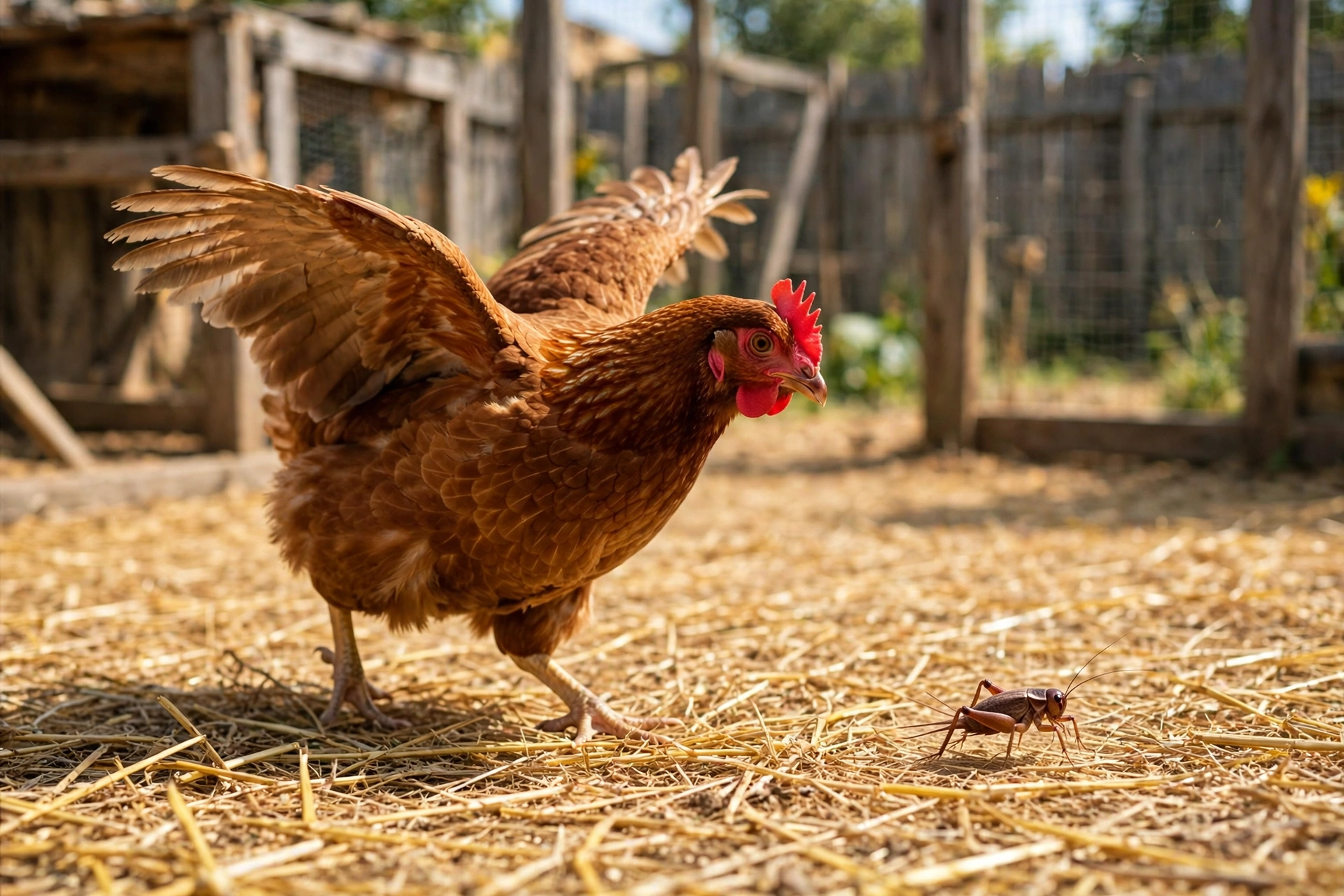
Throw a live cricket into a chicken run and watch what happens. Every hen in sight will stop what she is doing, fix her eyes on the hopping insect, and give chase. The cricket jumps, the hen jumps after it, another hen cuts across to steal it, and the whole run turns into a game in seconds. No other treat gets a flock moving quite like a live cricket does.
Chickens are natural insect hunters. A free ranging hen spends much of her day scratching, pecking and chasing down bugs, and crickets are one of the best of them. They are high in protein, easy for a hen to catch and swallow, and they give her the kind of moving target her instincts are built for. A cricket is food and entertainment in one small hopping package.
This guide covers everything you need to know about feeding crickets to chickens. You will learn whether crickets are good for chickens, how live, dried and freeze dried crickets compare, how many to feed each day, how crickets stack up against mealworms and black soldier fly larvae, when baby chicks can start eating them, where to get them safely, and the honest risks to watch for.

Table of Contents
- The Short Answer
- Why Crickets Are Good for Chickens
- Live Versus Dried Versus Freeze Dried Crickets
- How Many Crickets Can Chickens Eat
- Crickets Versus Mealworms for Chickens
- Crickets Versus Black Soldier Fly Larvae
- Can Baby Chicks Eat Crickets
- Where to Get Crickets Safely
- The Risks to Watch For
- How to Feed Crickets to Your Flock
- Frequently Asked Questions
Quick Facts
At a Glance Crickets are Safe for chickens. The food checker lists crickets as Safe, wild caught from untreated areas, or farmed. They are about 60 to 70 percent protein on a dry matter basis, which makes them one of the richest protein treats you can offer.
How Many About 10 to 20 crickets per hen per day is a sensible amount, and treats of every kind together should stay inside 10 percent of the daily diet. Live crickets add chasing and scratching enrichment that dried crickets cannot match.
Good to Know Chicks can start on small crickets from about 4 weeks old. Never feed crickets caught from a sprayed lawn or garden, and introduce them gradually so the flock gets used to them.
The Short Answer
Can chickens eat crickets. Yes, chickens can eat crickets, and crickets are a safe and healthy treat for them. The food checker lists crickets as Safe, with the note wild caught from untreated areas, or farmed. That one condition matters, because where a cricket comes from decides whether it is safe to feed. A cricket from a clean untreated area or a proper feeder cricket farm is a fine treat. A cricket from a lawn or garden that has been sprayed is not.
Hens love crickets for two reasons. The first is nutrition, since crickets are very high in protein and also provide healthy fats, minerals and chitin from their exoskeletons. The second is the chase itself, since a live cricket triggers the hunting instinct in a way that a bowl of feed never will. A hen that has to run, peck and scratch for her treat is a hen that is busy, active and entertained, and that is good for the whole flock.
Crickets fit neatly into the treat rules that apply to every extra food. They are a supplement to a balanced layer feed, not a replacement for it, and the total of all treats should stay inside 10 percent of what a hen eats each day. For a wider look at what belongs in that other 90 percent, and which foods are safe and which are not, our guide on what can chickens eat is the place to start.
Why Crickets Are Good for Chickens
Are crickets good for chickens. Yes, and the main reason is protein. Crickets are about 60 to 70 percent protein on a dry matter basis, which puts them among the most protein rich treats you can give a hen. Protein is the building block of feathers, muscle and eggs, and a laying hen needs plenty of it every day. A hen in lay, a hen growing new feathers after a moult, and a young bird still growing all benefit from a protein boost, and crickets deliver it in a natural form.
Crickets also provide healthy fats, which give energy and help keep feathers in good condition. They carry minerals including calcium, iron and zinc in useful amounts, and their exoskeletons contain chitin, a fibre that supports gut health. None of this makes crickets a complete feed on their own, and they should never replace layer feed, but as a treat they pack more nutrition into a small package than most kitchen scraps do.
The other benefit is harder to measure but easy to see. A live cricket gives a hen something to chase, and chasing is natural behaviour. Hens that spend their day foraging, scratching and hunting are less likely to get bored, and boredom in a flock leads to feather pecking, bullying and restlessness. Scattering live crickets through the run turns feeding time into foraging time, and the hens stay busy long after the last cricket is gone, still scratching through the straw in case one is left.
Crickets are also a good way to tempt a shy or stressed hen to eat. A hen that has just joined the flock, a hen recovering from a fright, or a hen that has gone off her feed will often ignore a bowl but cannot resist a moving insect. A few crickets scattered near her can get her eating again, and once she starts she usually keeps going.
Live Versus Dried Versus Freeze Dried Crickets
Live versus dried crickets for chickens is the first choice a keeper has to make, and each form has its own strengths. Live crickets are the best choice for enrichment, because they move, jump and hide, and the chase is half the point. They are also the freshest form, with nothing added and nothing taken away. The downside is that live crickets need care. They need a ventilated keeper tub, food, water and warmth, and they will escape if the tub is not secure. They also cost more per serving than dried crickets, and they need to be used within a few days.
Dried crickets are the convenient option. They keep for months in a sealed bag, they need no care at all, they are easy to store and easy to scatter, and they cost less than live crickets. Hens eat them happily, and they carry the same protein as live crickets on a dry matter basis. The downside is that dried crickets do not move, so they give no chasing enrichment, and some hens are slower to show interest in them at first. Once the flock learns that the crunchy brown things in the bowl are food, they will eat them fast enough.
Freeze dried crickets sit between the two. They are made by freezing live crickets and removing the water, which keeps more of their shape and texture than heat drying does. They keep for months like dried crickets, and many keepers find hens take to them more quickly, because they look more like a real insect. They usually cost a little more than heat dried crickets, and the difference in nutrition is small, so the choice mostly comes down to price and what your flock prefers.
For most keepers, a mix works well. Use live crickets when you want to give the flock an enrichment treat, perhaps once or twice a week, and keep a bag of dried or freeze dried crickets on hand for a quick daily protein top up. Whichever form you choose, buy from a reputable supplier and check that the crickets are sold as feeder insects, not as bait or pest control stock, since feeder crickets are raised to be eaten.

How Many Crickets Can Chickens Eat
About 10 to 20 crickets per hen per day is a sensible amount, and that figure already includes the treat rule that every extra food has to follow. Treats of all kinds together should stay inside 10 percent of a hen’s daily diet, with the other 90 percent coming from her balanced layer feed. A hen that fills up on crickets and other treats will eat less layer feed, and layer feed is where her calcium, vitamins and minerals come from. Too many treats can mean thinner shells, fewer eggs and a hen that is short on the nutrients she needs most.
The right number also depends on the size of the crickets and the size of the hen. Ten large adult crickets are a bigger meal than ten small ones, and a large dual purpose hen can handle more than a small bantam. Start at the lower end, about 10 crickets per hen, and watch how the flock responds. If the hens eat them eagerly and go back to their feed afterwards, the amount is right. If they leave layer feed untouched and wait around for more crickets, cut the amount back.
Frequency matters as much as amount. A small handful of crickets a few times a week is better than a large pile every day, because variety keeps the flock interested and keeps the diet balanced. Rotate crickets with other protein treats, such as mealworms or black soldier fly larvae, and with green treats such as leafy vegetables, so no single treat takes over the diet.
Always introduce crickets gradually. On the first day, offer just a few crickets per hen and watch for any problems over the next day, such as loose droppings or a hen that seems uncomfortable. A sudden large amount of any new rich food can upset a hen’s digestion, and crickets are rich. Once the flock is used to them, you can build up to the full amount.
Crickets Versus Mealworms for Chickens
Crickets versus mealworms for chickens is a common question, because the two are the most popular insect treats, and both are excellent. They are similar in many ways, and the best answer is that you do not have to choose, since both belong in a varied treat routine.
Mealworms are the easier treat to keep and store. Dried mealworms last for months in a bag, they need no care, and hens go crazy for them. They are high in protein, though not quite as high as crickets, and they are also higher in fat. A hen that eats too many mealworms can put on weight, so the amount matters just as much as it does with crickets. Live mealworms are also available, but they wriggle rather than jump, so they give less chasing excitement than a live cricket.
Crickets win on protein and on enrichment. At about 60 to 70 percent protein on a dry matter basis, they edge out mealworms, and a live cricket that jumps across the run gives a hen a proper hunt. Crickets are also leaner than mealworms, with less fat per serving, which makes them a slightly better choice for a flock that needs to watch its weight. The trade off is convenience, since live crickets need a keeper tub and care, while dried mealworms need nothing at all.
Price is the other difference. Dried mealworms are widely sold and often cheaper per serving, while live crickets cost more and need to be used quickly. Dried crickets close that gap, since they store just as well as dried mealworms and cost about the same. If your flock already loves mealworms, keep feeding them, and add crickets as a second insect treat for variety and for the chasing game. Our full guide on can chickens eat mealworms covers mealworms in detail, including how many to feed and the dried versus live choice.
Crickets Versus Black Soldier Fly Larvae
Black soldier fly larvae are the third insect treat in this series, and they bring something different to the run. They are famous for calcium, which crickets and mealworms do not provide in the same amounts. A laying hen needs calcium for strong shells, and black soldier fly larvae are one of the few treats that help with that directly. They are also high in protein and healthy fats, and hens eat them just as eagerly as they eat crickets.
Crickets win on protein and on the chase. At about 60 to 70 percent protein on a dry matter basis, crickets are the leanest and most protein rich of the three insect treats, and only a live cricket gives a hen a moving target to hunt. Black soldier fly larvae wriggle but they do not jump, so they give less enrichment than a live cricket, though they still encourage scratching and pecking when scattered through the run.
Black soldier fly larvae win on calcium and on ease of keeping. They store well dried, they are easy to scatter, and their calcium content makes them the better choice for a laying flock that needs shell support. Crickets are the better choice when you want maximum protein, a leaner treat, and a proper hunting game for the hens.
The honest answer is that all three insect treats are good, and a flock that gets a rotation of crickets, mealworms and black soldier fly larvae is better off than a flock that gets only one of them. Each one brings something the others do not, and variety keeps the hens interested. Our full guide on can chickens eat black soldier fly larvae covers that treat in detail, including its calcium content and how many to feed.
Can Baby Chicks Eat Crickets
Can baby chicks eat crickets. Yes, chicks can eat crickets from about 4 weeks old, as long as the crickets are small enough for them. A tiny chick cannot handle an adult cricket, and a cricket that is too large can be a choking risk, so size is the key. Use pinhead crickets or small crickets for young chicks, and only move up to larger sizes as the chicks grow. A good rule is that the cricket should be no longer than the width of the chick’s beak.
Before 4 weeks old, chicks should stick to their starter feed. Their digestive systems are still developing, and starter feed is made to give them exactly what they need in the right balance. Treats of any kind, including crickets, are best held back until the chick is old enough to handle them and old enough to have grit available. Grit is essential whenever chicks eat anything other than starter feed, because they need it to grind food in their gizzards. Make sure chick grit is available before you offer the first cricket.
When you do start, offer just one or two small crickets per chick, and watch how they react. Most chicks are cautious at first, then curious, then very keen. The chasing game is just as entertaining for chicks as it is for hens, and it encourages the scratching and pecking behaviour that young birds need to learn. Keep the amount small, since treats should stay a tiny part of a chick’s diet, and always offer crickets after the chicks have eaten some starter feed, not instead of it.
Live crickets are the best choice for chicks, because the movement catches their attention and teaches them to hunt. Dried crickets can work too, but crush them into smaller pieces first, since a whole dried cricket may be too large and too hard for a young chick. Never leave uneaten live crickets in the brooder overnight, since crickets can nibble at sleeping chicks. Remove any that are left after feeding time. For the full timeline of when chicks can start on treats of every kind, our guide on when can baby chicks eat treats covers it in detail.
Where to Get Crickets Safely
Where a cricket comes from decides whether it is safe to feed, and this is the one part of feeding crickets that you must get right. The food checker lists crickets as Safe, wild caught from untreated areas, or farmed, and those last words are the whole rule. A cricket from an untreated area or a proper feeder farm is safe. A cricket from a sprayed lawn, a treated garden or a field that has had pesticide is not.
Pet store feeder crickets are the safest and easiest source for most keepers. They are raised specifically to be eaten, they are fed a controlled diet, and they are sold in sizes from pinhead to adult, so you can match the cricket to your birds. Buy from a pet store or a reputable online feeder insect supplier, and ask how the crickets are raised if you are unsure. A good supplier will be happy to tell you.
Wild caught crickets are safe only if you are certain the area is untreated. That means no pesticide, no herbicide, no slug pellets and no chemical fertiliser anywhere the crickets could have fed. A wild meadow far from roads and gardens can be safe, but a suburban lawn, a vegetable garden, a park or a field edge is not a safe bet, because you cannot know what has been sprayed there. If you have any doubt at all, do not feed wild caught crickets. The risk is not worth it, and farmed crickets are cheap and easy to buy.
Never feed crickets that have been used as fishing bait if they have been treated, dyed or stored with chemicals, and never feed crickets you find dead in a pesticide treated area. A dead cricket found in the garden may have died from the very spray you are trying to avoid. If you raise your own crickets, keep them on clean food such as fresh vegetables, grains and commercial cricket feed, keep their tub clean and dry, and never feed them anything you would not want your hens to eat.
If you keep live crickets at home, a ventilated keeper tub with egg cartons for hiding places is all you need. Give them a shallow water source, such as a damp sponge or a water gel, and fresh food every day, and keep the tub warm and out of direct sun. Clean the tub regularly, because a dirty tub breeds bacteria, and bacteria in the crickets can pass to your hens.

The Risks to Watch For
Crickets are a safe treat, but they are not free of risk, and an honest guide should name the risks plainly. The biggest one is pesticide exposure. A cricket that has fed on a sprayed plant carries that pesticide in its body, and a hen that eats the cricket takes the pesticide in too. Even a small amount can make a hen ill, and repeated exposure is worse. This is why the sourcing rule matters so much, and why crickets from a sprayed lawn or garden should never be fed.
The second risk is bacterial contamination from poor suppliers. Crickets raised in dirty, crowded or damp conditions can carry bacteria such as salmonella, and those bacteria can pass to your hens and to you. Buy from a reputable supplier, check that the crickets look lively and healthy, and avoid any batch that smells bad, looks sluggish or has many dead crickets in the tub. Keep your own keeper tub clean, wash your hands after handling crickets, and store dried crickets in a sealed container in a cool dry place.
The third risk is overfeeding. Crickets are rich and high in protein, and too many of them can upset a hen’s digestion, leading to loose droppings, and can push layer feed out of the diet, which means less calcium and fewer vitamins. Stick to the 10 to 20 crickets per hen per day guide, keep all treats inside 10 percent of the diet, and watch the droppings and the laying rate after you start feeding crickets.
The fourth risk is choking, and it applies mainly to chicks and to small bantams. A cricket that is too large for the bird can get stuck, so always match the cricket size to the bird. Pinhead and small crickets for chicks, medium crickets for growers, and adult crickets only for full grown hens. If a hen struggles with a cricket, take it away and offer a smaller one.
Introduce crickets gradually, as you would with any new food. A few crickets on the first day, then a few more the next, and build up to the full amount over a week. That gives the flock’s digestion time to adjust, and it gives you time to spot any bird that does not take to them. If a hen develops loose droppings or goes off her feed after you start crickets, stop feeding them for a few days and start again more slowly, or leave them out altogether if the problem returns.
How to Feed Crickets to Your Flock
Feeding crickets is simple, but a little method makes it better. For live crickets, scatter them through the run rather than putting them in a bowl. Scattering spreads the flock out, gives every hen a fair chance, and turns feeding into foraging. Toss a few into the straw, a few under a bush, and a few in open ground, so the hens have to search for them. Avoid scattering live crickets in the coop, since any that escape will hide in the bedding and can nibble at the hens at night.
For dried or freeze dried crickets, a small bowl works well, or scatter them like scratch grain. A bowl keeps them clean and lets you see how much the flock eats, while scattering encourages scratching. Either way, offer them in the afternoon rather than the morning, so the hens have already eaten a good share of their layer feed first. A treat offered too early can fill a hen up before she gets the nutrition she needs from her feed.
Feeding time is also a good moment to watch the flock. A hen that ignores crickets while the rest of the flock chases them may be unwell, broody or low in the pecking order, and she is worth a closer look. A hen that chases hard and eats well is a hen in good health. Use the cricket game as a quick daily health check, and you will spot problems earlier than you would by watching feed bowls alone.
Keep live crickets in a ventilated keeper tub with egg cartons for hiding, and take out only as many as you need for one feeding. Do not tip the whole tub into the run, since uneaten crickets will escape, hide and die in the bedding. Store dried crickets in a sealed container in a cool dry place, and check the bag for any sign of damp or mould before you feed from it. Wash your hands after handling crickets, live or dried, just as you would after handling any raw animal feed.
Frequently Asked Questions
Can chickens eat crickets?
Yes, chickens can eat crickets, and crickets are a safe treat for them. The food checker lists crickets as Safe, wild caught from untreated areas, or farmed. Crickets are about 60 to 70 percent protein on a dry matter basis, and hens love chasing live ones. Feed about 10 to 20 crickets per hen per day, keep all treats inside 10 percent of the diet, and never feed crickets from a sprayed lawn or garden.
Are crickets good for chickens?
Yes, crickets are good for chickens. They are one of the most protein rich treats you can offer, at about 60 to 70 percent protein on a dry matter basis, and they also provide healthy fats, minerals and chitin. Live crickets add chasing and scratching enrichment that no other treat matches, which keeps the flock active and reduces boredom. They are a treat, not a replacement for layer feed, and all treats together should stay inside 10 percent of the daily diet.
Live vs dried crickets for chickens, which is better?
Live crickets are better for enrichment, because they move and jump and give the hens a proper hunt, but they need a keeper tub and care and must be used within a few days. Dried crickets are better for convenience, because they keep for months, cost less and need no care, though they give no chasing game. Freeze dried crickets sit between the two, keeping for months while looking more like a real insect. A mix of live crickets for enrichment and dried crickets for a daily top up works well for most keepers.
Can baby chicks eat crickets?
Yes, baby chicks can eat crickets from about 4 weeks old, as long as the crickets are small enough. Use pinhead or small crickets, no longer than the width of the chick’s beak, and make sure chick grit is available first. Offer just one or two small crickets per chick at first, after they have eaten starter feed. Never leave uneaten live crickets in the brooder overnight, since they can nibble at sleeping chicks.
Crickets vs mealworms for chickens, which should I feed?
Both are excellent, and a varied routine is better than either one alone. Crickets are higher in protein at about 60 to 70 percent on a dry matter basis, leaner, and far better for enrichment, since a live cricket gives a hen a real chase. Mealworms are easier to store and often cheaper, but they are higher in fat. Feed both in rotation, and keep each within the 10 percent treat allowance.
Are crickets safe for chickens from the garden?
Crickets from the garden are safe only if you are certain the area is untreated, with no pesticide, herbicide, slug pellets or chemical fertiliser anywhere the crickets could have fed. A suburban lawn, a vegetable garden or a park is not a safe bet, because you cannot know what has been sprayed there. If you have any doubt, do not feed wild caught crickets. Pet store feeder crickets or farmed crickets from a reputable supplier are the safe choice.
How many crickets can chickens eat in a day?
About 10 to 20 crickets per hen per day is a sensible amount, with the exact number depending on the size of the crickets and the size of the hen. All treats together, crickets included, should stay inside 10 percent of a hen’s daily diet. Start with a few crickets and build up gradually over a week, and offer them in the afternoon after the hens have eaten their layer feed.
Keep Reading
What Can Chickens Eat and the full feeding pillar for safe foods and treat rules.
Can Chickens Eat Mealworms and the other great insect treat.
Can Chickens Eat Black Soldier Fly Larvae and the calcium rich insect treat.

Nusrat
Author, TheChickenPet.com