
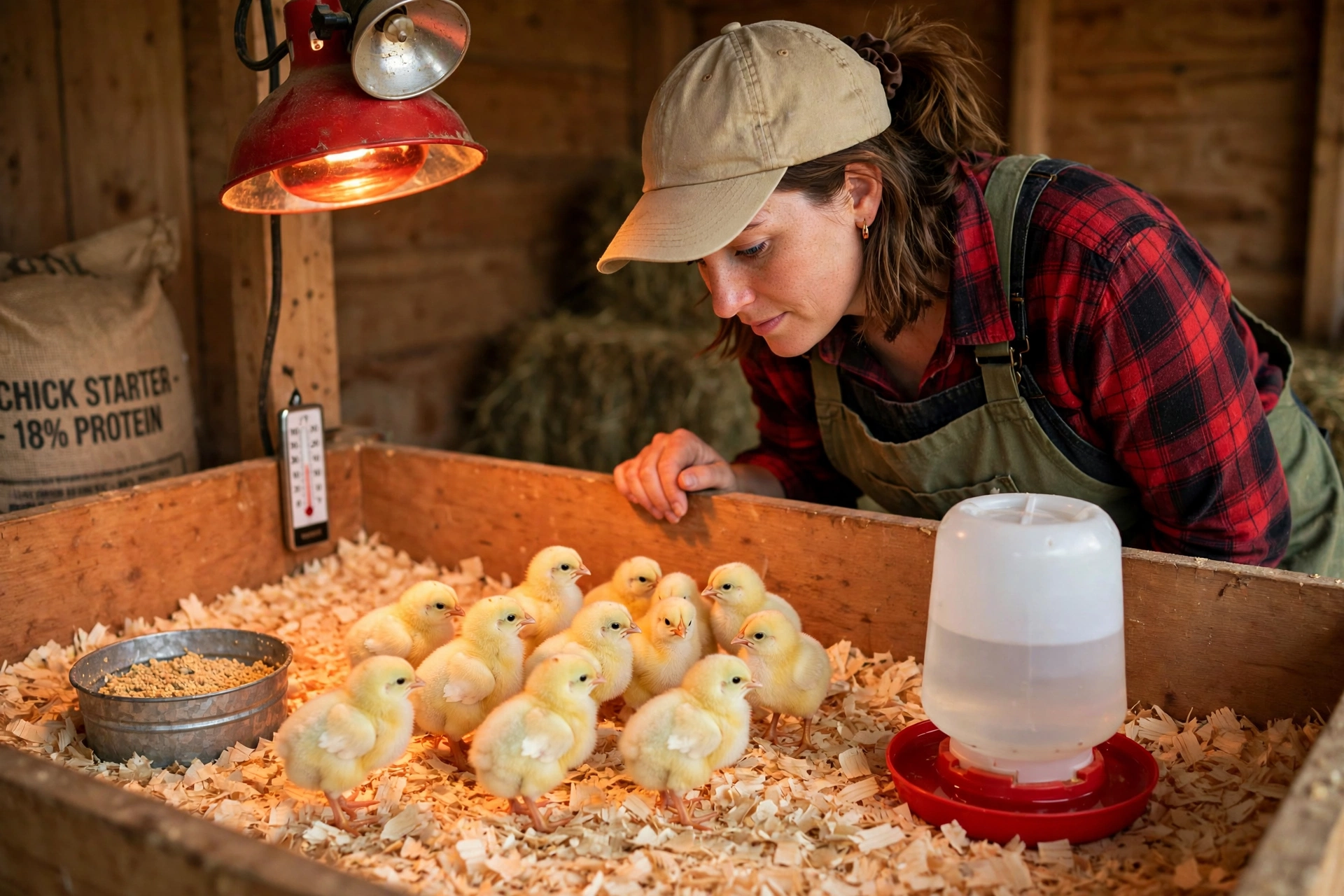
Coccidiosis in chickens is the gut disease that keepers fear most in young chicks, and for good reason. It moves fast, it hits the youngest birds hardest, and a chick that looked fine in the morning can be hunched, cold and off her feed by the evening.
Coccidiosis is caused by a tiny protozoan parasite called Eimeria, and it is not a worm. Corid treats coccidiosis, and it does nothing against worms. A dewormer treats worms, and it does nothing against coccidiosis. Mixing the two up wastes precious days while a chick gets weaker.
This guide walks through the whole picture in plain terms. You will learn what coccidiosis is and how it spreads, the signs to watch for in chicks and in adult hens, why chicks between 2 and 8 weeks old are hit hardest, the Corid dose that treats an outbreak, the supportive care that helps a sick bird pull through, and the dry litter habits that prevent the next outbreak before it starts.

Table of Contents
- The Short Answer
- What Coccidiosis Is and How It Spreads
- Coccidiosis Symptoms in Chickens
- Why Coccidiosis in Chicks Hits Hardest
- How to Tell Coccidiosis From Worms and Diarrhea
- Corid Dosage for Chickens
- Other Treatment and Supportive Care
- How to Prevent Coccidiosis in Chickens
- When to Call a Vet at Once
- Frequently Asked Questions
Quick Facts
At a Glance Coccidiosis is caused by Eimeria, a protozoan gut parasite, not a worm. It is the leading cause of death in young chicks, and it spreads through oocysts in droppings that become infective in damp ground and damp litter.
Approved Treatment Corid, which is amprolium 9.6 percent liquid, is the standard treatment. The usual dose is 1 teaspoon per gallon of water for a moderate outbreak and 2 teaspoons per gallon for a severe one, given for 5 to 7 days as the flock’s only water source, with zero-day egg withdrawal.
Good to Know Corid treats coccidiosis and does nothing against worms. Dry litter is the main prevention, because oocysts need damp ground to spread. Medicated starter feed and vaccination also help protect chicks. Call a vet at once if several birds are affected, if a bird cannot stand, or if there is no improvement after treatment.
The Short Answer
Coccidiosis in chickens is an infection of the gut caused by Eimeria, a microscopic single celled parasite. The parasite invades the lining of the intestine, damages it, and stops the bird from absorbing food and water properly.
The parasite spreads through droppings. An infected bird passes oocysts in her droppings, and those oocysts need warmth and moisture to become infective. Once they are infective, another bird picks them up by pecking at contaminated litter, feed, water or ground. That is why damp litter, a leaking waterer and a crowded brooder are the classic setup for an outbreak, and why dry litter is the classic defence against one.
Chicks between 2 and 8 weeks old are hit hardest, because they have not yet built immunity and because their small bodies have little reserve to lose. Adult hens that have met the parasite before usually carry some immunity, so they may show few signs or none at all, while still passing oocysts that can infect the chicks around them. Treatment is Corid, which is amprolium, given in the drinking water for 5 to 7 days. Prevention is dry litter, clean water, medicated starter feed or vaccination, and enough space that droppings do not build up under the birds.
What Coccidiosis Is and How It Spreads
Eimeria is not a worm and it is not a bacterium. It is a protozoan, which means it is a single celled organism that lives inside the cells of the gut lining. Different species favour different parts of the gut, and the cecal species are the ones most often linked to bloody droppings.
The life cycle is simple to follow and hard to stop once it starts. An infected bird passes oocysts in her droppings. A fresh oocyst is not yet infective, and it needs oxygen, warmth and moisture to mature, a process that usually takes a day or two in warm damp conditions. Inside the new bird the parasite breaks out, invades the gut lining and multiplies, and a few days later the bird starts passing new oocysts.
Dampness is the key that turns a background risk into an outbreak. Oocysts need damp ground to become infective, and they need damp litter to stay alive long enough to be picked up. A brooder with wet bedding, a leaking waterer and a muddy run all give the parasite what it needs, while dry litter and sunlight slow it down.
Crowding makes everything worse. The more birds in a small space, the more droppings land in the litter, the more oocysts build up, and the more often each bird pecks at contaminated ground. Stress makes it worse too, because a stressed bird has a weaker immune response.
Coccidiosis Symptoms in Chickens
Coccidiosis symptoms in chickens vary with the species involved, the number of oocysts the bird picked up, and the age and strength of the bird. A light infection may cause only a day or two of dullness and then pass. A heavy infection can kill a chick in a few days. Learning the signs early matters, because treatment works best when it starts on the first day a bird looks wrong, not the third.
Bloody or dark tarry diarrhea is the sign most keepers associate with coccidiosis, and it is a serious one. The blood comes from the damaged gut lining, and in a cecal infection it can be bright red or dark and tarry. A single bloody dropping is enough to act on, especially in chicks. Move the bird to a warm dry place, check the rest of the flock, and start treatment the same day. Our guide on why does my chicken have diarrhea covers the other causes of diarrhea too, and it is worth reading alongside this guide, because diarrhea alone has many causes and only the full picture points to coccidiosis.
A hunched ruffled bird off feed is the classic picture of a sick chick with coccidiosis. She stands with her feathers fluffed up, her head pulled in, her eyes half closed, and her wings drooping a little. She moves slowly or not at all, she stands apart from the others, and she shows little interest in food or treats.
A pale comb and pale wattles can appear as the infection goes on, because blood loss and poor absorption leave the bird anaemic. A chick that was bright and pink a few days ago and is now pale and dull has lost ground, and the change is worth taking seriously even if there is no blood in the droppings yet.
Weight loss and poor growth are slower signs, and they matter most in a group of growing chicks. A chick with coccidiosis eats less, absorbs less of what she does eat, and puts her energy into fighting the infection instead of into growing. In a brooder where one or two chicks are clearly smaller and weaker than the rest, coccidiosis should be on the list of causes to check.
Fewer eggs is the sign you are most likely to notice first in adult hens. A laying hen with a mild infection may keep eating and moving normally but lay fewer eggs, lay smaller eggs, or stop laying for a while. Her body is spending energy on the gut damage instead of on eggs, and the drop is often the first clue that something is wrong. Look for the other signs with it, and check the droppings.
Weakness and a cold bird are late signs, and they mean the bird is already in trouble. A chick that lies down and does not get up, that feels cold to the touch, or that cannot stand needs warmth and vet help at once. Keep her warm, quiet and safe, offer water within easy reach, and get vet help as soon as you can.
Why Coccidiosis in Chicks Hits Hardest
Coccidiosis in chicks is a different problem from coccidiosis in adult hens, and the difference is immunity. An adult hen that has lived on the ground has usually met Eimeria many times, in small doses, over many months. Each small exposure builds a little immunity, so the next exposure causes less damage. A young chick has no such history. Her first meeting with the parasite is often a heavy one, and her gut has no defence ready.
Chicks between 2 and 8 weeks old are in the danger window. Before 2 weeks they are still partly protected by antibodies from the hen, and after 8 weeks they have often had small exposures and started to build their own immunity. Between those ages they are pecking and exploring more, and they are still immunologically naive. That combination is why most coccidiosis deaths happen in that window.
A chick’s small size makes the damage worse. A chick has little blood and little fluid to lose, so bloody diarrhea that an adult hen might survive can kill a chick quickly. A chick also has little fat and little muscle to draw on, so a few days off feed leaves her weak and cold in a way that takes an adult hen much longer to reach. What looks like a mild illness in an adult can be a life threatening illness in a 3 week old chick, and that is why keepers are told to act fast with chicks.
The brooder itself can turn a risk into an outbreak. A warm brooder is also a warm place for oocysts to mature, and a brooder with damp bedding is a perfect place for them to stay infective. Chicks in a brooder peck at everything, including the bedding and each other’s droppings, so once one chick is infected, the rest are exposed within a day. A brooder that is cleaned daily, kept dry and given fresh bedding stays far safer than one that is topped up and left for a week.
New ground is a particular risk for chicks that have been raised indoors. A chick that has lived on clean shavings for 4 weeks and is then put straight onto old ground that adult birds have used is meeting a heavy oocyst load for the first time, all at once. A gentler move is to let chicks onto clean dry ground for short periods first, and to keep their feed and water clean and off the ground while they build immunity.
How to Tell Coccidiosis From Worms and Diarrhea
Coccidiosis, worms and plain diarrhea share signs, and telling them apart matters because each one needs a different treatment. Bloody droppings point most strongly to coccidiosis, especially in chicks, because worms rarely cause frank blood in droppings. Diarrhea without blood could be coccidiosis, worms, a feed change, too many treats, heat, stress or a bacterial infection. The full picture, the age of the bird, the speed of onset and the droppings themselves, is what narrows it down.
Age is the first clue. A 3 week old chick with bloody droppings and a hunched posture is most likely to have coccidiosis, because worms take longer to build up to a level that causes signs, and young chicks have had less time to pick up a heavy worm load. An adult hen with weight loss, a pale comb and fewer eggs over several weeks is more likely to have worms than a sudden coccidiosis outbreak.
Speed is the second clue. Coccidiosis moves fast. A chick can go from bright to hunched and bloody in a day or two, and several chicks in the same brooder can fall sick together. Worms move slowly. A worm load builds over weeks, the bird loses weight gradually, and the signs creep in rather than arriving all at once.
What you see in the droppings is the third clue. Bloody or dark tarry droppings point to coccidiosis. Long pale roundworms or short white tapeworm segments in droppings point to worms, and you will not see those with coccidiosis, because Eimeria is microscopic. A fecal test from a vet or a state poultry lab can settle the question, because it can find worm eggs and coccidia oocysts under the microscope. Our guide on how to tell if chickens have worms explains the fecal test in full, including how to collect a sample and why signs alone never prove worms. The same test is useful here, because it can confirm coccidia and rule worms in or out at the same time.
The treatment difference is the reason the distinction matters. Corid treats coccidiosis and does nothing against worms, so a wormy bird given Corid will not improve. A dewormer treats worms and does nothing against coccidiosis, so a chick with coccidiosis given a dewormer will keep getting worse. Giving the wrong medicine wastes the days when treatment works best, and it leaves the real problem untreated. If you are unsure which parasite you are dealing with, treat the most likely one for the age and signs, and ask your vet for a fecal test at the same time.
Diarrhea on its own is the least specific sign of all, and it deserves its own careful check. A hen with diarrhea after a sudden feed change, after a day of too many watery treats, or in a heatwave may have no parasite at all. A hen with diarrhea that lasts more than a day or two, that comes with blood, weight loss or weakness, or that affects several birds at once needs a closer look. Our guide on why does my chicken have diarrhea walks through those other causes in detail, and it is the right next read if the droppings are the only sign you have.

Corid Dosage for Chickens
Corid is the standard treatment for coccidiosis in chickens, and it is the medicine most vets and experienced keepers reach for first. Corid is amprolium, and the liquid sold for poultry is amprolium 9.6 percent liquid. Amprolium works by blocking thiamine, which is vitamin B1, and Eimeria needs thiamine to multiply. By cutting off that supply, amprolium stops the parasite from reproducing while the bird’s own immune system clears the infection.
Corid dosage for chickens is measured in the drinking water, and the dose depends on how severe the outbreak is. For a moderate outbreak, the usual dose is 1 teaspoon of Corid 9.6 percent liquid per gallon of water. For a severe outbreak, with bloody droppings and several sick birds, the usual dose is 2 teaspoons per gallon of water. Give the treated water for 5 to 7 days, and make it the flock’s only water source during the course, so every bird gets the medicine with every drink. Do not offer plain water alongside it, because birds will drink the plain water and miss the dose.
Measure the dose carefully, and mix a fresh batch every day. Use a proper measuring spoon, and mix the Corid into the full gallon before you fill the waterer. Check the waterer through the day, and top it up with the same treated mix, not with plain water.
Finish the full course even if the birds look better after two or three days. Birds often perk up quickly once treatment starts, and it is tempting to stop early. Stopping early leaves the infection half treated, and the birds can relapse within a few days.
Corid has zero-day egg withdrawal, which means you do not need to throw eggs away during or after treatment when it is used as labeled. That is a practical help for a keeper with laying hens in the same flock as sick chicks, because it means the laying hens can keep laying through the course. If you are unsure, ask your vet or your feed supplier before you start.
Do not add vitamin supplements to the treated water, because amprolium works by blocking thiamine, and extra thiamine in the water can undo the treatment. That includes vitamin B complex supplements and some electrolyte mixes that contain thiamine. Give plain treated water only during the course, and save vitamins for after it has finished.
Corid treats coccidiosis and does nothing against worms, and that point bears repeating in this section, because it is the mistake that costs the most time. If a fecal test later shows worms as well, your vet can advise a dewormer for after the coccidiosis course, once the birds are stronger. Do not mix a dewormer into the same water as Corid without vet advice.
Other Treatment and Supportive Care
Corid is the main treatment, and supportive care is what helps a sick bird survive long enough for it to work. A chick with coccidiosis is losing fluid and blood, she is cold, and she is not eating, so warmth, water and easy food matter as much as the medicine. Move sick birds to a warm dry place with fresh bedding, away from the damp litter where the outbreak started.
Offer the treated water within easy reach, in a shallow waterer that a weak chick can drink from without falling in. Do not force water into a chick that cannot swallow properly, because she may choke. A chick that is too weak to walk to the waterer will not drink, so put the waterer close to where she is sitting, and check it often. If a bird will not drink at all, call your vet for advice on fluids.
Food should be easy to reach and easy to eat. Offer the bird’s normal starter feed or layer feed in a shallow dish close to her, and keep it dry and clean. A sick bird will often pick at feed before she eats a full meal, and that is a good sign. Do not offer watery treats or new foods during an outbreak, because they can make diarrhea worse.
Clean the brooder or coop while treatment is running, because the birds are still passing oocysts and reinfecting themselves from the litter. Remove wet and soiled bedding every day during an outbreak, and replace it with fresh dry bedding. Move the waterer to a dry spot, raise it so birds cannot kick litter into it, and clean it daily.
How to Prevent Coccidiosis in Chickens
How to prevent coccidiosis in chickens comes down to three things, dry litter, clean water, and protection through the danger window. Get those three right, and most flocks will see far fewer outbreaks, and the outbreaks they do see will be milder. No prevention makes coccidiosis impossible, because oocysts are so widespread, but good prevention makes it manageable.
Oocysts need damp ground to become infective and to stay alive, so dry litter breaks the cycle at its weakest point. Keep the brooder and the coop dry, change wet bedding at once, and do not let waterers leak onto the floor. Our guide on how often should you clean a chicken coop covers the cleaning routine that keeps litter dry, and it is worth following alongside this guide. Our Care and Health pillar has more on routine coop care too.
Clean water matters as much as dry litter, because a dirty waterer is a direct route for oocysts into the bird. Clean waterers daily during warm weather, scrub them out, and refill them with fresh water. Keep waterers off the ground so droppings and litter cannot fall in.
Medicated starter feed is the simplest protection for chicks through the danger window. Medicated chick starter contains a low preventive level of amprolium, enough to slow the parasite and let the chick build immunity gradually, without causing illness. It is not a treatment dose, and it will not cure an outbreak on its own, but it lowers the risk while chicks are at their most vulnerable. Feed medicated starter from day one until the chicks are about 8 weeks old, or as the feed label directs.
Vaccination is the other protection through the danger window. Coccidiosis vaccines are given to day old chicks, usually by spray or in the drinking water, and they contain a small controlled dose of live oocysts that lets the chick build immunity safely. Vaccinated chicks should not be fed medicated starter feed, because the amprolium in the feed can kill the vaccine oocysts before they have a chance to work. If you buy chicks from a hatchery, ask whether they were vaccinated for coccidiosis, so you know whether to feed medicated or unmedicated starter.
Give chicks enough room to move, and enough feeder and waterer space that they are not crowding around one spot. Rest ground where you can, because sunlight and drying kill many oocysts over time. Quarantine new birds for at least two weeks before you add them to the flock, and keep chicks separate from adult birds until they are old enough to cope with ground the adults have used.

When to Call a Vet at Once
Most coccidiosis cases need treatment the same day, and a vet call is the right pace for the first sick chick. Some situations are urgent, and they should not wait for a home remedy or for the next day. Call a vet at once if several birds are affected at the same time, because a problem that hits several birds at once is more likely to be serious and to spread quickly through the brooder.
Call a vet at once if a bird cannot stand, cannot walk, or lies on her side and does not get up. Keep her warm, quiet and safe, offer water within easy reach, and get vet help as soon as you can. Call a vet at once if a chick feels cold to the touch and will not drink, because dehydration and blood loss can kill a young chick in hours. Call a vet at once if there is blood in the droppings of several birds, or if the droppings stay bloody for more than a day after treatment has started.
Call your vet again if there is no improvement after treatment, because the diagnosis may have been wrong, the dose may have been missed because birds drank plain water instead, or there may be a second problem alongside the coccidiosis. Do not repeat the Corid course on your own, and do not switch to a different anticoccidial without vet advice.

Frequently Asked Questions
What is coccidiosis in chickens?
Coccidiosis in chickens is a gut infection caused by Eimeria, a microscopic protozoan parasite, not a worm. The parasite invades the lining of the intestine, damages it, and stops the bird from absorbing food and water properly. It spreads through oocysts in droppings that become infective in damp ground and damp litter, and it hits chicks between 2 and 8 weeks old hardest. Treatment is Corid, which is amprolium, in the drinking water for 5 to 7 days, and prevention is dry litter, clean water, medicated starter feed or vaccination.
What are the coccidiosis symptoms in chickens?
Coccidiosis symptoms in chickens include bloody or dark tarry diarrhea, a hunched ruffled bird off feed, a pale comb and pale wattles, weight loss and poor growth, fewer eggs in laying hens, and weakness in a bird that is already in trouble. Chicks are affected most severely, and they can go from bright to hunched and bloody in a day or two. A single bloody dropping in a chick is enough to act on the same day.
What is the Corid dosage for chickens?
Corid dosage for chickens is 1 teaspoon of Corid 9.6 percent liquid per gallon of water for a moderate outbreak and 2 teaspoons per gallon for a severe one, given for 5 to 7 days as the flock’s only water source. Finish the full course even if the birds look better after two or three days, and mix a fresh batch every day. Corid has zero-day egg withdrawal when used as labeled. Do not add vitamin supplements containing thiamine to the treated water, because thiamine can undo the treatment.
Does Corid treat worms in chickens?
No, Corid treats coccidiosis and does nothing against worms. Corid is amprolium, and it works by blocking thiamine, which Eimeria needs to multiply. Worms are a different parasite and need a dewormer, such as fenbendazole, after a fecal test has confirmed worms and identified the type. Our guide on how to tell if chickens have worms explains the fecal test and the deworming options in full.
How can I prevent coccidiosis in chickens?
How to prevent coccidiosis in chickens comes down to dry litter, clean water and protection through the danger window. Keep litter and ground dry, clean waterers daily, fix leaks and muddy patches, and give chicks enough space. Feed medicated starter feed from day one until about 8 weeks old, or use vaccination for day old chicks and feed unmedicated starter, because medicated feed can cancel a coccidiosis vaccine. Rest ground where you can, and keep chicks separate from adult birds until they are old enough to cope with ground the adults have used.
Keep Reading
Chicken Care and Health and the pillar guide for keeping your flock healthy.
How to Tell if Chickens Have Worms and the fecal test that tells coccidiosis from worms.
Why Does My Chicken Have Diarrhea and the other causes behind bloody droppings.

Nusrat
Author, TheChickenPet.com