
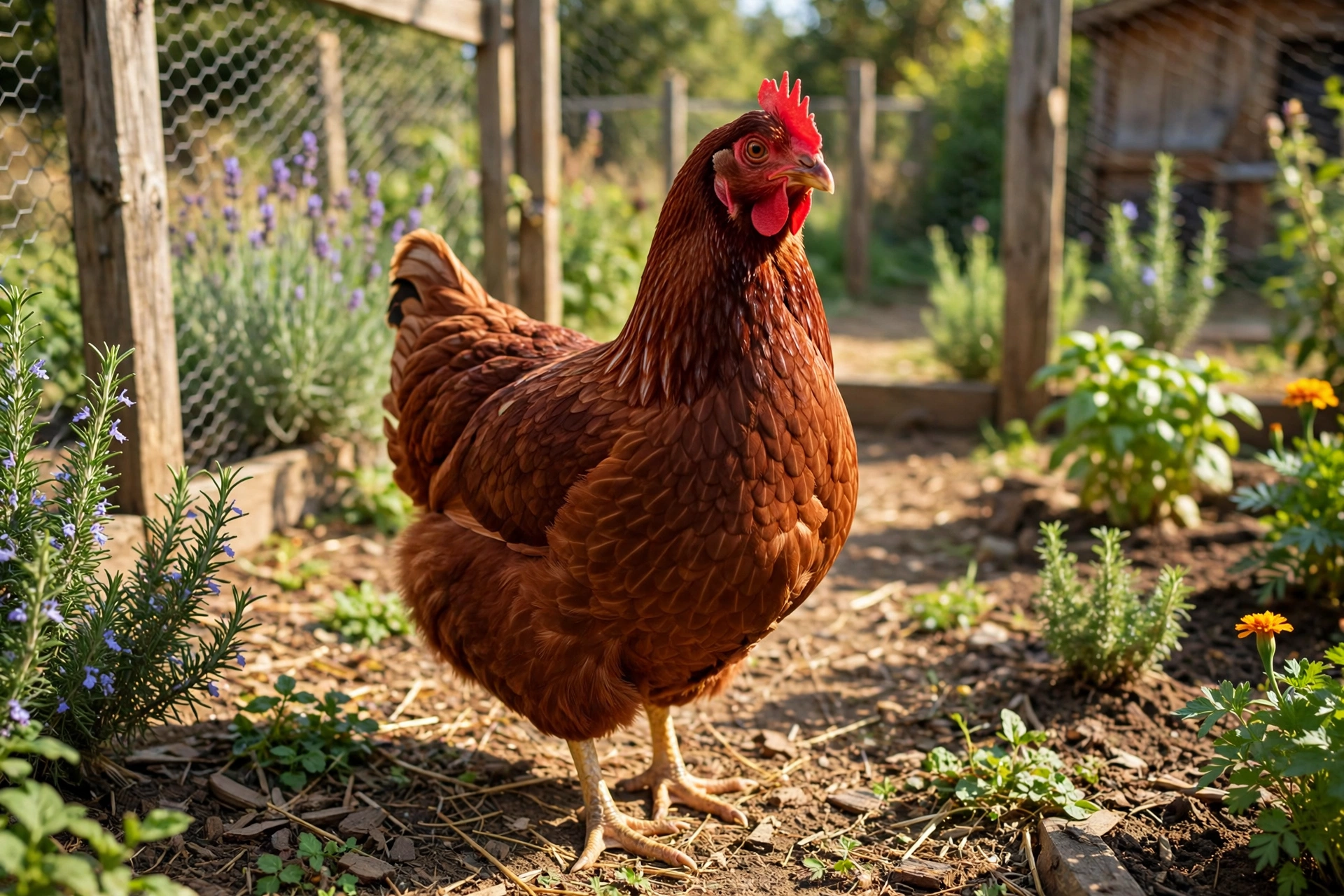
Rhode Island Reds are one of the most popular breeds in the world, and for good reason. They are hardy, friendly, good layers and easy to keep, and a keeper who brings home a few red hens often wants to know how long they will be around. It is a fair question, because a chicken is a pet as well as a layer, and the answer shapes how you plan for her.
A Rhode Island Red usually lives 5 to 8 years. That is the honest middle of the range, and it is a good life for a laying hen. Some birds live longer, especially heritage birds that were bred for hardiness rather than for maximum eggs, and some live less, especially production birds that were bred to lay hard and fast. The difference between those two kinds of Rhode Island Red is the single biggest thing that decides how long your bird will live.
This guide covers the lifespan of Rhode Island Reds in detail. You will learn the difference between heritage and production strains, how long they lay for, what affects their lifespan, the health problems that cut life short, the signs of an ageing hen, and what you can do to help your birds live as long as possible.

Table of Contents
Quick Facts
At a Glance A Rhode Island Red usually lives 5 to 8 years. Heritage birds often live longer, sometimes 8 to 10 years or more, while production birds bred for heavy laying often live less.
Laying Life Most hens lay well for 2 to 3 years, then slow down. A hen can live several years after she stops laying, and she still makes a good pet.
Good to Know The biggest threats to a Rhode Island Red are predators, reproductive problems in high laying strains, and poor housing. Good feed, a secure coop and regular checks add years to a bird’s life.
How Long Do Rhode Island Reds Live
How long do Rhode Island Red chickens live. A Rhode Island Red usually lives 5 to 8 years, and that is a fair answer for most backyard birds. Some live a little less, and some live a good deal longer. A heritage bird that was bred for hardiness can reach 8 to 10 years, and some keepers report birds living to 12 or even 15 years, though that is rare. A production bird that was bred to lay as many eggs as possible may only live 3 to 5 years.
Roosters live about as long as hens, and sometimes a little longer, because they do not go through the strain of laying eggs. A Rhode Island Red rooster in a safe run with good care can live 6 to 10 years. Roosters face their own risks, though, and a rooster that fights other roosters or spends his days defending the flock can wear himself out faster than a quiet bird.
These are averages, not promises. A chicken’s life depends on far more than her breed, and two Rhode Island Reds from the same hatchery can live very different lengths of life. The sections below explain what makes the difference, so you can give your birds the best chance of a long one.
Heritage or Production
The most important thing to know about Rhode Island Red lifespan is that there are two kinds of Rhode Island Red, and they live very different lives. Heritage Rhode Island Reds are the old type, bred to the traditional standard for hardiness, good health and steady laying. Production Reds, sometimes called production Rhode Island Reds, are hatchery birds bred to lay as many eggs as possible as fast as possible.
Heritage birds are bigger, darker and more mahogany in colour, and they lay around 200 eggs a year. They grow more slowly, they lay for more years, and they usually live longer, often 8 to 10 years. Production birds are lighter in colour, a little smaller, and they can lay 250 to 300 eggs a year in their first two years. That heavy laying takes a toll on the body, and production birds often slow down sharply after two or three years and live shorter lives.
Most backyard keepers buy production birds without knowing it, because hatcheries sell them as Rhode Island Reds and they are cheaper and easier to find. That is fine, and a production bird can still be a wonderful hen, but it helps to know which kind you have, because it sets your expectations. If your hen lays an egg almost every day in her first year, she is probably a production bird, and you should expect her best laying years to be short and her life to be on the shorter side of the range.
Lifespan or Laying Life
Lifespan and laying life are two different things, and it helps to keep them separate. A Rhode Island Red may live 5 to 8 years, but she will not lay well for all of that time. Most hens lay best in their first two years, then slow down by about 10 to 20 percent each year after that. By the time a hen is four or five, she may lay only a few eggs a week, and by six or seven she may stop altogether.
That does not mean an old hen is useless. A hen that has stopped laying still eats bugs, turns the compost, keeps the flock calm and makes a good pet. Many keepers keep their retired hens for years after they stop laying, and those birds often live their longest, quietest years after the laying stops. Our guide on how long do hens lay eggs for covers the laying side of this in full, and it is worth reading if you are planning your flock around egg numbers.
If you want eggs every day for years, you will need to add young birds to the flock over time, because no hen lays well forever. A common pattern is to add two or three pullets every year or two, so the flock always has young layers alongside the older birds. That way the older hens can retire in peace while the young ones keep the egg basket full.
What Affects Their Lifespan
Feed is the first thing that affects lifespan. A hen that eats a balanced layer feed, with oyster shell on the side and clean water always available, has the building blocks for a long life. A hen that eats mostly scraps and scratch grain will be short on protein and calcium, and that shortage shows up over time in weak bones, thin shells and poor health. Treats are fine, but they should stay under 10 percent of what a hen eats in a day.
Housing is the second. A coop that is dry, draught free, well ventilated and cleaned regularly keeps birds healthy, and a run with space to scratch, dust bathe and forage keeps them active. A crowded, damp or dirty coop breeds disease, and disease shortens lives. Rhode Island Reds are hardy birds, but no bird stays healthy in a wet, crowded coop.
Predators are the third, and they are the most sudden threat. A fox, a dog, a hawk or a raccoon can end a hen’s life in a moment, whatever her age. A secure coop with a buried wire skirt, a solid roof and a latch that a raccoon cannot open is the best protection a keeper can give. Many backyard hens do not die of old age at all, they die because something got into the run, and that is a loss that good housing can prevent.
Stress is the fourth. A flock that is crowded, bullied, or constantly disturbed lays less and lives less well. Rhode Island Reds are calm birds, but they still need space, perches, and a pecking order that is allowed to settle. A hen that is chased from the feeder every day will eat less, and a hen that eats less will not live as long as she should.
How Hardy Are Rhode Island Reds
Rhode Island Reds are one of the hardiest breeds a keeper can choose. They handle cold weather well, thanks to their thick feathers and sturdy build, and they keep laying through the winter better than many breeds. They handle heat reasonably well too, as long as they have shade, fresh water and good ventilation. They are good foragers, and they do well on free range, finding much of their own food in the garden.
Their temperament helps as well. Rhode Island Reds are calm, confident birds that are not easily frightened, and they settle into a flock quickly. Hens are usually friendly with people, and they tolerate handling better than many breeds. Roosters can be assertive, and some are aggressive, especially in the breeding season, but most are manageable with firm, calm handling.
Hardiness does not mean a bird can look after herself. A hardy breed still needs good feed, clean water, a dry coop and a keeper who checks on her. Hardiness means the breed copes well when things are less than perfect, not that it needs no care at all. A Rhode Island Red that is well looked after will outlive one that is left to fend for herself, however hardy the breed is.
Health Problems That Cut Life Short
Reproductive problems are the biggest health threat to a high laying Rhode Island Red. A hen that lays 300 eggs a year puts enormous strain on her reproductive system, and that strain can lead to egg binding, internal laying, egg yolk peritonitis and tumours of the reproductive tract. These problems are more common in production birds than in heritage birds, and they are the reason many production hens die young. A hen that stops laying suddenly, walks like a penguin, or has a swollen belly needs a vet, because those are signs of a reproductive problem.
Parasites are the next threat. Mites, lice and internal worms all drain a bird’s strength over time, and a heavy parasite load can kill a bird that looks fine on the surface. Regular checks for mites around the vent and under the wings, and a worm check when droppings look wrong, catch these problems early. A bird that is losing weight, has pale wattles or looks dull may be carrying parasites, even if she is still eating.
Respiratory disease can also cut a life short. Rhode Island Reds are no more prone to respiratory problems than other breeds, but a damp coop, poor ventilation or a cold draught can set off a respiratory infection that lingers. A bird that sneezes, wheezes or has a runny nose should be checked, and our guide on why is my chicken sneezing is a useful starting point, though a vet should see any bird that is struggling to breathe.
Signs of an Ageing Hen
An ageing Rhode Island Red shows her years in small ways. She lays fewer eggs, and the eggs she does lay may be larger than they used to be. She may moult more slowly and grow her feathers back less neatly than she once did. Her comb may look paler and less upright, and her legs may look rougher and more scaled than a young bird’s.
She will move more slowly too. An old hen still scratches and forages, but she takes longer to get going in the morning, she rests more during the day, and she may be the last one to the feeder. She may choose a lower perch at night, or sleep on the floor of the coop, because jumping up is harder than it used to be. None of this is a problem on its own. It is simply an old bird living at her own pace.
Her place in the flock may change as well. A hen that was once near the top of the pecking order may slip down as she ages, and younger birds may push her away from food. That is normal flock behaviour, but it means an old hen needs a keeper who watches to make sure she is still eating and drinking enough. A second feeder and waterer, placed where the old hen likes to rest, can make a real difference.
Helping an Old Hen
An old hen needs a few small kindnesses that make her last years comfortable. Put her food and water close to where she rests, so she does not have to walk far or fight younger birds for a place at the feeder. Offer soft food now and then, such as soaked pellets or scrambled egg, which is easier for an old beak to manage. Make sure she has a low perch or a comfortable spot on the coop floor, so she does not have to jump to roost.
Keep her warm in winter. An old bird feels the cold more than a young one, and a draught free coop with deep dry bedding helps her through the cold months. A little extra protein during the moult helps her grow new feathers, and a regular check for mites and lice matters more for an old bird, because she has less strength to fight them off.
Do not separate an old hen from the flock unless she is being bullied badly. Chickens are flock animals, and an old bird that is taken away from her companions will be lonely and stressed. If she is being pecked, give her a safe corner of the run with her own food and water, where she can see the flock but rest in peace. Most old hens do best when they stay with the flock, at their own pace, until the end.
Rhode Island Reds Beside Other Breeds
Rhode Island Reds sit in the middle of the lifespan range for common breeds. They live longer than the very high production breeds, such as the White Leghorn, which is bred to lay hard and often lives only 4 to 6 years. They live about as long as the other dual purpose breeds, such as the Plymouth Rock and the Orpington, which also live around 5 to 8 years. They live less long than some of the small, slow laying breeds, such as the Silkie, which can live 7 to 9 years or more.
Our guide on how long do Silkie chickens live covers the Silkie side of this comparison, and it shows the same pattern. Breeds that lay fewer eggs tend to live longer, and breeds that lay the most tend to live shorter lives. The Rhode Island Red is a good balance, a bird that lays well and lives well, without pushing either side to the extreme.
The breed you choose should match what you want from your flock. If you want the most eggs possible and you are happy to replace your birds every few years, a production breed makes sense. If you want birds that will be with you for many years and you are happy with fewer eggs, a heritage breed or a slow laying breed makes more sense. The Rhode Island Red sits comfortably in the middle, which is why so many keepers choose it.

When to Worry
Most of the changes in an ageing hen are normal, but some signs mean a vet should be called. A hen that stops eating or drinking, that sits hunched and fluffed up for more than a day, or that cannot stand, needs help at once. A swollen belly, a penguin walk, or a hen that strains without laying an egg can mean a reproductive problem, and those problems get worse fast without treatment.
Weight loss is another warning sign. An old hen may lose a little weight as she ages, but a hen that loses weight quickly, or that feels thin and bony when you pick her up, may be carrying parasites or fighting an illness. Pale wattles and comb, dull eyes and dirty vent feathers are all signs that a bird is not well, whatever her age.
Do not wait to see if a sick old hen gets better on her own. Old birds have less strength to fight with, and a problem that a young bird shakes off in a few days can kill an old one. A vet visit for an old hen is never wasted, and it is better to go a day early than a day late. For more on keeping the whole flock healthy, the Chicken Care and Health pillar is a good place to start.


Frequently Asked Questions
How long do Rhode Island Red chickens live?
A Rhode Island Red usually lives 5 to 8 years. Heritage birds often live longer, sometimes 8 to 10 years or more, while production birds bred for heavy laying often live less, sometimes only 3 to 5 years. Roosters live about as long as hens, sometimes a little longer.
How long do Rhode Island Reds lay eggs for?
Most Rhode Island Reds lay well for 2 to 3 years, then slow down by about 10 to 20 percent each year. By four or five years old, a hen may lay only a few eggs a week, and by six or seven she may stop altogether. A hen can live several years after she stops laying.
When do Rhode Island Reds start laying eggs?
Rhode Island Reds usually start laying at around 18 to 24 weeks old, which is about 4 to 6 months. Production birds often start a little earlier, and heritage birds a little later. Our guide on when do Silkie chickens start laying eggs shows how laying age varies by breed.
Do Rhode Island Reds lay eggs every day?
A young Rhode Island Red in her first year can lay an egg almost every day, and production birds often do. As she ages, she will lay less often, and by her third or fourth year she may lay only three or four eggs a week. Our guide on do chickens lay eggs every day covers laying frequency across breeds.
Are Rhode Island Reds good for beginners?
Yes, Rhode Island Reds are a good breed for beginners. They are hardy, calm, good layers and easy to keep, and they handle cold weather well. Roosters can be assertive, so beginners should be ready for a rooster that needs firm, calm handling.
Do heritage Rhode Island Reds live longer than production Reds?
Yes, heritage Rhode Island Reds usually live longer than production Reds. Heritage birds lay fewer eggs, around 200 a year, and their bodies are under less strain, so they often live 8 to 10 years. Production birds can lay 250 to 300 eggs a year, and that heavy laying shortens their lives.
Keep Reading
How Long Do Silkie Chickens Live and another breed lifespan question answered.
How Long Do Hens Lay Eggs For and the laying life behind the lifespan.
Chicken Care and Health and the pillar guide for keeping your flock healthy.

Nusrat
Author, TheChickenPet.com