
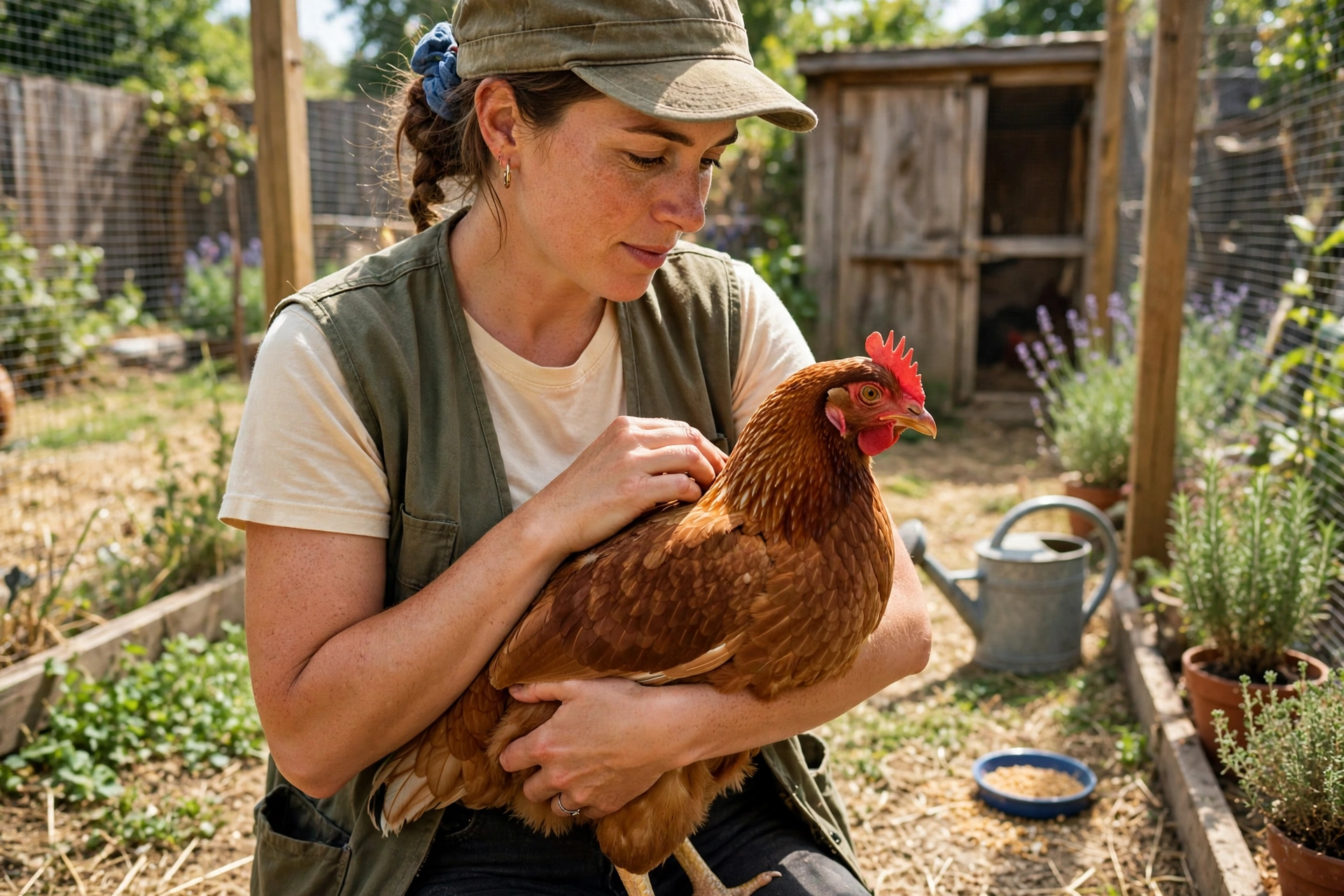
A hen can carry worms and look perfectly fine, and a hen can look sick and have no worms at all. That is the honest starting point for this guide. Keepers see a pale comb or a runny dropping, assume worms, and treat a bird that never needed treatment. Or they see a healthy looking bird, assume she is clear, and miss a worm load that is quietly stealing her food and her strength.
This guide will help you tell the difference between a guess and a diagnosis. You will learn the five common internal worms in chickens, the signs that should make you suspicious, how to deworm chickens safely, and how to answer the question do chickens need worming for your own flock. Some flocks do and some do not, and a simple fecal test is how you find out which kind yours is.

Table of Contents
- The Short Answer
- Why Signs Alone Never Prove Worms
- The Five Common Worms in Chickens
- Signs of Worms in Chickens
- How to Check Your Flock Properly
- How to Deworm Chickens Safely
- Natural Dewormer Claims and What Is True
- Prevention That Actually Lowers Worm Risk
- When to Call a Vet at Once
- Frequently Asked Questions
Quick Facts
At a Glance A light worm load often causes no signs at all, and many sick looking hens do not have worms. Signs alone never prove worms, and a fecal test from a vet or a state poultry lab is the way to know.
Approved Treatment In the US, fenbendazole sold as Safe-Guard AquaSol is the FDA approved dewormer for chickens. The labeled course is 1 mg per kg a day in drinking water for 5 days, with no egg withdrawal when used as labeled. It treats large roundworms and cecal worms in laying hens.
Good to Know Pumpkin seeds, garlic, herbs and apple cider vinegar are not proven dewormers. Corid and Amprol treat coccidiosis, not worms. Call a vet at once if several birds are affected, if a bird is gasping or cannot stand, or if there is no improvement after treatment.
The Short Answer
How to tell if chickens have worms is not a question you can answer by looking at a hen. You can spot the signs that make worms more likely, and you can check your flock in a sensible order, but you cannot confirm worms without a test. A fecal test looks at a dropping sample under a microscope and finds worm eggs if they are there.
Most keepers meet worms in one of two ways. The first is a bird that is slowly losing weight even though she eats well, lays fewer eggs than she used to, and looks a little pale and tired. The second is a dropping that contains a long pale roundworm or a short white tapeworm segment. Both are worth taking seriously, and neither is proof on its own.
Why Signs Alone Never Prove Worms
Worms are good at hiding. A light worm load often causes no signs at all, which means a hen can look bright, eat well and lay normally while still carrying worms. A heavy load can cause real harm, but even then the signs are general. Weight loss, diarrhea, a pale comb, fewer eggs and weakness are all signs of worms in chickens, and they are also signs of many other problems.
Think about a pale comb. A pale comb can mean worms, and it can also mean mites draining blood at night, a moult, heat stress, a poor diet, or a hen that has stopped laying for the season. The same is true for diarrhea, which can follow a worm infection, a sudden feed change, too many watery treats, heat, stress, coccidiosis or a bacterial infection. Our guide on why does my chicken have diarrhea covers those other causes in detail. Different worms also live in different places, so there is no single set of worm symptoms that fits every case.
The Five Common Worms in Chickens
Large roundworms are the most common worms in backyard chickens. They live in the small intestine, where they feed on the food the hen has just eaten. A light load may cause no signs, while a heavy load can cause weight loss despite a good appetite, poor growth in young birds, fewer eggs and diarrhea. In a very heavy infection, the worms can block the intestine, which is a serious emergency. You may see a long pale worm in a dropping. Roundworm eggs pass out in droppings and can survive in soil for a long time, which is why a run that is never cleaned or rested keeps reinfecting the flock.
Cecal worms live in the ceca, the two blind pouches at the junction of the small and large intestine. They are smaller than large roundworms and they often cause no signs at all, even when present in fair numbers. They can also carry the organism that causes blackhead disease, a serious illness in turkeys and a less common but real risk in chickens. A fecal test can find cecal worm eggs, and that is usually how a keeper learns they are present.
Capillary worms are thin, hair like worms that live in the crop, the esophagus and the intestine, depending on the species. They are small and hard to see, and they cause damage by burrowing into the lining of the gut or the crop. Affected birds lose weight, become weak, eat less and may have diarrhea. Because they can live in the crop, a bird with a crop problem deserves a careful check, and our guide on sour crop in chickens and how to tell it from an impacted crop is useful if the crop feels wrong, though sour crop itself is a different problem.
Gapeworms live in the windpipe. An affected bird gasps for air, stretches her neck, shakes her head and may make a snoring or gurgling sound when she breathes. Young birds are affected most often, and a heavy infection can block the windpipe and kill a bird. Gapeworms spread when birds eat infected earthworms, slugs or snails, so flocks that free range on damp ground are at higher risk. Gasping is an emergency sign even if the cause turns out not to be gapeworms, so a gasping bird needs a vet at once.
Tapeworms live in the small intestine and are made of a chain of flat white segments. They need an intermediate host, usually a beetle, a fly, an earthworm, a snail or an ant, which the chicken eats. A light load often causes no signs, while a heavy load can cause weight loss, weakness and poor laying. Keepers usually spot tapeworms by finding small white rice like segments in droppings or around the vent. Those segments move when fresh, so save a sample or take a clear photo for your vet if you find one.
Signs of Worms in Chickens
Every sign on this list has other causes too, so treat each one as a reason to investigate, not as a diagnosis. Weight loss despite eating is one of the most useful early signs. A hen with worms may eat normally or even eat more than usual, yet still lose weight, because the worms are taking nutrients from her food before she can use them. Her breast bone may feel sharper than it used to. The same pattern can come from mites, a poor diet, a crop problem, or an illness that affects digestion.
Diarrhea is common with a heavy worm load, and it can be watery, greenish or mixed with mucus. It can also come from a feed change, too many treats, heat, stress, coccidiosis or a bacterial infection, so diarrhea alone never proves worms. Watch whether it lasts more than a day or two, whether several birds have it, and whether it comes with weight loss or weakness. A pale comb and pale wattles can mean worms, because some worms cause blood loss or poor nutrition over time. A pale comb can also mean mites, a moult, a hen that has stopped laying, heat stress or a diet low in protein.
Fewer eggs is a sign many keepers notice first, because it is easy to count. A wormy hen may lay fewer eggs, lay smaller eggs, or stop laying for a while, because her body is spending energy on fighting the infection instead of on eggs. Fewer eggs can also mean shorter days, a moult, age, heat, stress, a poor diet, or a hidden nest. Do not treat for worms just because laying has dropped. Weakness and a dull, hunched posture are late signs, and they mean the bird is already in trouble. A weak hen may stand apart, sit fluffed up, move slowly and show little interest in food or treats. Weakness can also come from coccidiosis, a respiratory infection, egg binding, heat or cold, or an injury you have not spotted.
Visible worms in droppings are the most direct sign a keeper will see. Large roundworms are long, pale and smooth, and they may appear whole in a dropping. Tapeworm segments are short, flat and white, and they look like grains of rice. Finding either one means that bird has worms, and it is worth saving a sample or taking a photo for your vet. It does not tell you how many worms she has, or whether the rest of the flock is infected, so still test the flock before you treat the whole group. Gasping and neck stretching point most strongly to gapeworms, and they need urgent attention. A bird with gapeworms stretches her neck forward, opens her beak, gasps for air and may shake her head as if trying to clear something from her throat. The same gasping can come from a respiratory infection, from heat, from dust, or from something stuck in the throat, so gasping alone does not prove gapeworms. It does prove that the bird cannot breathe properly, and that is enough to call a vet at once.

How to Check Your Flock Properly
A good check starts with watching, not with treating. Spend ten minutes watching the flock before you handle any bird, and note who is eating, who is drinking, who is laying, and who is standing apart. A hen that stands apart, sits fluffed up, or moves slowly is worth a closer look. Then handle the birds that worry you, and feel their weight, their breast bone, their comb colour and their vent area.
Check for external parasites at the same time, because they are quicker to find than internal worms and they cause many of the same signs. Part the feathers around the vent, under the wings and at the base of the neck, and look for tiny moving mites or pale lice eggs stuck to feather shafts. Our guide on chicken mites explains what to look for, and our guide on how to treat chicken lice and tell them from mites helps you tell the two apart. If you find external parasites, treat those and watch the bird for a few days before you decide about worms.
Look at the droppings in the run and in the coop, and learn what normal looks like for your flock. Normal droppings are firm and brown with a white cap. Cecal droppings are softer, browner and stickier, and they appear a few times a day, which is normal and not a sign of illness. What you are watching for is a change, such as droppings that stay watery for more than a day, droppings with blood, droppings with visible worms or white segments, or droppings that smell much worse than usual.
The fecal test is the step that turns a suspicion into an answer. Call your vet or your state poultry lab and ask how they want the sample collected, how fresh it needs to be, and how many birds to sample. Collect fresh droppings from several birds, keep them cool and dry, and deliver them promptly. Do not collect a sample that has sat in the run for a day, and do not collect only from the sickest bird, because the result should represent the flock. If the test finds worm eggs, your vet can tell you which worm you have and which treatment fits. If the test finds no worm eggs, you can stop worrying about worms and look for the real cause.
How to Deworm Chickens Safely
Chicken worm treatment starts with a diagnosis, not with a product. Once a fecal test has confirmed worms and your vet has identified the type, you can choose a treatment that fits that worm, follow the label exactly, and recheck after treatment. Treating without a test risks giving the wrong product, or giving it to birds that never needed it, and it risks missing the real problem.
In the US, fenbendazole sold as Safe-Guard AquaSol is the FDA approved dewormer for chickens. The labeled course is 1 mg per kg a day in drinking water for 5 days, with no egg withdrawal when used as labeled, and it treats large roundworms and cecal worms in laying hens. That is the only dose given in this article. Read the label before you start, measure the water correctly, make sure it is the only drinking water available during the course, and finish the full 5 days even if the birds look better after two or three days.
Other dewormers are extra label, which means they are not approved for chickens in the way you are using them, and they need a vet to decide whether they are safe and legal for your flock. That includes products that work well in other animals, and products that other keepers recommend online. A recommendation from a forum is not a prescription, and a product that is safe for a dog or a goat is not automatically safe for a laying hen. Ask your vet before you use any dewormer that is not labeled for chickens, and ask about egg withdrawal.
Ivermectin needs particular care. It can leave residues in eggs for weeks, and it needs vet guidance before you use it in laying hens. Do not use ivermectin on a laying flock because someone online said it works, and do not use it without asking your vet about withdrawal times and about whether it will even treat the worm you have. Ivermectin does not treat every worm. Corid and Amprol treat coccidiosis, not worms, and they must never be presented as dewormers. Coccidiosis is a different parasite that lives in the gut, and Corid and Amprol are useful medicines for it, but they do nothing against roundworms, tapeworms, gapeworms or capillary worms.
After treatment, watch the flock and note whether weight, appetite, droppings and laying improve. Improvement is usually gradual, not instant, because a bird that has lost weight needs time to regain it. If there is no improvement after treatment, call your vet again, because the diagnosis may have been wrong, the product may not have covered the worm you have, or there may be a second problem alongside the worms. Do not repeat the treatment on your own, and do not switch to a different dewormer without vet advice. Do chickens need worming as a routine, on a calendar, whether they show signs or not. The honest answer is that it depends on your flock, your ground and your history. A flock on clean dry ground with good hygiene may go a long time without worms, while a flock on damp ground that never rests may need regular testing and treatment. The safer routine is regular testing, not regular dosing, with treatment only when a test shows worms.

Natural Dewormer Claims and What Is True
Pumpkin seeds, garlic, herbs and apple cider vinegar are often sold as natural dewormers. The honest truth is that none of them is a proven dewormer, and none of them should ever be presented as a treatment for an infested bird. A hen with a heavy worm load needs a proven treatment and a vet, not a kitchen remedy, and waiting while you try a natural option lets the worms do more damage.
Pumpkin seeds are the most common claim. They contain a compound that has shown some effect against worms in laboratory studies, but the studies do not show that feeding pumpkin seeds to chickens clears a worm infection in a real flock. Pumpkin seeds are a fine treat, but they are not a dewormer. Garlic has the same problem. There is no reliable proof that garlic kills worms in chickens or clears a worm infection. Garlic in large amounts can also cause problems, including anemia in some animals.
Herbs such as wormwood, oregano and thyme are often listed in natural deworming mixes, and they suffer from the same lack of proof. Some herbs have compounds that affect parasites in a laboratory dish, but that does not mean they work in a chicken’s gut at the amounts a hen will eat. Apple cider vinegar is often added to drinking water, and keepers claim it creates a gut environment that worms dislike. There is no reliable proof that it kills worms or prevents a worm infection in chickens. A small amount in water is generally safe for most flocks, though it should never be added to a metal drinker, because the acid can corrode the metal. If you use it, use it as a water additive you enjoy, not as a worm treatment, and never delay a proven treatment because you are waiting to see whether vinegar will work.
Prevention That Actually Lowers Worm Risk
Prevention will not make worms impossible, but it will make them less likely and less heavy when they do appear. The aim is to break the worm life cycle, which usually means stopping worm eggs in droppings from reaching a new bird. Most worm eggs need warm damp ground and time to become infective, so dry, clean and rested ground is your best defence. Clear droppings from the run and the coop regularly, and more often in wet weather, because wet droppings and damp bedding let worm eggs survive longer. Use fresh dry bedding, keep waterers from leaking onto the ground, and fix any low spot where water pools after rain. Our Care and Health pillar has more on routine coop care.
Do not let wild birds share feed and water with your flock. Wild birds can carry worm eggs and other parasites, and they will visit a feeder that is left open or a waterer that is left uncovered. Keep feed in a covered feeder, keep waterers clean and covered where possible, and clean up spilled feed promptly. Netting over the run helps if wild birds are a regular problem, and it also protects against predators. Rotate ground where possible. If you can move the run or rest a patch of ground for a few weeks, do it, because sunlight and drying kill many worm eggs over time. A run that is used all year without a break builds up worm eggs in the soil. If you cannot rotate, dig over the top layer, add fresh dry bedding or sand, and keep stocking low.
Keep the flock healthy in general, because a strong hen resists worms better than a weak one. Give a balanced feed, fresh water every day, enough space, and a dry dust bath, and avoid overcrowding. Quarantine new birds for at least two weeks before you add them to the flock, and ask for a fecal test during quarantine if you can, because a new bird can bring worms with her.

When to Call a Vet at Once
Most worm cases develop slowly, and a fecal test plus a planned treatment is the right pace for them. Some situations are urgent, and they should not wait for a test result or for a home remedy to work. Call a vet at once if several birds are affected at the same time, because a problem that hits several birds at once is more likely to be serious and to spread quickly. Call a vet at once if a bird is losing weight rapidly, even over a few days.
Call a vet at once if a bird is gasping, stretching her neck and struggling to breathe, because she may have gapeworms, a respiratory infection, or something stuck in her throat. Call a vet at once if a bird cannot stand, cannot walk, or lies on her side and does not get up. Keep her warm, quiet and safe, offer water within easy reach, and get vet help as soon as you can. Do not try to force feed or force water a bird that cannot swallow properly, because she may choke. Call your vet again if there is no improvement after treatment.
Frequently Asked Questions
How can I tell if my chickens have worms without a vet?
You can watch for the signs in this guide, such as weight loss despite eating, diarrhea, a pale comb, fewer eggs and weakness, and you can check droppings for visible roundworms or tapeworm segments. Those signs make worms more likely, but they never prove worms, because each sign has other causes too. The only way to know for sure is a fecal test from a vet or a state poultry lab.
Do chickens need worming every year?
Do chickens need worming on a fixed calendar. The honest answer is that it depends on your flock and your ground. Some flocks on clean dry ground with good hygiene may go a long time without worms, while flocks on damp ground that never rests may need regular testing and treatment. The safer routine is regular testing, not regular dosing, with treatment only when a test shows worms. Ask your vet how often to test for your setup.
How do I deworm my chickens?
How to deworm chickens starts with a fecal test to confirm worms and identify the type. In the US, fenbendazole sold as Safe-Guard AquaSol is the FDA approved dewormer for chickens, with a labeled course of 1 mg per kg a day in drinking water for 5 days, and no egg withdrawal when used as labeled. It treats large roundworms and cecal worms in laying hens. Follow the product label exactly, finish the full course, and ask your vet before using any other dewormer, because other products are extra label and need vet guidance.
Can I use pumpkin seeds or garlic to treat worms?
No, pumpkin seeds, garlic, herbs and apple cider vinegar are not proven dewormers, and they must never be presented as a treatment for an infested bird. They are fine as treats or feed additions in normal amounts, but they do not clear a worm infection. A hen with worms needs a proven treatment and a vet, and delaying that treatment while you try a natural option lets the worms do more damage.
Are worms in chickens dangerous to people?
Most chicken worms do not infect people, and the risk from a backyard flock is low if you follow basic hygiene. Wash your hands after handling birds and after cleaning the coop, keep chickens away from food preparation areas, and wear gloves when you clean droppings. Children should wash their hands after handling hens, and droppings should be composted properly before they are used on food crops.
Keep Reading
Chicken Care and Health and the pillar guide for keeping your flock healthy.
Chicken Mites and how to rule out external parasites first.
Why Does My Chicken Have Diarrhea and the other causes behind this common sign.

Nusrat
Author, TheChickenPet.com