

A broody hen is a hen who has decided to sit on eggs and hatch them, whether those eggs are fertile or not. She will stay on the nest day and night, puff up and growl at anyone who comes near, and stop laying altogether. Left alone she can sit for weeks, losing weight and condition the whole time. The good news is that breaking a broody hen is usually simple, and the gentle way works best. Start by collecting the eggs and lifting her off the nest, block the nest box if she keeps going back, and use a broody breaker cage only for a determined hen who will not give up. This guide covers the signs, the step by step method, how long the breaker cage takes, what never to do, and when to let her sit instead.
Table of Contents
- A broody hen stays on the nest day and night, puffs up and growls, stops laying, and shows a bare breast patch.
- Act in the first day or two, not after a week.
- Collect eggs several times a day and lift her off the nest.
- Block the nest box next.
- Use a broody breaker cage only for a determined hen. Most hens break in 2 to 4 days.
- Never use ice baths, cold water or food and water deprivation.
- A hen who sat for about 3 weeks and is weak needs a vet.
- Laying resumes over days to weeks after she breaks.
The Short Answer. Gentle First, Breaker Cage Only If She Persists
To break a broody hen, start gentle and escalate only if she persists. First collect every egg, several times a day, and lift her calmly off the nest every time she is caught sitting. For a mild case, repeated removal over a day or two is sometimes enough on its own.
Next block the nesting box she keeps returning to, or close off the nest boxes during the day once the flock has finished laying, so she cannot resettle.
Only a determined hen who keeps going straight back to the nest needs the breaker cage. The broody breaker cage is an elevated wire bottom cage with food and water inside, no bedding and no solid floor. The open wire lets air circulate under her and cools the brood patch, which calms the broody hormones. Most hens break in 2 to 4 days in the cage.
Signs of a Broody Hen and How to Tell Her From a Sick Hen
The signs of a broody hen are hard to miss once you know them. She stays on the nest day and night and leaves it only for a short break. She puffs her feathers out, growls, screeches or pecks when approached, and shows a bare patch on her breast where feathers have thinned for skin to egg contact. She stops laying, and her droppings become large and strong smelling because she holds them in while she sits.
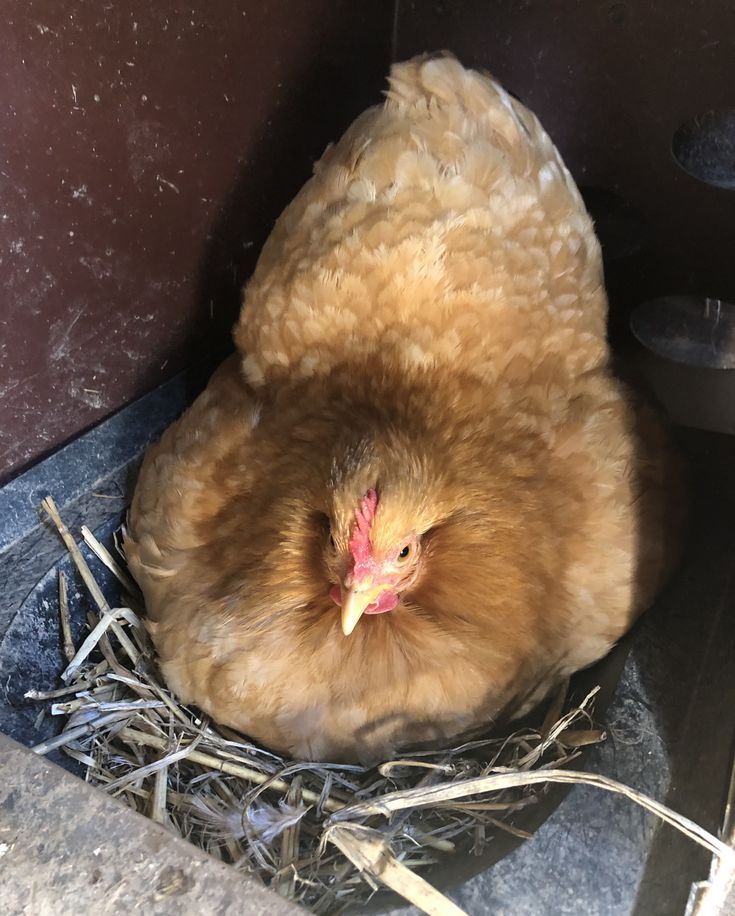
The harder question is how to tell if a hen is broody or sick, because a sick hen also sits still and looks miserable. The difference is in the attitude. A broody hen is defensive and fierce on the nest, puffing up, growling and pecking at your hand. A sick hen is listless and dull, and she may not eat or drink at all when lifted off the nest. Lifted off the nest, a broody hen eats, drinks, dust bathes and marches straight back, while a sick hen stands hunched and ignores food and water.
If she is listless, very thin, or will not eat or drink at all when lifted off the nest, treat that as a sick hen, not a broody one, and get vet help. A broody hen not eating or drinking much is normal while she sits, since she leaves the nest only once or twice a day, but she should eat and drink eagerly during that break.
Why to Act in the First Day or Two
Act sooner rather than later. The longer she sits, the more weight she loses and the longer it takes her to start laying again, so a hen confirmed broody should be dealt with in the first day or two, not left to sit for a week to see if she gives up on her own.
A broody hen eats and drinks far less than normal. She leaves the nest only for a short break, grabs a quick bite and a drink, and hurries back. Day after day of that adds up. She loses weight, her condition drops, and she becomes more open to parasites because she is not dust bathing normally. The longer the sit, the longer the recovery, since she has to regain weight and condition before she lays again.
One broody hen sitting in the favourite nest box blocks it for the other hens, and they may start laying elsewhere or squabbling over the remaining boxes. Once you are sure she is broody, start the method the same day. Waiting does not help her and does not help the flock.
Step 1. Collect the Eggs and Lift Her Off the Nest
The first step in how to stop a hen sitting on eggs is to take the eggs away. Collect every egg, several times a day, so there is never a clutch building up under her. A growing pile only makes her more determined, and eggs left under her can crack or rot. Check the nest morning, afternoon and evening.
Every time you find her sitting, lift her calmly off the nest and set her down near the food and water. Lift her gently, with both hands under her body, and expect her to puff up and complain. That is normal broody behaviour, not a sign you are hurting her. She will probably march straight back to the nest. Lift her off again the next time you catch her.
For a mild case, repeated removal over a day or two is sometimes enough on its own. Some hens who have only just gone broody give up when the eggs keep vanishing and they keep being moved. If she is still sitting firmly after a day or two of this, move on to step 2. Do not repeat step 1 for a week. The method works by escalating gently, not by waiting.
Step 2. Block the Nest Box She Keeps Returning To
If she keeps going straight back to the nest, take the nest away from her. Block the nesting box she keeps returning to, or close off the nest boxes during the day once the flock has finished laying, so she cannot resettle. A board, a piece of cardboard or a closed nest box door all work, as long as she cannot get in and sit down. Close the boxes during the day after the other hens have laid, and open them again by evening so the flock can lay normally.
For the right number of boxes, see our guide to nesting boxes for 6 hens.
A hen with nowhere to settle will usually wander off, eat, dust bathe and rejoin the flock. If she paces the blocked box, growls at it and tries every other dark corner in the coop, she is a determined broody, and it is time for step 3.
Step 3. The Broody Breaker Cage Setup That Works
The broody breaker cage is the reliable method for a determined hen. Use an elevated wire bottom cage, and a wire dog crate raised on bricks works well. Put food and water inside, with no bedding, straw or solid floor, and a small perch so she can stand comfortably. The open wire lets air circulate under her and cools the brood patch, which calms the broody hormones.
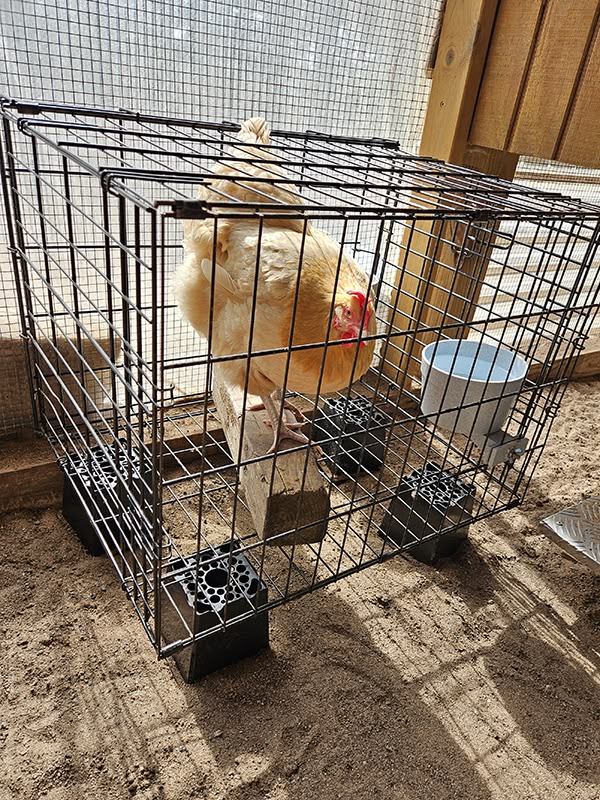
Keep the cage in a bright, breezy, safe spot, such as a shaded porch or a corner of the run, with weather protection and predator security.
The broody breaker cage setup is simple, but every part of it matters. No bedding means she cannot make a nest. The wire floor lets air flow under her belly. The perch lets her stand and rest normally. Food and water inside mean she eats and drinks properly while she is in there. Keep the cage bright and airy, since a dark, warm, cosy box would do the opposite of what you want. Check her at least twice a day while she is in the breaker, and keep food and water fresh.
How Long in the Breaker and How to Test Her Each Morning
How long does the broody breaker cage take. Most hens break in 2 to 4 days. Mississippi State Extension recommends a wire floored cage for about 3 to 4 days with ample feed and water the whole time.
Each morning let her out under supervision and watch what she does. If she runs straight back to the nest, put her back in the cage. If she chooses to forage and roost with the flock for a full day, she has broken.
Chronic broodies, Silkies in particular, may need 3 to 5 days and a firm follow up, and a second round if she relapses. Some breeds are simply more broody than others.
Breed matters here. See how often Cochins go broody and our Australorp guide for two of the broodiest breeds.
Expect a longer break from those breeds, and do not take one good morning as proof she is done. After she breaks, keep the nests blocked overnight for a day or two to stop a relapse. Skipping that follow up is why some hens go broody again the next week. A hen who forages all day and roosts with the flock has broken. A hen who slips back onto the nest at dusk has not, and she goes back in the cage for another day.
| Method | How It Works | How Long |
|---|---|---|
| Repeated removal | Collect eggs and lift her off the nest | A day or two for mild cases |
| Blocked nest | Close off the nest box she returns to | She cannot resettle, often breaks in a day or two |
| Breaker cage | Elevated wire bottom cage, food and water, no bedding | 2 to 4 days for most hens, 3 to 5 for chronic broodies |
| Letting her sit | Safe separate nest, fertile eggs only | About 21 days of natural incubation |
What Never to Do to a Broody Hen
Never use the cruel shortcuts. Never use ice baths, frozen objects or cold water immersion, never dunk or hose her, and never withhold food or water or use frightening restraint. A broody hen is already eating and drinking less, so depriving her further only weakens her and does not break her faster.
These shortcuts still circulate online, and they are worth naming plainly so you can ignore them when you see them. An ice bath or a dunk shocks a bird whose body temperature is already raised by sitting, and it does nothing to the hormones driving the behaviour. Withholding food or water is worse, because a weakened hen takes longer to recover and longer to lay again.
The gentle method is not the slow method. Collecting eggs, blocking the nest and using a breaker cage breaks most hens in a few days without harming them. Check her at least twice a day, keep food and water fresh, and let the light and airflow do the work.
Can a Broody Hen Die and When to Call a Vet
Can a broody hen die. A healthy hen rarely dies from a few days of broodiness, but the risk rises the longer she sits. Without intervention a hen can sit for several weeks, losing weight, getting dehydrated and picking up parasites, and a hen who is weak after sitting for about 3 weeks needs a vet.
A hen who is listless, very thin, or will not eat or drink at all when lifted off the nest is a sick hen, and she needs vet help. The same goes for a hen who has been sitting for about 3 weeks and is weak, wobbly or unable to stand properly. Do not wait another week to see if she recovers on her own.
After she breaks, expect a gap before she lays again. How long before a broody hen lays again depends on how long she sat. She must regain weight and condition first, and laying resumes over days to weeks. Keep her with the flock, keep food and water easy to reach, and do not expect eggs the next morning.
When to Let Her Sit Instead and FAQs
Sometimes the right answer is not to break her at all. If fertile eggs are wanted and chicks are welcome, letting her sit is the kind option. Give her a safe separate nest away from the flock, fertile eggs only, fresh food and water within reach, and a daily check that she is eating and drinking. Natural incubation lasts about 21 days.
A separate nest matters, because other hens will keep laying in her nest and crowding her. Move her gently to her own quiet spot, give her only the fertile eggs you want her to hatch, and mark them so a fresh egg can be spotted and removed. Check her every day, lift her off once a day if she will not leave on her own, and make sure she eats and drinks.
Letting her sit is also the right call when the hen is a breed that makes a good mother and you have room for chicks. A broody hen does the warming, the teaching and the protecting. If you do not want chicks, or the eggs are not fertile, breaking her gently is kinder than letting her sit on eggs that will never hatch.
How to break a broody hen.
Start gentle. Collect every egg several times a day and lift her calmly off the nest. Block the nest box if she keeps going back. Use a broody breaker cage, an elevated wire bottom cage with food and water and no bedding, only for a determined hen. Most hens break in 2 to 4 days.
Broody breaker cage how long.
Most hens break in 2 to 4 days in the cage, and Mississippi State Extension recommends about 3 to 4 days with ample feed and water. Chronic broodies, Silkies in particular, may need 3 to 5 days and a second round if she relapses. Test her each morning by letting her out and watching whether she runs back to the nest or forages with the flock.
Signs of a broody hen.
She stays on the nest day and night, puffs her feathers out, growls, screeches or pecks when approached, shows a bare breast patch, stops laying, and leaves large strong smelling droppings. A sick hen is listless and dull instead of defensive, and will not eat or drink when lifted off the nest.
Can a broody hen die.
A healthy hen rarely dies from a few days of broodiness, but the risk rises the longer she sits. A hen can sit for several weeks, losing weight, getting dehydrated and picking up parasites. A hen who is weak after sitting for about 3 weeks needs a vet, and so does a hen who will not eat or drink at all.
How to stop a hen sitting on eggs.
Collect the eggs several times a day, lift her off the nest every time she is caught sitting, and block the nest box she keeps returning to. If she still goes straight back, use a broody breaker cage for 2 to 4 days. After she breaks, keep the nests blocked overnight for a day or two to stop a relapse.
Also see How to Tell If a Chick Is Male or Female Without Guessing

Nusrat
Author, TheChickenPet.com