
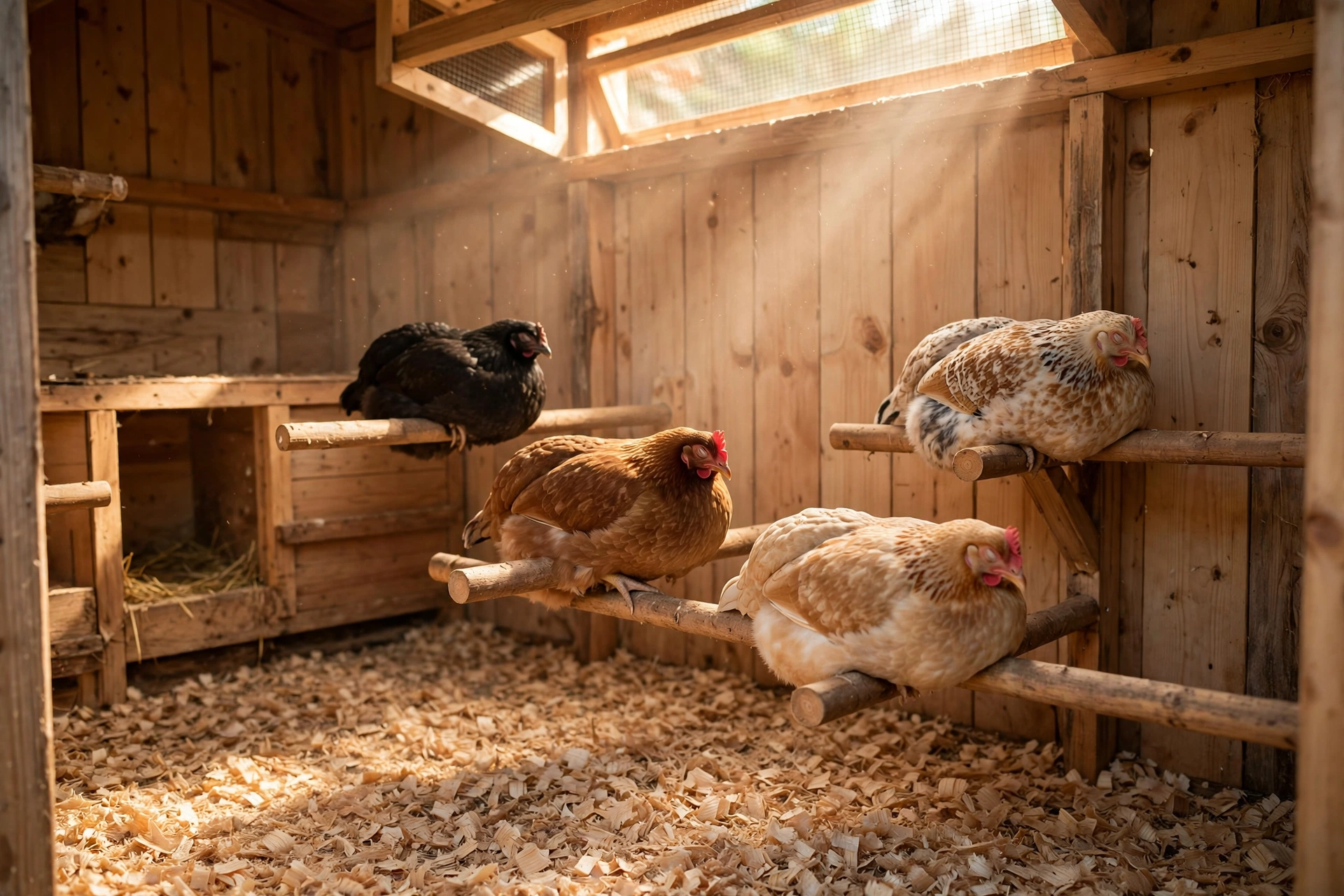
Yes, you can stop a chicken coop smelling, and the fix is not a spray. A coop smells because droppings meet moisture, and that mix makes ammonia, the sharp gas that stings your nose when you open the coop door. Spraying scent over it hides the smell for an hour and leaves the ammonia right where it was, in the air your hens breathe all night. The real fix is drier bedding and better airflow.
The equation is simple, and it runs the whole article. Manure plus moisture equals ammonia. Take away the moisture, take away the droppings fast enough, or move the air, and the smell goes with it. That is the whole answer to how to stop chicken coop smelling, and you do not need a new coop or expensive products to get it. A droppings board under the roosts, absorbent bedding kept dry, and vents high in the walls will do more than any deodoriser on the shelf.
This guide covers the smell problem only. The cleaning schedule lives in our guide to how often to clean a chicken coop, the full deep litter system lives in our deep litter method guide, and the winter airflow rules live in our guide to coop ventilation in winter. Each of those is linked where it belongs below.
Table of Contents
Quick Facts
Smell source. Droppings plus moisture make ammonia, and ammonia is the smell.
Warning sign. If you can smell ammonia at the coop door, the air inside is already too strong for your hens.
Cheapest fix. A droppings board under the roosts catches most of the night droppings in one place.
Best bedding. Dry pine shavings absorb moisture well and are safe for hens.
Never use. Cedar shavings, scented sprays, air fresheners and essential oils inside the coop.
The routine. Scrape the board daily, top up dry bedding weekly, and keep the high vents open all year.
Why Does My Chicken Coop Smell
If you are asking why your chicken coop smells, the short answer is that something in it is wet. Dry droppings barely smell at all. It is the wet ones, mixed with damp bedding, spilled water and humid air, that break down and release ammonia. That is why a coop can smell fine on a dry week and turn sharp overnight after rain or a spilled waterer.
The usual suspects are easy to find once you know what to look for. The floor under the roosts is the first, because hens drop most of their overnight manure there. The second is the waterer, because every splash lands on the bedding and stays there. The third is the bedding itself, because old bedding stops absorbing and starts holding moisture instead. And the fourth is the air, because a coop with no airflow traps humid air inside.
Crowding makes all of it worse, because more hens means more droppings, more breath moisture and more body heat in the same small space, and the bedding gives up sooner. A coop that smells in summer usually has a moisture problem, and one that smells in winter usually has a ventilation problem, because keepers seal the coop against the cold and trap the damp air inside. Either way, the smell is a symptom, and the cause is always the same mix of manure and moisture.
A healthy coop smells faintly earthy, like dry straw and clean bedding. If you open the door and pull your head back, that is not normal, and your hens should not be breathing it. The rest of this guide walks through the fixes in the order that makes the biggest difference first.
Sometimes the smell is on the bird rather than the bedding. A hen with droppings caked on her vent feathers needs a wash, not just a cleaner coop.
Manure Plus Moisture Equals Ammonia
Ammonia is the gas that makes a chicken coop smell sharp and sting your eyes, and it comes from the droppings themselves. Hen droppings are rich in nitrogen, and when they sit in damp bedding, bacteria break that nitrogen down and release ammonia gas into the air. Dry droppings break down slowly and release almost nothing. Wet droppings break down fast and release a lot.
The chicken coop ammonia smell is more than unpleasant. Hens breathe that air all night with their heads close to the bedding, and ammonia irritates their airways, eyes and lungs. A coop with a strong ammonia smell can leave hens sneezing, with watery eyes and rattling breathing, and it makes them far more likely to catch a respiratory infection. Chicks are hit hardest, because their airways are smaller. A keeper who fixes the smell is also protecting the flock’s health, and that is the real reason this matters.
There is a simple test you can do every morning. Open the coop door and take one breath at the doorway. If you can smell ammonia from outside the coop, the level inside is already too high for your hens, and you need to act the same day. If the air smells faintly of bedding and nothing else, the coop is in good shape.
The fix follows from the cause. You cannot stop hens making droppings, so you have to deal with the other half of the equation. Keep the droppings dry, remove them fast, or move the air so the moisture never builds up. The next three sections cover each of those in turn, and together they are the whole answer to how to stop a chicken coop smelling.
Droppings Boards
A droppings board is the cheapest and fastest win against coop smell, and it is the first thing to add if your coop does not have one. It is a flat board fixed under the roosts, about 8 to 12 inches below the perches, that catches the overnight droppings in one place instead of letting them fall into the bedding. Hens do most of their droppings at night, so one board under the roosts catches most of the manure in the whole coop.
The board works because it makes removal easy. A quick scrape each morning takes less than a minute, and it takes the wettest droppings out of the coop before they soak into the bedding and start making ammonia. Without a board, those same droppings sit in the bedding all week, getting wetter and smellier every day, and no amount of fresh bedding on top will fix that.
Any flat board will do, as long as it is smooth enough to scrape. A piece of plywood, an old shelf board, or a sheet of plastic will all work. Some keepers cover the board with a thin layer of sand or sweet PDZ, a natural mineral that absorbs moisture and ammonia, and scrape the lot off each morning. Others leave the board bare and scrape it dry. Either way works, and the habit matters more than the material.
Fit the board so it runs the full length of the roosts and sticks out a few inches on each side, because hens do not always aim straight down. About 18 to 24 inches wide is right for most backyard coops, and it should sit low enough that hens can hop up to the roosts without bumping into it.
Scraping the board is a daily job, and it is the single best habit for a fresh smelling coop. A paint scraper, a dustpan, or an old trowel will do the job, and the scrapings go straight into the compost bin or the garden. Do it in the morning when you open the coop, and it becomes part of the routine in a week. Our guide to how often to clean a chicken coop covers the full cleaning schedule, including how the daily board scrape fits with the weekly and monthly jobs.

Best Bedding to Stop Coop Smell
Bedding is the second half of the dryness fix, because it is the bedding that soaks up the moisture the droppings leave behind. The best bedding to stop coop smell is dry pine shavings, and the reason is simple. Pine shavings are absorbent, they dry out fast, they are cheap, and they are safe for hens. A deep layer of dry shavings pulls moisture away from the droppings and holds it until you change the bedding.
Straw is the common alternative, and it is fine in a dry coop, but it is a weaker choice for smell. Straw is hollow, so it holds air and insulates well, but it absorbs far less moisture than shavings, and it mats down into a damp layer when it gets wet. If you use straw, change it more often, and never let it sit damp.
Sand is another option, and it works well in dry climates. It drains fast and is easy to scoop like a litter tray, but it holds no warmth in winter, it is heavy to carry, and it absorbs no ammonia on its own. It suits a covered run better than a coop floor, and it is a poor choice in a damp climate where the sand itself stays wet. Hemp bedding is the premium choice, and it absorbs more moisture than pine shavings, but it costs more and is harder to find.
Two beddings should never go in a chicken coop. Cedar shavings are the first, because the oils in cedar irritate a hen’s airways and liver, and a coop full of cedar smells strong to the birds long before it smells strong to you. The second is any bedding that is already damp, mouldy or dusty when you buy it, because damp bedding starts the ammonia problem on day one. If a bale smells musty in the shop, leave it there.
How you use the bedding matters as much as which kind you choose. Start with a layer 4 to 6 inches deep on a dry floor, and top it up with a fresh handful whenever you see a damp patch. Never add fresh bedding on top of wet bedding and call it done, because the wet layer underneath keeps making ammonia. Take the wet patch out first, then add the dry.

Ventilation That Works
Ventilation is the third fix, and it is the one most keepers get wrong, because it feels wrong to leave holes in a coop in winter. But a coop needs fresh air moving through it all year, and the smell is the proof. Stale air holds moisture, moisture feeds ammonia, and ammonia fills the coop.
The rule is simple. Vents go high, above the roosts, and draughts stay low. Warm damp air rises, so a vent near the roof lets it out, and fresh air comes in to replace it, without blowing cold air across the hens at roost level. A vent at the top of each gable end is the classic setup, and it works in every season.
The mistake is sealing the coop tight in winter. Keepers do it to keep the hens warm, but a sealed coop is a damp coop, and a damp coop smells worse in winter than in summer. Hens cope with cold far better than they cope with damp ammonia air, and a dry ventilated coop at freezing point is healthier than a sealed damp coop five degrees warmer.
In summer, the problem flips. Hot still air holds the smell close, and the coop can turn into an oven by mid afternoon. The same high vents help, and a shaded run with a breeze does more than any fan. If you run a fan, point it so it pulls air out of the coop, not so it blows across the roosts.
How much ventilation is enough is a fair question, and the honest answer is that you can tell by the smell and the condensation. If the coop smells fresh and the roof is dry in the morning, the vents are doing their job. If it smells sharp or the roof is wet, open more vent area. Our guide to chicken coop ventilation in winter covers the cold season rules in full, including how to vent without creating a draught at roost level.

Deep Litter or Clean Out
Once the droppings board and the bedding are sorted, there is one more choice to make, and it is the choice between the deep litter method and a regular clean out. Both work, and both keep a coop smelling fresh, but they work in opposite ways, so pick the one that fits your coop and your habits, and do not try to do both at once.
The deep litter method means letting the bedding and droppings compost in place. You start with 4 to 6 inches of pine shavings, add a fresh layer whenever the surface looks damp, turn the litter now and then so air gets in, and do a full clean out only once or twice a year. The litter composts slowly, gives off a little warmth in winter, and smells faintly earthy when it is working right. It only works in a coop with good ventilation and a dry floor, and it needs a keeper who will turn it and watch it. Our deep litter method guide covers the full system.
The regular clean out is the simpler choice. You change the bedding every week or two, take the lot out, and start fresh. It takes more bedding and more time, but it is forgiving, and it suits small coops, damp climates, and keepers who like a clean slate. The cleaning schedule in our guide to how often to clean a chicken coop lays out the daily, weekly and monthly jobs, so you can see exactly what a clean out routine looks like.
One more thing to check before you blame either method is the run. A muddy run sends wet feet and wet bedding back into the coop every evening, and no litter system can keep up with that. If the run is a mud pit after rain, fix the run first. Our guide to bedding for a muddy chicken run covers five fixes that work, and a dry run is half the battle for a fresh smelling coop.
What Not to Do
Most of the products sold to stop coop smell do not work, and a few of them make the problem worse. The first group is sprays and air fresheners. They cover the smell for an hour and leave the ammonia in the air, and the hens breathe the spray chemicals as well as the ammonia. A coop that smells of lavender and ammonia is still a coop full of ammonia, and the birds are no better off.
Essential oils are the second group to skip. They are sold as natural, but a hen’s airways are far more sensitive than yours, and strong oils in a small closed coop can irritate her breathing badly. Never put essential oils, scented candles, or plug in air fresheners inside a coop, and never spray anything scented near the birds. If a product needs a warning label about breathing it in, it does not belong in a coop.
Scented bedding and scented cat litter are the third group. They smell pleasant in the bag, and they do nothing for the ammonia, because the scent fades in a day and the moisture is still there. Worse, some scented litters contain chemicals that are not safe for birds. Plain dry bedding, changed on time, beats scented bedding every time.
The last thing to skip is lime. Garden lime and hydrated lime are sometimes suggested for coop smell, but hydrated lime is caustic, it burns skin and feet, and it irritates airways. If you want a mineral that helps, sweet PDZ on the droppings board is the safe choice, because it absorbs ammonia without harming the birds.
The honest rule is that anything that promises to make a coop smell nice without removing droppings or moisture is selling a scent, not a solution. Spend the money on a droppings board and a bale of dry shavings instead, and the smell will take care of itself.
The Weekly Smell Routine
Putting it all together takes less time than most keepers expect, and the routine below is the whole system in one place. It is a summary, not a replacement for the full cleaning schedule, which lives in our guide to how often to clean a chicken coop. Use this page for the smell, and that page for the cleaning.
Every morning, scrape the droppings board and check the waterer. A minute of scraping takes the wettest droppings out before they soak in, and a quick look at the waterer catches the leak that would undo the whole week’s work. If the bedding under the waterer is wet, move the waterer, raise it on a brick, or put a tray under it.
Once a week, walk the coop with your nose. Open the door, take a breath, and check the bedding with your hand. If the bedding feels damp, take the wet patches out and top up with dry shavings. If the roof is wet with condensation, open more vent area. If the droppings board is hard to scrape, it needs a deeper clean.
Once a month, do a proper check of the whole coop. Look for leaks in the roof, gaps where rain blows in, and bedding that has packed down into a damp mat. A roof leak that drips onto the bedding all winter is a smell problem that no cleaning routine can fix, so find it before the rainy season starts.
In summer, watch the waterer twice as hard, because heat makes hens drink more and splash more, and warm damp bedding makes ammonia faster. In winter, watch the ventilation twice as hard, because the temptation to seal the coop is strongest when it is cold, and a sealed coop is a smelly coop. Do this every week, and that is how to keep chicken coop smelling fresh without ever reaching for a spray.

Frequently Asked Questions
Why does my chicken coop smell even after I clean it?
Because cleaning alone does not fix moisture. If the bedding is dry and the vents are open, a cleaned coop stays fresh. If the waterer leaks, the roof drips, or the vents are shut, the bedding gets wet again within days and the ammonia comes back. Check the waterer and the vents first, then the cleaning interval.
Is the ammonia smell in a chicken coop dangerous for hens?
Yes, and it is more dangerous than most keepers realise. Ammonia irritates a hen’s airways and eyes, and long exposure leaves her open to respiratory infections. The morning door test is the guide. If you can smell ammonia from outside the coop, the level inside is already too high for your hens, and you need to act the same day.
What is the best bedding to stop coop smell?
Dry pine shavings are the best all round choice, because they absorb moisture well, dry out fast, are cheap, and are safe for hens. Hemp bedding absorbs even more, but costs more. Straw works in a dry coop but absorbs less and mats down when wet. Never use cedar shavings, because the oils irritate a hen’s airways, and never use bedding that is already damp or mouldy.
Will deep litter make my coop smell worse?
Not when it is done right. A working deep litter bed smells faintly earthy, not sharp. If a deep litter coop smells of ammonia, the litter has gone wrong, usually because it is too wet or has not been turned, and the fix is to take the wet litter out and start again. Deep litter only works in a coop with good ventilation and a dry floor, and it needs a keeper who will turn it and watch it. Our deep litter method guide covers the full system.
Can I use air freshener or essential oils in a chicken coop?
No, and this one is firm. Air fresheners and essential oils cover the smell without removing the ammonia, and the chemicals irritate a hen’s airways in a small closed space. Hens have far more sensitive airways than people, and strong scents in a coop can do real harm. The fix is dryness and airflow, not scent.

Nusrat
Author, TheChickenPet.com
Keep Reading
How Often Should You Clean a Chicken Coop? A Simple Schedule That Works, the full cleaning schedule, with the daily, weekly and monthly jobs.
The Deep Litter Method for Chicken Coops and When Not to Use It, the full deep litter system, with the turning and clean out rules.
Chicken Coop Ventilation in Winter Without Creating a Draft, the cold season rules, with vents high and no draught at roost level.